brake light PONTIAC G5 2008 Owner's Manual
[x] Cancel search | Manufacturer: PONTIAC, Model Year: 2008, Model line: G5, Model: PONTIAC G5 2008Pages: 388, PDF Size: 2.22 MB
Page 266 of 388
Brake Wear
Your vehicle has front disc brakes and could have rear
drum brakes or rear disc brakes.
Disc brake pads have built-in wear indicators that make
a high-pitched warning sound when the brake pads
are worn and new pads are needed. The sound
can come and go or be heard all the time your vehicle
is moving, except when you are pushing on the
brake pedal rmly.
{CAUTION:
The brake wear warning sound means that soon
the brakes will not work well. That could lead to
an accident. When you hear the brake wear
warning sound, have your vehicle serviced.
Notice:Continuing to drive with worn-out brake
pads could result in costly brake repair.
Some driving conditions or climates can cause a brake
squeal when the brakes are rst applied or lightly
applied. This does not mean something is wrong with
the brakes.Properly torqued wheel nuts are necessary to help
prevent brake pulsation. When tires are rotated, inspect
brake pads for wear and evenly tighten wheel nuts in
the proper sequence to torque specications in
Capacities and Specifications on page 5-102.
If your vehicle has rear drum brakes, they do not have
wear indicators, but if you ever hear a rear brake
rubbing noise, have the rear brake linings inspected
immediately. Also, the rear brake drums should
be removed and inspected each time the tires are
removed for rotation or changing. When you have the
front brake pads replaced, have the rear brakes
inspected, too.
Brake linings should always be replaced as complete
axle sets.
Brake Pedal Travel
See your dealer/retailer if the brake pedal does not
return to normal height, or if there is a rapid increase in
pedal travel. This could be a sign that brake service
might be required.
5-32
Page 269 of 388
Notice:Ignoring these steps could result in costly
damage to your vehicle that would not be covered
by your warranty.
Trying to start your vehicle by pushing or pulling it
will not work, and it could damage your vehicle.
1. Check the other vehicle. It must have a 12-volt
battery with a negative ground system.
Notice:If the other vehicle’s system is not a 12-volt
system with a negative ground, both vehicles can
be damaged. Only use vehicles with 12-volt systems
with negative grounds to jump start your vehicle.
2. Get the vehicles close enough so the jumper cables
can reach, but be sure the vehicles are not touching
each other. If they are, it could cause a ground
connection you do not want. You would not be able
to start your vehicle, and the bad grounding
could damage the electrical systems.
To avoid the possibility of the vehicles rolling, set
the parking brake rmly on both vehicles involved
in the jump start procedure. Put an automatic
transmission in PARK (P) or a manual transmission
in NEUTRAL before setting the parking brake.Notice:If you leave your radio or other accessories
on during the jump starting procedure, they could
be damaged. The repairs would not be covered
by your warranty. Always turn off your radio and
other accessories when jump starting your vehicle.
3. Turn off the ignition on both vehicles. Unplug
unnecessary accessories plugged into the cigarette
lighter or the accessory power outlet. Turn off
the radio and all lamps that are not needed.
This will avoid sparks and help save both batteries.
And it could save the radio!
5-35
Page 345 of 388
Maintenance Footnotes
(a)Visually inspect brake lines and hoses for proper
hook-up, binding, leaks, cracks, chafing, etc. Inspect
disc brake pads for wear and rotors for surface
condition. Inspect drum brake linings/shoes for wear or
cracks. Inspect other brake parts, including drums,
wheel cylinders, calipers, parking brake, etc.
(b)Visually inspect front and rear suspension and
steering system for damaged, loose, or missing parts or
signs of wear. Inspect power steering cables for
proper hook-up, binding, cracks, chafing, etc.
(c)Visually inspect hoses and have them replaced if they
are cracked, swollen, or deteriorated. Inspect all pipes,
fittings and clamps; replace with genuine parts as
needed. To help ensure proper operation, a pressure test
of the cooling system and pressure cap and cleaning the
outside of the radiator and air conditioning condenser is
recommended at least once a year.
(d)Inspect wiper blades for wear, cracking, or
contamination. Clean the windshield and wiper blades, if
contaminated. Replace wiper blades that are worn or
damaged. See Windshield Wiper Blade Replacement on
page 5-47 and Windshield and Wiper Blades on
page 5-91 for more information.
(e)Make sure the safety belt reminder light and safety
belt assemblies are working properly. Look for any
other loose or damaged safety belt system parts.If you see anything that might keep a safety belt system
from doing its job, have it repaired. Have any torn or
frayed safety belts replaced. Also see Checking
the Restraint Systems on page 1-66.
(f)Lubricate all key lock cylinders, door hinges and
latches, hood hinges and latches and trunk lid hinges and
latches. More frequent lubrication may be required when
exposed to a corrosive environment. Applying silicone
grease on weatherstrips with a clean cloth will make them
last longer, seal better, and not stick or squeak.
(g)Check system for interference or binding and for
damaged or missing parts. Replace parts as needed.
Replace any components that have high effort or
excessive wear. Do not lubricate accelerator or cruise
control cables.
(h)Change automatic transmission fluid and filter if the
vehicle is mainly driven under one or more of these
conditions:
In heavy city traffic where the outside temperature
regularly reaches 90°F (32°C) or higher.
In hilly or mountainous terrain.
When doing frequent trailer towing.
Uses such as found in taxi, police, or delivery
service.
If you do not use your vehicle under any of these
conditions, the fluid and filter do not require changing.
6-7
Page 375 of 388

A
Accessories and Modications............................ 5-3
Adding Equipment to Your Airbag-Equipped
Vehicle.......................................................1-65
Additives, Fuel................................................. 5-6
Add-On Electrical Equipment............................5-96
Air Cleaner/Filter, Engine.................................5-17
Air Conditioning..............................................3-19
Airbag
Passenger Status Indicator...........................3-30
Readiness Light..........................................3-29
Airbag System................................................1-51
What Will You See After an Airbag Inates?........1-58
When Should an Airbag Inate?....................1-56
Where Are the Airbags?...............................1-54
Airbag Systems
Adding Equipment to Your Airbag-Equipped
Vehicle...................................................1-65
How Does an Airbag Restrain?......................1-58
Passenger Sensing System...........................1-60
Servicing Your Airbag-Equipped Vehicle..........1-64
What Makes an Airbag Inate?......................1-57
Antenna, Fixed Mast.......................................3-77Antenna, XM™ Satellite Radio
Antenna System..........................................3-77
Antilock Brake System (ABS)............................. 4-5
Anti-lock Brake, System Warning Light...............3-34
Appearance Care
Aluminum or Chrome-Plated Wheels..............5-92
Care of Safety Belts....................................5-89
Chemical Paint Spotting...............................5-93
Cleaning Exterior Lamps/Lenses....................5-90
Fabric/Carpet..............................................5-87
Finish Care.................................................5-90
Finish Damage............................................5-93
Instrument Panel, Vinyl, and Other
Plastic Surfaces.......................................5-88
Interior Cleaning..........................................5-86
Sheet Metal Damage...................................5-93
Tires..........................................................5-93
Underbody Maintenance...............................5-93
Vehicle Care/Appearance Materials................5-94
Washing Your Vehicle...................................5-89
Weatherstrips..............................................5-89
Windshield and Wiper Blades........................5-91
Appointments, Scheduling Service.....................7-10
Ashtray.........................................................3-19
1
Page 376 of 388
Audio System.................................................3-55
Audio Steering Wheel Controls......................3-76
Fixed Mast Antenna.....................................3-77
Radio Reception..........................................3-76
Setting the Clock.........................................3-56
Theft-Deterrent Feature................................3-75
XM™ Satellite Radio Antenna System............3-77
Audio System(s).............................................3-59
Automatic Door Lock.......................................2-11
Automatic Transmission
Fluid..........................................................5-18
Operation...................................................2-27
B
Battery..........................................................5-33
Electric Power Management..........................3-17
Run-Down Protection...................................3-18
Brake
Emergencies................................................ 4-6
Brakes..........................................................5-30
System Warning Light..................................3-33
Braking........................................................... 4-4
Braking in Emergencies..................................... 4-6Break-In, New Vehicle.....................................2-20
Bulb Replacement...........................................5-42
Back-Up Lamps...........................................5-46
Center High-Mounted Stoplamp (CHMSL)........5-44
Halogen Bulbs............................................5-42
Headlamp Aiming........................................5-39
Headlamps, Front Turn Signal, Sidemarker,
and Parking Lamps..................................5-42
License Plate Lamps....................................5-46
Replacement Bulbs......................................5-47
Taillamps and Turn Signal Lamps..................5-44
Taillamps, Turn Signal, Stoplamps and
Back-up Lamps........................................5-45
Buying New Tires...........................................5-65C
California Fuel.................................................. 5-6
California Perchlorate Materials Requirements....... 5-4
California Proposition 65 Warning....................... 5-3
Canadian Owners................................................ ii
Capacities and Specications..........................5-102
Carbon Monoxide...................2-12, 2-36, 4-20, 4-32
Care of
Safety Belts................................................5-89
2
Page 381 of 388

I
Ignition Positions.............................................2-21
Infants and Young Children, Restraints...............1-32
Ination - Tire Pressure...................................5-55
Instrument Panel
Overview..................................................... 3-4
Instrument Panel (I/P)
Brightness..................................................3-16
Cluster.......................................................3-26
J
Jump Starting.................................................5-34
K
Keyless Entry System....................................... 2-3
Keys............................................................... 2-2
L
Labeling, Tire Sidewall.....................................5-49
Lamps
Dome........................................................3-16
Mirror Reading............................................3-17Lap-Shoulder Belt...........................................1-23
LATCH System
Child Restraints...........................................1-39
License Plate Lamps.......................................5-46
Light
Airbag Readiness........................................3-29
Anti-lock Brake System (ABS) Warning...........3-34
Brake System Warning.................................3-33
Charging System.........................................3-32
Engine Coolant Temperature Warning.............3-36
Enhanced Traction System (ETS) Warning
Light......................................................3-34
Fog Lamp..................................................3-40
Highbeam On.............................................3-41
Malfunction Indicator....................................3-37
Oil Pressure...............................................3-40
Passenger Airbag Status Indicator..................3-30
Safety Belt Reminders..................................3-28
Security.....................................................3-40
Tire Pressure..............................................3-36
Up-Shift.....................................................3-32
Lighting
Entry/Exit...................................................3-17
Lights............................................................3-14
Flash-to-Pass............................................... 3-8
High/Low Beam Changer................................ 3-8
On Reminder..............................................3-15
7
Page 383 of 388
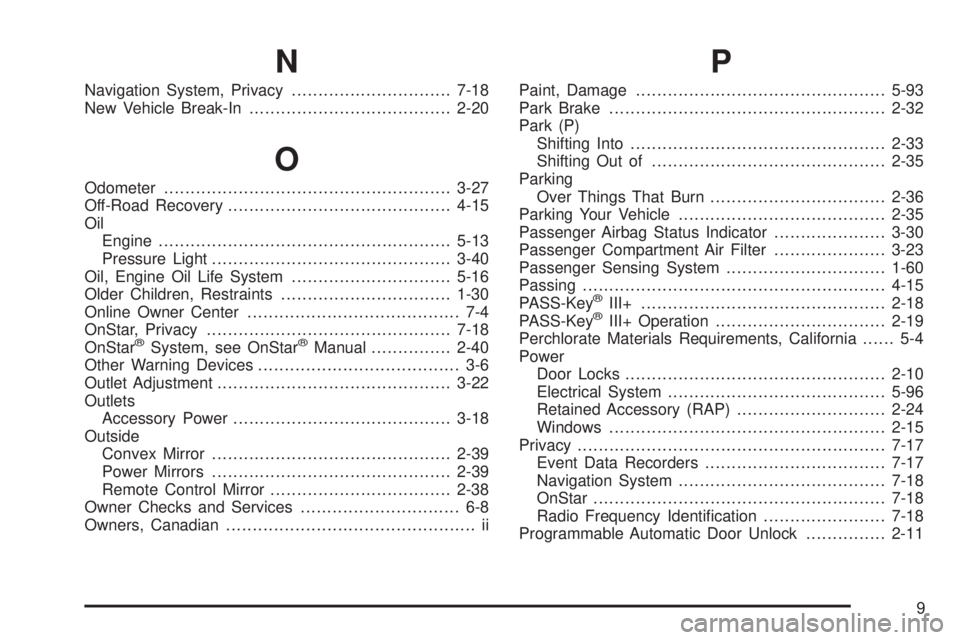
N
Navigation System, Privacy..............................7-18
New Vehicle Break-In......................................2-20
O
Odometer......................................................3-27
Off-Road Recovery..........................................4-15
Oil
Engine.......................................................5-13
Pressure Light.............................................3-40
Oil, Engine Oil Life System..............................5-16
Older Children, Restraints................................1-30
Online Owner Center........................................ 7-4
OnStar, Privacy..............................................7-18
OnStar
®System, see OnStar®Manual...............2-40
Other Warning Devices...................................... 3-6
Outlet Adjustment............................................3-22
Outlets
Accessory Power.........................................3-18
Outside
Convex Mirror.............................................2-39
Power Mirrors.............................................2-39
Remote Control Mirror..................................2-38
Owner Checks and Services.............................. 6-8
Owners, Canadian............................................... ii
P
Paint, Damage...............................................5-93
Park Brake....................................................2-32
Park (P)
Shifting Into................................................2-33
Shifting Out of............................................2-35
Parking
Over Things That Burn.................................2-36
Parking Your Vehicle.......................................2-35
Passenger Airbag Status Indicator.....................3-30
Passenger Compartment Air Filter.....................3-23
Passenger Sensing System..............................1-60
Passing.........................................................4-15
PASS-Key
®III+..............................................2-18
PASS-Key®III+ Operation................................2-19
Perchlorate Materials Requirements, California...... 5-4
Power
Door Locks.................................................2-10
Electrical System.........................................5-96
Retained Accessory (RAP)............................2-24
Windows....................................................2-15
Privacy..........................................................7-17
Event Data Recorders..................................7-17
Navigation System.......................................7-18
OnStar.......................................................7-18
Radio Frequency Identication.......................7-18
Programmable Automatic Door Unlock...............2-11
9