instrument panel PONTIAC G5 2008 Owner's Manual
[x] Cancel search | Manufacturer: PONTIAC, Model Year: 2008, Model line: G5, Model: PONTIAC G5 2008Pages: 388, PDF Size: 2.22 MB
Page 124 of 388
Turn and Lane-Change Signals
The turn signal has two upward (for right) and
two downward (for left) positions. These positions allow
you to signal a turn or a lane change.
To signal a turn, move the lever all the way up or down.
When the turn is nished, the lever will return
automatically.
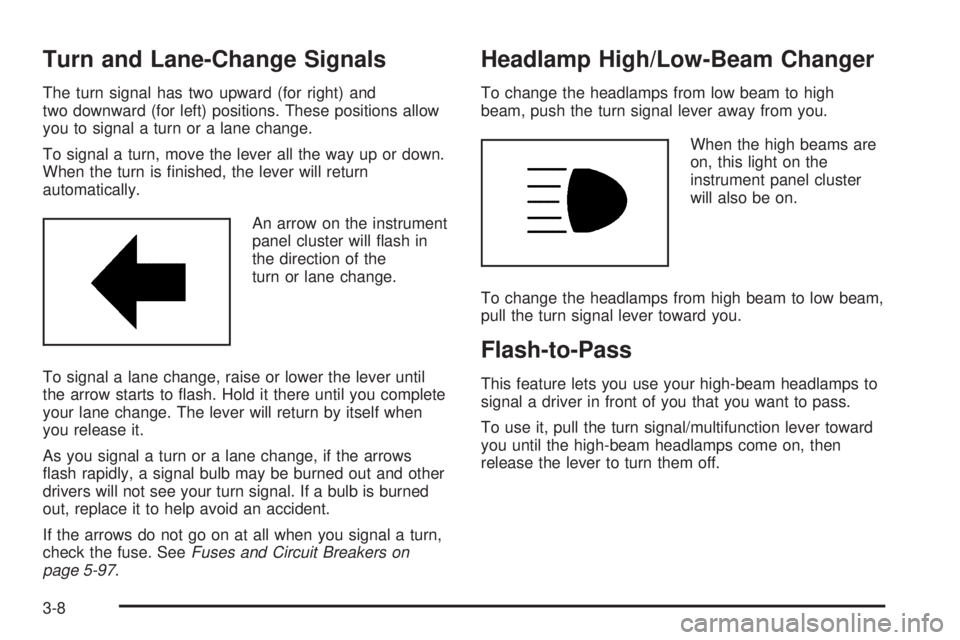
An arrow on the instrument
panel cluster will ash in
the direction of the
turn or lane change.
To signal a lane change, raise or lower the lever until
the arrow starts to ash. Hold it there until you complete
your lane change. The lever will return by itself when
you release it.
As you signal a turn or a lane change, if the arrows
ash rapidly, a signal bulb may be burned out and other
drivers will not see your turn signal. If a bulb is burned
out, replace it to help avoid an accident.
If the arrows do not go on at all when you signal a turn,
check the fuse. SeeFuses and Circuit Breakers on
page 5-97.
Headlamp High/Low-Beam Changer
To change the headlamps from low beam to high
beam, push the turn signal lever away from you.
When the high beams are
on, this light on the
instrument panel cluster
will also be on.
To change the headlamps from high beam to low beam,
pull the turn signal lever toward you.
Flash-to-Pass
This feature lets you use your high-beam headlamps to
signal a driver in front of you that you want to pass.
To use it, pull the turn signal/multifunction lever toward
you until the high-beam headlamps come on, then
release the lever to turn them off.
3-8
Page 131 of 388
Headlamps on Reminder
If the driver’s door is opened with the ignition off and
the lamps on, a warning chime will sound. This lets you
know that the headlamps are still on.
Daytime Running Lamps (DRL)
Daytime Running Lamps (DRL) can make it easier for
others to see the front of your vehicle during the
day. DRL can be helpful in many different driving
conditions, but they can be especially helpful in the short
periods after dawn and before sunset. Fully functional
daytime running lamps are required on all vehicles
rst sold in Canada.
Your vehicle has a light sensor on top of the instrument
panel. Make sure it is not covered or the headlamps
will come on when you do not need them.The DRL system will make the headlamps come on at
reduced intensity when the following conditions are met:
The ignition is on.
The exterior lamp control is turned to AUTO.
The light sensor detects daytime light.
The shift lever is not in PARK (P).
While the DRL system is on, the taillamps, sidemarker
lamps, and instrument panel lights will not be
illuminated.
The DRL system will be off any time your vehicle is
in PARK (P). The DRL system on U.S. vehicles can also
be turned off by using the off/on switch for one ignition
cycle.
As with any vehicle, you should turn on the regular
headlamp system when you need it.
3-15
Page 132 of 388
Fog Lamps
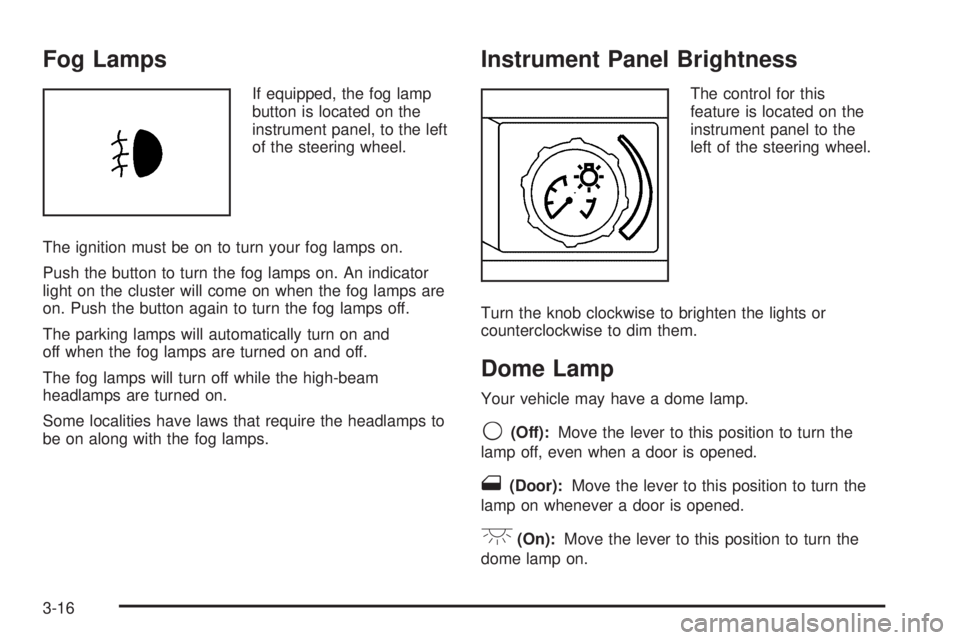
If equipped, the fog lamp
button is located on the
instrument panel, to the left
of the steering wheel.
The ignition must be on to turn your fog lamps on.
Push the button to turn the fog lamps on. An indicator
light on the cluster will come on when the fog lamps are
on. Push the button again to turn the fog lamps off.
The parking lamps will automatically turn on and
off when the fog lamps are turned on and off.
The fog lamps will turn off while the high-beam
headlamps are turned on.
Some localities have laws that require the headlamps to
be on along with the fog lamps.
Instrument Panel Brightness
The control for this
feature is located on the
instrument panel to the
left of the steering wheel.
Turn the knob clockwise to brighten the lights or
counterclockwise to dim them.
Dome Lamp
Your vehicle may have a dome lamp.
9(Off):Move the lever to this position to turn the
lamp off, even when a door is opened.
1(Door):Move the lever to this position to turn the
lamp on whenever a door is opened.
+(On):Move the lever to this position to turn the
dome lamp on.
3-16
Page 135 of 388
Ashtray(s) and Cigarette Lighter
Your vehicle may have an ashtray and cigarette lighter.
To use the lighter, located on the instrument panel
below the climate controls, push it in all the way and let
go. When it is ready, it will pop back out by itself.
Notice:Holding a cigarette lighter in while it is
heating will not allow the lighter to back away from
the heating element when it is hot. Damage from
overheating may occur to the lighter or heating
element, or a fuse could be blown. Do not hold a
cigarette lighter in while it is heating. Do not
use equipment exceeding maximum amperage rating
of 15 amperes.
To clean the center console ashtray, remove the entire
ashtray and empty it.
Notice:If you put papers, pins, or other ammable
items in the ashtray, hot cigarettes or other
smoking materials could ignite them and possibly
damage your vehicle. Never put ammable items in
the ashtray.
Climate Controls
Climate Control System
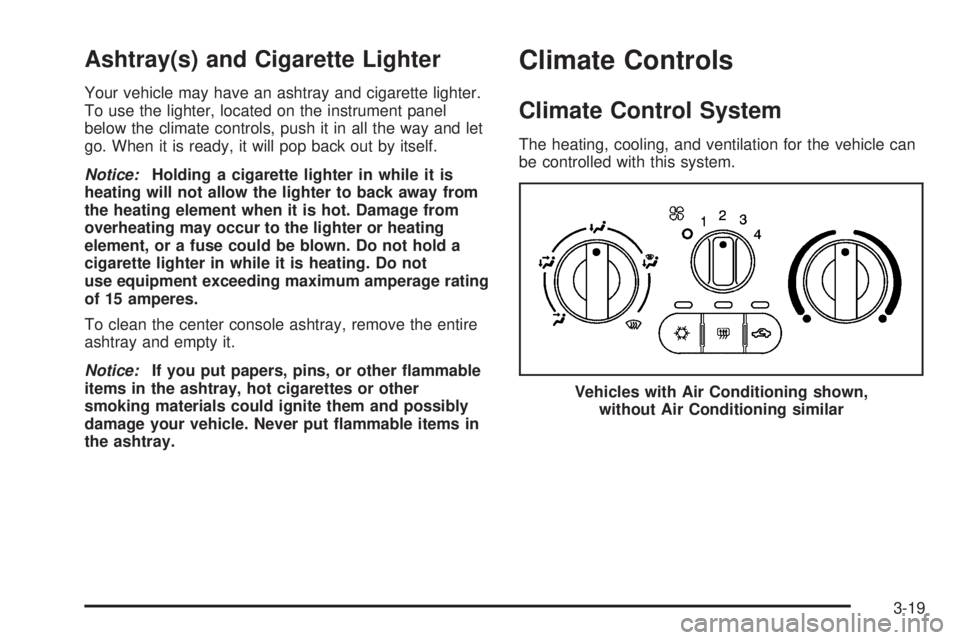
The heating, cooling, and ventilation for the vehicle can
be controlled with this system.
Vehicles with Air Conditioning shown,
without Air Conditioning similar
3-19
Page 136 of 388
Operation
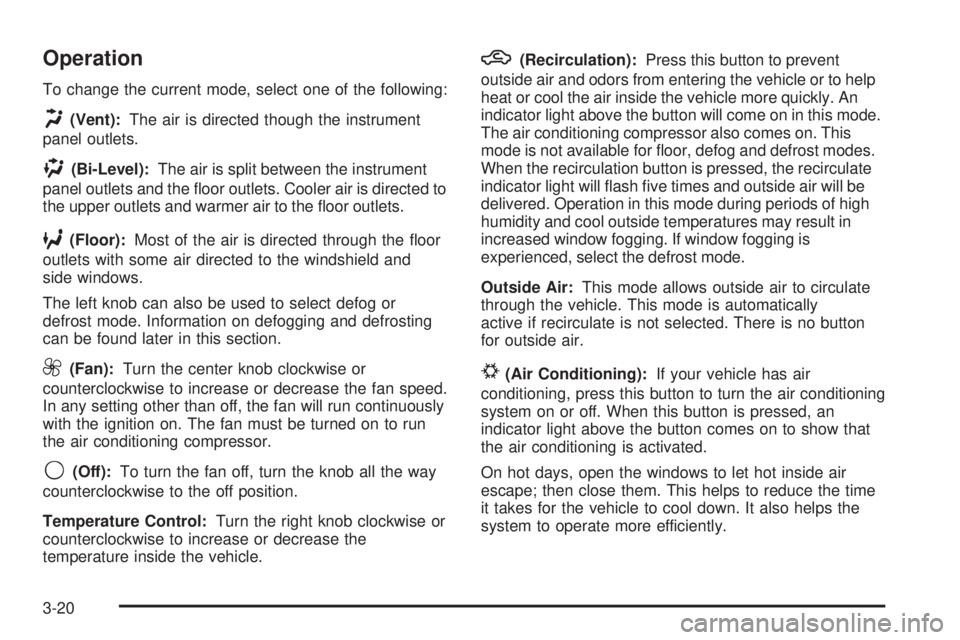
To change the current mode, select one of the following:
H(Vent):The air is directed though the instrument
panel outlets.
)(Bi-Level):The air is split between the instrument
panel outlets and the oor outlets. Cooler air is directed to
the upper outlets and warmer air to the oor outlets.
6(Floor):Most of the air is directed through the oor
outlets with some air directed to the windshield and
side windows.
The left knob can also be used to select defog or
defrost mode. Information on defogging and defrosting
can be found later in this section.
9(Fan):Turn the center knob clockwise or
counterclockwise to increase or decrease the fan speed.
In any setting other than off, the fan will run continuously
with the ignition on. The fan must be turned on to run
the air conditioning compressor.
9(Off):To turn the fan off, turn the knob all the way
counterclockwise to the off position.
Temperature Control:Turn the right knob clockwise or
counterclockwise to increase or decrease the
temperature inside the vehicle.
h(Recirculation):Press this button to prevent
outside air and odors from entering the vehicle or to help
heat or cool the air inside the vehicle more quickly. An
indicator light above the button will come on in this mode.
The air conditioning compressor also comes on. This
mode is not available for oor, defog and defrost modes.
When the recirculation button is pressed, the recirculate
indicator light will ash ve times and outside air will be
delivered. Operation in this mode during periods of high
humidity and cool outside temperatures may result in
increased window fogging. If window fogging is
experienced, select the defrost mode.
Outside Air:This mode allows outside air to circulate
through the vehicle. This mode is automatically
active if recirculate is not selected. There is no button
for outside air.
#(Air Conditioning):If your vehicle has air
conditioning, press this button to turn the air conditioning
system on or off. When this button is pressed, an
indicator light above the button comes on to show that
the air conditioning is activated.
On hot days, open the windows to let hot inside air
escape; then close them. This helps to reduce the time
it takes for the vehicle to cool down. It also helps the
system to operate more efficiently.
3-20
Page 142 of 388
Instrument Panel Cluster
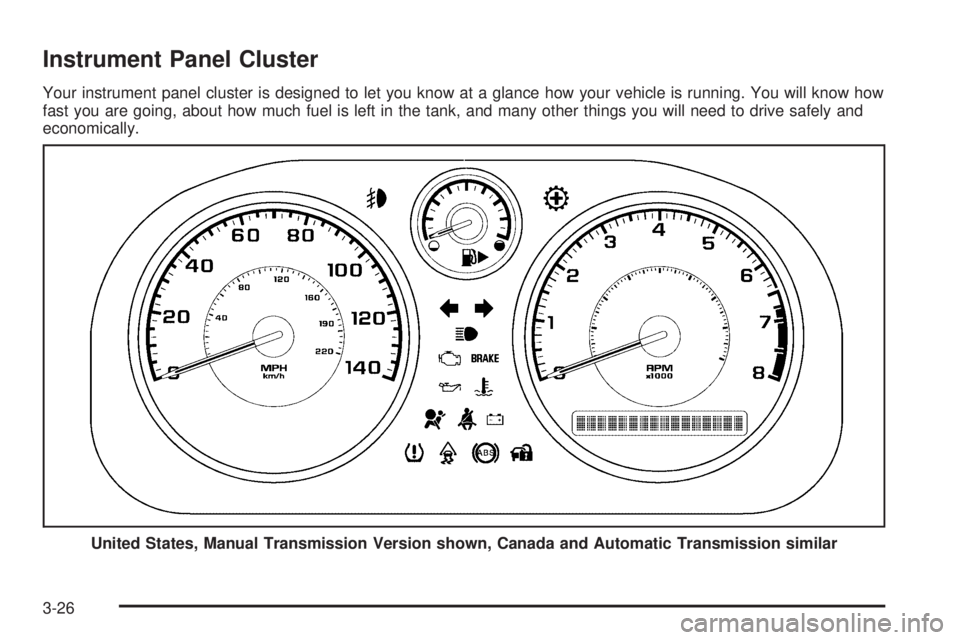
Your instrument panel cluster is designed to let you know at a glance how your vehicle is running. You will know how
fast you are going, about how much fuel is left in the tank, and many other things you will need to drive safely and
economically.
United States, Manual Transmission Version shown, Canada and Automatic Transmission similar
3-26
Page 145 of 388
Airbag Readiness Light
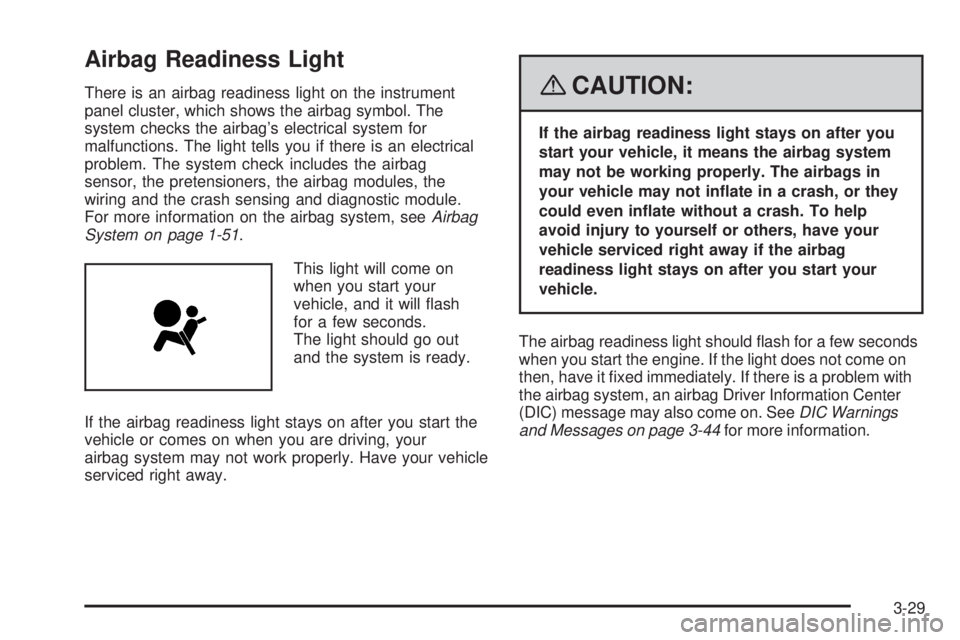
There is an airbag readiness light on the instrument
panel cluster, which shows the airbag symbol. The
system checks the airbag’s electrical system for
malfunctions. The light tells you if there is an electrical
problem. The system check includes the airbag
sensor, the pretensioners, the airbag modules, the
wiring and the crash sensing and diagnostic module.
For more information on the airbag system, seeAirbag
System on page 1-51.
This light will come on
when you start your
vehicle, and it will ash
for a few seconds.
The light should go out
and the system is ready.
If the airbag readiness light stays on after you start the
vehicle or comes on when you are driving, your
airbag system may not work properly. Have your vehicle
serviced right away.{CAUTION:
If the airbag readiness light stays on after you
start your vehicle, it means the airbag system
may not be working properly. The airbags in
your vehicle may not inate in a crash, or they
could even inate without a crash. To help
avoid injury to yourself or others, have your
vehicle serviced right away if the airbag
readiness light stays on after you start your
vehicle.
The airbag readiness light should ash for a few seconds
when you start the engine. If the light does not come on
then, have it xed immediately. If there is a problem with
the airbag system, an airbag Driver Information Center
(DIC) message may also come on. SeeDIC Warnings
and Messages on page 3-44for more information.
3-29
Page 146 of 388
Passenger Airbag Status Indicator
Your vehicle has the passenger sensing system.
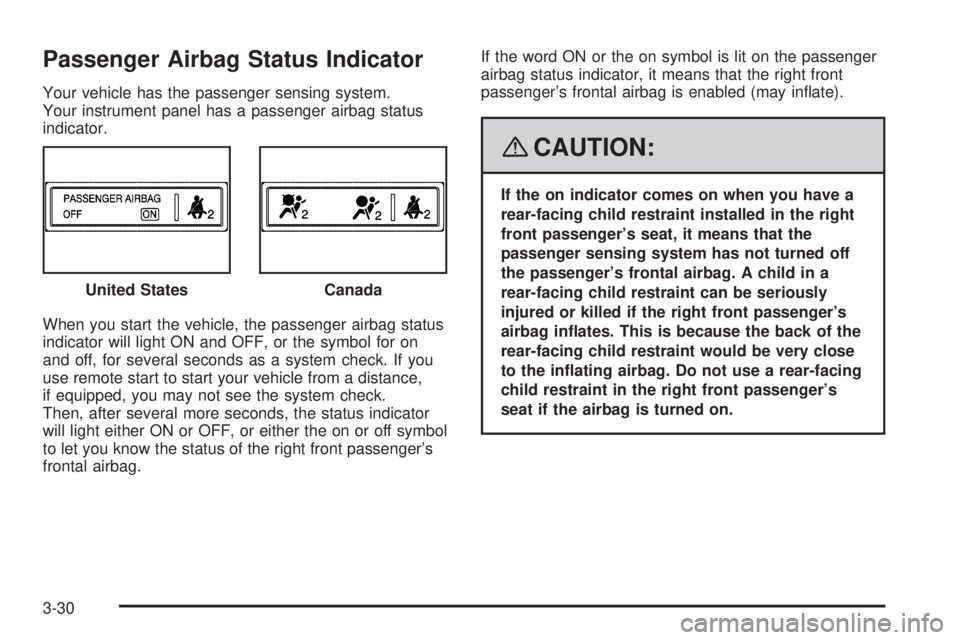
Your instrument panel has a passenger airbag status
indicator.
When you start the vehicle, the passenger airbag status
indicator will light ON and OFF, or the symbol for on
and off, for several seconds as a system check. If you
use remote start to start your vehicle from a distance,
if equipped, you may not see the system check.
Then, after several more seconds, the status indicator
will light either ON or OFF, or either the on or off symbol
to let you know the status of the right front passenger’s
frontal airbag.If the word ON or the on symbol is lit on the passenger
airbag status indicator, it means that the right front
passenger’s frontal airbag is enabled (may inate).
{CAUTION:
If the on indicator comes on when you have a
rear-facing child restraint installed in the right
front passenger’s seat, it means that the
passenger sensing system has not turned off
the passenger’s frontal airbag. A child in a
rear-facing child restraint can be seriously
injured or killed if the right front passenger’s
airbag inates. This is because the back of the
rear-facing child restraint would be very close
to the inating airbag. Do not use a rear-facing
child restraint in the right front passenger’s
seat if the airbag is turned on. United States
Canada
3-30
Page 147 of 388
{CAUTION:
Even though the passenger sensing system is
designed to turn off the right front passenger’s
frontal airbag if the system detects a
rear-facing child restraint, no system is
fail-safe, and no one can guarantee that an
airbag will not deploy under some unusual
circumstance, even though it is turned off.
We recommend that rear-facing child restraints
be secured in the rear seat, even if the airbag
is off.
If the word OFF or the off symbol is lit on the airbag
status indicator, it means that the passenger sensing
system has turned off the right front passenger’s frontal
airbag. SeePassenger Sensing System on page 1-60
for more on this, including important safety information.If, after several seconds, both status indicator lights
remain on, or if there are no lights at all, there may be a
problem with the lights or the passenger sensing
system. See your dealer/retailer for service.
{CAUTION:
If the airbag readiness light in the instrument
panel cluster ever comes on and stays on, it
means that something may be wrong with the
airbag system. If this ever happens, have the
vehicle serviced promptly, because an
adult-size person sitting in the right front
passenger’s seat may not have the protection
of the airbag(s). SeeAirbag Readiness Light
on page 3-29for more on this, including
important safety information.
3-31
Page 151 of 388
Electronic Stability Control (ESC)/
Traction Control System (TCS)
Indicator/Warning Light
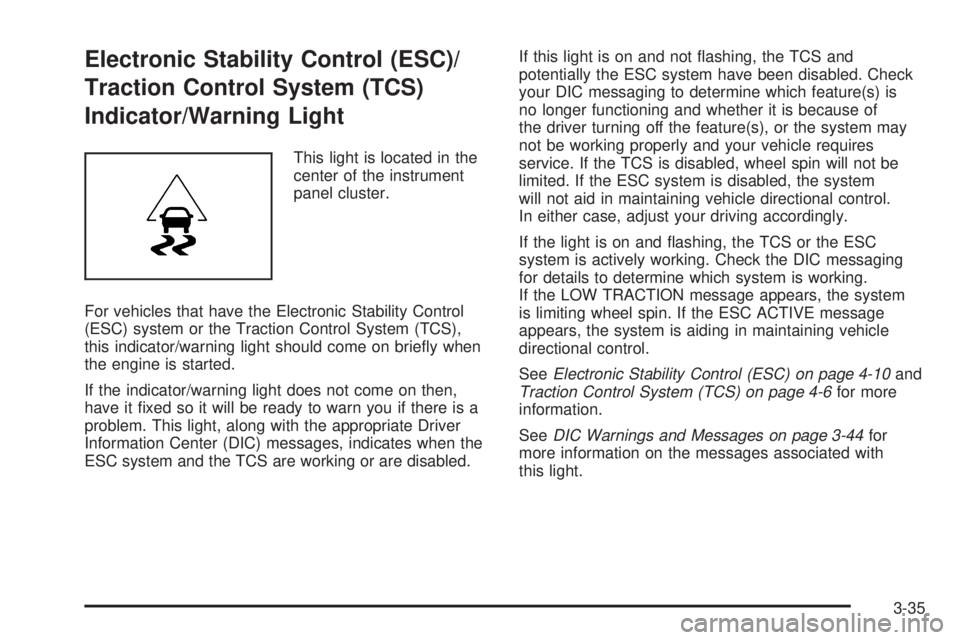
This light is located in the
center of the instrument
panel cluster.
For vehicles that have the Electronic Stability Control
(ESC) system or the Traction Control System (TCS),
this indicator/warning light should come on briey when
the engine is started.
If the indicator/warning light does not come on then,
have it xed so it will be ready to warn you if there is a
problem. This light, along with the appropriate Driver
Information Center (DIC) messages, indicates when the
ESC system and the TCS are working or are disabled.If this light is on and not ashing, the TCS and
potentially the ESC system have been disabled. Check
your DIC messaging to determine which feature(s) is
no longer functioning and whether it is because of
the driver turning off the feature(s), or the system may
not be working properly and your vehicle requires
service. If the TCS is disabled, wheel spin will not be
limited. If the ESC system is disabled, the system
will not aid in maintaining vehicle directional control.
In either case, adjust your driving accordingly.
If the light is on and ashing, the TCS or the ESC
system is actively working. Check the DIC messaging
for details to determine which system is working.
If the LOW TRACTION message appears, the system
is limiting wheel spin. If the ESC ACTIVE message
appears, the system is aiding in maintaining vehicle
directional control.
SeeElectronic Stability Control (ESC) on page 4-10and
Traction Control System (TCS) on page 4-6for more
information.
SeeDIC Warnings and Messages on page 3-44for
more information on the messages associated with
this light.
3-35