parking brake PONTIAC G5 2008 Owner's Manual
[x] Cancel search | Manufacturer: PONTIAC, Model Year: 2008, Model line: G5, Model: PONTIAC G5 2008Pages: 388, PDF Size: 2.22 MB
Page 335 of 388
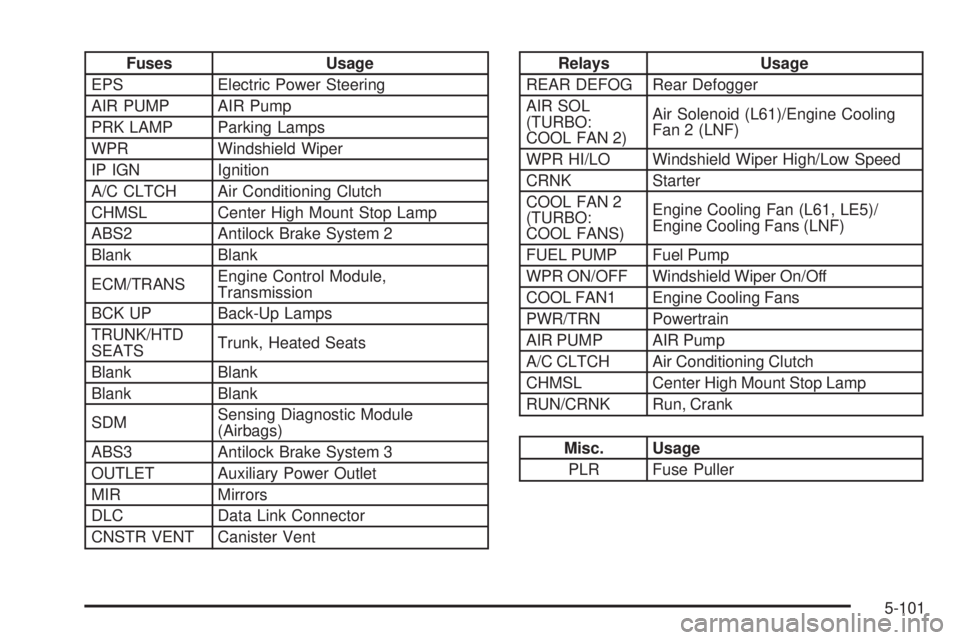
Fuses Usage
EPS Electric Power Steering
AIR PUMP AIR Pump
PRK LAMP Parking Lamps
WPR Windshield Wiper
IP IGN Ignition
A/C CLTCH Air Conditioning Clutch
CHMSL Center High Mount Stop Lamp
ABS2 Antilock Brake System 2
Blank Blank
ECM/TRANSEngine Control Module,
Transmission
BCK UP Back-Up Lamps
TRUNK/HTD
SEATSTrunk, Heated Seats
Blank Blank
Blank Blank
SDMSensing Diagnostic Module
(Airbags)
ABS3 Antilock Brake System 3
OUTLET Auxiliary Power Outlet
MIR Mirrors
DLC Data Link Connector
CNSTR VENT Canister VentRelays Usage
REAR DEFOG Rear Defogger
AIR SOL
(TURBO:
COOL FAN 2)Air Solenoid (L61)/Engine Cooling
Fan 2 (LNF)
WPR HI/LO Windshield Wiper High/Low Speed
CRNK Starter
COOL FAN 2
(TURBO:
COOL FANS)Engine Cooling Fan (L61, LE5)/
Engine Cooling Fans (LNF)
FUEL PUMP Fuel Pump
WPR ON/OFF Windshield Wiper On/Off
COOL FAN1 Engine Cooling Fans
PWR/TRN Powertrain
AIR PUMP AIR Pump
A/C CLTCH Air Conditioning Clutch
CHMSL Center High Mount Stop Lamp
RUN/CRNK Run, Crank
Misc. Usage
PLR Fuse Puller
5-101
Page 345 of 388
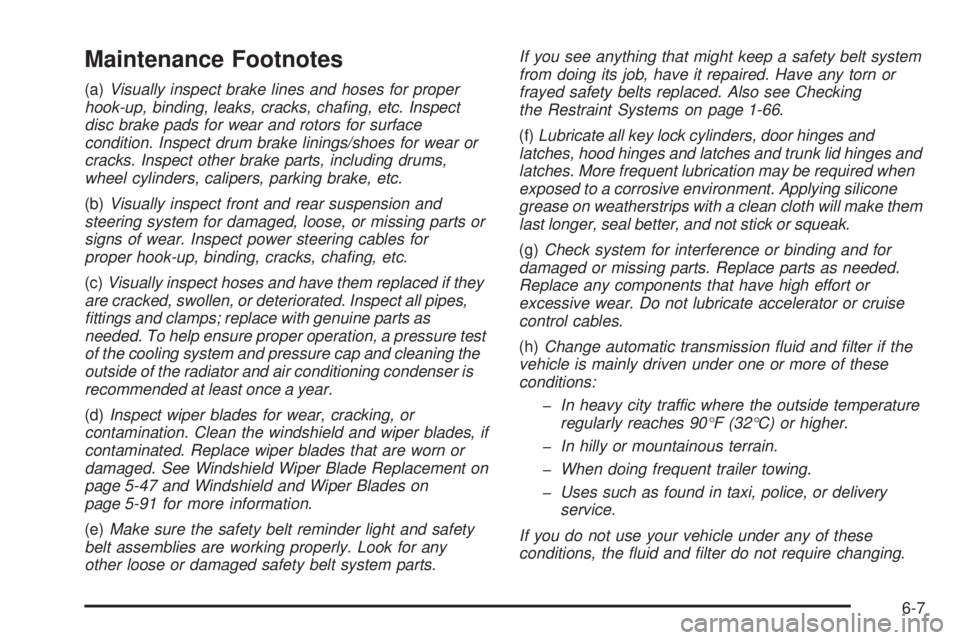
Maintenance Footnotes
(a)Visually inspect brake lines and hoses for proper
hook-up, binding, leaks, cracks, chafing, etc. Inspect
disc brake pads for wear and rotors for surface
condition. Inspect drum brake linings/shoes for wear or
cracks. Inspect other brake parts, including drums,
wheel cylinders, calipers, parking brake, etc.
(b)Visually inspect front and rear suspension and
steering system for damaged, loose, or missing parts or
signs of wear. Inspect power steering cables for
proper hook-up, binding, cracks, chafing, etc.
(c)Visually inspect hoses and have them replaced if they
are cracked, swollen, or deteriorated. Inspect all pipes,
fittings and clamps; replace with genuine parts as
needed. To help ensure proper operation, a pressure test
of the cooling system and pressure cap and cleaning the
outside of the radiator and air conditioning condenser is
recommended at least once a year.
(d)Inspect wiper blades for wear, cracking, or
contamination. Clean the windshield and wiper blades, if
contaminated. Replace wiper blades that are worn or
damaged. See Windshield Wiper Blade Replacement on
page 5-47 and Windshield and Wiper Blades on
page 5-91 for more information.
(e)Make sure the safety belt reminder light and safety
belt assemblies are working properly. Look for any
other loose or damaged safety belt system parts.If you see anything that might keep a safety belt system
from doing its job, have it repaired. Have any torn or
frayed safety belts replaced. Also see Checking
the Restraint Systems on page 1-66.
(f)Lubricate all key lock cylinders, door hinges and
latches, hood hinges and latches and trunk lid hinges and
latches. More frequent lubrication may be required when
exposed to a corrosive environment. Applying silicone
grease on weatherstrips with a clean cloth will make them
last longer, seal better, and not stick or squeak.
(g)Check system for interference or binding and for
damaged or missing parts. Replace parts as needed.
Replace any components that have high effort or
excessive wear. Do not lubricate accelerator or cruise
control cables.
(h)Change automatic transmission fluid and filter if the
vehicle is mainly driven under one or more of these
conditions:
In heavy city traffic where the outside temperature
regularly reaches 90°F (32°C) or higher.
In hilly or mountainous terrain.
When doing frequent trailer towing.
Uses such as found in taxi, police, or delivery
service.
If you do not use your vehicle under any of these
conditions, the fluid and filter do not require changing.
6-7
Page 347 of 388
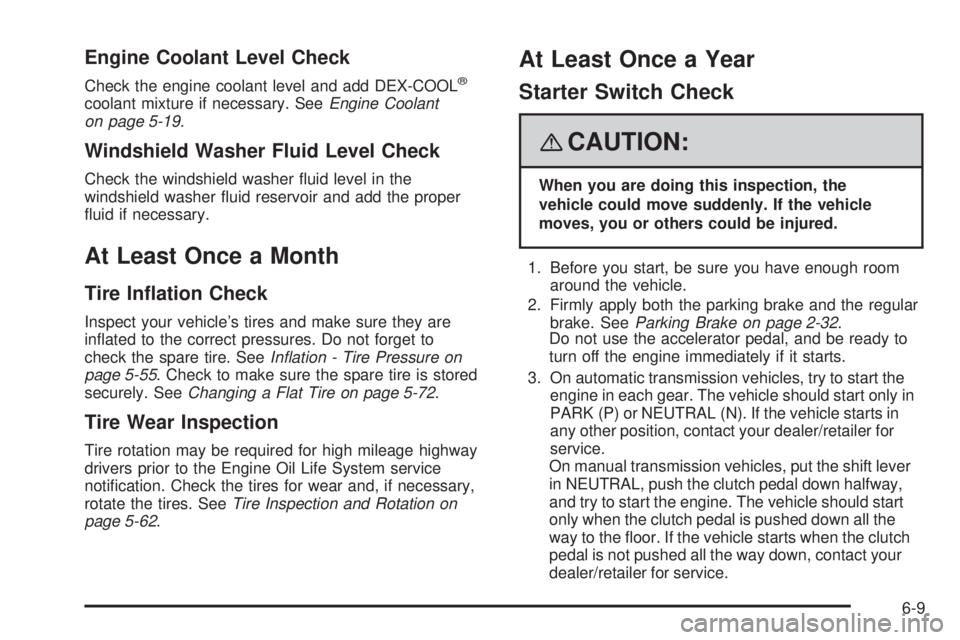
Engine Coolant Level Check
Check the engine coolant level and add DEX-COOL®
coolant mixture if necessary. SeeEngine Coolant
on page 5-19.
Windshield Washer Fluid Level Check
Check the windshield washer uid level in the
windshield washer uid reservoir and add the proper
uid if necessary.
At Least Once a Month
Tire Ination Check
Inspect your vehicle’s tires and make sure they are
inated to the correct pressures. Do not forget to
check the spare tire. SeeInflation - Tire Pressure on
page 5-55. Check to make sure the spare tire is stored
securely. SeeChanging a Flat Tire on page 5-72.
Tire Wear Inspection
Tire rotation may be required for high mileage highway
drivers prior to the Engine Oil Life System service
notication. Check the tires for wear and, if necessary,
rotate the tires. SeeTire Inspection and Rotation on
page 5-62.
At Least Once a Year
Starter Switch Check
{CAUTION:
When you are doing this inspection, the
vehicle could move suddenly. If the vehicle
moves, you or others could be injured.
1. Before you start, be sure you have enough room
around the vehicle.
2. Firmly apply both the parking brake and the regular
brake. SeeParking Brake on page 2-32.
Do not use the accelerator pedal, and be ready to
turn off the engine immediately if it starts.
3. On automatic transmission vehicles, try to start the
engine in each gear. The vehicle should start only in
PARK (P) or NEUTRAL (N). If the vehicle starts in
any other position, contact your dealer/retailer for
service.
On manual transmission vehicles, put the shift lever
in NEUTRAL, push the clutch pedal down halfway,
and try to start the engine. The vehicle should start
only when the clutch pedal is pushed down all the
way to the oor. If the vehicle starts when the clutch
pedal is not pushed all the way down, contact your
dealer/retailer for service.
6-9
Page 348 of 388
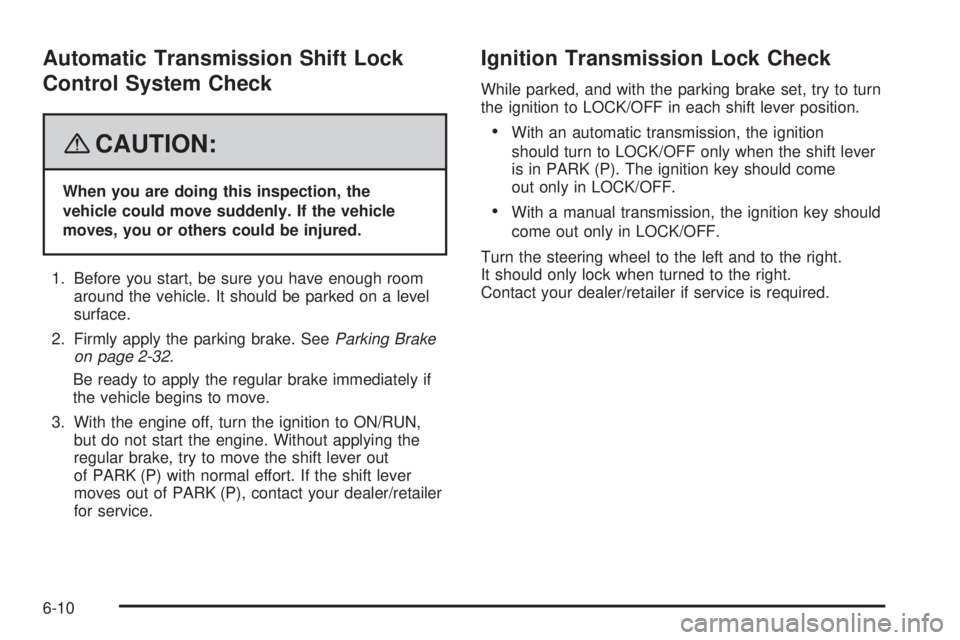
Automatic Transmission Shift Lock
Control System Check
{CAUTION:
When you are doing this inspection, the
vehicle could move suddenly. If the vehicle
moves, you or others could be injured.
1. Before you start, be sure you have enough room
around the vehicle. It should be parked on a level
surface.
2. Firmly apply the parking brake. SeeParking Brake
on page 2-32.
Be ready to apply the regular brake immediately if
the vehicle begins to move.
3. With the engine off, turn the ignition to ON/RUN,
but do not start the engine. Without applying the
regular brake, try to move the shift lever out
of PARK (P) with normal effort. If the shift lever
moves out of PARK (P), contact your dealer/retailer
for service.
Ignition Transmission Lock Check
While parked, and with the parking brake set, try to turn
the ignition to LOCK/OFF in each shift lever position.
With an automatic transmission, the ignition
should turn to LOCK/OFF only when the shift lever
is in PARK (P). The ignition key should come
out only in LOCK/OFF.
With a manual transmission, the ignition key should
come out only in LOCK/OFF.
Turn the steering wheel to the left and to the right.
It should only lock when turned to the right.
Contact your dealer/retailer if service is required.
6-10
Page 349 of 388
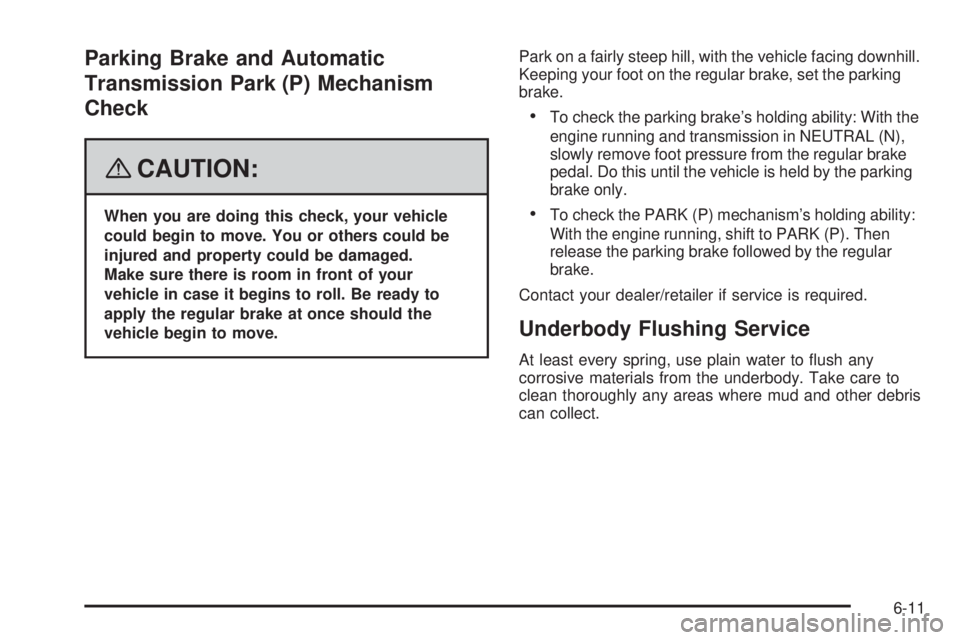
Parking Brake and Automatic
Transmission Park (P) Mechanism
Check
{CAUTION:
When you are doing this check, your vehicle
could begin to move. You or others could be
injured and property could be damaged.
Make sure there is room in front of your
vehicle in case it begins to roll. Be ready to
apply the regular brake at once should the
vehicle begin to move.Park on a fairly steep hill, with the vehicle facing downhill.
Keeping your foot on the regular brake, set the parking
brake.
To check the parking brake’s holding ability: With the
engine running and transmission in NEUTRAL (N),
slowly remove foot pressure from the regular brake
pedal. Do this until the vehicle is held by the parking
brake only.
To check the PARK (P) mechanism’s holding ability:
With the engine running, shift to PARK (P). Then
release the parking brake followed by the regular
brake.
Contact your dealer/retailer if service is required.
Underbody Flushing Service
At least every spring, use plain water to ush any
corrosive materials from the underbody. Take care to
clean thoroughly any areas where mud and other debris
can collect.
6-11
Page 350 of 388
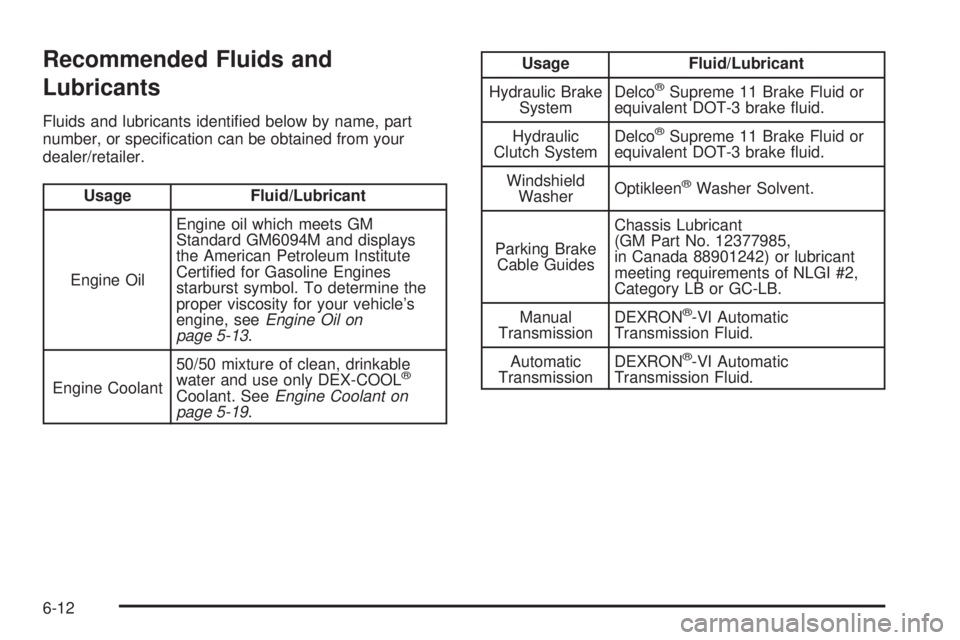
Recommended Fluids and
Lubricants
Fluids and lubricants identied below by name, part
number, or specication can be obtained from your
dealer/retailer.
Usage Fluid/Lubricant
Engine OilEngine oil which meets GM
Standard GM6094M and displays
the American Petroleum Institute
Certied for Gasoline Engines
starburst symbol. To determine the
proper viscosity for your vehicle’s
engine, seeEngine Oil on
page 5-13.
Engine Coolant50/50 mixture of clean, drinkable
water and use only DEX-COOL
®
Coolant. SeeEngine Coolant on
page 5-19.
Usage Fluid/Lubricant
Hydraulic Brake
SystemDelco
®Supreme 11 Brake Fluid or
equivalent DOT-3 brake uid.
Hydraulic
Clutch SystemDelco
®Supreme 11 Brake Fluid or
equivalent DOT-3 brake uid.
Windshield
WasherOptikleen
®Washer Solvent.
Parking Brake
Cable GuidesChassis Lubricant
(GM Part No. 12377985,
in Canada 88901242) or lubricant
meeting requirements of NLGI #2,
Category LB or GC-LB.
Manual
TransmissionDEXRON
®-VI Automatic
Transmission Fluid.
Automatic
TransmissionDEXRON
®-VI Automatic
Transmission Fluid.
6-12
Page 376 of 388
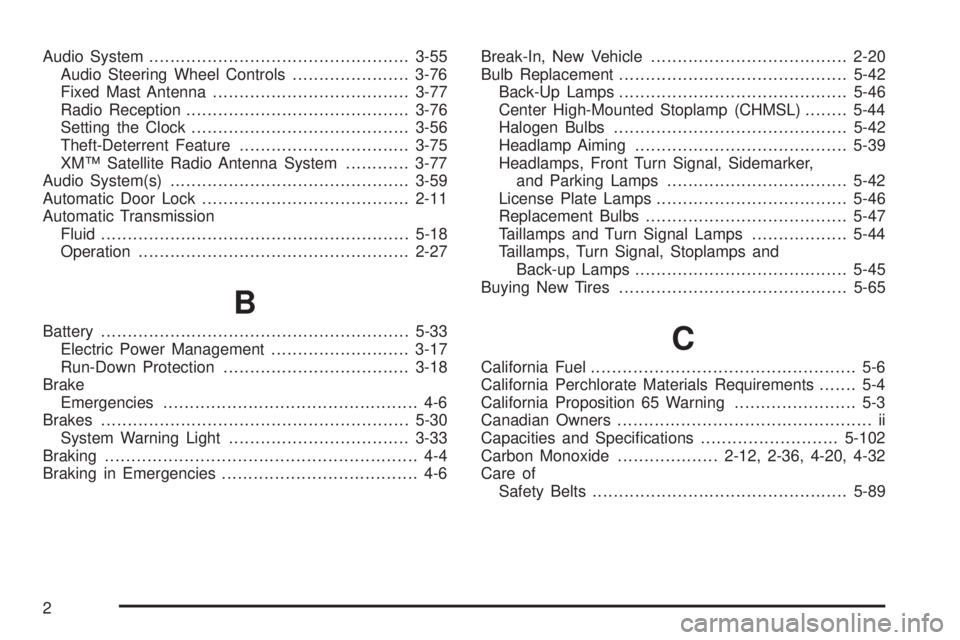
Audio System.................................................3-55
Audio Steering Wheel Controls......................3-76
Fixed Mast Antenna.....................................3-77
Radio Reception..........................................3-76
Setting the Clock.........................................3-56
Theft-Deterrent Feature................................3-75
XM™ Satellite Radio Antenna System............3-77
Audio System(s).............................................3-59
Automatic Door Lock.......................................2-11
Automatic Transmission
Fluid..........................................................5-18
Operation...................................................2-27
B
Battery..........................................................5-33
Electric Power Management..........................3-17
Run-Down Protection...................................3-18
Brake
Emergencies................................................ 4-6
Brakes..........................................................5-30
System Warning Light..................................3-33
Braking........................................................... 4-4
Braking in Emergencies..................................... 4-6Break-In, New Vehicle.....................................2-20
Bulb Replacement...........................................5-42
Back-Up Lamps...........................................5-46
Center High-Mounted Stoplamp (CHMSL)........5-44
Halogen Bulbs............................................5-42
Headlamp Aiming........................................5-39
Headlamps, Front Turn Signal, Sidemarker,
and Parking Lamps..................................5-42
License Plate Lamps....................................5-46
Replacement Bulbs......................................5-47
Taillamps and Turn Signal Lamps..................5-44
Taillamps, Turn Signal, Stoplamps and
Back-up Lamps........................................5-45
Buying New Tires...........................................5-65C
California Fuel.................................................. 5-6
California Perchlorate Materials Requirements....... 5-4
California Proposition 65 Warning....................... 5-3
Canadian Owners................................................ ii
Capacities and Specications..........................5-102
Carbon Monoxide...................2-12, 2-36, 4-20, 4-32
Care of
Safety Belts................................................5-89
2
Page 383 of 388
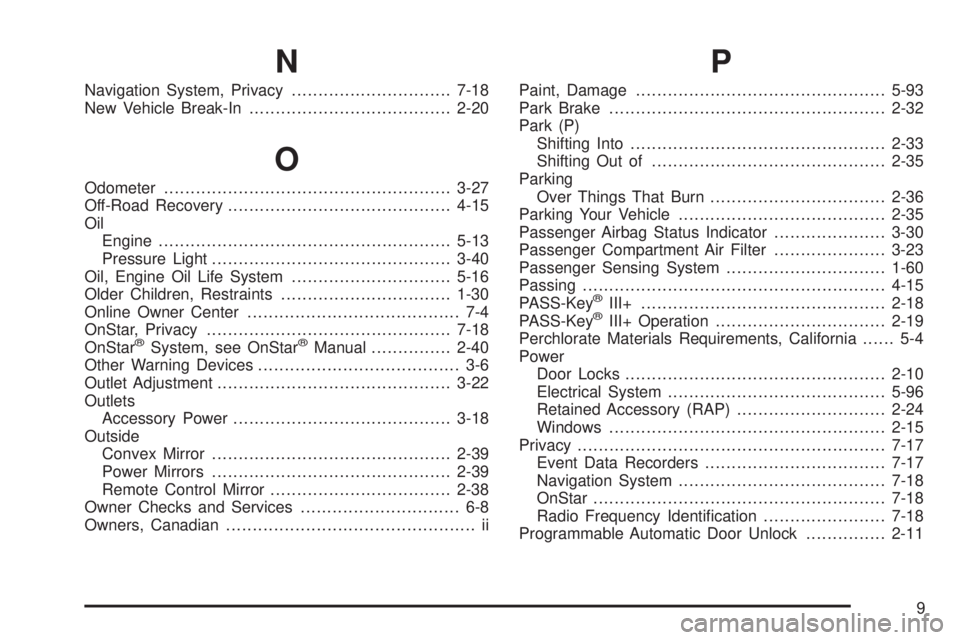
N
Navigation System, Privacy..............................7-18
New Vehicle Break-In......................................2-20
O
Odometer......................................................3-27
Off-Road Recovery..........................................4-15
Oil
Engine.......................................................5-13
Pressure Light.............................................3-40
Oil, Engine Oil Life System..............................5-16
Older Children, Restraints................................1-30
Online Owner Center........................................ 7-4
OnStar, Privacy..............................................7-18
OnStar
®System, see OnStar®Manual...............2-40
Other Warning Devices...................................... 3-6
Outlet Adjustment............................................3-22
Outlets
Accessory Power.........................................3-18
Outside
Convex Mirror.............................................2-39
Power Mirrors.............................................2-39
Remote Control Mirror..................................2-38
Owner Checks and Services.............................. 6-8
Owners, Canadian............................................... ii
P
Paint, Damage...............................................5-93
Park Brake....................................................2-32
Park (P)
Shifting Into................................................2-33
Shifting Out of............................................2-35
Parking
Over Things That Burn.................................2-36
Parking Your Vehicle.......................................2-35
Passenger Airbag Status Indicator.....................3-30
Passenger Compartment Air Filter.....................3-23
Passenger Sensing System..............................1-60
Passing.........................................................4-15
PASS-Key
®III+..............................................2-18
PASS-Key®III+ Operation................................2-19
Perchlorate Materials Requirements, California...... 5-4
Power
Door Locks.................................................2-10
Electrical System.........................................5-96
Retained Accessory (RAP)............................2-24
Windows....................................................2-15
Privacy..........................................................7-17
Event Data Recorders..................................7-17
Navigation System.......................................7-18
OnStar.......................................................7-18
Radio Frequency Identication.......................7-18
Programmable Automatic Door Unlock...............2-11
9