towing PONTIAC G5 2008 Owner's Manual
[x] Cancel search | Manufacturer: PONTIAC, Model Year: 2008, Model line: G5, Model: PONTIAC G5 2008Pages: 388, PDF Size: 2.22 MB
Page 233 of 388
When You Are Ready to Leave After
Parking on a Hill
1. Apply your regular brakes and hold the pedal down
while you:
Start your engine.
Shift into a gear.
Release the parking brake.
2. Let up on the brake pedal.
3. Drive slowly until the trailer is clear of the chocks.
4. Stop and have someone pick up and store the
chocks.
Maintenance When Trailer Towing
Your vehicle will need service more often when you are
pulling a trailer. SeeScheduled Maintenance on
page 6-4for more on this. Things that are especially
important in trailer operation are automatic transmission
uid (do not overll), engine oil, drive belt, cooling system
and brake system.
Each of these is covered in this manual, and the Index
will help you nd them quickly. If you are trailering,
it is a good idea to review this information before you
start your trip.
Check periodically to see that all hitch nuts and bolts
are tight.
Engine Cooling When Trailer Towing
Your cooling system may temporarily overheat during
severe operating conditions. SeeEngine Overheating on
page 5-22.
4-39
Page 345 of 388
Maintenance Footnotes
(a)Visually inspect brake lines and hoses for proper
hook-up, binding, leaks, cracks, chafing, etc. Inspect
disc brake pads for wear and rotors for surface
condition. Inspect drum brake linings/shoes for wear or
cracks. Inspect other brake parts, including drums,
wheel cylinders, calipers, parking brake, etc.
(b)Visually inspect front and rear suspension and
steering system for damaged, loose, or missing parts or
signs of wear. Inspect power steering cables for
proper hook-up, binding, cracks, chafing, etc.
(c)Visually inspect hoses and have them replaced if they
are cracked, swollen, or deteriorated. Inspect all pipes,
fittings and clamps; replace with genuine parts as
needed. To help ensure proper operation, a pressure test
of the cooling system and pressure cap and cleaning the
outside of the radiator and air conditioning condenser is
recommended at least once a year.
(d)Inspect wiper blades for wear, cracking, or
contamination. Clean the windshield and wiper blades, if
contaminated. Replace wiper blades that are worn or
damaged. See Windshield Wiper Blade Replacement on
page 5-47 and Windshield and Wiper Blades on
page 5-91 for more information.
(e)Make sure the safety belt reminder light and safety
belt assemblies are working properly. Look for any
other loose or damaged safety belt system parts.If you see anything that might keep a safety belt system
from doing its job, have it repaired. Have any torn or
frayed safety belts replaced. Also see Checking
the Restraint Systems on page 1-66.
(f)Lubricate all key lock cylinders, door hinges and
latches, hood hinges and latches and trunk lid hinges and
latches. More frequent lubrication may be required when
exposed to a corrosive environment. Applying silicone
grease on weatherstrips with a clean cloth will make them
last longer, seal better, and not stick or squeak.
(g)Check system for interference or binding and for
damaged or missing parts. Replace parts as needed.
Replace any components that have high effort or
excessive wear. Do not lubricate accelerator or cruise
control cables.
(h)Change automatic transmission fluid and filter if the
vehicle is mainly driven under one or more of these
conditions:
In heavy city traffic where the outside temperature
regularly reaches 90°F (32°C) or higher.
In hilly or mountainous terrain.
When doing frequent trailer towing.
Uses such as found in taxi, police, or delivery
service.
If you do not use your vehicle under any of these
conditions, the fluid and filter do not require changing.
6-7
Page 365 of 388
Calling For Assistance
For prompt and efficient assistance when calling, please
provide the following to the Roadside Assistance
Representative:
Your name, home address, and home telephone
number
Telephone number of your location
Location of the vehicle
Model, year, color, and license plate number of the
vehicle
Odometer reading, Vehicle Identication Number
(VIN), and delivery date of the vehicle
Description of the problem
Towing and Road Service Exclusions
Specically excluded from Roadside Assistance
coverage are towing or services for vehicles operated
on a non-public roadway or highway, nes, impound
towing caused by a violation of local, Municipal, State,
Provincial, or Federal law, and mounting, dismounting or
changing of snow tires, chains, or other traction
devices.
Roadside Assistance is not part of or included in the
coverage provided by the New Vehicle Limited Warranty.
Pontiac and General Motors of Canada Limited reserve
the right to make any changes or discontinue the
Roadside Assistance program at any time without
notication.
7-9
Page 369 of 388
Some insurance companies will not specify aftermarket
collision parts. When purchasing insurance, we
recommend that you assure your vehicle will be repaired
with GM original equipment collision parts. If such
insurance coverage is not available from your current
insurance carrier, consider switching to another
insurance carrier.
If your vehicle is leased, the leasing company may
require you to have insurance that assures repairs with
Genuine GM Original Equipment Manufacturer (OEM)
parts or Genuine Manufacturer replacement parts. Read
your lease carefully, as you may be charged at the end
of your lease for poor quality repairs.
If a Crash Occurs
Here is what to do if you are involved in a crash.
Check to make sure that you are all right. If you are
uninjured, make sure that no one else in your
vehicle, or the other vehicle, is injured.
If there has been an injury, call emergency services
for help. Do not leave the scene of a crash until all
matters have been taken care of. Move your vehicle
only if its position puts you in danger or you are
instructed to move it by a police officer.
Give only the necessary and requested information
to police and other parties involved in the crash.
Do not discuss your personal condition, mental frame
of mind, or anything unrelated to the crash. This will
help guard against post-crash legal action.
If you need roadside assistance, call GM Roadside
Assistance. SeeRoadside Assistance Program on
page 7-7for more information.
If your vehicle cannot be driven, know where the
towing service will be taking it. Get a card from the
tow truck operator or write down the driver’s name,
the service’s name, and the phone number.
Remove any valuables from your vehicle before it is
towed away. Make sure this includes your insurance
information and registration if you keep these items
in your vehicle.
Gather the important information you will need from
the other driver. Things like name, address, phone
number, driver’s license number, vehicle license
plate, vehicle make, model and model year, Vehicle
Identication Number (VIN), insurance company and
policy number, and a general description of the
damage to the other vehicle.
7-13
Page 384 of 388
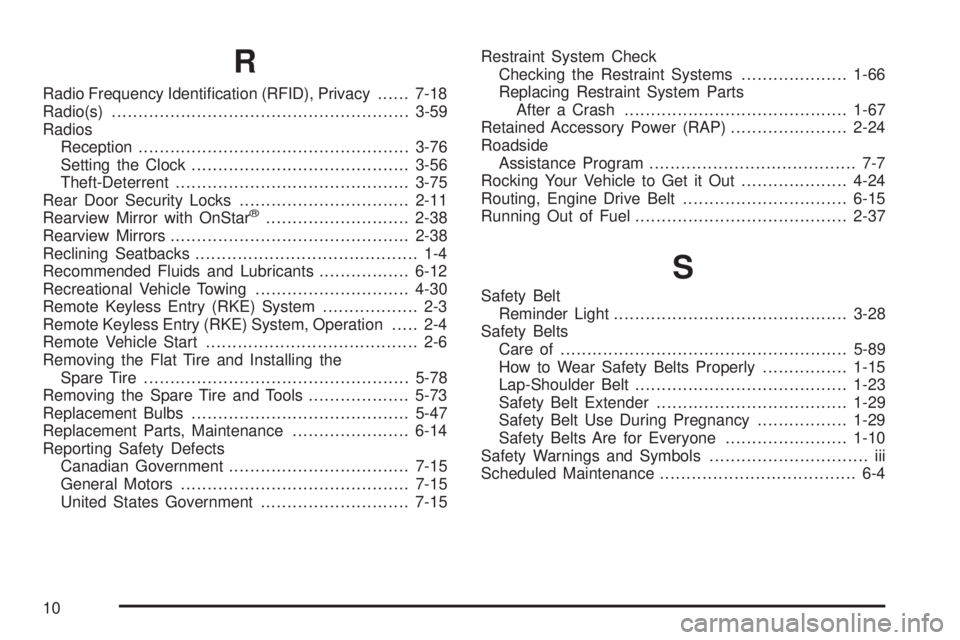
R
Radio Frequency Identication (RFID), Privacy......7-18
Radio(s)........................................................3-59
Radios
Reception...................................................3-76
Setting the Clock.........................................3-56
Theft-Deterrent............................................3-75
Rear Door Security Locks................................2-11
Rearview Mirror with OnStar
®...........................2-38
Rearview Mirrors.............................................2-38
Reclining Seatbacks.......................................... 1-4
Recommended Fluids and Lubricants.................6-12
Recreational Vehicle Towing.............................4-30
Remote Keyless Entry (RKE) System.................. 2-3
Remote Keyless Entry (RKE) System, Operation..... 2-4
Remote Vehicle Start........................................ 2-6
Removing the Flat Tire and Installing the
Spare Tire..................................................5-78
Removing the Spare Tire and Tools...................5-73
Replacement Bulbs.........................................5-47
Replacement Parts, Maintenance......................6-14
Reporting Safety Defects
Canadian Government..................................7-15
General Motors...........................................7-15
United States Government............................7-15Restraint System Check
Checking the Restraint Systems....................1-66
Replacing Restraint System Parts
After a Crash..........................................1-67
Retained Accessory Power (RAP)......................2-24
Roadside
Assistance Program....................................... 7-7
Rocking Your Vehicle to Get it Out....................4-24
Routing, Engine Drive Belt...............................6-15
Running Out of Fuel........................................2-37
S
Safety Belt
Reminder Light............................................3-28
Safety Belts
Care of......................................................5-89
How to Wear Safety Belts Properly................1-15
Lap-Shoulder Belt........................................1-23
Safety Belt Extender....................................1-29
Safety Belt Use During Pregnancy.................1-29
Safety Belts Are for Everyone.......................1-10
Safety Warnings and Symbols.............................. iii
Scheduled Maintenance..................................... 6-4
10
Page 386 of 388
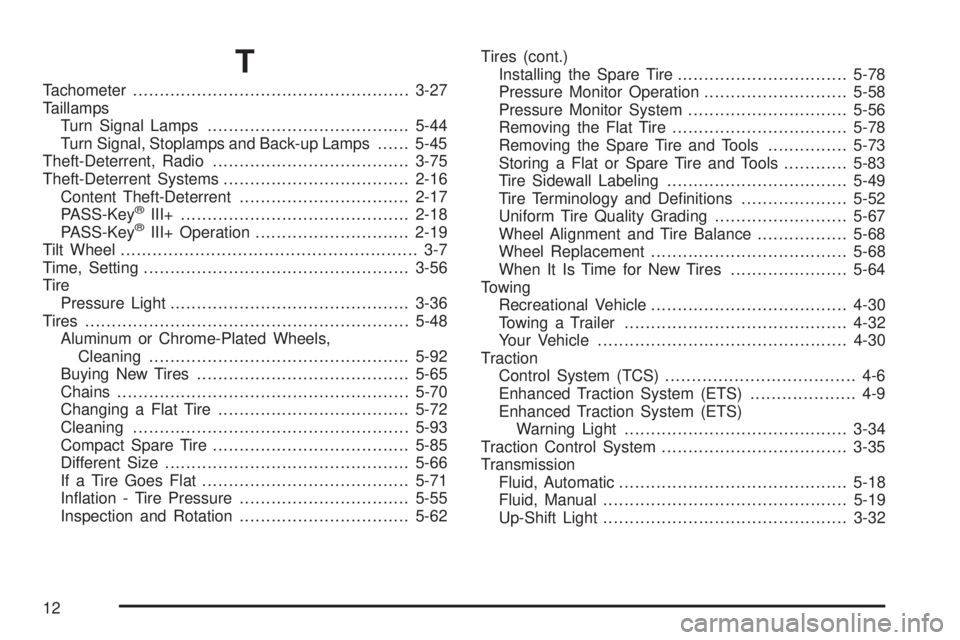
T
Tachometer....................................................3-27
Taillamps
Turn Signal Lamps......................................5-44
Turn Signal, Stoplamps and Back-up Lamps......5-45
Theft-Deterrent, Radio.....................................3-75
Theft-Deterrent Systems...................................2-16
Content Theft-Deterrent................................2-17
PASS-Key
®III+...........................................2-18
PASS-Key®III+ Operation.............................2-19
Tilt Wheel........................................................ 3-7
Time, Setting..................................................3-56
Tire
Pressure Light.............................................3-36
Tires.............................................................5-48
Aluminum or Chrome-Plated Wheels,
Cleaning.................................................5-92
Buying New Tires........................................5-65
Chains.......................................................5-70
Changing a Flat Tire....................................5-72
Cleaning....................................................5-93
Compact Spare Tire.....................................5-85
Different Size..............................................5-66
If a Tire Goes Flat.......................................5-71
Ination - Tire Pressure................................5-55
Inspection and Rotation................................5-62Tires (cont.)
Installing the Spare Tire................................5-78
Pressure Monitor Operation...........................5-58
Pressure Monitor System..............................5-56
Removing the Flat Tire.................................5-78
Removing the Spare Tire and Tools...............5-73
Storing a Flat or Spare Tire and Tools............5-83
Tire Sidewall Labeling..................................5-49
Tire Terminology and Denitions....................5-52
Uniform Tire Quality Grading.........................5-67
Wheel Alignment and Tire Balance.................5-68
Wheel Replacement.....................................5-68
When It Is Time for New Tires......................5-64
Towing
Recreational Vehicle.....................................4-30
Towing a Trailer..........................................4-32
Your Vehicle...............................................4-30
Traction
Control System (TCS).................................... 4-6
Enhanced Traction System (ETS).................... 4-9
Enhanced Traction System (ETS)
Warning Light..........................................3-34
Traction Control System...................................3-35
Transmission
Fluid, Automatic...........................................5-18
Fluid, Manual..............................................5-19
Up-Shift Light..............................................3-32
12