fuse PONTIAC G5 2009 User Guide
[x] Cancel search | Manufacturer: PONTIAC, Model Year: 2009, Model line: G5, Model: PONTIAC G5 2009Pages: 402, PDF Size: 2.22 MB
Page 253 of 402

A.Engine Air Cleaner/Filter on page 5-18.
B. Engine Oil Fill Cap. See “When to Add Engine Oil”
underEngine Oil on page 5-13.
C. Engine Oil Dipstick (Out of View). See “Checking
Engine Oil” underEngine Oil on page 5-13.
D. Brake Master Cylinder Reservoir. See “Brake Fluid”
underBrakes on page 5-30andHydraulic Clutch
on page 5-19.
E.Engine Compartment Fuse Block on page 5-105.
F. Remote Positive (+) Terminal. SeeJump Starting on
page 5-34.
G. Remote Negative (−) Terminal. SeeJump Starting
on page 5-34.
H. Engine Coolant Surge Tank. SeeCooling System on
page 5-20.
I. Windshield Washer Fluid Reservoir. See “Adding
Washer Fluid” underWindshield Washer Fluid
on page 5-29.Engine Oil
Checking Engine Oil
It is a good idea to check the engine oil every time you
get fuel. In order to get an accurate reading, the oil
must be warm and the vehicle must be on level ground.
The engine oil dipstick handle is a yellow loop.
SeeEngine Compartment Overview on page 5-12
for the location of the engine oil dipstick.
1. Turn off the engine and give the oil several minutes
to drain back into the oil pan. If you do not do this,
the oil dipstick might not show the actual level.
2. Pull the dipstick and clean it with a paper towel or
cloth, then push it back in all the way. Remove it
again, keeping the tip down and check the level.
5-13
Page 275 of 402

4. Open the hood on the other vehicle and locate the
positive (+) and negative (−) terminal locations on
that vehicle.
You will not see the battery of your vehicle under the
hood. It is located in the trunk. You will not need to
access your battery for jump starting. The vehicle has
a remote positive (+) and a remote negative (−) jump
starting terminal.
Locate the remote
positive (+) terminal which
is located under a red
tethered cap on the engine
compartment fuse block.
Lift the cap to access
the terminal.Locate the remote
negative (−) ground
terminal, marked GND (−),
which is located behind
the engine coolant
surge tank.
SeeEngine Compartment Overview on page 5-12
for more information on the location of the
positive (+) and negative (−) terminals on the
vehicle.
5-35
Page 343 of 402

Headlamp Wiring
The headlamp wiring is protected by fuses. Should the
headlamps fail to function, have the headlamp system
checked right away.
Windshield Wiper Fuses
The windshield wiper motor is protected by a circuit
breaker and a fuse. If the motor overheats due to heavy
snow, etc., the wiper will stop until the motor cools. If the
overload is caused by some electrical problem, have it
xed.
Power Windows and Other Power
Options
Fuses in the fuse block protect the power windows.
When the current load is too heavy, the fuse opens
protecting the circuit until the problem is xed.
Fuses and Circuit Breakers
The wiring circuits in the vehicle are protected from short
circuits by a combination of fuses, circuit breakers and
fusible thermal links. This greatly reduces the chance of
damage caused by electrical problems.
Look at the silver-colored band inside the fuse. If the
band is broken or melted, replace the fuse. Be sure you
replace a bad fuse with a new one of the identical size
and rating.
If you ever have a problem on the road and do not have
a spare fuse, you can “borrow” one that has the same
amperage. Just pick some feature of the vehicle that
you can get along without — like the radio or cigarette
lighter — and use its fuse if it is the correct amperage.
Replace it as soon as you can.
There are two fuse blocks in the vehicle: the oor
console fuse block and the engine compartment fuse
block.
There is one additional fuse located in the back of the
vehicle near the battery.
5-103
Page 344 of 402
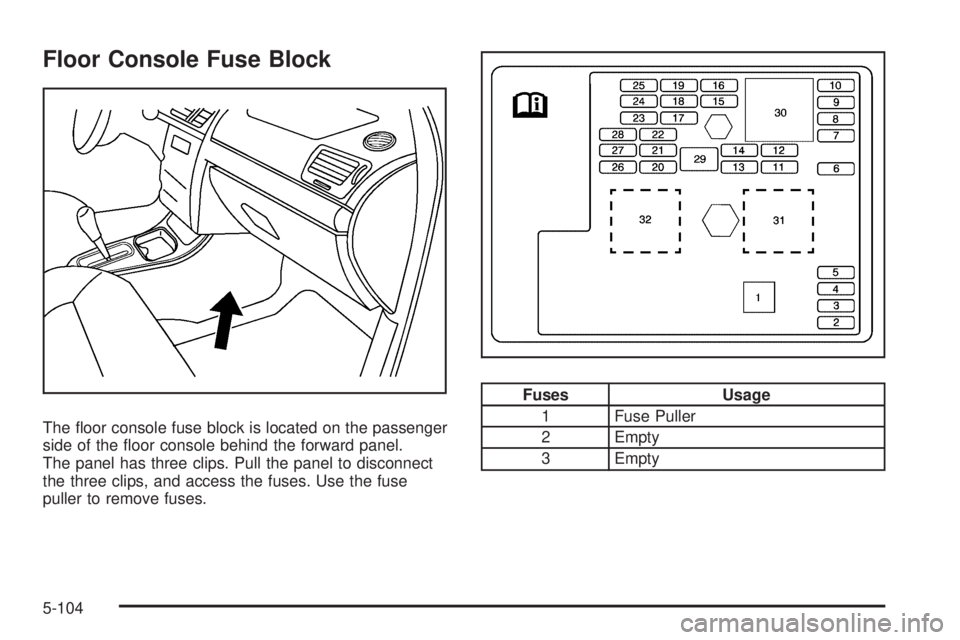
Floor Console Fuse Block
The oor console fuse block is located on the passenger
side of the oor console behind the forward panel.
The panel has three clips. Pull the panel to disconnect
the three clips, and access the fuses. Use the fuse
puller to remove fuses.
Fuses Usage
1 Fuse Puller
2 Empty
3 Empty
5-104
Page 345 of 402

Fuses Usage
4 Empty
5 Empty
6 Amplier
7 Cluster
8 Ignition Switch, PASS-Key
®III+
9 Stoplamp
10Heating, Ventilation, Air
Conditioning, PASS-Key
®III+
11 Empty
12 Spare
13 Airbag
14 Spare
15 Windshield Wiper
16 Climate Control System, Ignition
17 Window Retained Accessory Power
18 Empty
19Electric Power Steering, Steering
Wheel Control
20 Sunroof
21 Spare
22 Empty
23 Audio System
Fuses Usage
24 XM Radio™, OnStar™
25Engine Control Module,
Transmission Control Module
26 Door Locks
27 Interior Lights
28 Steering Wheel Control Illumination
29 Power Windows
Relays Usage
30 Climate Control System
31 Empty
32 Retained Accessory Power (RAP)
Engine Compartment Fuse Block
The engine compartment fuse block is located on the
driver side of the vehicle. Lift off the cover to check
the fuses. SeeEngine Compartment Overview on
page 5-12for more information on location.
Notice:Spilling liquid on any electrical components
on the vehicle may damage it. Always keep the
covers on any electrical component.
5-105
Page 346 of 402
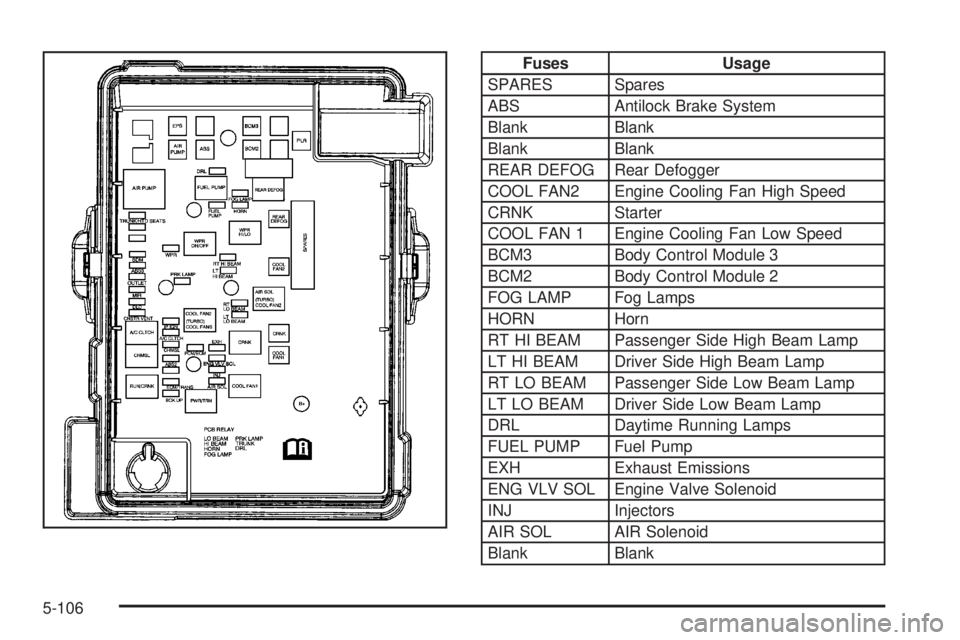
Fuses Usage
SPARES Spares
ABS Antilock Brake System
Blank Blank
Blank Blank
REAR DEFOG Rear Defogger
COOL FAN2 Engine Cooling Fan High Speed
CRNK Starter
COOL FAN 1 Engine Cooling Fan Low Speed
BCM3 Body Control Module 3
BCM2 Body Control Module 2
FOG LAMP Fog Lamps
HORN Horn
RT HI BEAM Passenger Side High Beam Lamp
LT HI BEAM Driver Side High Beam Lamp
RT LO BEAM Passenger Side Low Beam Lamp
LT LO BEAM Driver Side Low Beam Lamp
DRL Daytime Running Lamps
FUEL PUMP Fuel Pump
EXH Exhaust Emissions
ENG VLV SOL Engine Valve Solenoid
INJ Injectors
AIR SOL AIR Solenoid
Blank Blank
5-106
Page 347 of 402

Fuses Usage
PCM/ECMPowertrain Control Module/
Engine Control Module
EPS Electric Power Steering
AIR PUMP AIR Pump
PRK LAMP Parking Lamps
WPR Windshield Wiper
IP IGN Ignition
A/C CLTCH Air Conditioning Clutch
CHMSL Center High Mount Stop Lamp
ABS2 Antilock Brake System 2
Blank Blank
ECM/TRANSEngine Control Module,
Transmission
BCK UP Back-Up Lamps
TRUNK/ HTD
SEATSTrunk, Heated Seats
Blank Blank
Blank Blank
SDM Sensing Diagnostic Module (Airbags)
ABS3 Antilock Brake System 3
OUTLET Auxiliary Power Outlet
MIR Mirrors
DLC Data Link Connector
CNSTR VENT Canister VentRelays Usage
REAR DEFOG Rear Defogger
AIR SOL
(TURBO: COOL
FAN 2)AIR Solenoid (L61)/Engine Cooling
Fan 2 (LNF)
WPR HI/LO Windshield Wiper High/Low Speed
CRNK Starter
COOL FAN 2
(TURBO: COOL
FANS)Engine Cooling Fan(L61, LE5)/
Engine Cooling Fans (LNF)
FUEL PUMP Fuel Pump
WPR ON/OFF Windshield Wiper On/Off
COOL FAN 1 Engine Cooling Fan 1
PWR/TRN Powertrain
AIR PUMP AIR Pump
A/C CLTCH Air Conditioning Clutch
CHMSL Center High Mount Stop Lamp
RUN/CRNK Run, Crank
Misc. Usage
PLR Fuse Puller
5-107
Page 393 of 402

Driving (cont.)
Off-Road Recovery......................................4-13
Rocking Your Vehicle to Get it Out.................4-22
Winter........................................................4-19
Driving for Better Fuel Economy......................... 4-2
E
Easy Entry Seat............................................... 1-8
EDR .............................................................7-17
Electrical Equipment
Add-On Equipment.....................................5-102
Electrical System
Engine Compartment Fuse Block.................5-105
Floor Console Fuse Block...........................5-104
Fuses and Circuit Breakers.........................5-103
Headlamp Wiring.......................................5-103
Power Windows and Other Power Options....5-103
Windshield Wiper Fuses.............................5-103
Electronic Immobilizer
PASS-Key
®III+...........................................2-18
Electronic Immobilizer Operation
PASS-Key
®III+...........................................2-19
Electronic Stability Control................................. 4-6
Electronic Stability Control Indicator Light...........3-31
Engine
Air Cleaner/Filter.........................................5-18
Check and Service Engine Soon Lamp...........3-33
Compartment Overview................................5-12Engine (cont.)
Coolant......................................................5-24
Coolant Heater............................................2-25
Coolant Temperature Warning Light................3-32
Cooling System...........................................5-20
Drive Belt Routing.......................................6-15
Exhaust.....................................................2-34
Oil .............................................................5-13
Oil Life System...........................................5-16
Overheating................................................5-27
Starting......................................................2-24
Enhanced Traction System (ETS) Active Light.....4-10
Enhanced Traction System (ETS) Indicator/
Warning Light.............................................3-31
Entry/Exit Lighting...........................................3-15
Event Data Recorders.....................................7-18
Extender, Safety Belt.......................................1-28
F
Filter
Engine Air Cleaner......................................5-18
Finish Damage.............................................5-101
Fixed Mast Antenna........................................3-87
Flashers, Hazard Warning.................................. 3-6
Flash-to-Pass................................................... 3-8
Flat Tire........................................................5-71
Flat Tire, Changing.........................................5-80
5
Page 394 of 402

Flat Tire, Storing.............................................5-90
Fluid
Automatic Transmission................................5-19
Windshield Washer......................................5-29
Fog Lamp
Fog ...........................................................3-14
Fog Lamp Light..............................................3-37
Folding Rear Seat............................................ 1-9
Fuel............................................................... 5-5
Additives...................................................... 5-6
California Fuel.............................................. 5-6
Economy Driving........................................... 4-2
Filling a Portable Fuel Container....................5-10
Filling the Tank............................................. 5-8
Fuels in Foreign Countries.............................. 5-7
Gage .........................................................3-38
Gasoline Octane........................................... 5-5
Gasoline Specications.................................. 5-5
Fuses
Engine Compartment Fuse Block.................5-105
Floor Console Fuse Block...........................5-104
Fuses and Circuit Breakers.........................5-103
Windshield Wiper.......................................5-103G
Gage
Speedometer..............................................3-24
Tachometer.................................................3-24
Gages
Fuel..........................................................3-38
Gasoline
Octane........................................................ 5-5
Specications............................................... 5-5
Glove Box.....................................................2-41
GM Mobility Reimbursement Program.................. 7-7
H
Halogen Bulbs................................................5-41
Hazard Warning Flashers................................... 3-6
Head Restraints............................................... 1-7
Headlamp
Aiming .......................................................5-38
Headlamp Wiring...........................................5-103
6
Page 402 of 402

V
Vehicle
Control........................................................ 4-3
Loading......................................................4-22
Parking Your...............................................2-33
Running While Parked..................................2-35
Symbols......................................................... iii
Vehicle Data Recording and Privacy..................7-17
Vehicle Data Recording, Radio
Frequency (RFID)........................................7-19
Vehicle Identication
Number (VIN)............................................5-102
Service Parts Identication Label..................5-102
Vehicle Personalization
DIC ...........................................................3-47
Vehicle, Remote Start....................................... 2-6
Ventilation Adjustment......................................3-20
Visors...........................................................2-16
W
Warning Lights, Gages, and Indicators...............3-22
Warnings
DIC Warnings and Messages........................3-42
Hazard Warning Flashers............................... 3-6
Safety and Symbols......................................... iiiWheels
Alignment and Tire Balance..........................5-68
Different Size..............................................5-67
Replacement...............................................5-69
When It Is Time for New Tires..........................5-64
Where to Put the Child Restraint.......................1-38
Windows.......................................................2-14
Manual......................................................2-15
Power ........................................................2-15
Windshield
Washer........................................................ 3-9
Washer Fluid..............................................5-29
Wiper Blade Replacement.............................5-47
Wiper Blades, Cleaning................................5-99
Wiper Fuses.............................................5-103
Wipers......................................................... 3-8
Winter Driving................................................4-19
Wiper Activated Headlamps..............................3-13
X
XM Radio Messages.......................................3-73
XM™ Satellite Radio Antenna System................3-87
Y
Your Vehicle and the Environment....................... 6-2
14