lock PONTIAC G5 2010 Owners Manual
[x] Cancel search | Manufacturer: PONTIAC, Model Year: 2010, Model line: G5, Model: PONTIAC G5 2010Pages: 422, PDF Size: 2.22 MB
Page 367 of 422
Fuses and Circuit Breakers
The wiring circuits in the vehicle are protected from
short circuits by a combination of fuses, circuit breakers
and fusible thermal links. This greatly reduces the
chance of damage caused by electrical problems.
Look at the silver-colored band inside the fuse. If the
band is broken or melted, replace the fuse. Be sure you
replace a bad fuse with a new one of the identical
size and rating.
If you ever have a problem on the road and do not have
a spare fuse, you can “borrow” one that has the same
amperage. Just pick some feature of the vehicle that you
can get along without — like the radio or cigarette
lighter — and use its fuse if it is the correct amperage.
Replace it as soon as you can.
There are two fuse blocks in the vehicle: the floor
console fuse block and the engine compartment fuse
block.
There is one additional fuse located in the back of the
vehicle near the battery.
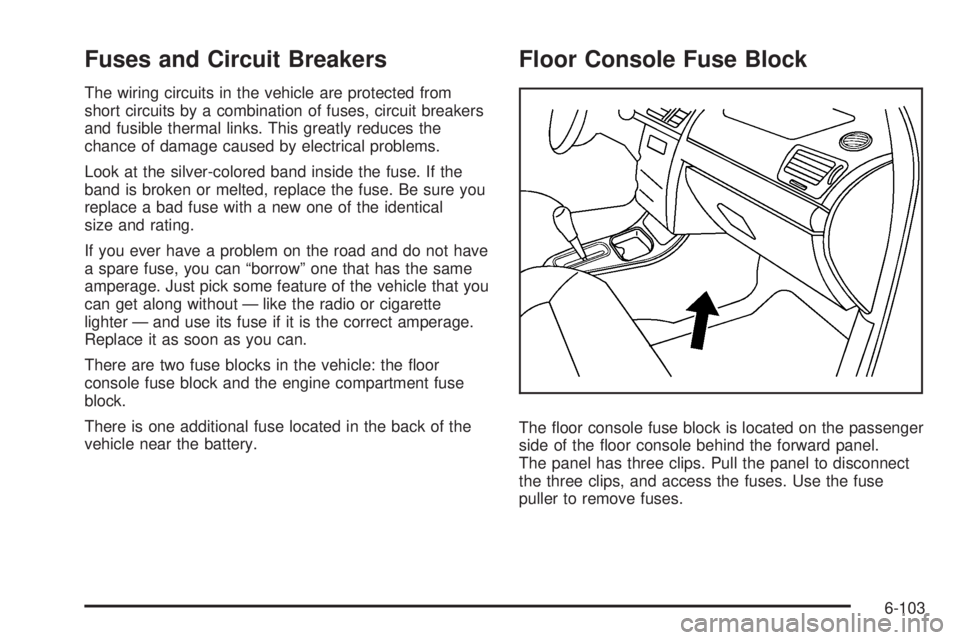
Floor Console Fuse Block
The floor console fuse block is located on the passenger
side of the floor console behind the forward panel.
The panel has three clips. Pull the panel to disconnect
the three clips, and access the fuses. Use the fuse
puller to remove fuses.
6-103
Page 369 of 422

FusesUsage
18 Empty
19 Electric Power Steering, Steering
Wheel Control
20 Sunroof
21 Spare
22 Empty
23 Audio System
24 XM Radio™, OnStar™
25 Engine Control Module,
Transmission Control Module
26 Door Locks
27 Interior Lights
28 Steering Wheel Control Illumination
29 Power WindowsRelays Usage
30 Climate Control System
31 Empty
32 Retained Accessory Power (RAP)
Engine Compartment Fuse Block
The engine compartment fuse block is located on the
driver side of the vehicle. Lift off the cover to check the
fuses. See Engine Compartment Overview on
page 6-12 for more information on location.
Notice: Spilling liquid on any electrical components
on the vehicle may damage it. Always keep the
covers on any electrical component.
6-105
Page 370 of 422
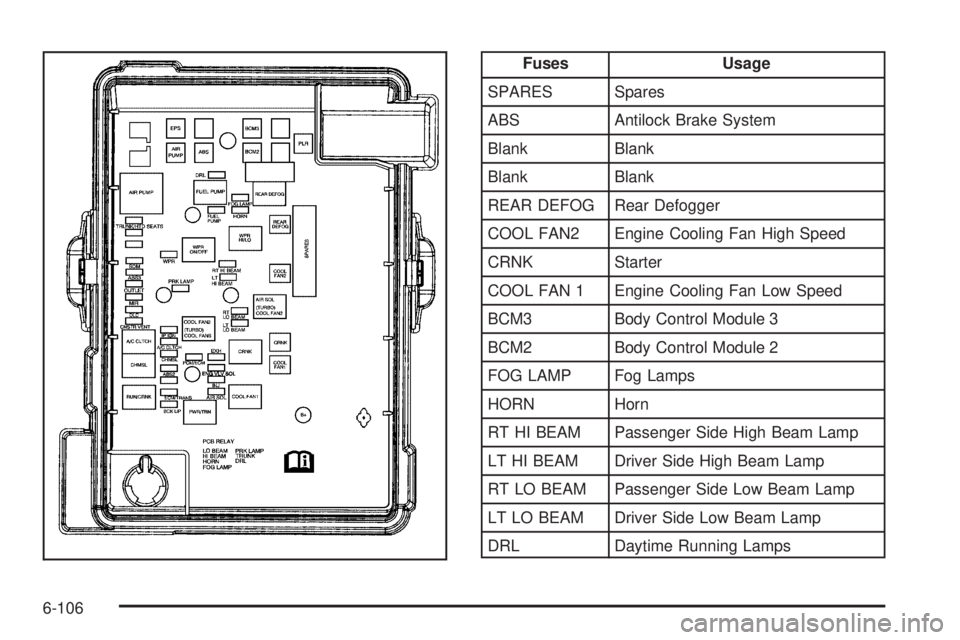
FusesUsage
SPARES Spares
ABS Antilock Brake System
Blank Blank
Blank Blank
REAR DEFOG Rear Defogger
COOL FAN2 Engine Cooling Fan High Speed
CRNK Starter
COOL FAN 1 Engine Cooling Fan Low Speed
BCM3 Body Control Module 3
BCM2 Body Control Module 2
FOG LAMP Fog Lamps
HORN Horn
RT HI BEAM Passenger Side High Beam Lamp
LT HI BEAM Driver Side High Beam Lamp
RT LO BEAM Passenger Side Low Beam Lamp
LT LO BEAM Driver Side Low Beam Lamp
DRL Daytime Running Lamps
6-106
Page 371 of 422
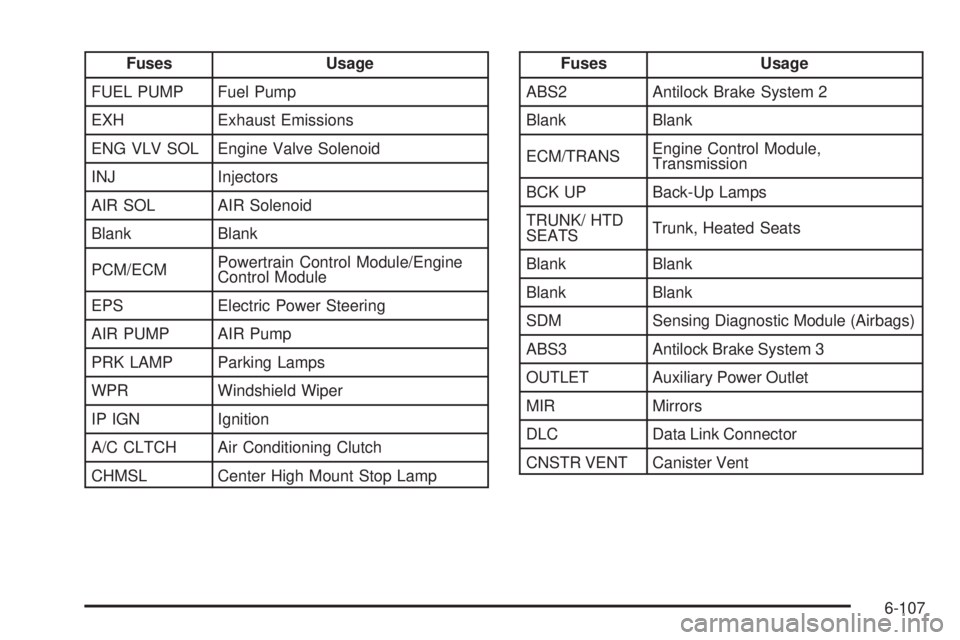
FusesUsage
FUEL PUMP Fuel Pump
EXH Exhaust Emissions
ENG VLV SOL Engine Valve Solenoid
INJ Injectors
AIR SOL AIR Solenoid
Blank Blank
PCM/ECM Powertrain Control Module/Engine
Control Module
EPS Electric Power Steering
AIR PUMP AIR Pump
PRK LAMP Parking Lamps
WPR Windshield Wiper
IP IGN Ignition
A/C CLTCH Air Conditioning Clutch
CHMSL Center High Mount Stop LampFuses Usage
ABS2 Antilock Brake System 2
Blank Blank
ECM/TRANS Engine Control Module,
Transmission
BCK UP Back-Up Lamps
TRUNK/ HTD
SEATS Trunk, Heated Seats
Blank Blank
Blank Blank
SDM Sensing Diagnostic Module (Airbags)
ABS3 Antilock Brake System 3
OUTLET Auxiliary Power Outlet
MIR Mirrors
DLC Data Link Connector
CNSTR VENT Canister Vent
6-107
Page 378 of 422

•Fluids visual leak check (or every 12 months,
whichever occurs first). A leak in any system must
be repaired and the fluid level checked.
•Engine air cleaner filter inspection (vehicles driven
in dusty conditions only). SeeEngine Air Cleaner/
Filter on page 6-18.
•Brake system inspection (or every 12 months,
whichever occurs first).
Maintenance II
•Perform all services described in Maintenance I.
•Steering and suspension inspection. Visual
inspection for damaged, loose, or missing parts or
signs of wear.
•Engine cooling system inspection. Visual inspection
of hoses, pipes, fittings, and clamps and
replacement, if needed.
•Windshield wiper blade inspection for wear, cracking,
or contamination and windshield and wiper blade
cleaning, if contaminated. SeeWindshield and Wiper
Blades on page 6-98. Worn or damaged wiper blade
replacement. See Windshield Wiper Blade
Replacement on page 6-47 .
•Body hinges and latches, key lock cylinders, and
trunk lid hinges and latches lubrication. See
Recommended Fluids and Lubricants on page 7-10 .
More frequent lubrication may be required when
vehicle is exposed to a corrosive environment.
Applying silicone grease on weatherstrips with a
clean cloth makes them last longer, seal better, and
not stick or squeak.
•Restraint system component check. See Checking
the Restraint Systems on page 2-71 .
•Automatic transmission fluid level check and adding
fluid, if needed. SeeAutomatic Transmission Fluid
on page 6-19.
•Engine air cleaner filter inspection. See Engine Air
Cleaner/Filter on page 6-18 .
•Passenger compartment air filter replacement (or
every 12 months, whichever occurs first). More
frequent replacement may be required if vehicle is
driven regularly under dusty conditions.
7-4
Page 379 of 422

Additional Required Services
At Each Fuel Stop•
Engine oil level check. See Engine Oil on page 6-13.
•Engine coolant level check. See Engine Coolant on
page 6-24.
•Windshield washer fluid level check. See Windshield
Washer Fluid on page 6-28 .
Once a Month
•
Tire inflation check. See Ination - Tire Pressure on
page 6-55.
•Tire wear inspection. See Tire Inspection and
Rotation on page 6-62 .
Once a Year
•
Starter switch check. See Owner Checks and
Services on page 7-8 .
•Parking brake and automatic transmission P (Park)
mechanism check. See Owner Checks and
Services on page 7-8 .
•Automatic transmission shiftlock control system
check. SeeOwner Checks and Services on
page 7-8.
•Ignition transmission lock check. See Owner
Checks and Services on page 7-8 .
•Engine cooling system and pressure cap pressure
check. Radiator and air conditioning condenser
outside cleaning. SeeCooling System on
page 6-20.
•Exhaust system and nearby heat shields inspection
for loose or damaged components.
•Throttle system inspection for interference, binding
or for damaged or missing parts. Replace parts as
needed. Replace any components that have
high effort or excessive wear. Do not lubricate
accelerator or cruise control cables.
•If the vehicle has a Tire Sealant and Compressor
Kit, check the sealant expiration date printed on
the instruction label of the kit. See Tire Sealant and
Compressor Kit on page 6-72 .
First Engine Oil Change After Every
40 000 km/25,000 Miles
•
Fuel system inspection for damage or leaks.
7-5
Page 382 of 422

Owner Checks and Services
Starter Switch Check
{WARNING:
When you are doing this inspection, the vehicle
could move suddenly. If the vehicle moves, you or
others could be injured.
1. Before starting this check, be sure there is enough room around the vehicle.
2. Firmly apply both the parking brake and the regular brake. See Parking Brake on page 3-29 .
Do not use the accelerator pedal, and be ready to
turn off the engine immediately if it starts.
3. For automatic transmission vehicles, try to start the engine in each gear. The starter should work only
in P (Park) or N (Neutral). If the starter works in any
other position, your vehicle needs service.
For manual transmission vehicles, put the shift lever
in Neutral, push the clutch pedal down halfway, and
try to start the engine. The starter should work only
when the clutch pedal is pushed down all the way to
the floor. If the starter works when the clutch pedal is
not pushed all the way down, your vehicle needs
service.
Automatic Transmission Shift Lock
Control System Check
{WARNING:
When you are doing this inspection, the vehicle
could move suddenly. If the vehicle moves, you or
others could be injured.
1. Before starting this check, be sure there is enough room around the vehicle. It should be parked on a
level surface.
2. Firmly apply the parking brake. See Parking Brake
on page 3-29.
Be ready to apply the regular brake immediately if
the vehicle begins to move.
3. With the engine off, turn the ignition to ON/RUN, but do not start the engine. Without applying the
regular brake, try to move the shift lever out
of P (Park) with normal effort. If the shift lever
moves out of P (Park), contact your dealer/retailer
for service.
7-8
Page 383 of 422

Ignition Transmission Lock Check
While parked, and with the parking brake set, try to turn
the ignition to LOCK/OFF in each shift lever position.
•For automatic transmission vehicles, the ignition
should turn to LOCK/OFF only when the shift
lever is in P (Park). The ignition key should come
out only in LOCK/OFF.
•For manual transmission vehicles, the ignition key
should come out only in LOCK/OFF.
Turn the steering wheel to the left and to the right. It
should only lock when turned to the right.
Contact your dealer/retailer if service is required.
Parking Brake and Automatic
Transmission P (Park) Mechanism
Check
{WARNING:
When you are doing this check, the vehicle could
begin to move. You or others could be injured and
property could be damaged. Make sure there is
room in front of the vehicle in case it begins to roll.
Be ready to apply the regular brake at once should
the vehicle begin to move.
Park on a fairly steep hill, with the vehicle facing
downhill. Keeping your foot on the regular brake, set the
parking brake.
•To check the parking brake’s holding ability: With the
engine running and the transmission in N (Neutral),
slowly remove foot pressure from the regular brake
pedal. Do this until the vehicle is held by the parking
brake only.
•To check the P (Park) mechanism’s holding ability:
With the engine running, shift to P (Park). Then
release the parking brake followed by the regular
brake.
Contact your dealer/retailer if service is required.
7-9
Page 385 of 422

UsageFluid/Lubricant
Key Lock Cylinders Multi-Purpose Lubricant, Superlube
(GM Part No. U.S. 12346241, in
Canada 10953474).
Manual
Transmission Shift Linkage Chassis Lubricant
(GM Part No. U.S. 12377985, in
Canada 88901242) or lubricant
meeting requirements of NLGI #2,
Category LB or GC-LB.
Chassis
Lubrication Chassis Lubricant
(GM Part No. U.S. 12377985, in
Canada 88901242) or lubricant
meeting requirements of NLGI #2,
Category LB or GC-LB.Usage
Fluid/Lubricant
Hood Latch Assembly,
Secondary Latch,
Pivots, Spring Anchor, and
Release Pawl Lubriplate Lubricant Aerosol
(GM Part No. U.S. 12346293, in
Canada 992723) or lubricant
meeting requirements of NLGI #2,
Category LB or GC-LB.
Hood and Door Hinges Multi-Purpose Lubricant, Superlube
(GM Part No. U.S. 12346241, in
Canada 10953474).
Weatherstrip Conditioning Weatherstrip Lubricant
(GM Part No. U.S. 3634770, in
Canada 10953518) or
Dielectric Silicone Grease
(GM Part No. U.S. 12345579, in
Canada 992887).
7-11
Page 398 of 422

Coverage
Services are provided up to 5 years/100,000 miles
(160 000 km), whichever comes first.
In the U.S., anyone driving the vehicle is covered. In
Canada, a person driving the vehicle without permission
from the owner is not covered.
Roadside Assistance is not a part of the New Vehicle
Limited Warranty. Pontiac and General Motors of
Canada Limited reserve the right to make any changes
or discontinue the Roadside Assistance program at
any time without notification.
Pontiac and General Motors of Canada Limited reserve
the right to limit services or payment to an owner or
driver if they decide the claims are made too often, or
the same type of claim is made many times.
Services Provided
•Emergency Fuel Delivery:Delivery of enough fuel
for the vehicle to get to the nearest service station.
•Lock-Out Service: Service is provided to unlock the
vehicle if you are locked out. A remote unlock may
be available if you have OnStar
®. For security
reasons, the driver must present identification
before this service is given.
•Emergency Tow From a Public Road or Highway:
Tow to the nearest Pontiac dealer for warranty
service, or if the vehicle was in a crash and cannot
be driven. Assistance is also given when the vehicle
is stuck in sand, mud, or snow.
•Flat Tire Change: Service is provided to change a
flat tire with the spare tire. The spare tire, if equipped,
must be in good condition and properly inflated.
It is the owner’s responsibility for the repair or
replacement of the tire if it is not covered by the
warranty.
•Battery Jump Start: Service is provided to jump
start a dead battery.
•Trip Interruption Benets and Assistance: If your
trip is interrupted due to a warranty failure, incidental
expenses may be reimbursed during the 5 years/
100,000 miles (160 000 km) Powertrain warranty
period. Items considered are hotel, meals, and
rental car.
8-8