towing PONTIAC G5 2010 Owner's Manual
[x] Cancel search | Manufacturer: PONTIAC, Model Year: 2010, Model line: G5, Model: PONTIAC G5 2010Pages: 422, PDF Size: 2.22 MB
Page 259 of 422
Weight of the Trailer Tongue
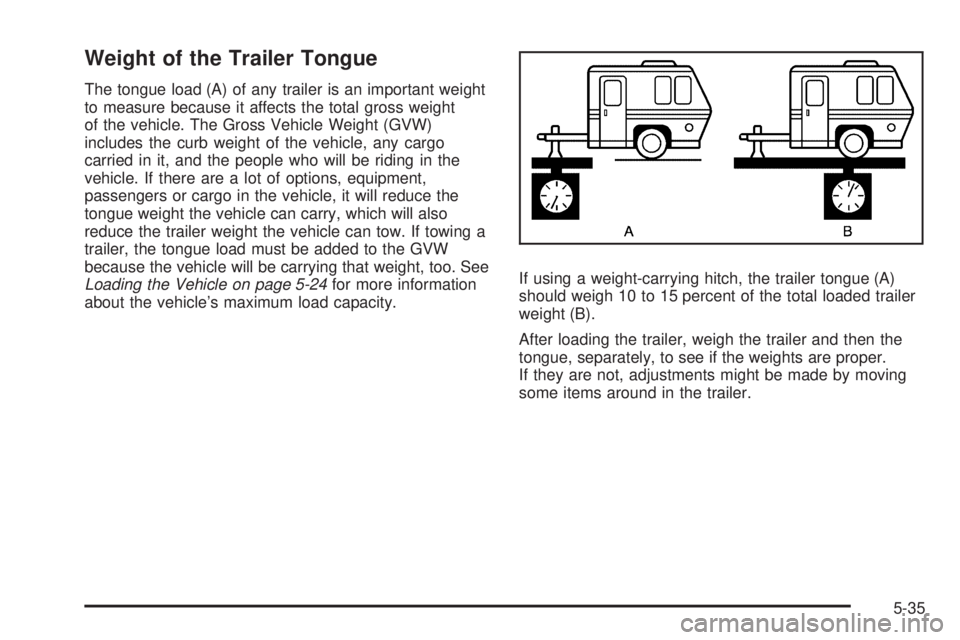
The tongue load (A) of any trailer is an important weight
to measure because it affects the total gross weight
of the vehicle. The Gross Vehicle Weight (GVW)
includes the curb weight of the vehicle, any cargo
carried in it, and the people who will be riding in the
vehicle. If there are a lot of options, equipment,
passengers or cargo in the vehicle, it will reduce the
tongue weight the vehicle can carry, which will also
reduce the trailer weight the vehicle can tow. If towing a
trailer, the tongue load must be added to the GVW
because the vehicle will be carrying that weight, too. See
Loading the Vehicle on page 5-24for more information
about the vehicle’s maximum load capacity. If using a weight-carrying hitch, the trailer tongue (A)
should weigh 10 to 15 percent of the total loaded trailer
weight (B).
After loading the trailer, weigh the trailer and then the
tongue, separately, to see if the weights are proper.
If they are not, adjustments might be made by moving
some items around in the trailer.
5-35
Page 261 of 422
Driving with a Trailer
Towing a trailer requires a certain amount of experience.
Get to know the rig before setting out for the open
road. Get acquainted with the feel of handling and
braking with the added weight of the trailer. And always
keep in mind that the vehicle you are driving is now
longer and not as responsive as the vehicle is by itself.
Before starting, check all trailer hitch parts and
attachments, safety chains, electrical connectors, lamps,
tires and mirror adjustments. If the trailer has electric
brakes, start the vehicle and trailer moving and
then apply the trailer brake controller by hand to be sure
the brakes are working. This checks the electrical
connection at the same time.
During the trip, check occasionally to be sure that the
load is secure, and that the lamps and any trailer brakes
are still working.
Following Distance
Stay at least twice as far behind the vehicle ahead as
you would when driving the vehicle without a trailer. This
can help to avoid situations that require heavy braking
and sudden turns.
Passing
More passing distance is needed when towing a trailer.
Because the rig is longer, it is necessary to go much
farther beyond the passed vehicle before returning to
the lane.
Backing Up
Hold the bottom of the steering wheel with one hand.
Then, to move the trailer to the left, move that hand
to the left. To move the trailer to the right, move your
hand to the right. Always back up slowly and, if possible,
have someone guide you.
Making Turns
Notice:Making very sharp turns while trailering
could cause the trailer to come in contact with the
vehicle. The vehicle could be damaged. Avoid
making very sharp turns while trailering.
When turning with a trailer, make wider turns than
normal. Do this so the trailer will not strike soft shoulders,
curbs, road signs, trees or other objects. Avoid jerky or
sudden maneuvers. Signal well in advance.
5-37
Page 262 of 422

Turn Signals When Towing a Trailer
The arrows on the instrument panel flash whenever
signaling a turn or lane change. Properly hooked up, the
trailer lamps also flash, telling other drivers the vehicle
is turning, changing lanes or stopping.
When towing a trailer, the arrows on the instrument
panel flash for turns even if the bulbs on the trailer are
burned out. For this reason you may think other
drivers are seeing the signal when they are not. It is
important to check occasionally to be sure the
trailer bulbs are still working.
Driving on Grades
Notice:Do not tow on steep continuous grades
exceeding 6 miles (9.6 km). Extended, higher
than normal engine and transmission temperatures
may result and damage the vehicle. Frequent
stops are very important to allow the engine and
transmission to cool.
Reduce speed and shift to a lower gear beforestarting
down a long or steep downgrade. If the transmission is
not shifted down, the brakes might have to be used so
much that they would get hot and no longer work well.
On a long uphill grade, shift down and reduce the
vehicle’s speed to around 45 mph (70 km/h) to reduce
the possibility of the engine and the transmission
overheating. Vehicles can tow in D (Drive). Shift the transmission to
a lower gear if the transmission shifts too often under
heavy loads and/or hilly conditions.
Pay attention to the engine coolant gage. If the indicator
is in the red area, turn off the air conditioning to reduce
engine load. See
Engine Overheating on page 6-27 .
When towing under severe conditions such as hot
ambient temperatures or steep grades, the vehicle may
experience more transmission shifting. A COOLING
MODE ON message may also appear in the DIC. This
alerts the driver that the shifting mode is in progress
and is aiding engine cooling. See DIC Warnings
and Messages on page 4-38 DIC Warnings and
Messages for more information.Parking on Hills
{WARNING:
Parking the vehicle on a hill with the trailer
attached can be dangerous. If something goes
wrong, the rig could start to move. People can be
injured, and both the vehicle and the trailer can be
damaged. When possible, always park the rig on a
flat surface.
5-38
Page 263 of 422

If parking the rig on a hill:1. Press the brake pedal, but do not shift into P (Park) yet for an automatic transmission, or into gear for a
manual transmission. Turn the wheels into the
curb if facing downhill or into traffic if facing uphill.
2. Have someone place chocks under the trailer wheels.
3. When the wheel chocks are in place, release the regular brakes until the chocks absorb the load.
4. Reapply the regular brakes. Then apply the parking brake, and then shift into P (Park) for an automatic
transmission or R (Reverse) for a manual
transmission.
5. Release the brake pedal.
Leaving After Parking on a Hill
1. Apply the regular brakes and hold the pedal down while you:
•Start the engine.
•Shift into a gear.
•Release the parking brake.
2. Let up on the brake pedal.
3. Drive slowly until the trailer is clear of the chocks.
4. Stop and have someone pick up and store the chocks.
Maintenance When Trailer Towing
The vehicle needs service more often when pulling a
trailer. See Scheduled Maintenance on page 7-3
for more on this. Things that are especially important in
trailer operation are automatic transmission fluid (do
not overfill), engine oil, drive belt, cooling system
and brake system.
Each of these is covered in this manual, and the Index
will help to find them quickly. When trailering, it is a good
idea to review this information before starting the trip.
Check periodically to see that all hitch nuts and bolts are
tight.
Engine Cooling When Trailer Towing
The cooling system may temporarily overheat during
severe operating conditions. See Engine Overheating on
page 6-27.
Towing a Trailer (Manual
Transmission)
Do not tow a trailer if the vehicle is equipped with a
manual transmission.
5-39
Page 380 of 422

First Engine Oil Change After Every
80 000 km/50,000 Miles•
Engine air cleaner filter replacement. See Engine
Air Cleaner/Filter on page 6-18 .
•Automatic transmission fluid change (severe service
only) for vehicles mainly driven in heavy city traffic
in hot weather, in hilly or mountainous terrain,
when frequently towing a trailer, or used for taxi,
police, or delivery service. See Automatic
Transmission Fluid on page 6-19 .
First Engine Oil Change After Every
160 000 km/100,000 Miles
•
Spark plug replacement. An Emission Control
Service.
First Engine Oil Change After Every
240 000 km/150,000 Miles
•
Engine cooling system drain, flush, and refill,
cooling system and cap pressure check, and
cleaning of outside of radiator and air conditioning
condenser (or every 5 years, whichever occurs
first). See Engine Coolant on page 6-24 .An
Emission Control Service.
•Engine accessory drive belt inspection for fraying,
excessive cracks, or obvious damage and
replacement, if needed. An Emission Control
Service.
7-6
Page 399 of 422

Services Not Included in Roadside
Assistance
•Impound towing caused by violation of any laws.
•Legal fines.
•Mounting, dismounting or changing of snow tires,
chains, or other traction devices.
•Towing or services for vehicles driven on a
non-public road or highway.
Services Specic to Canadian
Purchased Vehicles
•Fuel delivery:Reimbursement is approximately
$5 Canadian. Diesel fuel delivery may be
restricted. Propane and other fuels are not provided
through this service.
•Lock-Out Service: Vehicle registration is required.
•Trip Routing Service: Detailed maps of North
America are provided when requested either with the
most direct route or the most scenic route. There is a
limit of six requests per year. Additional travel
information is also available. Allow three weeks for
delivery.
•Trip Interruption Benets and Assistance: Must
be over 250 kilometres from where your trip was
started to qualify. General Motors of Canada Limited
requires pre-authorization, original detailed receipts,
and a copy of the repair orders. Once authorization
has been received, the Roadside Assistance advisor
will help you make arrangements and explain how to
receive payment.
•Alternative Service: If assistance cannot be
provided right away, the Roadside Assistance
advisor may give you permission to get local
emergency road service. You will receive payment,
up to $100, after sending the original receipt to
Roadside Assistance. Mechanical failures may be
covered, however any cost for parts and labor for
repairs not covered by the warranty are the owner
responsibility.
8-9
Page 403 of 422
If a Crash Occurs
Here is what to do if you are involved in a crash.
•Check to make sure that you are all right. If you are
uninjured, make sure that no one else in your
vehicle, or the other vehicle, is injured.
•If there has been an injury, call emergency services
for help. Do not leave the scene of a crash until all
matters have been taken care of. Move your vehicle
only if its position puts you in danger or you are
instructed to move it by a police officer.
•Give only the necessary and requested information
to police and other parties involved in the crash. Do
not discuss your personal condition, mental frame of
mind, or anything unrelated to the crash. This will
help guard against post-crash legal action.
•If you need roadside assistance, call GM Roadside
Assistance. SeeRoadside Assistance Program on
page 8-7 for more information.
•If your vehicle cannot be driven, know where the
towing service will be taking it. Get a card from the
tow truck operator or write down the driver’s name,
the service’s name, and the phone number.
•Remove any valuables from your vehicle before it is
towed away. Make sure this includes your insurance
information and registration if you keep these items
in your vehicle.
•Gather the important information you will need from
the other driver. Things like name, address, phone
number, driver’s license number, vehicle license
plate, vehicle make, model and model year, Vehicle
Identification Number (VIN), insurance company and
policy number, and a general description of the
damage to the other vehicle.
•If possible, call your insurance company from the
scene of the crash. They will walk you through the
information they will need. If they ask for a police
report, phone or go to the police department
headquarters the next day and you can get a copy of
the report for a nominal fee. In some states/provinces
with “no fault” insurance laws, a report may not be
necessary. This is especially true if there are no
injuries and both vehicles are driveable.
•Choose a reputable collision repair facility for your
vehicle. Whether you select a dealer/retailer or a
private collision repair facility to fix the damage,
make sure you are comfortable with them.
Remember, you will have to feel comfortable with
their work for a long time.
•Once you have an estimate, read it carefully and
make sure you understand what work will be
performed on your vehicle. If you have a question,
ask for an explanation. Reputable shops welcome
this opportunity.
8-13
Page 418 of 422

ProgramCourtesy Transportation ................................8-10
Programmable Automatic Door Unlock ...............3-10
Proposition 65 Warning, California ....................... 6-4
R
Radio Frequency
Identification (RFID) ..................................... 8-18
Statement ................................................... 8-18
Radio(s) ........................................................ 4-51
Radios Reception ................................................... 4-83
Setting the Clock ......................................... 4-50
Theft-Deterrent ............................................ 4-81
Range Adjustment, Headlamps ........................... 2-7
Rear Door Security Locks ................................3-10
Rearview Mirrors ............................................. 3-35
Reclining Seatbacks .......................................... 2-4
Recommended Fluids and Lubricants .................7-10
Recreational Vehicle Towing .............................5-30
Reimbursement Program, GM Mobility ................. 8-7
Remote Keyless Entry (RKE) System .................. 3-3Remote Vehicle Start
........................................ 3-6
Removing the Flat Tire and Installing the Spare Tire .................................................. 6-86
Removing the Spare Tire and Tools ...................6-81
Replacement Bulbs ......................................... 6-47
Replacement Parts Maintenance ............................................... 7-12
Reporting Safety Defects Canadian Government .................................. 8-15
General Motors ........................................... 8-15
U.S. Government ......................................... 8-14
Restraint System Check Checking the Restraint Systems ....................2-71
Replacing Restraint System Parts After a Crash ..................................................... 2-72
Retained Accessory Power (RAP) ......................3-22
Ride Control Systems ....................................... 5-6
Electronic Stability (ESC) ................................ 5-6
Roadside Assistance Program ............................ 8-7
Rocking Your Vehicle to Get it Out ....................5-24
Roof Sunroof ...................................................... 3-37
Running the Vehicle While Parked .....................3-34
10
Page 421 of 422
Tires (cont.)Storing a Flat or Spare Tire and Tools ............6-90
Terminology and Definitions ...........................6-52
Uniform Tire Quality Grading .........................6-67
Wheel Alignment and Tire Balance .................6-68
Wheel Replacement ..................................... 6-68
When It Is Time for New Tires ......................6-64
Towing Recreational Vehicle ..................................... 5-30
Towing a Trailer .................................. 5-33, 5-39
Your Vehicle ............................................... 5-30
Traction Control System (TCS) .................................... 5-8
Traction System Enhanced ................................................... 4-27
Transmission Fluid, Automatic ........................................... 6-19
Transmission Operation, Automatic ....................3-24
Transmission Operation, Manual ........................3-27
Transportation Program, Courtesy ......................8-10
Trunk ............................................................ 3-11
Turn and Lane-Change Signals .......................... 4-4
Turn Signal/Multifunction Lever ........................... 4-4U
Uniform Tire Quality Grading............................6-67
Up-Shift Light ................................................. 4-25
V
Vehicle
Control ........................................................ 5-3
Loading ...................................................... 5-24
Parking Your ............................................... 3-32
Remote Start ................................................ 3-6
Running While Parked .................................. 3-34
Symbols ......................................................... iv
Vehicle Data Recording and Privacy ..................8-16
Vehicle Identification Number (VIN) ............................................ 6-101
Service Parts Identification Label ..................6-101
Vehicle Personalization DIC ........................................................... 4-43
Ventilation Adjustment ...................................... 4-17
Visors ........................................................... 3-15
13