ECU PONTIAC G5 2010 Service Manual
[x] Cancel search | Manufacturer: PONTIAC, Model Year: 2010, Model line: G5, Model: PONTIAC G5 2010Pages: 422, PDF Size: 2.22 MB
Page 257 of 422

5. Clamp the steering wheel in a straight-aheadposition with a clamping device designed for towing.
6. Remove the key from the ignition.
7. Secure the vehicle to the dolly.
8. Release the parking brake only after the vehicle being towed is firmly attached to the towing vehicle.
Towing a Trailer (Automatic
Transmission)
{WARNING:
The driver can lose control when pulling a trailer if
the correct equipment is not used or the vehicle is
not driven properly. For example, if the trailer is
too heavy, the brakes may not work well or even
at all. The driver and passengers could be
seriously injured. The vehicle may also be
damaged; the resulting repairs would not be
covered by the vehicle warranty. Pull a trailer only
if all the steps in this section have been followed.
Ask your dealer/retailer for advice and information
about towing a trailer with the vehicle. The vehicle can tow a trailer if it is equipped with the
proper trailer towing equipment.
To identify the trailering capacity of the vehicle, read the
information in “Weight of the Trailer” that appears
later in this section.
Trailering is different than just driving the vehicle by
itself. Trailering means changes in handling,
acceleration, braking, durability and fuel economy.
Successful, safe trailering takes correct equipment, and
it has to be used properly.
The following information has many time-tested,
important trailering tips and safety rules. Many of these
are important for your safety and that of your
passengers. So please read this section carefully before
pulling a trailer.
Load-pulling components such as the engine,
transmission, rear axle, wheel assemblies and tires are
forced to work harder against the drag of the added
weight. The engine is required to operate at relatively
higher speeds and under greater loads, generating extra
heat. The trailer also adds considerably to wind
resistance, increasing the pulling requirements.
5-33
Page 261 of 422
Driving with a Trailer
Towing a trailer requires a certain amount of experience.
Get to know the rig before setting out for the open
road. Get acquainted with the feel of handling and
braking with the added weight of the trailer. And always
keep in mind that the vehicle you are driving is now
longer and not as responsive as the vehicle is by itself.
Before starting, check all trailer hitch parts and
attachments, safety chains, electrical connectors, lamps,
tires and mirror adjustments. If the trailer has electric
brakes, start the vehicle and trailer moving and
then apply the trailer brake controller by hand to be sure
the brakes are working. This checks the electrical
connection at the same time.
During the trip, check occasionally to be sure that the
load is secure, and that the lamps and any trailer brakes
are still working.
Following Distance
Stay at least twice as far behind the vehicle ahead as
you would when driving the vehicle without a trailer. This
can help to avoid situations that require heavy braking
and sudden turns.
Passing
More passing distance is needed when towing a trailer.
Because the rig is longer, it is necessary to go much
farther beyond the passed vehicle before returning to
the lane.
Backing Up
Hold the bottom of the steering wheel with one hand.
Then, to move the trailer to the left, move that hand
to the left. To move the trailer to the right, move your
hand to the right. Always back up slowly and, if possible,
have someone guide you.
Making Turns
Notice:Making very sharp turns while trailering
could cause the trailer to come in contact with the
vehicle. The vehicle could be damaged. Avoid
making very sharp turns while trailering.
When turning with a trailer, make wider turns than
normal. Do this so the trailer will not strike soft shoulders,
curbs, road signs, trees or other objects. Avoid jerky or
sudden maneuvers. Signal well in advance.
5-37
Page 334 of 422
Tire Chains
{WARNING:
If your vehicle has P205/55R16 or P205/50R17
size tires, do not use tire chains. They can
damage your vehicle because there is not enough
clearance.
Tire chains used on a vehicle without the proper
amount of clearance can cause damage to the
brakes, suspension, or other vehicle parts. The
area damaged by the tire chains could cause you
to lose control of your vehicle and you or others
may be injured in a crash.
Use another type of traction device only if its
manufacturer recommends it for use on your
vehicle and tire size combination and road
conditions. Follow that manufacturer’s instructions.
To help avoid damage to your vehicle, drive
slowly, readjust, or remove the device if it is
contacting your vehicle, and do not spin your
vehicle’s wheels.
If you do find traction devices that will fit, install
them on the front tires.Notice:
If your vehicle has a tire size other than
P205/55R16 or P205/50R17, use tire chains only
where legal and only when you must. Use only SAE
Class S-type chains that are the proper size for
your tires. Install them on the front tires and tighten
them as tightly as possible with the ends securely
fastened. Drive slowly and follow the chain
manufacturer’s instructions. If you can hear the
chains contacting your vehicle, stop and retighten
them. If the contact continues, slow down until
it stops. Driving too fast or spinning the wheels with
chains on will damage your vehicle.
If a Tire Goes Flat
It is unusual for a tire to blowout while you are driving,
especially if you maintain the tires properly. See
Tires on page 6-48 . If air goes out of a tire, It is much
more likely to leak out slowly. But if you should ever
have a blowout, here are a few tips about what to expect
and what to do:
If a front tire fails, the flat tire will create a drag that
pulls the vehicle toward that side. Take your foot off the
accelerator pedal and grip the steering wheel firmly.
Steer to maintain lane position, and then gently brake to
a stop well out of the traffic lane.
6-70
Page 341 of 422
Using the Tire Sealant and Compressor
Kit without Sealant to Inate a Tire
(Not Punctured)
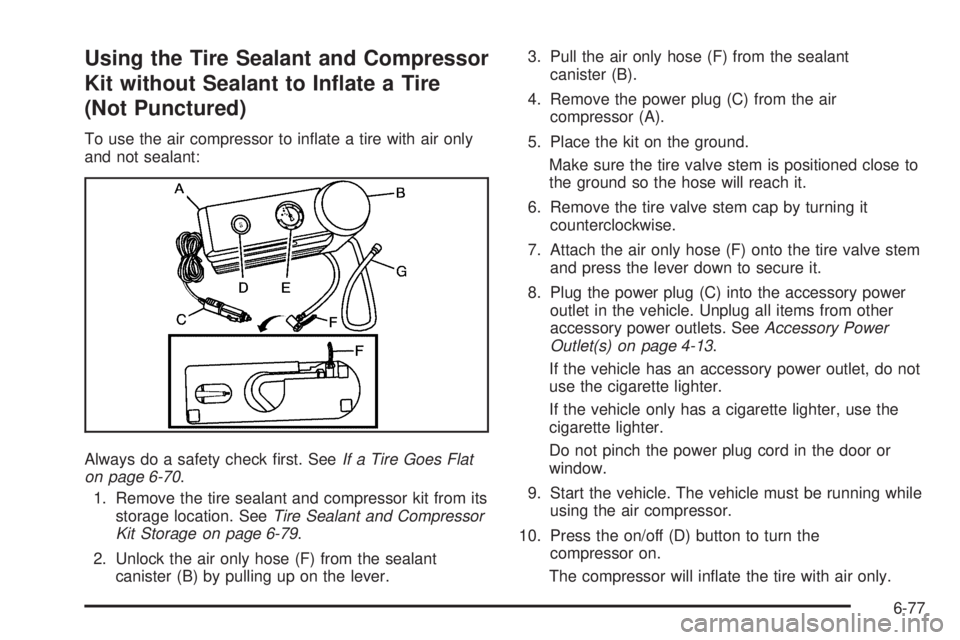
To use the air compressor to inflate a tire with air only
and not sealant:
Always do a safety check first. SeeIf a Tire Goes Flat
on page 6-70.
1. Remove the tire sealant and compressor kit from its storage location. See Tire Sealant and Compressor
Kit Storage on page 6-79 .
2. Unlock the air only hose (F) from the sealant canister (B) by pulling up on the lever. 3. Pull the air only hose (F) from the sealant
canister (B).
4. Remove the power plug (C) from the air compressor (A).
5. Place the kit on the ground. Make sure the tire valve stem is positioned close to
the ground so the hose will reach it.
6. Remove the tire valve stem cap by turning it counterclockwise.
7. Attach the air only hose (F) onto the tire valve stem and press the lever down to secure it.
8. Plug the power plug (C) into the accessory power outlet in the vehicle. Unplug all items from other
accessory power outlets. See Accessory Power
Outlet(s) on page 4-13 .
If the vehicle has an accessory power outlet, do not
use the cigarette lighter.
If the vehicle only has a cigarette lighter, use the
cigarette lighter.
Do not pinch the power plug cord in the door or
window.
9. Start the vehicle. The vehicle must be running while using the air compressor.
10. Press the on/off (D) button to turn the compressor on.
The compressor will inflate the tire with air only.
6-77
Page 356 of 422
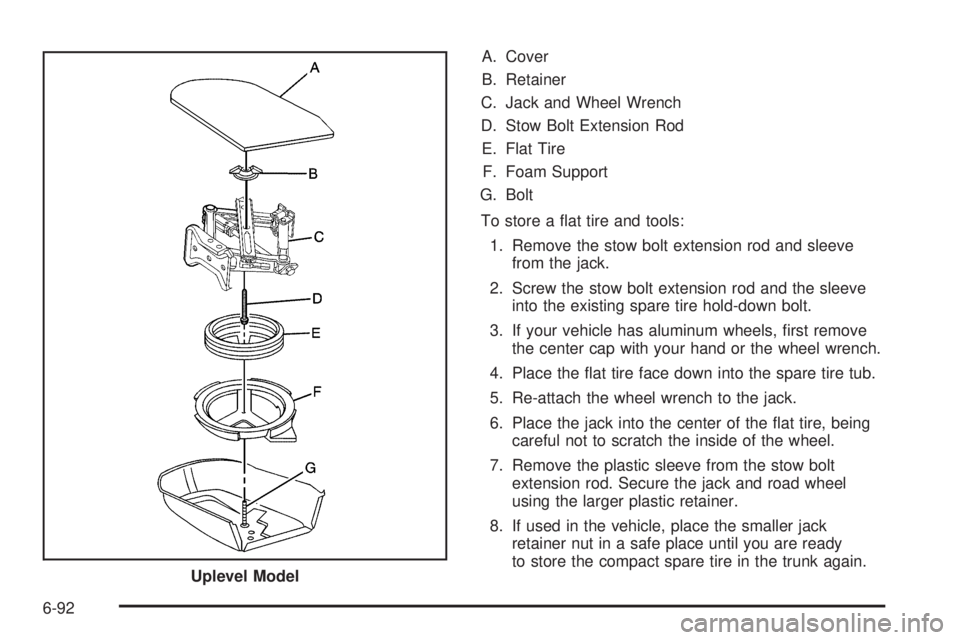
A. Cover
B. Retainer
C. Jack and Wheel Wrench
D. Stow Bolt Extension Rod E. Flat Tire F. Foam Support
G. Bolt
To store a flat tire and tools: 1. Remove the stow bolt extension rod and sleeve from the jack.
2. Screw the stow bolt extension rod and the sleeve into the existing spare tire hold-down bolt.
3. If your vehicle has aluminum wheels, first remove the center cap with your hand or the wheel wrench.
4. Place the flat tire face down into the spare tire tub.
5. Re-attach the wheel wrench to the jack.
6. Place the jack into the center of the flat tire, being careful not to scratch the inside of the wheel.
7. Remove the plastic sleeve from the stow bolt extension rod. Secure the jack and road wheel
using the larger plastic retainer.
8. If used in the vehicle, place the smaller jack retainer nut in a safe place until you are ready
to store the compact spare tire in the trunk again.
Uplevel Model
6-92
Page 398 of 422

Coverage
Services are provided up to 5 years/100,000 miles
(160 000 km), whichever comes first.
In the U.S., anyone driving the vehicle is covered. In
Canada, a person driving the vehicle without permission
from the owner is not covered.
Roadside Assistance is not a part of the New Vehicle
Limited Warranty. Pontiac and General Motors of
Canada Limited reserve the right to make any changes
or discontinue the Roadside Assistance program at
any time without notification.
Pontiac and General Motors of Canada Limited reserve
the right to limit services or payment to an owner or
driver if they decide the claims are made too often, or
the same type of claim is made many times.
Services Provided
•Emergency Fuel Delivery:Delivery of enough fuel
for the vehicle to get to the nearest service station.
•Lock-Out Service: Service is provided to unlock the
vehicle if you are locked out. A remote unlock may
be available if you have OnStar
®. For security
reasons, the driver must present identification
before this service is given.
•Emergency Tow From a Public Road or Highway:
Tow to the nearest Pontiac dealer for warranty
service, or if the vehicle was in a crash and cannot
be driven. Assistance is also given when the vehicle
is stuck in sand, mud, or snow.
•Flat Tire Change: Service is provided to change a
flat tire with the spare tire. The spare tire, if equipped,
must be in good condition and properly inflated.
It is the owner’s responsibility for the repair or
replacement of the tire if it is not covered by the
warranty.
•Battery Jump Start: Service is provided to jump
start a dead battery.
•Trip Interruption Benets and Assistance: If your
trip is interrupted due to a warranty failure, incidental
expenses may be reimbursed during the 5 years/
100,000 miles (160 000 km) Powertrain warranty
period. Items considered are hotel, meals, and
rental car.
8-8
Page 408 of 422

OnStar®
If the vehicle has OnStar and you subscribe to the
OnStar services, please refer to the OnStar Terms and
Conditions for information on data collection and use.
Navigation System
If your vehicle has a navigation system, use of the
system may result in the storage of destinations,
addresses, telephone numbers, and other trip
information. Refer to the navigation system operating
manual for information on stored data and for deletion
instructions.
Radio Frequency
Identication (RFID)
RFID technology is used in some vehicles for functions
such as tire pressure monitoring and ignition system
security, as well as in connection with conveniences
such as key fobs for remote door locking/unlocking and
starting, and in-vehicle transmitters for garage door
openers. RFID technology in GM vehicles does not use
or record personal information or link with any other
GM system containing personal information.
Radio Frequency Statement
This vehicle has systems that operate on a radio
frequency that comply with Part 15 of the Federal
Communications Commission (FCC) Rules and with
RSS-210/211 of Industry and Science Canada.
Operation is subject to the following two conditions:1. The device may not cause interference.
2. The device must accept any interference received, including interference that may cause undesired
operation of the device.
Changes or modifications to any of these systems by
other than an authorized service facility could void
authorization to use this equipment.
8-18
Page 411 of 422

Carbon MonoxideEngine Exhaust ........................................... 3-33
Trunk ......................................................... 3-11
Winter Driving ............................................. 5-21
Care of Safety Belts ................................................ 6-96
CD, MP3 ....................................................... 4-63
Center Console Storage ................................... 3-36
Center High-Mounted Stoplamp (CHMSL) ...........6-43
Chains, Tire ................................................... 6-70
Charging System Light .................................... 4-25
Check Engine Lamp .............................................. 4-30
Checking Things Under the Hood ......................6-10
Chemical Paint Spotting .................................6-100
Child Restraints Infants and Young Children ...........................2-35
Lower Anchors and Tethers for Children ..........2-43
Older Children ............................................. 2-32
Securing a Child Restraint in a Rear Seat Position .................................................. 2-49
Securing a Child Restraint in the Right Front Seat Position ........................................... 2-52
Systems ..................................................... 2-39
Where to Put the Restraint ...........................2-41
Cigarette Lighter ............................................. 4-14
Circuit Breakers ............................................ 6-103Cleaning
Aluminum or Chrome-Plated Wheels ..............6-99
Exterior Lamps/Lenses ................................. 6-97
Fabric/Carpet .............................................. 6-95
Finish Care ................................................. 6-98
Instrument Panel, Vinyl, and Other Plastic Surfaces ................................................. 6-96
Interior ....................................................... 6-94
Leather ...................................................... 6-96
Tires ........................................................ 6-100
Underbody Maintenance .............................6-100
Washing Your Vehicle ................................... 6-97
Weatherstrips .............................................. 6-97
Windshield
and Wiper Blades ........................6-98
Climate Control System ................................... 4-14
Outlet Adjustment ........................................ 4-17
Climate Controls ............................................. 1-14
Clock, Setting ................................................. 4-50
Clutch, Hydraulic ............................................. 6-19
Collision Damage Repair .................................. 8-11
Compact Spare Tire ........................................ 6-93
Compressor Kit, Tire Sealant ............................6-72
Content Theft-Deterrent .................................... 3-15
Control of a Vehicle .......................................... 5-3
Convenience Net ............................................ 3-36
Coolant Engine ....................................................... 6-24
Engine Temperature Warning Light .................4-29
3
Page 412 of 422

Cooling System.............................................. 6-20
Courtesy Transportation Program ......................8-10
Cruise Control .................................................. 4-7
Cupholders .................................................... 3-36
Customer Assistance ......................................... 8-6
Offices ......................................................... 8-6
Text Telephone (TTY) Users ........................... 8-6
Customer Information Service Publications Ordering Information ........8-15
Customer Satisfaction Procedure ........................ 8-2
D
Damage Repair, Collision.................................8-11
Data Recorders, Event .................................... 8-17
Daytime Running Lamps (DRL) .........................4-10
Defensive Driving ............................................. 5-2
Delayed Locking ............................................... 3-9
Disc, MP3 ...................................................... 4-63
Doing Your Own Service Work ........................... 6-4
Dome Lamp ................................................... 4-11
Door Automatic Door Lock ..................................... 3-9
Delayed Locking ........................................... 3-9
Locks .......................................................... 3-8
Power Locks ................................................ 3-9
Programmable Automatic Door Unlock ............3-10
Rear Door Security Locks .............................3-10Driver
Seat Height Adjuster ...................................... 2-3
Driver Information Center (DIC) .........................4-35
DIC Operation and Displays ..........................4-36
DIC Vehicle Personalization ..........................4-43
DIC Warnings and Messages ........................4-38
Driver Storage Compartment ............................3-36
Driving At Night ..................................................... 5-17
Before a Long Trip ...................................... 5-19
Defensive ..................................................... 5-2
Drunk .......................................................... 5-2
Highway Hypnosis ....................................... 5-19
Hill and Mountain Roads ..............................5-20
In Rain and on Wet Roads ...........................5-18
Loss of Control ........................................... 5-15
Off-Road Recovery ...................................... 5-15
Rocking Your Vehicle to Get it Out .................5-24
Winter ........................................................ 5-21
Driving for Better Fuel Economy .......................1-21
E
Easy Entry Seat............................................... 2-8
EDR ............................................................. 8-16
Electrical Equipment, Add-On ..........................6-102
4
Page 416 of 422

Lights (cont.)Passenger Airbag Status Indicator ..................4-24
Safety Belt Reminders .................................. 4-22
Security ..................................................... 4-33
Tire Pressure .............................................. 4-29
Up-Shift ..................................................... 4-25
Loading Your Vehicle ....................................... 5-24
Locks Automatic Door Lock ..................................... 3-9
Delayed Locking ........................................... 3-9
Door ........................................................... 3-8
Lockout Protection ....................................... 3-11
Power Door .................................................. 3-9
Programmable Automatic Door Unlock ............3-10
Rear Door Security Locks .............................3-10
Loss of Control ............................................... 5-15
Lower Anchors and Tethers for Children .............2-43
Lumbar Manual Controls ............................................ 2-3
M
Maintenance Schedule
Maintenance Record .................................... 7-14
Maintenance Replacement Parts ....................7-12
Owner Checks and Services ........................... 7-8
Recommended Fluids and Lubricants .............7-10
Scheduled Maintenance ................................. 7-3 Malfunction Indicator Lamp
...............................4-30
Manual Lumbar Controls .................................... 2-3
Manual Seats ................................................... 2-2
Manual Transmission Operation ................................................... 3-27
Manual Windows ............................................ 3-13
Message DIC Warnings and Messages ........................4-38
Mirror Reading Lamps ..................................... 4-12
Mirrors Manual Rearview ......................................... 3-35
Outside Convex Mirror ................................. 3-36
Outside Power Mirrors .................................. 3-35
Outside Remote Control Mirror ......................3-35
MP3 ............................................................. 4-63
N
Navigation System, Privacy..............................8-18
Net, Convenience ........................................... 3-36
New Vehicle Break-In ...................................... 3-19
8