wheel PONTIAC G5 2010 Manual PDF
[x] Cancel search | Manufacturer: PONTIAC, Model Year: 2010, Model line: G5, Model: PONTIAC G5 2010Pages: 422, PDF Size: 2.22 MB
Page 348 of 422

A. Retainer
B. Jack and Wheel Wrench
C. Spare Tire
D. Foam Support E. Bolt
3. Remove the retainer (A) that holds down the jack, wheel wrench (B) and spare tire (C).
4. Remove the spare tire by gently pulling it up and out of the trunk.
The tools you will be using include the jack (A) and
wheel wrench (B).
6-84
Page 349 of 422
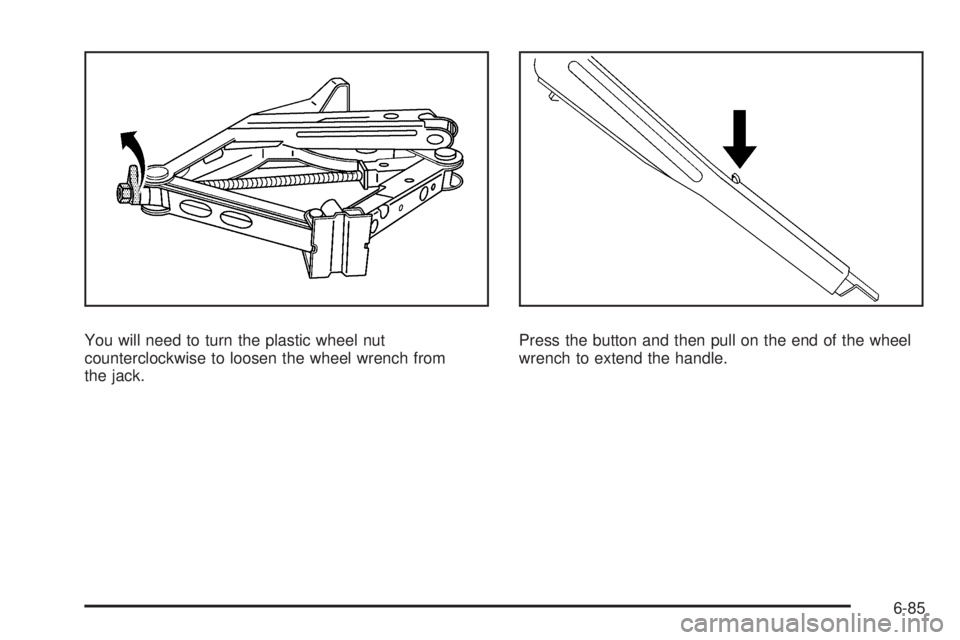
You will need to turn the plastic wheel nut
counterclockwise to loosen the wheel wrench from
the jack.Press the button and then pull on the end of the wheel
wrench to extend the handle.
6-85
Page 350 of 422
Removing the Flat Tire and
Installing the Spare Tire
1. Do a safety check before preceding. SeeChanging
a Flat Tire on page 6-80.
2. If your vehicle has plastic wheel covers, use the wheel wrench to loosen the plastic wheel nut caps.
Once you have loosened the plastic wheel nut caps
with the wheel wrench, you can finish loosening
them with your fingers. The plastic nut caps do not
come off.
3. If necessary, use the flat end of the wheel wrench to pry along the edge of the wheel cover until it
comes off.
Store the wheel cover in the trunk until you have
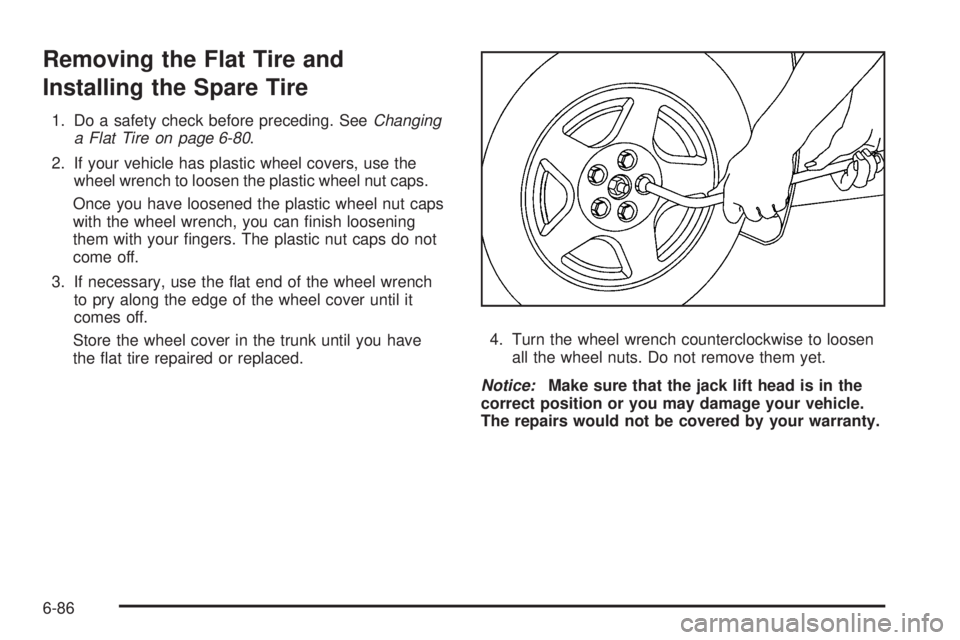
the flat tire repaired or replaced. 4. Turn the wheel wrench counterclockwise to loosen
all the wheel nuts. Do not remove them yet.
Notice: Make sure that the jack lift head is in the
correct position or you may damage your vehicle.
The repairs would not be covered by your warranty.
6-86
Page 351 of 422
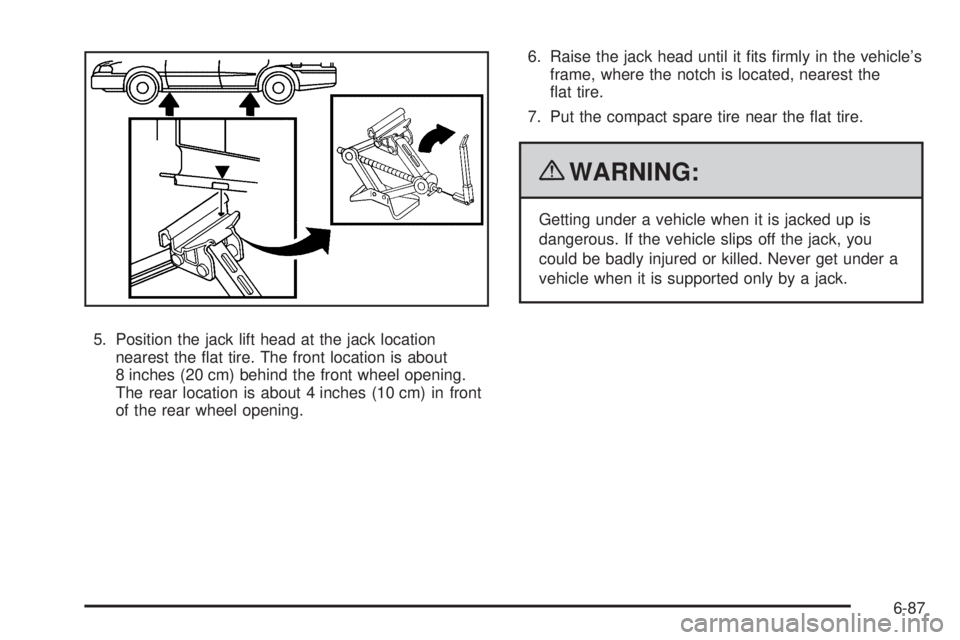
5. Position the jack lift head at the jack locationnearest the flat tire. The front location is about
8 inches (20 cm) behind the front wheel opening.
The rear location is about 4 inches (10 cm) in front
of the rear wheel opening. 6. Raise the jack head until it fits firmly in the vehicle’s
frame, where the notch is located, nearest the
flat tire.
7. Put the compact spare tire near the flat tire.
{WARNING:
Getting under a vehicle when it is jacked up is
dangerous. If the vehicle slips off the jack, you
could be badly injured or killed. Never get under a
vehicle when it is supported only by a jack.
6-87
Page 352 of 422
{WARNING:
Raising your vehicle with the jack improperly
positioned can damage the vehicle and even make
the vehicle fall. To help avoid personal injury and
vehicle damage, be sure to fit the jack lift head into
the proper location before raising the vehicle.
8. Turn the jack handle clockwise to raise the vehicle. Raise the vehicle far enough off the ground so
there is enough room for the compact spare tire to
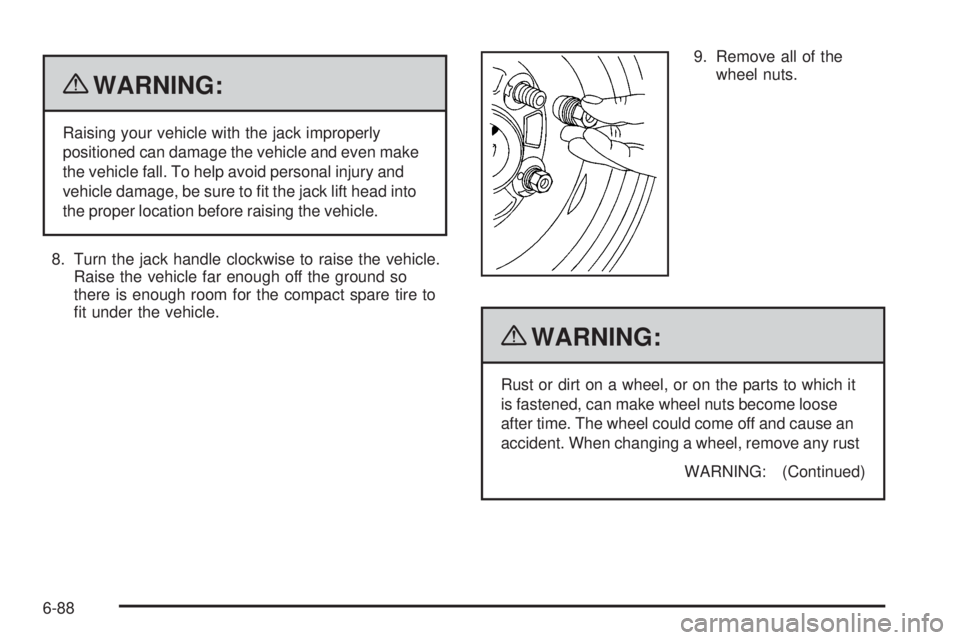
fit under the vehicle. 9. Remove all of the
wheel nuts.
{WARNING:
Rust or dirt on a wheel, or on the parts to which it
is fastened, can make wheel nuts become loose
after time. The wheel could come off and cause an
accident. When changing a wheel, remove any rust
WARNING: (Continued)
6-88
Page 353 of 422
WARNING: (Continued)
or dirt from places where the wheel attaches to
the vehicle. In an emergency, use a cloth or a
paper towel to do this; but be sure to use a
scraper or wire brush later, if needed, to get all
the rust or dirt off. SeeChanging a Flat Tire on
page 6-80.
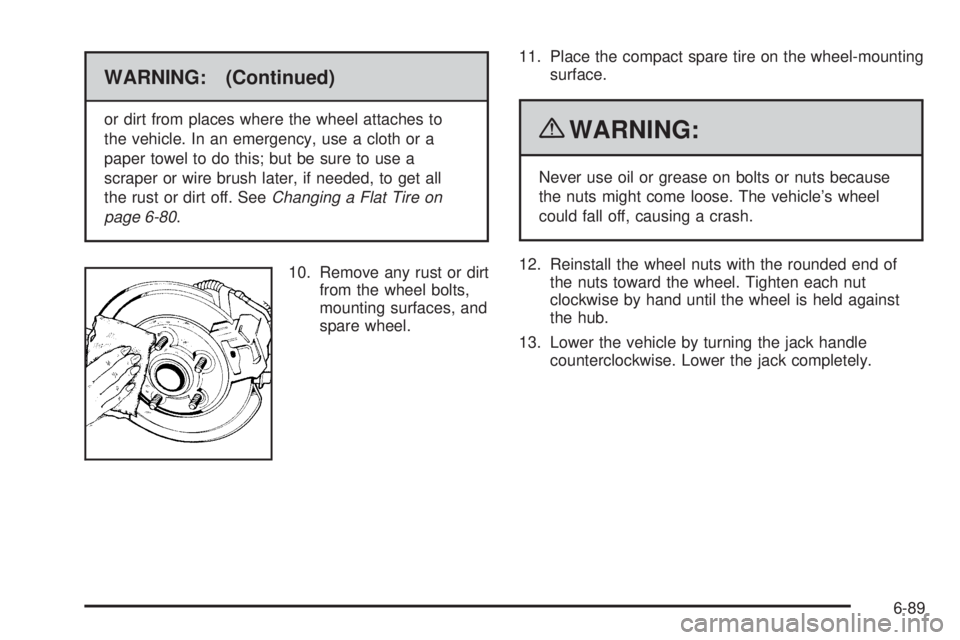
10. Remove any rust or dirtfrom the wheel bolts,
mounting surfaces, and
spare wheel. 11. Place the compact spare tire on the wheel-mounting
surface.{WARNING:
Never use oil or grease on bolts or nuts because
the nuts might come loose. The vehicle’s wheel
could fall off, causing a crash.
12. Reinstall the wheel nuts with the rounded end of the nuts toward the wheel. Tighten each nut
clockwise by hand until the wheel is held against
the hub.
13. Lower the vehicle by turning the jack handle counterclockwise. Lower the jack completely.
6-89
Page 354 of 422
{WARNING:
Wheel nuts that are improperly or incorrectly
tightened can cause the wheels to become loose or
come off. The wheel nuts should be tightened with a
torque wrench to the proper torque specification
after replacing. Follow the torque specification
supplied by the aftermarket manufacturer when
using accessory locking wheel nuts. SeeCapacities
and Specications on page 6-109 for original
equipment wheel nut torque specifications.
Notice: Improperly tightened wheel nuts can lead
to brake pulsation and rotor damage. To avoid
expensive brake repairs, evenly tighten the wheel
nuts in the proper sequence and to the proper
torque specication. See Capacities and
Specifications on page 6-109 for the wheel nut
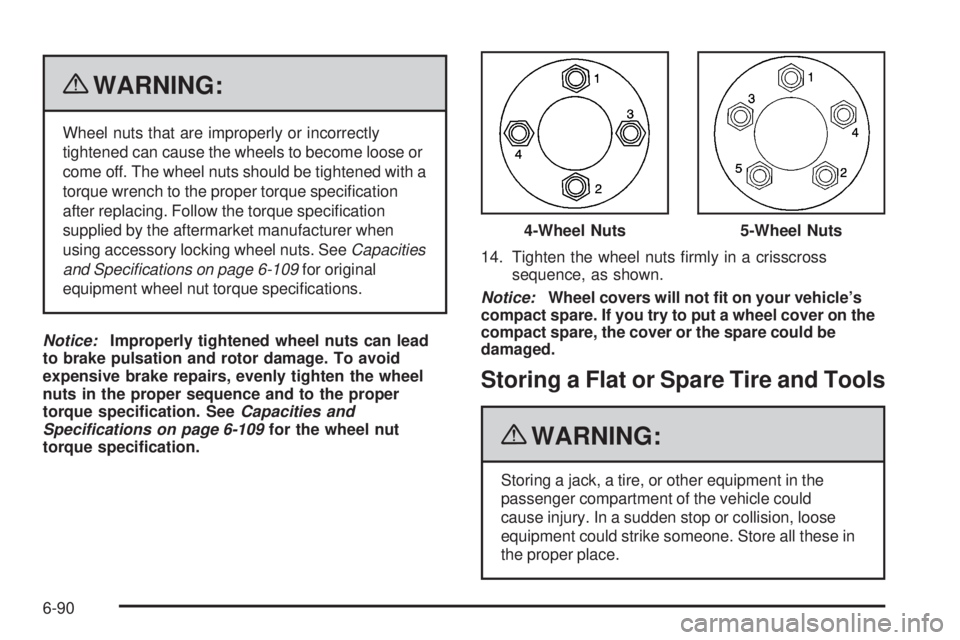
torque specication. 14. Tighten the wheel nuts firmly in a crisscross
sequence, as shown.
Notice: Wheel covers will not t on your vehicle’s
compact spare. If you try to put a wheel cover on the
compact spare, the cover or the spare could be
damaged.
Storing a Flat or Spare Tire and Tools
{WARNING:
Storing a jack, a tire, or other equipment in the
passenger compartment of the vehicle could
cause injury. In a sudden stop or collision, loose
equipment could strike someone. Store all these in
the proper place. 4-Wheel Nuts
5-Wheel Nuts
6-90
Page 355 of 422
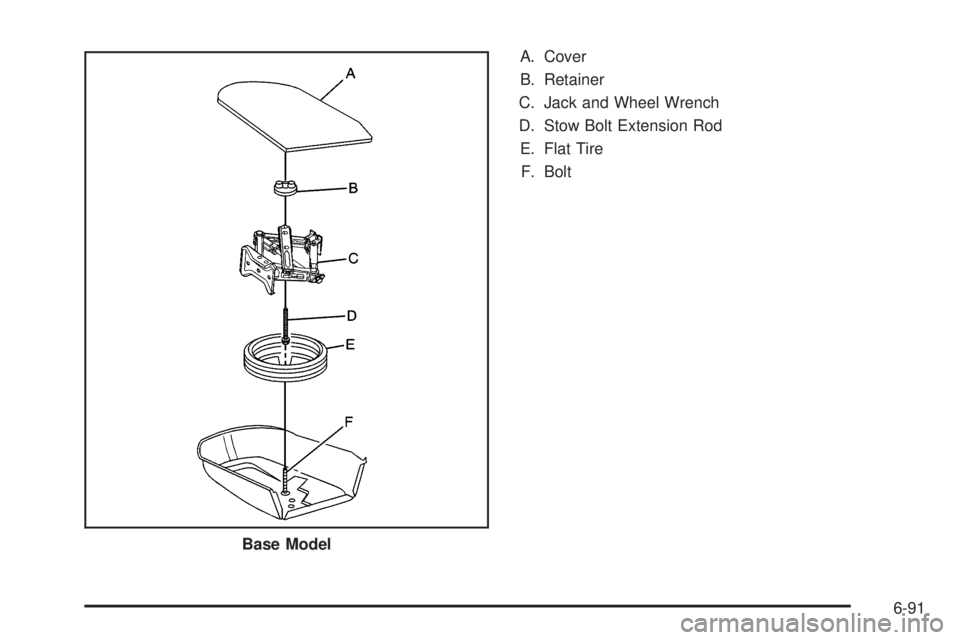
A. Cover
B. Retainer
C. Jack and Wheel Wrench
D. Stow Bolt Extension Rod E. Flat Tire F. Bolt
Base Model
6-91
Page 356 of 422
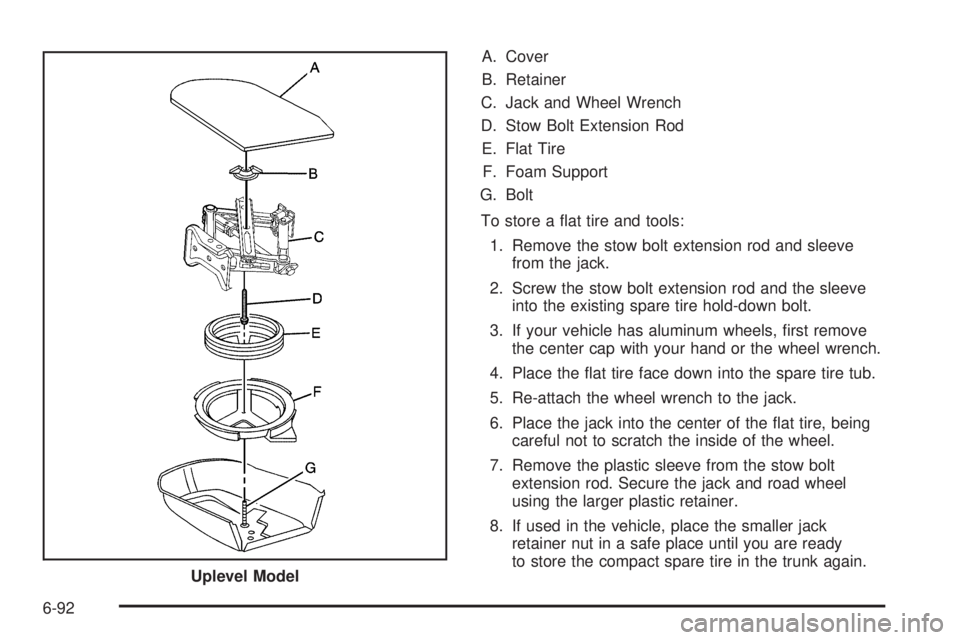
A. Cover
B. Retainer
C. Jack and Wheel Wrench
D. Stow Bolt Extension Rod E. Flat Tire F. Foam Support
G. Bolt
To store a flat tire and tools: 1. Remove the stow bolt extension rod and sleeve from the jack.
2. Screw the stow bolt extension rod and the sleeve into the existing spare tire hold-down bolt.
3. If your vehicle has aluminum wheels, first remove the center cap with your hand or the wheel wrench.
4. Place the flat tire face down into the spare tire tub.
5. Re-attach the wheel wrench to the jack.
6. Place the jack into the center of the flat tire, being careful not to scratch the inside of the wheel.
7. Remove the plastic sleeve from the stow bolt extension rod. Secure the jack and road wheel
using the larger plastic retainer.
8. If used in the vehicle, place the smaller jack retainer nut in a safe place until you are ready
to store the compact spare tire in the trunk again.
Uplevel Model
6-92
Page 357 of 422
To store the compact spare tire and tools, follow the
previous procedure without using the stow bolt extension
rod and seeRemoving the Spare Tire and Tools on
page 6-81 and follow the removal procedure, in reverse,
for the proper jack storage instructions for this vehicle.
The compact spare tire is for temporary use only.
Replace the compact spare with a full-size tire as soon
as possible.
Compact Spare Tire
{WARNING:
Driving with more than one compact spare tire at a
time could result in loss of braking and handling.
This could lead to a crash and you or others could
be injured. Use only one compact spare tire at
a time.
This vehicle may have a compact spare tire. Although the
compact spare tire was fully inflated when the vehicle
was new, it can lose air after a time. Check the inflation
pressure regularly. It should be 60 psi (420 kPa). After installing the compact spare on the vehicle, if the
vehicle has one, stop as soon as possible and make
sure the spare tire is correctly inflated. The compact
spare is made to perform well at speeds up to 65 mph
(105 km/h) for distances up to 3,000 miles (5 000 km),
so you can finish your trip and have the full-size
tire repaired or replaced at your convenience. Of course,
it is best to replace the spare with a full-size tire as
soon as possible. The spare tire will last longer and be
in good shape in case it is needed again.
Notice:
When the compact spare is installed, do
not take the vehicle through an automatic car wash
with guide rails. The compact spare can get
caught on the rails which can damage the tire,
wheel and other parts of the vehicle.
Do not use the compact spare on other vehicles.
And do not mix the compact spare tire or wheel with
other wheels or tires. They will not fit. Keep the
spare tire and its wheel together.
Notice: Tire chains will not t the compact spare.
Using them can damage the vehicle and can damage
the chains too. Do not use tire chains on the
compact spare.
6-93