rear view mirror PONTIAC G5 2010 Owners Manual
[x] Cancel search | Manufacturer: PONTIAC, Model Year: 2010, Model line: G5, Model: PONTIAC G5 2010Pages: 422, PDF Size: 2.22 MB
Page 1 of 422
In Brief........................................................... 1-1
Instrument Panel ........................................ 1-2
Initial Drive Information ............................... 1-4
Vehicle Features ...................................... 1-14
Performance and Maintenance ...................1-18
Seats and Restraint System ............................. 2-1
Front Seats ............................................... 2-2
Rear Seats ............................................... 2-9
Safety Belts ............................................. 2-11
Child Restraints ....................................... 2-32
Airbag System ......................................... 2-55
Restraint System Check ............................2-71
Features and Controls ..................................... 3-1
Keys ........................................................ 3-2
Doors and Locks ....................................... 3-8
Windows ................................................. 3-13
Theft-Deterrent Systems ............................3-15
Starting and Operating Your Vehicle ...........3-19 Mirrors
.................................................... 3-35
Storage Areas ......................................... 3-36
Sunroof .................................................. 3-37
Instrument Panel ............................................. 4-1
Instrument Panel Overview .......................... 4-3
Climate Controls ...................................... 4-14
Warning Lights, Gages, and Indicators ........4-19
Driver Information Center (DIC) ..................4-35
Audio System(s) ....................................... 4-49
Driving Your Vehicle ....................................... 5-1
Your Driving, the Road, and the Vehicle ....... 5-2
Towing ................................................... 5-30
Service and Appearance Care .......................... 6-1
Service ..................................................... 6-3
Fuel ......................................................... 6-5
Checking Things Under the Hood ...............6-10
Headlamp Aiming ..................................... 6-38
Bulb Replacement .................................... 6-41
2010 Pontiac G5 Owner ManualM
Page 16 of 422
Mirror Adjustment
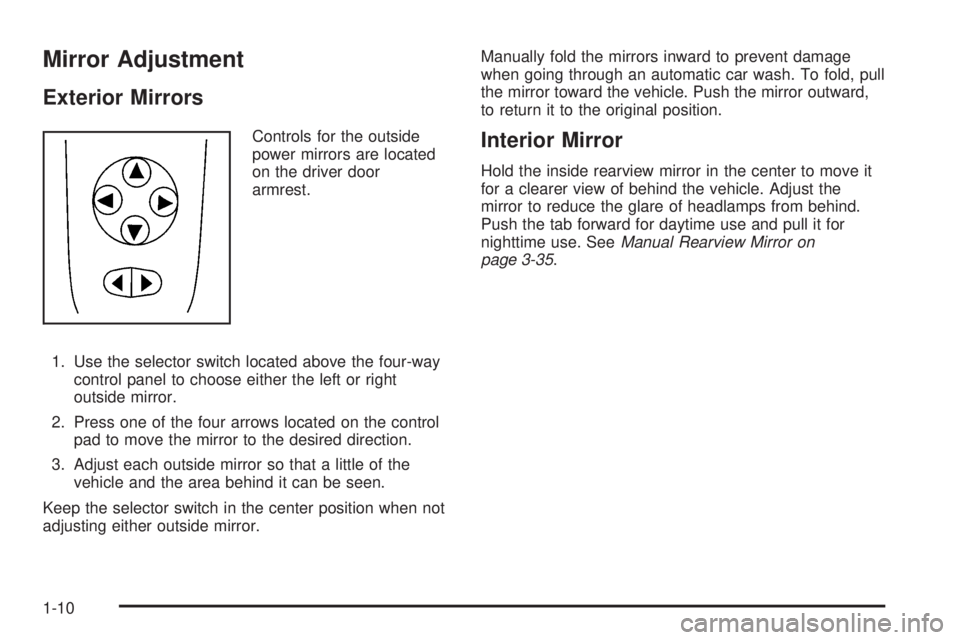
Exterior Mirrors
Controls for the outside
power mirrors are located
on the driver door
armrest.
1. Use the selector switch located above the four-way control panel to choose either the left or right
outside mirror.
2. Press one of the four arrows located on the control pad to move the mirror to the desired direction.
3. Adjust each outside mirror so that a little of the vehicle and the area behind it can be seen.
Keep the selector switch in the center position when not
adjusting either outside mirror. Manually fold the mirrors inward to prevent damage
when going through an automatic car wash. To fold, pull
the mirror toward the vehicle. Push the mirror outward,
to return it to the original position.Interior Mirror
Hold the inside rearview mirror in the center to move it
for a clearer view of behind the vehicle. Adjust the
mirror to reduce the glare of headlamps from behind.
Push the tab forward for daytime use and pull it for
nighttime use. See
Manual Rearview Mirror on
page 3-35.
1-10
Page 17 of 422
Steering Wheel Adjustment
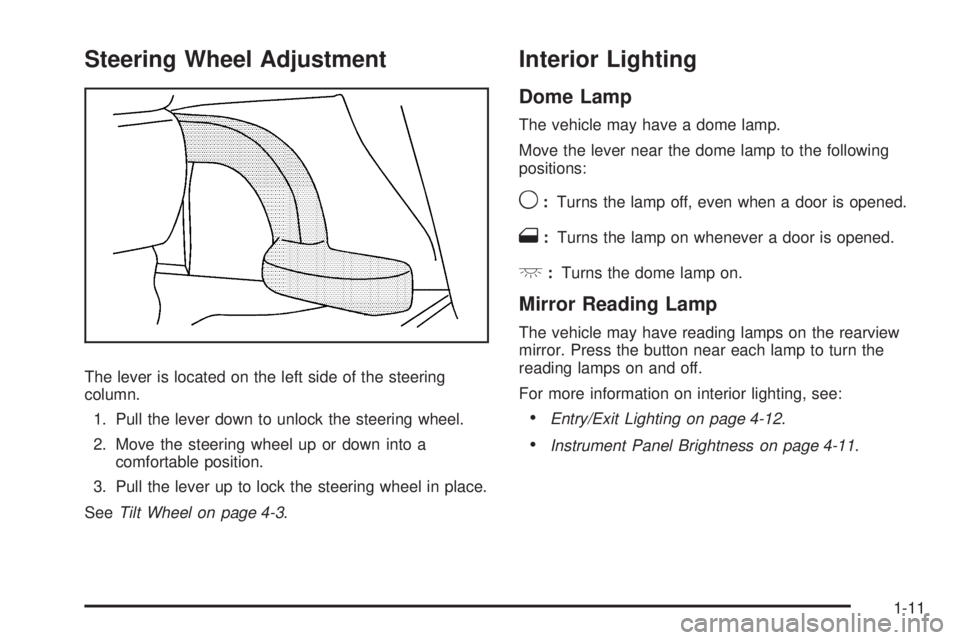
The lever is located on the left side of the steering
column.1. Pull the lever down to unlock the steering wheel.
2. Move the steering wheel up or down into a comfortable position.
3. Pull the lever up to lock the steering wheel in place.
See Tilt Wheel on page 4-3.
Interior Lighting
Dome Lamp
The vehicle may have a dome lamp.
Move the lever near the dome lamp to the following
positions:
9:Turns the lamp off, even when a door is opened.
1:Turns the lamp on whenever a door is opened.
+:Turns the dome lamp on.
Mirror Reading Lamp
The vehicle may have reading lamps on the rearview
mirror. Press the button near each lamp to turn the
reading lamps on and off.
For more information on interior lighting, see:
•Entry/Exit Lighting on page 4-12 .
•Instrument Panel Brightness on page 4-11 .
1-11
Page 103 of 422
Keys.............................................................. .3-2
Remote Keyless Entry (RKE) System ................3-3
Remote Keyless Entry (RKE) System Operation .................................................. .3-3
Remote Vehicle Start ..................................... .3-6
Doors and Locks ............................................ .3-8
Door Locks ................................................... .3-8
Power Door Locks ......................................... .3-9
Delayed Locking ............................................ .3-9
Automatic Door Lock ...................................... .3-9
Programmable Automatic Door Unlock .............3-10
Rear Door Security Locks (Sedan) ..................3-10
Lockout Protection ....................................... .3-11
Trunk ......................................................... .3-11
Windows ....................................................... .3-13
Manual Windows ......................................... .3-13
Power Windows ........................................... .3-14
Sun Visors .................................................. .3-15
Theft-Deterrent Systems ..................................3-15
Content Theft-Deterrent .................................3-15
PASS-Key
®III+ Electronic Immobilizer .............3-17
PASS-Key®III+ Electronic Immobilizer
Operation ................................................ .3-17
Starting and Operating Your Vehicle ................3-19
New Vehicle Break-In ................................... .3-19
Ignition Positions ......................................... .3-19
Retained Accessory Power (RAP) ...................3-22Starting the Engine
...................................... .3-22
Engine Coolant Heater ................................. .3-23
Automatic Transmission Operation ...................3-24
Manual Transmission Operation ......................3-27
Parking Brake ............................................. .3-29
Shifting Into Park (Automatic Transmission) ............................3-30
Shifting Out of Park (Automatic Transmission) ............................3-31
Parking the Vehicle (Manual Transmission) ...............................3-32
Parking Over Things That Burn .......................3-32
Engine Exhaust ........................................... .3-33
Running the Vehicle While Parked ..................3-34
Mirrors .......................................................... .3-35
Manual Rearview Mirror .................................3-35
Outside Remote Control Mirror .......................3-35
Outside Power Mirrors .................................. .3-35
Outside Convex Mirror .................................. .3-36
Storage Areas ............................................... .3-36
Glove Box .................................................. .3-36
Cupholders ................................................. .3-36
Center Console Storage .................................3-36
Driver Storage Compartment ..........................3-36
Convenience Net ......................................... .3-36
Sunroof ........................................................ .3-37
Section 3 Features and Controls
3-1
Page 137 of 422
Mirrors
Manual Rearview Mirror
Hold the inside rearview mirror in the center to move it
for a clearer view of behind your vehicle. Adjust the
mirror to avoid glare from the headlamps behind you.
Push the tab forward for daytime use and pull it for
nighttime use.
Vehicles with OnStar
®have three additional control
buttons located at the bottom of the mirror. See
your dealer/retailer for more information on the system
and how to subscribe to OnStar
®. See the OnStar®
owner’s guide for more information about the services
OnStar®provides.
If the vehicle has map lamps, press the buttons located
at the bottom of the mirror to turn them on or off.
Outside Remote Control Mirror
Adjust the driver outside mirror with the control lever
located on the driver door. Adjust the outside mirrors so
that the side of the vehicle can be seen.
Manually fold the mirrors inward to prevent damage when
going through an automatic car wash. To fold, pull the
mirror toward the vehicle. Push the mirror outward, to
return it to the original position.
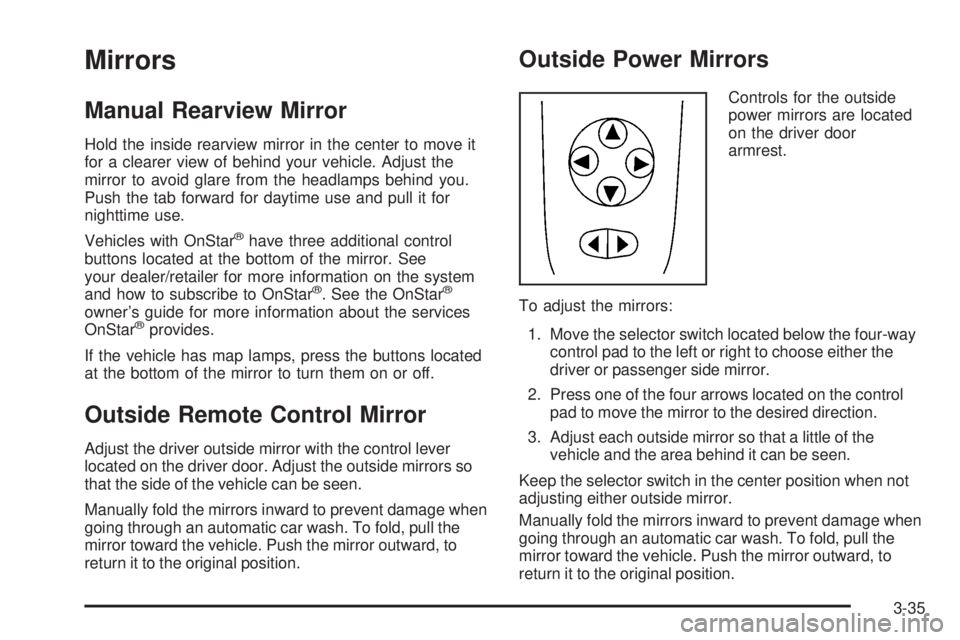
Outside Power Mirrors
Controls for the outside
power mirrors are located
on the driver door
armrest.
To adjust the mirrors: 1. Move the selector switch located below the four-way control pad to the left or right to choose either the
driver or passenger side mirror.
2. Press one of the four arrows located on the control pad to move the mirror to the desired direction.
3. Adjust each outside mirror so that a little of the vehicle and the area behind it can be seen.
Keep the selector switch in the center position when not
adjusting either outside mirror.
Manually fold the mirrors inward to prevent damage when
going through an automatic car wash. To fold, pull the
mirror toward the vehicle. Push the mirror outward, to
return it to the original position.
3-35
Page 152 of 422
Entry/Exit Lighting
The lamps inside the vehicle will go on when any door is
opened. These lamps fade out about 20 seconds after all
of the doors have been closed or when the ignition is
turned to ON/RUN. These lamps will also go on when
pressing the trunk release, unlock symbol, or the horn
symbol button on the Remote Keyless Entry System
(RKE) Transmitter.
After the key is removed from the ignition, the lamps
inside the vehicle stay on for about 20 seconds to
provide an illuminated exit.
Mirror Reading Lamps
The vehicle may have reading lamps on the rearview
mirror. Press the button near each lamp to turn the
reading lamps on and off.
Electric Power Management
This vehicle has Electric Power Management (EPM),
an advanced control system. It estimates the battery’s
temperature and state of charge and then adjusts
the voltage for best performance and extended life
of the battery.When the battery’s state of charge is low, the voltage is
raised slightly to quickly put the charge back in. When the
state of charge is high, the voltage is lowered slightly to
prevent overcharging. If the vehicle has a voltmeter gage
or voltage display on the Driver Information Center (DIC),
you may see the voltage move up or down. This is
normal. If there is a problem, an alert will be displayed.
The battery can be discharged at idle if the electrical
loads are very high. This is true for all vehicles. This is
because the generator (alternator) may not be spinning
fast enough at idle to produce all the power that is
needed for very high electrical loads.
A high electrical load occurs when several of the following
loads are on: headlamps, high beams, fog lamps, rear
window defogger, climate control fan at high speed,
heated seats, engine cooling fans, trailer loads, and
loads plugged into accessory power outlets.
EPM works to prevent excessive discharge of the battery.
It does this by balancing the generator’s output and the
vehicle’s electrical needs. It can increase engine idle
speed to generate more power, whenever needed.
It can temporarily reduce the power demands of some
accessories.
Normally, these actions occur in steps or levels, without
being noticeable. In rare cases at the highest levels
of corrective action, this action may be noticeable to
the driver.
4-12
Page 241 of 422
Driving at Night
Night driving is more dangerous than day driving because
some drivers are likely to be impaired — by alcohol or
drugs, with night vision problems, or by fatigue.
Night driving tips include:
•Drive defensively.
•Do not drink and drive.
•Reduce headlamp glare by adjusting the inside
rearview mirror.
•Slow down and keep more space between you and
other vehicles because headlamps can only light up
so much road ahead.
•Watch for animals.
•When tired, pull off the road.
•Do not wear sunglasses.
•Avoid staring directly into approaching headlamps.
•Keep the windshield and all glass on your vehicle
clean — inside and out.
•Keep your eyes moving, especially during turns or
curves.
No one can see as well at night as in the daytime. But, as
we get older, these differences increase. A 50-year-old
driver might need at least twice as much light to see the
same thing at night as a 20-year-old.
5-17
Page 243 of 422

Before Leaving on a Long Trip
To prepare your vehicle for a long trip, consider having
it serviced by your dealer/retailer before departing.
Things to check on your own include:
•Windshield Washer Fluid:Reservoir full? Windows
clean — inside and outside?
•Wiper Blades: In good shape?
•Fuel, Engine Oil, Other Fluids: All levels checked?
•Lamps:Do they all work and are lenses clean?
•Tires:Are treads good? Are tires inflated to
recommended pressure?
•Weather and Maps: Safe to travel? Have
up-to-date maps?
Highway Hypnosis
Always be alert and pay attention to your surroundings
while driving. If you become tired or sleepy, find a
safe place to park your vehicle and rest.
Other driving tips include:
•Keep the vehicle well ventilated.
•Keep interior temperature cool.
•Keep your eyes moving — scan the road ahead
and to the sides.
•Check the rearview mirror and vehicle instruments
often.
5-19
Page 416 of 422

Lights (cont.)Passenger Airbag Status Indicator ..................4-24
Safety Belt Reminders .................................. 4-22
Security ..................................................... 4-33
Tire Pressure .............................................. 4-29
Up-Shift ..................................................... 4-25
Loading Your Vehicle ....................................... 5-24
Locks Automatic Door Lock ..................................... 3-9
Delayed Locking ........................................... 3-9
Door ........................................................... 3-8
Lockout Protection ....................................... 3-11
Power Door .................................................. 3-9
Programmable Automatic Door Unlock ............3-10
Rear Door Security Locks .............................3-10
Loss of Control ............................................... 5-15
Lower Anchors and Tethers for Children .............2-43
Lumbar Manual Controls ............................................ 2-3
M
Maintenance Schedule
Maintenance Record .................................... 7-14
Maintenance Replacement Parts ....................7-12
Owner Checks and Services ........................... 7-8
Recommended Fluids and Lubricants .............7-10
Scheduled Maintenance ................................. 7-3 Malfunction Indicator Lamp
...............................4-30
Manual Lumbar Controls .................................... 2-3
Manual Seats ................................................... 2-2
Manual Transmission Operation ................................................... 3-27
Manual Windows ............................................ 3-13
Message DIC Warnings and Messages ........................4-38
Mirror Reading Lamps ..................................... 4-12
Mirrors Manual Rearview ......................................... 3-35
Outside Convex Mirror ................................. 3-36
Outside Power Mirrors .................................. 3-35
Outside Remote Control Mirror ......................3-35
MP3 ............................................................. 4-63
N
Navigation System, Privacy..............................8-18
Net, Convenience ........................................... 3-36
New Vehicle Break-In ...................................... 3-19
8
Page 418 of 422

ProgramCourtesy Transportation ................................8-10
Programmable Automatic Door Unlock ...............3-10
Proposition 65 Warning, California ....................... 6-4
R
Radio Frequency
Identification (RFID) ..................................... 8-18
Statement ................................................... 8-18
Radio(s) ........................................................ 4-51
Radios Reception ................................................... 4-83
Setting the Clock ......................................... 4-50
Theft-Deterrent ............................................ 4-81
Range Adjustment, Headlamps ........................... 2-7
Rear Door Security Locks ................................3-10
Rearview Mirrors ............................................. 3-35
Reclining Seatbacks .......................................... 2-4
Recommended Fluids and Lubricants .................7-10
Recreational Vehicle Towing .............................5-30
Reimbursement Program, GM Mobility ................. 8-7
Remote Keyless Entry (RKE) System .................. 3-3Remote Vehicle Start
........................................ 3-6
Removing the Flat Tire and Installing the Spare Tire .................................................. 6-86
Removing the Spare Tire and Tools ...................6-81
Replacement Bulbs ......................................... 6-47
Replacement Parts Maintenance ............................................... 7-12
Reporting Safety Defects Canadian Government .................................. 8-15
General Motors ........................................... 8-15
U.S. Government ......................................... 8-14
Restraint System Check Checking the Restraint Systems ....................2-71
Replacing Restraint System Parts After a Crash ..................................................... 2-72
Retained Accessory Power (RAP) ......................3-22
Ride Control Systems ....................................... 5-6
Electronic Stability (ESC) ................................ 5-6
Roadside Assistance Program ............................ 8-7
Rocking Your Vehicle to Get it Out ....................5-24
Roof Sunroof ...................................................... 3-37
Running the Vehicle While Parked .....................3-34
10