seats PONTIAC G6 2006 User Guide
[x] Cancel search | Manufacturer: PONTIAC, Model Year: 2006, Model line: G6, Model: PONTIAC G6 2006Pages: 416, PDF Size: 2.66 MB
Page 33 of 416
Rear Safety Belt Comfort Guides
(Sedan and Coupe Only)
Rear shoulder belt comfort guides may provide added
safety belt comfort for older children who have outgrown
booster seats and for some adults. When installed on
a shoulder belt, the comfort guide positions the belt
away from the neck and head.
There is one guide for each outboard passenger
position in the rear seat. Here is how to install a comfort
guide and use the safety belt:
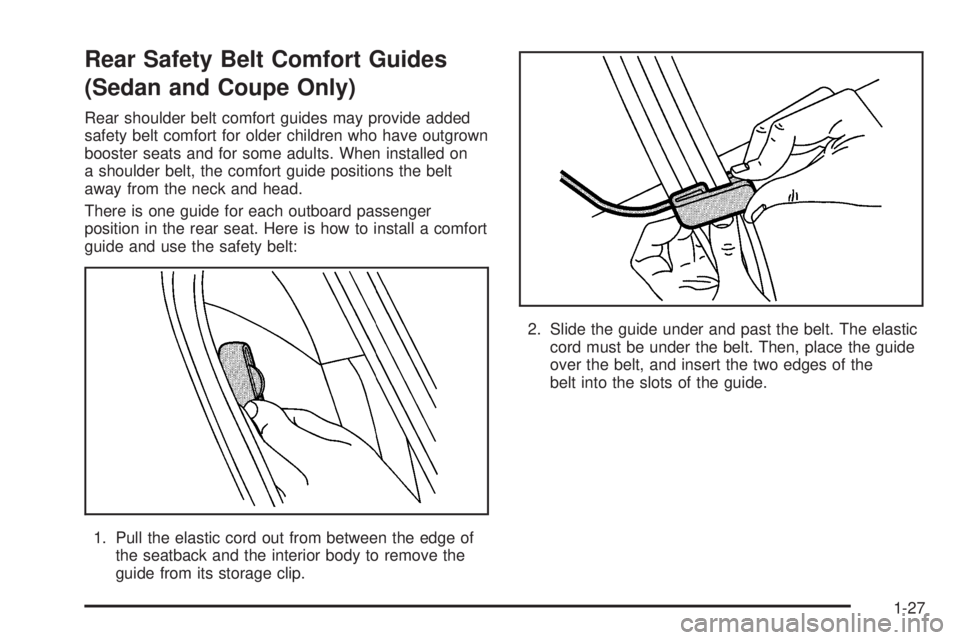
1. Pull the elastic cord out from between the edge of
the seatback and the interior body to remove the
guide from its storage clip.2. Slide the guide under and past the belt. The elastic
cord must be under the belt. Then, place the guide
over the belt, and insert the two edges of the
belt into the slots of the guide.
1-27
Page 35 of 416
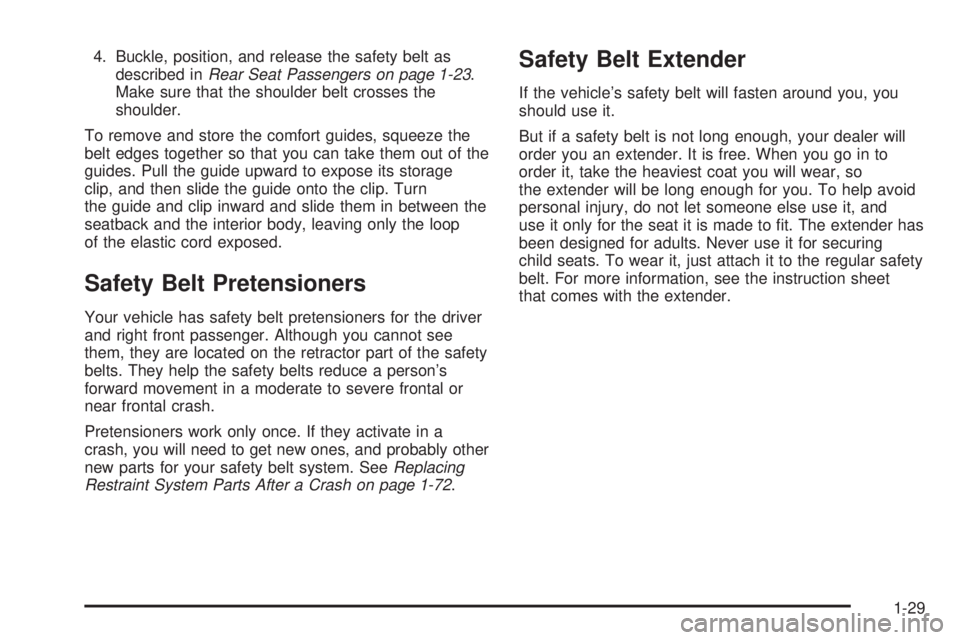
4. Buckle, position, and release the safety belt as
described inRear Seat Passengers on page 1-23.
Make sure that the shoulder belt crosses the
shoulder.
To remove and store the comfort guides, squeeze the
belt edges together so that you can take them out of the
guides. Pull the guide upward to expose its storage
clip, and then slide the guide onto the clip. Turn
the guide and clip inward and slide them in between the
seatback and the interior body, leaving only the loop
of the elastic cord exposed.
Safety Belt Pretensioners
Your vehicle has safety belt pretensioners for the driver
and right front passenger. Although you cannot see
them, they are located on the retractor part of the safety
belts. They help the safety belts reduce a person’s
forward movement in a moderate to severe frontal or
near frontal crash.
Pretensioners work only once. If they activate in a
crash, you will need to get new ones, and probably other
new parts for your safety belt system. SeeReplacing
Restraint System Parts After a Crash on page 1-72.
Safety Belt Extender
If the vehicle’s safety belt will fasten around you, you
should use it.
But if a safety belt is not long enough, your dealer will
order you an extender. It is free. When you go in to
order it, take the heaviest coat you will wear, so
the extender will be long enough for you. To help avoid
personal injury, do not let someone else use it, and
use it only for the seat it is made to t. The extender has
been designed for adults. Never use it for securing
child seats. To wear it, just attach it to the regular safety
belt. For more information, see the instruction sheet
that comes with the extender.
1-29
Page 36 of 416
Child Restraints
Older Children
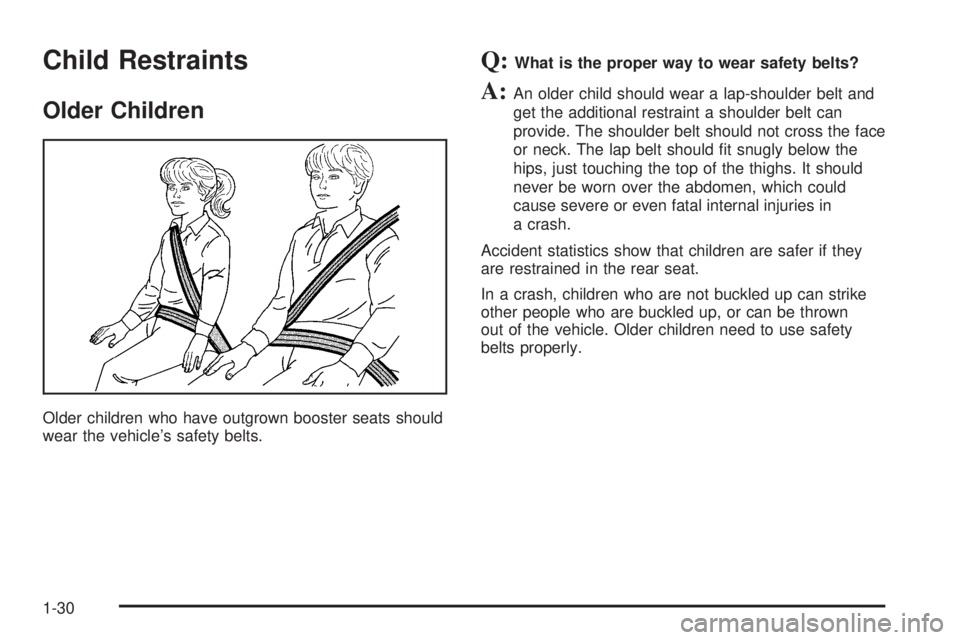
Older children who have outgrown booster seats should
wear the vehicle’s safety belts.
Q:What is the proper way to wear safety belts?
A:An older child should wear a lap-shoulder belt and
get the additional restraint a shoulder belt can
provide. The shoulder belt should not cross the face
or neck. The lap belt should t snugly below the
hips, just touching the top of the thighs. It should
never be worn over the abdomen, which could
cause severe or even fatal internal injuries in
a crash.
Accident statistics show that children are safer if they
are restrained in the rear seat.
In a crash, children who are not buckled up can strike
other people who are buckled up, or can be thrown
out of the vehicle. Older children need to use safety
belts properly.
1-30
Page 43 of 416
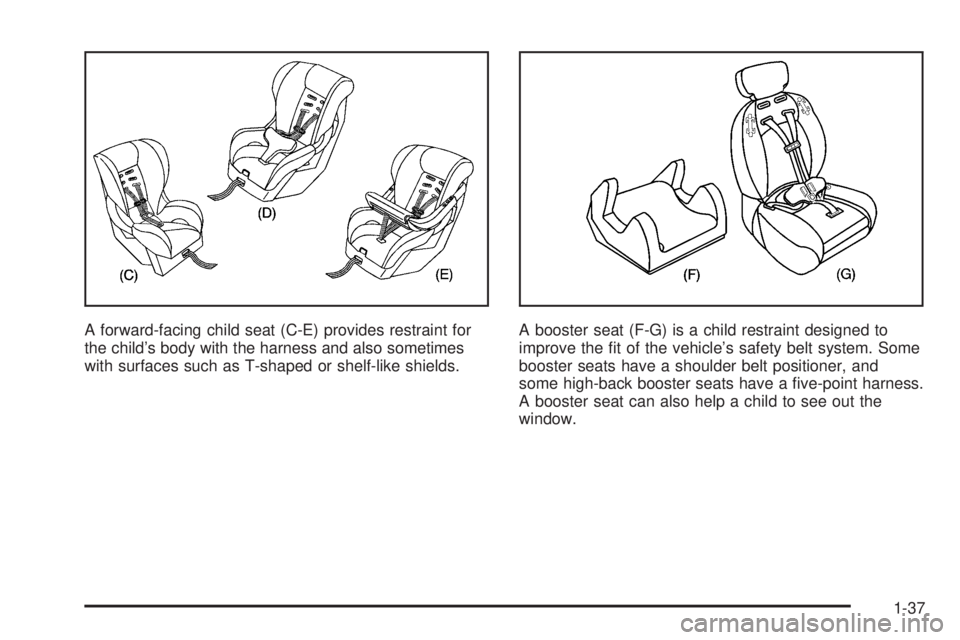
A forward-facing child seat (C-E) provides restraint for
the child’s body with the harness and also sometimes
with surfaces such as T-shaped or shelf-like shields.A booster seat (F-G) is a child restraint designed to
improve the t of the vehicle’s safety belt system. Some
booster seats have a shoulder belt positioner, and
some high-back booster seats have a ve-point harness.
A booster seat can also help a child to see out the
window.
1-37
Page 58 of 416
Securing a Child Restraint in the
Right Front Seat Position
Your vehicle has a right front passenger’s airbag. A rear
seat is a safer place to secure a forward-facing child
restraint. SeeWhere to Put the Restraint on page 1-39.
In addition, your vehicle has the passenger sensing
system. The passenger sensing system is designed to
turn off the right front passenger’s frontal airbag
when an infant in a rear-facing infant seat or a small
child in a forward-facing child restraint or booster seat is
detected. SeePassenger Sensing System on page 1-65
andPassenger Airbag Status Indicator on page 3-34
for more information on this including important
safety information.
A label on your sun visor says, “Never put a rear-facing
child seat in the front.” This is because the risk to the
rear-facing child is so great, if the airbag deploys.
{CAUTION:
A child in a rear-facing child restraint can be
seriously injured or killed if the right front
passenger’s airbag inates. This is because
the back of the rear-facing child restraint
would be very close to the inating airbag.
Even though the passenger sensing system is
designed to turn off the passenger’s frontal
airbag if the system detects a rear-facing child
restraint, no system is fail-safe, and no one
can guarantee that an airbag will not deploy
under some unusual circumstance, even
though it is turned off. We recommend that
rear-facing child restraints be secured in the
rear seat, even if the airbag is off.
If you need to secure a forward-facing child restraint in
the right front seat position, move the seat as far
back as it will go before securing the forward-facing
child restraint. SeeManual Seats on page 1-2orPower
Seat on page 1-3.
1-52
Page 59 of 416
If your child restraint is equipped with the LATCH
system, seeLower Anchors and Tethers for Children
(LATCH) on page 1-41.
There is no top tether anchor in the right front
passenger’s position. Do not secure a child seat in this
position if a national or local law requires that the
top tether be anchored, or if the instructions that come
with the child restraint say that the top tether must
be anchored. SeeLower Anchors and Tethers
for Children (LATCH) on page 1-41if the child restraint
has a top tether.
You will be using the lap-shoulder belt to secure the
child restraint in this position. Be sure to follow the
instructions that came with the child restraint. Secure
the child in the child restraint when and as the
instructions say.1. Your vehicle has a right front passenger’s frontal
airbag. SeePassenger Sensing System on
page 1-65. General Motors recommends that
rear-facing child restraints be secured in a rear seat,
even if the airbag is off. If your child restraint is
forward-facing, move the seat as far back as it will
go before securing the child restraint in this
seat. SeeManual Seats on page 1-2orPower Seat
on page 1-3.
When the passenger sensing system has turned off
the right front passenger’s frontal airbag, the off
indicator in the passenger airbag status indicator
should light and stay lit when you turn the ignition to
ON or START. SeePassenger Airbag Status
Indicator on page 3-34.
2. Put the child restraint on the seat.
3. If your vehicle has retractable hardtop or is a
coupe, remove the safety belt from the guide on the
head restraint by sliding the webbing through the
opening on the guide. Do not secure the child
restraint with the safety belt routed through
the guide.
4. Pick up the latch plate, and run the lap and shoulder
portions of the vehicle’s safety belt through or
around the restraint. The child restraint instructions
will show you how.
1-53
Page 77 of 416

Q:Because I have a disability, I have to get my
vehicle modied. How can I nd out whether
this will affect my airbag system?
A:Changing or moving any parts of the front seats,
safety belts, the airbag sensing and diagnostic
module (located under the center console), or the
instrument panel can affect the operation of
the airbag system. If you have questions, call
Customer Assistance. The phone numbers
and addresses for Customer Assistance are in
Step Two of the Customer Satisfaction Procedure
in this manual. SeeCustomer Satisfaction
Procedure on page 7-2.
Restraint System Check
Checking the Restraint Systems
Now and then, make sure the safety belt reminder light
and all your belts, buckles, latch plates, retractors
and anchorages are working properly. Look for any other
loose or damaged safety belt system parts. If you see
anything that might keep a safety belt system from doing
its job, have it repaired.Torn or frayed safety belts may not protect you in a
crash. They can rip apart under impact forces. If a belt
is torn or frayed, get a new one right away.
Also look for any opened or broken airbag covers, and
have them repaired or replaced. (The airbag system
does not need regular maintenance.)
Notice:If you damage the covering for the driver’s
or the right front passenger’s airbag, or the airbag
covering on the driver’s and right front passenger’s
seatback (if equipped), or the side impact airbag
covering on the ceiling near the side windows
(if equipped), the bag may not work properly. You
may have to replace the airbag module in the
steering wheel, both the airbag module and the
instrument panel for the right front passenger’s
airbag, the airbag module and seatback for the
driver’s and right front passenger’s seat-mounted
side impact airbags (if equipped), or side impact
airbag module and ceiling covering for the
roof-mounted side impact airbags (if equipped).
Do not open or break the airbag coverings.
1-71
Page 106 of 416

3. Plug the cord into a normal, grounded 110-volt
AC outlet.
{CAUTION:
Plugging the cord into an ungrounded outlet
could cause an electrical shock. Also, the
wrong kind of extension cord could overheat
and cause a re. You could be seriously
injured. Plug the cord into a properly grounded
three-prong 110-volt AC outlet. If the cord will
not reach, use a heavy-duty three-prong
extension cord rated for at least 15 amps.
4. Before starting the engine, be sure to unplug and
store the cord as it was before to keep it away
from moving engine parts. If you do not, it could
be damaged.
How long should you keep the coolant heater plugged
in? The answer depends on the outside temperature, the
kind of oil you have, and some other things. Instead
of trying to list everything here, we ask that you contact
your dealer in the area where you will be parking
your vehicle. The dealer can give you the best advice
for that particular area.
Automatic Transaxle Operation
Your automatic transaxle has a shift lever located on
the console between the seats.
PARK (P):This position locks your front wheels. It is
the best position to use when you start your engine
because your vehicle cannot move easily.SE Model
GT and GTP Models
2-28
Page 158 of 416
Rear Window Defogger
The rear window defogger uses a warming grid to
remove fog from the rear window.
<(Rear):Press this button to turn the rear window
defogger on or off. An indicator light above the
button will come on to let you know that the rear window
defogger is activated.
If driving below 50 mph (80 km/h), the rear window
defogger will turn off about 15 minutes after the button
is pressed. If you need additional warming time,
press the button again.
If your vehicle’s speed is maintained above 50 mph
(80 km/h), the rear window defogger will remain on once
the button is pressed.
If your vehicle has the remote start feature, the rear
defogger will automatically be turned on if it is cold
outside. The indicator light will not be on. When
the vehicle transitions out of remote start mode the rear
defogger will turn off.
Notice:Using a razor blade or sharp object to clear
the inside rear window may damage the rear
window defogger. Repairs would not be covered by
your warranty. Do not clear the inside of the rear
window with sharp objects.
Outlet Adjustment
Rotate the instrument panel outlets and move the
louvers on the outlets to change the direction and
amount of airow in your vehicle.
Operation Tips
Clear away any ice, snow or leaves from the air
inlets at the base of the windshield that may
block the ow of air into your vehicle.
Use of non-GM approved hood deectors may
adversely affect the performance of the system.
Keep the path under the front seats clear of objects
to help circulate the air inside of your vehicle more
effectively.
When an objectionable odor outside the vehicle is
encountered, use the recirculation mode, with the
temperature knob at a comfortable setting to prevent
the odor from entering the vehicle through the
ventilation system. This can be helpful when driving
through a long tunnel with poor ventilation.
However, extended usage of this mode in cold or
cool weather can cause window fogging.
3-28
Page 257 of 416
{CAUTION:
Do not load your vehicle any heavier than the
Gross Vehicle Weight Rating (GVWR), or either
the maximum front or rear Gross Axle Weight
Rating (GAWR). If you do, parts on your
vehicle can break, and it can change the way
your vehicle handles. These could cause you
to lose control and crash. Also, overloading
can shorten the life of your vehicle.
If you put things inside your vehicle — like suitcases,
tools, packages, or anything else — they will go as fast
as the vehicle goes. If you have to stop or turn
quickly, or if there is a crash, they will keep going.
{CAUTION:
Things you put inside your vehicle can strike
and injure people in a sudden stop or turn, or
in a crash.
Put things in the trunk or rear area of your
vehicle. In a trunk, put them as far forward
as you can. Try to spread the weight
evenly. If you have fold-down rear seats,
you will nd four anchors on the back wall
of your trunk. You can use these anchors
to tie down lighter loads. They are not
strong enough for heavy things, however,
so put them as far forward as you can in
the trunk or rear area.
Never stack heavier things, like suitcases,
inside the vehicle so that some of them
are above the tops of the seats.
Do not leave an unsecured child restraint
in your vehicle.
When you carry something inside the
vehicle, secure it whenever you can.
Do not leave a seat folded down unless
you need to.
4-37