brake light PONTIAC G6 2007 User Guide
[x] Cancel search | Manufacturer: PONTIAC, Model Year: 2007, Model line: G6, Model: PONTIAC G6 2007Pages: 486, PDF Size: 2.78 MB
Page 259 of 486
Avoid needless heavy braking. Some people drive
in spurts — heavy acceleration followed by heavy
braking — rather than keeping pace with traffic.
This is a mistake. The brakes may not have time to
cool between hard stops. The brakes will wear out
much faster if you do a lot of heavy braking. If you
keep pace with the traffic and allow realistic
following distances, you will eliminate a lot of
unnecessary braking. That means better braking
and longer brake life.
If your vehicle’s engine ever stops while you are
driving, brake normally but do not pump the
brakes. If you do, the pedal may get harder to
push down. If the engine stops, you will still have
some power brake assist. But you will use it
when you brake. Once the power assist is used
up, it may take longer to stop and the brake pedal
will be harder to push.
Adding non-GM accessories can affect your
vehicle’s performance. SeeAccessories and
Modications on page 308.Anti-Lock Brake System (ABS)
Your vehicle may have the Anti-Lock Brake
System (ABS), an advanced electronic braking
system that will help prevent a braking skid.
If your vehicle has ABS,
this warning light on the
instrument panel will
come on briey when
you start your vehicle.
When you start your engine, or when you begin to
drive away, ABS will check itself. You may hear a
momentary motor or clicking noise while this test is
going on, and you may even notice that your brake
pedal moves or pulses a little. This is normal.
259
Page 261 of 486
Remember: ABS does not change the time you
need to get your foot up to the brake pedal
or always decrease stopping distance. If you get
too close to the vehicle in front of you, you will not
have time to apply your brakes if that vehicle
suddenly slows or stops. Always leave enough
room up ahead to stop, even though you
have ABS.
Using ABS
Do not pump the brakes. Just hold the brake
pedal down rmly and let anti-lock work for you.
You may feel a slight brake pedal pulsation
or notice some noise, but this is normal. See
Braking in Emergencies on page 261.
Braking in Emergencies
At some time, nearly every driver gets into a
situation that requires hard braking.
If you have ABS, you can steer and brake at the
same time. However, if you do not have ABS, your
rst reaction — to hit the brake pedal hard and hold
it down — may be the wrong thing to do.Your wheels can stop rolling. Once they do, the
vehicle cannot respond to your steering.
Momentum will carry it in whatever direction it was
headed when the wheels stopped rolling. That
could be off the road, into the very thing you were
trying to avoid, or into traffic.
If you do not have ABS, use a “squeeze” braking
technique. This will give you maximum braking
while maintaining steering control. You can do this
by pushing on the brake pedal with steadily
increasing pressure.
In an emergency, you will probably want to squeeze
the brakes hard without locking the wheels. If you
hear or feel the wheels sliding, ease off the brake
pedal. This will help you retain steering control. If
you do have ABS, it is different. SeeAnti-Lock
Brake System (ABS) on page 259.
In many emergencies, steering can help you more
than even the very best braking.
261
Page 262 of 486

Traction Control System (TCS)
Your vehicle may have a Traction Control System
(TCS) that limits wheel spin. This is especially
useful in slippery road conditions. The system
operates only if it senses that one or both of the
front wheels are spinning or beginning to lose
traction. When this happens, the system reduces
engine power and may also upshift the transaxle
to limit wheel spin. Also, the traction control system
activates the appropriate corner brakes to gain
even quicker control to limit wheel spin.
This light, located on the
instrument panel, will
come on when your
Traction Control System
is limiting wheel spin.
You may feel or hear the system working, but this
is normal.
If your vehicle is in cruise control when the
traction control system begins to limit wheel spin,
the cruise control will automatically disengage.When road conditions allow you to safely use it
again, you may re-engage the cruise control. See
Cruise Control on page 171.
The Traction Control System operates in all
transaxle shift lever positions except park or
neutral. But the system can upshift the transaxle
only as high as the shift lever position you’ve
chosen, so you should use the lower gears only
when necessary. SeeAutomatic Transaxle
Operation on page 129.
This light is located on
the instrument panel
cluster.
When the system is on, this light will come on to let
you know if there’s a problem, or if the system has
been turned off.
When this warning light is on, the system will not
limit wheel spin. Adjust your driving accordingly.
262
Page 265 of 486
StabiliTrak®System
Your vehicle may be equipped with a vehicle
stability enhancement system called StabiliTrak®.
It is an advanced computer controlled system
that assists you with directional control of
the vehicle in difficult driving conditions.
StabiliTrak
®activates when the computer senses
a discrepancy between your intended path
and the direction the vehicle is actually traveling.
StabiliTrak
®selectively applies braking pressure
at any one of the vehicle’s brakes to help steer the
vehicle in the direction which you are steering.
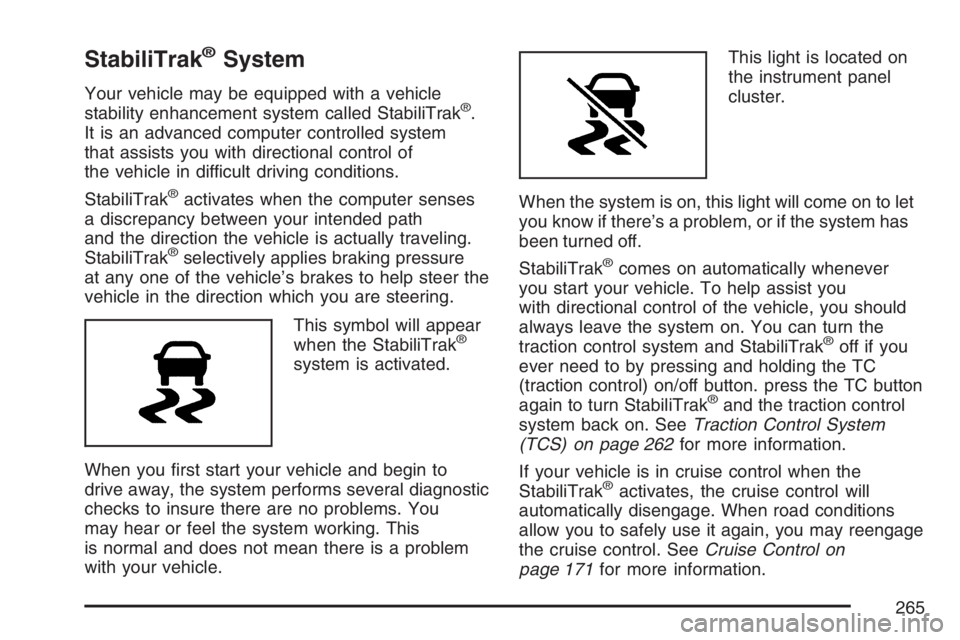
This symbol will appear
when the StabiliTrak
®
system is activated.
When you rst start your vehicle and begin to
drive away, the system performs several diagnostic
checks to insure there are no problems. You
may hear or feel the system working. This
is normal and does not mean there is a problem
with your vehicle.This light is located on
the instrument panel
cluster.
When the system is on, this light will come on to let
you know if there’s a problem, or if the system has
been turned off.
StabiliTrak
®comes on automatically whenever
you start your vehicle. To help assist you
with directional control of the vehicle, you should
always leave the system on. You can turn the
traction control system and StabiliTrak
®off if you
ever need to by pressing and holding the TC
(traction control) on/off button. press the TC button
again to turn StabiliTrak
®and the traction control
system back on. SeeTraction Control System
(TCS) on page 262for more information.
If your vehicle is in cruise control when the
StabiliTrak
®activates, the cruise control will
automatically disengage. When road conditions
allow you to safely use it again, you may reengage
the cruise control. SeeCruise Control on
page 171for more information.
265
Page 275 of 486
{CAUTION:
Wet brakes can cause accidents. They
may not work as well in a quick stop and
may cause pulling to one side. You could
lose control of the vehicle.
After driving through a large puddle of
water or a car wash, apply your brake pedal
lightly until your brakes work normally.
Driving too fast through large water puddles or
even going through some car washes can cause
problems, too. The water may affect your brakes.
Try to avoid puddles. But if you cannot, try to slow
down before you hit them.
Hydroplaning
Hydroplaning is dangerous. So much water can
build up under your tires that they can actually ride
on the water. This can happen if the road is wet
enough and you are going fast enough. When your
vehicle is hydroplaning, it has little or no contact
with the road.
Hydroplaning does not happen often. But it can if
your tires do not have much tread or if the
pressure in one or more is low. It can happen if a
lot of water is standing on the road. If you can
see reections from trees, telephone poles,
or other vehicles, and raindrops dimple the water’s
surface, there could be hydroplaning.
Hydroplaning usually happens at higher speeds.
There just is not a hard and fast rule about
hydroplaning. The best advice is to slow down
when it is raining.
275
Page 354 of 486
Brake Wear
Your vehicle has four-wheel disc brakes.
Disc brake pads have built-in wear indicators that
make a high-pitched warning sound when the brake
pads are worn and new pads are needed. The
sound may come and go or be heard all the time
your vehicle is moving, except when you are
pushing on the brake pedal rmly.
{CAUTION:
The brake wear warning sound means that
soon the brakes will not work well. That
could lead to an accident. When you hear
the brake wear warning sound, have your
vehicle serviced.
Notice:Continuing to drive with worn-out
brake pads could result in costly brake repair.Some driving conditions or climates may cause a
brake squeal when the brakes are rst applied
or lightly applied. This does not mean something
is wrong with your brakes.
Properly torqued wheel nuts are necessary to help
prevent brake pulsation. When tires are rotated,
inspect brake pads for wear and evenly tighten
wheel nuts in the proper sequence to GM torque
specications.
Brake linings should always be replaced as
complete axle sets.
Brake Pedal Travel
See your dealer if the brake pedal does not return
to normal height, or if there is a rapid increase
in pedal travel. This could be a sign of brake
trouble.
Brake Adjustment
Every time you apply the brakes, with or without
the vehicle moving, your brakes adjust for wear.
354
Page 357 of 486

Notice:Ignoring these steps could result in
costly damage to your vehicle that would
not be covered by your warranty.
Trying to start your vehicle by pushing or
pulling it will not work, and it could damage
your vehicle.
1. Check the other vehicle. It must have a
12-volt battery with a negative ground system.
Notice:If the other vehicle’s system is not a
12-volt system with a negative ground, both
vehicles can be damaged. Only use vehicles
with 12-volt systems with negative grounds to
jump start your vehicle.
2. Get the vehicles close enough so the jumper
cables can reach, but be sure the vehicles are
not touching each other. If they are, it could
cause a ground connection you do not want.
You would not be able to start your vehicle, and
the bad grounding could damage the electrical
systems.To avoid the possibility of the vehicles rolling,
set the parking brake rmly on both vehicles
involved in the jump start procedure. Put an
automatic transaxle in PARK (P) or a manual
transaxle in NEUTRAL before setting the
parking brake.
Notice:If you leave your radio or other
accessories on during the jump starting
procedure, they could be damaged. The repairs
would not be covered by your warranty. Always
turn off your radio and other accessories when
jump starting your vehicle.
3. Turn off the ignition on both vehicles. Unplug
unnecessary accessories plugged into the
cigarette lighter or the accessory power outlet.
Turn off the radio and all lamps that are not
needed. This will avoid sparks and help save
both batteries. And it could save the radio!
357
Page 436 of 486
Maintenance Footnotes
(a)Visually inspect brake lines and hoses for
proper hook-up, binding, leaks, cracks, chang,
etc. Inspect disc brake pads for wear and rotors for
surface condition. Inspect other brake parts,
including calipers, parking brake, etc.
(b)Visually inspect front and rear suspension and
steering system for damaged, loose, or missing
parts or signs of wear. Inspect electric power
steering cables for proper hook-up, binding,
cracks, chang, etc. Inspect hydraulic power
steering lines and hoses for proper hook-up,
binding, leaks, cracks, chang, etc.
(c)Visually inspect hoses and have them replaced
if they are cracked, swollen, or deteriorated.
Inspect all pipes, ttings and clamps; replace with
genuine GM parts as needed. To help ensure
proper operation, a pressure test of the cooling
system and pressure cap and cleaning the outside
of the radiator and air conditioning condenser is
recommended at least once a year.
(d)Visually inspect wiper blades for wear or
cracking. Replace blades that appear worn or
damaged or that streak or miss areas of the
windshield.(e)Make sure the safety belt reminder light and all
your belts, buckles, latch plates, retractors, and
anchorages are working properly. Look for
any other loose or damaged safety belt system
parts. If you see anything that might keep a safety
belt system from doing its job, have it repaired.
Have any torn or frayed safety belts replaced. Also
look for any opened or broken airbag coverings,
and have them repaired or replaced. The
airbag system does not need regular maintenance.
(f)Lubricate all key lock cylinders, door hinges
and latches, hood hinges and latches, and trunk lid
hinges and latches. More frequent lubrication
may be required when exposed to a corrosive
environment. Applying silicone grease on
weatherstrips with a clean cloth will make them
last longer, seal better, and not stick or squeak.
(g)Check system for interference or binding
and for damaged or missing parts. Replace parts
as needed. Replace any components that
have high effort or excessive wear. Do not
lubricate accelerator or cruise control cables.
436
Page 471 of 486

A
Accessories and Modications..................... 308
Accessory Power Outlet(s).......................... 181
Adding Equipment to Your
Airbag-Equipped Vehicle............................ 93
Additives, Fuel............................................ 311
Add-On Electrical Equipment....................... 415
Adjustable Throttle and Brake Pedal............ 127
Air Cleaner/Filter, Engine............................. 330
Air Conditioning..................................182, 187
Airbag
Passenger Status Indicator....................... 197
Readiness Light....................................... 196
Airbag Sensing and Diagnostic
Module (SDM).......................................... 461
Airbag System............................................... 76
Adding Equipment to Your
Airbag-Equipped Vehicle......................... 93
How Does an Airbag Restrain?.................. 85
Passenger Sensing System....................... 87
Servicing Your Airbag-Equipped Vehicle....... 92
What Makes an Airbag Inate?.................. 85
What Will You See After an Airbag
Inates?................................................. 86Airbag System (cont.)
When Should an Airbag Inate?................. 83
Where Are the Airbags?............................. 79
Antenna, Backglass..................................... 250
Antenna, Fixed Mast................................... 250
Antenna, XM™ Satellite Radio
Antenna System....................................... 251
Anti-Lock Brake System (ABS).................... 259
Anti-Lock Brake, System Warning Light....... 200
Appearance Care
Aluminum Wheels.................................... 410
Care of Safety Belts................................ 408
Chemical Paint Spotting........................... 412
Cleaning Exterior Lamps/Lenses.............. 409
Cleaning the Inside of Your Vehicle.......... 404
Fabric/Carpet........................................... 406
Finish Care.............................................. 409
Finish Damage......................................... 411
Instrument Panel, Vinyl, and
Other Plastic Surfaces.......................... 407
Leather.................................................... 407
Sheet Metal Damage............................... 411
Tires........................................................ 411
Underbody Maintenance........................... 412
Vehicle Care/Appearance Materials.......... 413
471
Page 472 of 486

Appearance Care (cont.)
Washing Your Vehicle.............................. 408
Weatherstrips........................................... 408
Windshield and Wiper Blades................... 410
Audio System(s).......................................... 219
Audio Steering Wheel Controls................. 248
Backglass Antenna................................... 250
Care of Your CD Player........................... 250
Care of Your CDs.................................... 250
Fixed Mast Antenna................................. 250
Radio with CD......................................... 221
Radio with Six-Disc CD............................ 231
Setting the Time for Radios with
Radio Data Systems (RDS).................. 221
Setting the Time for Radios without
Radio Data Systems (RDS).................. 220
Theft-Deterrent Feature............................ 248
Understanding Radio Reception............... 249
XM™ Satellite Radio Antenna System........ 251
Automatic Climate Control System............... 187
Automatic Door Lock................................... 110
Automatic Headlamp System....................... 177
Automatic Transaxle
Fluid...............................................332, 335
Operation................................................. 129B
Backglass Antenna...................................... 250
Battery........................................................ 355
Electric Power Management..................... 180
Run-Down Protection............................... 181
Before Leaving on a Long Trip.................... 279
Bench Seat, Split (60/40).............................. 20
Brake
Anti-Lock Brake System (ABS)................. 259
Emergencies............................................ 261
Parking.................................................... 135
System Warning Light.............................. 199
Brake Pedal, Throttle................................... 127
Brakes........................................................ 352
Braking....................................................... 258
Braking in Emergencies............................... 261
Break-In, New Vehicle................................. 122
Bulb Replacement....................................... 361
Center High-Mounted
Stoplamp (CHMSL)......................363, 364
Halogen Bulbs......................................... 361
Headlamps, Front Turn Signal,
Sidemarker, and Parking Lamps........... 362
License Plate Lamps................................ 368
472