Temperature PONTIAC G6 2007 Owner's Guide
[x] Cancel search | Manufacturer: PONTIAC, Model Year: 2007, Model line: G6, Model: PONTIAC G6 2007Pages: 486, PDF Size: 2.78 MB
Page 374 of 486
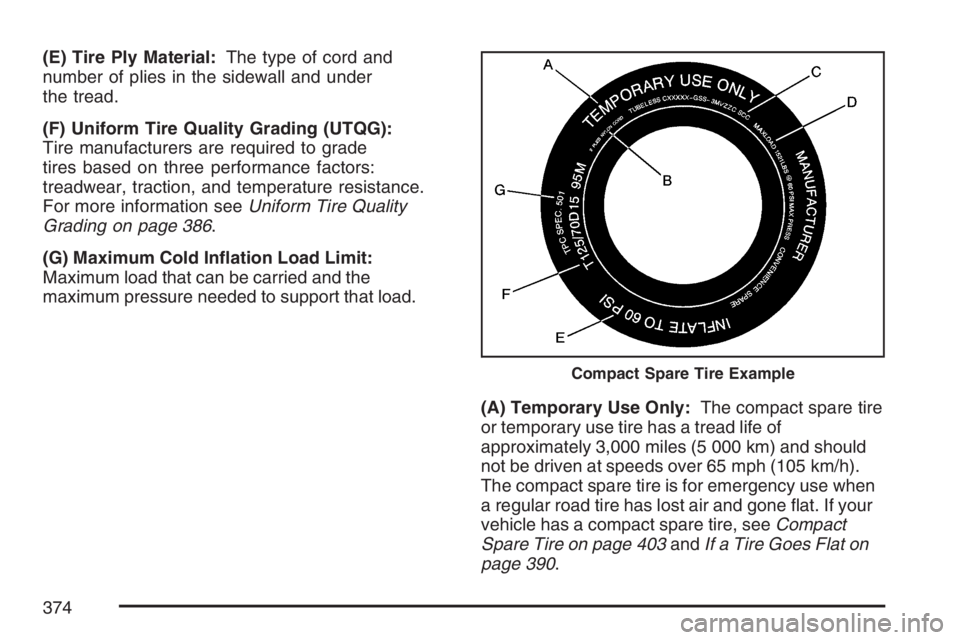
(E) Tire Ply Material:The type of cord and
number of plies in the sidewall and under
the tread.
(F) Uniform Tire Quality Grading (UTQG):
Tire manufacturers are required to grade
tires based on three performance factors:
treadwear, traction, and temperature resistance.
For more information seeUniform Tire Quality
Grading on page 386.
(G) Maximum Cold Ination Load Limit:
Maximum load that can be carried and the
maximum pressure needed to support that load.
(A) Temporary Use Only:The compact spare tire
or temporary use tire has a tread life of
approximately 3,000 miles (5 000 km) and should
not be driven at speeds over 65 mph (105 km/h).
The compact spare tire is for emergency use when
a regular road tire has lost air and gone at. If your
vehicle has a compact spare tire, seeCompact
Spare Tire on page 403andIf a Tire Goes Flat on
page 390.
Compact Spare Tire Example
374
Page 378 of 486

Occupant Distribution:Designated seating
positions.
Outward Facing Sidewall:The side of an
asymmetrical tire that has a particular side that
faces outward when mounted on a vehicle.
The side of the tire that contains a whitewall, bears
white lettering, or bears manufacturer, brand,
and/or model name molding that is higher
or deeper than the same moldings on the other
sidewall of the tire.
Passenger (P-Metric) Tire:A tire used on
passenger cars and some light duty trucks and
multipurpose vehicles.
Recommended Ination Pressure:Vehicle
manufacturer’s recommended tire ination pressure
as shown on the tire placard. SeeInation - Tire
Pressure on page 379andLoading Your Vehicle on
page 288.
Radial Ply Tire:A pneumatic tire in which
the ply cords that extend to the beads are laid
at 90 degrees to the centerline of the tread.
Rim:A metal support for a tire and upon which
the tire beads are seated.
Sidewall:The portion of a tire between the tread
and the bead.Speed Rating:An alphanumeric code assigned to
a tire indicating the maximum speed at which a tire
can operate.
Traction:The friction between the tire and the
road surface. The amount of grip provided.
Tread:The portion of a tire that comes into
contact with the road.
Treadwear Indicators:Narrow bands, sometimes
called wear bars, that show across the tread of a
tire when only 1/16 inch (1.6 mm) of tread remains.
SeeWhen It Is Time for New Tires on page 383.
UTQGS (Uniform Tire Quality Grading
Standards):A tire information system that
provides consumers with ratings for a tire’s
traction, temperature, and treadwear. Ratings are
determined by tire manufacturers using government
testing procedures. The ratings are molded into the
sidewall of the tire. SeeUniform Tire Quality
Grading on page 386.
Vehicle Capacity Weight:The number of
designated seating positions multiplied by 150 lbs
(68 kg) plus the rated cargo load. SeeLoading
Your Vehicle on page 288.
378
Page 386 of 486
Uniform Tire Quality Grading
Quality grades can be found where applicable on
the tire sidewall between tread shoulder and
maximum section width. For example:
Treadwear 200 Traction AA Temperature A
The following information relates to the system
developed by the United States National Highway
Traffic Safety Administration (NHTSA), which
grades tires by treadwear, traction, and
temperature performance. This applies only to
vehicles sold in the United States. The grades are
molded on the sidewalls of most passenger car
tires. The Uniform Tire Quality Grading (UTQG)
system does not apply to deep tread, winter-type
snow tires, space-saver, or temporary use spare
tires, tires with nominal rim diameters of
10 to 12 inches (25 to 30 cm), or to some
limited-production tires.
While the tires available on General Motors
passenger cars and light trucks may vary with
respect to these grades, they must also conform
to federal safety requirements and additional
General Motors Tire Performance Criteria (TPC)
standards.
Treadwear
The treadwear grade is a comparative rating
based on the wear rate of the tire when tested
under controlled conditions on a specied
government test course. For example, a tire
graded 150 would wear one and a half (1.5) times
as well on the government course as a tire
graded 100. The relative performance of tires
depends upon the actual conditions of their use,
however, and may depart signicantly from
the norm due to variations in driving habits, service
practices, and differences in road characteristics
and climate.
Traction – AA, A, B, C
The traction grades, from highest to lowest, are AA,
A, B, and C. Those grades represent the tire’s
ability to stop on wet pavement as measured under
controlled conditions on specied government test
surfaces of asphalt and concrete. A tire marked C
may have poor traction performance.
Warning:The traction grade assigned to this tire
is based on straight-ahead braking traction tests,
and does not include acceleration, cornering,
hydroplaning, or peak traction characteristics.
386
Page 387 of 486
Temperature – A, B, C
The temperature grades are A (the highest), B,
and C, representing the tire’s resistance to the
generation of heat and its ability to dissipate heat
when tested under controlled conditions on a
specied indoor laboratory test wheel. Sustained
high temperature can cause the material of the tire
to degenerate and reduce tire life, and excessive
temperature can lead to sudden tire failure. The
grade C corresponds to a level of performance
which all passenger car tires must meet under the
Federal Motor Vehicle Safety Standard No. 109.
Grades B and A represent higher levels of
performance on the laboratory test wheel
than the minimum required by law.
Warning:The temperature grade for this tire is
established for a tire that is properly inated and not
overloaded. Excessive speed, underination, or
excessive loading, either separately or in
combination, can cause heat buildup and
possible tire failure.
Wheel Alignment and Tire Balance
The tires and wheels on your vehicle were aligned
and balanced carefully at the factory to give you
the longest tire life and best overall performance.
Adjustments to wheel alignment and tire balancing
will not be necessary on a regular basis. However,
if you notice unusual tire wear or your vehicle
pulling to one side or the other, the alignment may
need to be checked. If you notice your vehicle
vibrating when driving on a smooth road, your tires
and wheels may need to be rebalanced. See your
dealer for proper diagnosis.
387
Page 437 of 486

(h)Change automatic transaxle uid and lter if
the vehicle is mainly driven under one or more of
these conditions:
In heavy city traffic where the outside
temperature regularly reaches 90°F (32°C) or
higher.
In hilly or mountainous terrain.
When doing frequent trailer towing.
Uses such as found in taxi, police, or delivery
service.
If you do not use your vehicle under any of these
conditions, the uid and lter do not require
changing.
(i)Drain, ush, and rell cooling system. This
service can be complex; you should have
your dealer perform this service. See Engine
Coolant on page 339 for what to use. Inspect
hoses. Clean radiator, condenser, pressure cap,
and ller neck. Pressure test the cooling
system and pressure cap.
(j)A uid loss in any vehicle system could indicate
a problem. Have the system inspected and
repaired and the uid level checked. Add uid if
needed.(k)If you drive regularly under dusty conditions,
inspect the lter at each engine oil change.
(l)Change automatic transaxle uid if the vehicle
is mainly driven under one or more of these
conditions:
In heavy city traffic where the outside
temperature regularly reaches 90°F (32°C) or
higher.
In hilly or mountainous terrain.
When doing frequent trailer towing.
Uses such as found in taxi, police, or delivery
service.
If you do not use your vehicle under any of these
conditions, the uid does not require changing.
(m)Visually inspect belt for fraying, excessive
cracks, or obvious damage. Replace belt if
necessary.
437
Page 474 of 486

Cleaning (cont.)
Underbody Maintenance........................... 412
Washing Your Vehicle.............................. 408
Weatherstrips........................................... 408
Windshield and Wiper Blades................... 410
Climate Control System............................... 182
Automatic................................................. 187
Outlet Adjustment..................................... 191
Clutch, Hydraulic......................................... 338
Collision Damage Repair............................. 462
Comfort Guides, Rear Safety Belt................. 42
Compact Spare Tire.................................... 403
Compass............................................143, 145
Content Theft-Deterrent............................... 118
Control of a Vehicle..................................... 258
Convenience Net......................................... 150
Coolant
Engine Temperature Gage........................ 203
Heater, Engine......................................... 128
Cooling System........................................... 345
Courtesy Lamps.......................................... 178
Cruise Control............................................. 171
Cruise Control Light.................................... 208
Cupholder(s)................................................ 150Customer Assistance Information
Courtesy Transportation........................... 459
Customer Assistance for Text
Telephone (TTY) Users ......................... 454
Customer Assistance Offices.................... 454
Customer Satisfaction Procedure.............. 450
GM Mobility Reimbursement Program........ 455
Reporting Safety Defects to
General Motors..................................... 467
Reporting Safety Defects to the
Canadian Government.......................... 467
Reporting Safety Defects to the
United States Government.................... 466
Roadside Assistance Program.................. 456
Service Publications Ordering
Information........................................... 468
D
Daytime Running Lamps............................. 176
Defensive Driving........................................ 254
Delayed Headlamps.................................... 176
Delayed Locking.......................................... 110
Doing Your Own Service Work.................... 309
474
Page 475 of 486

Dome Lamp................................................ 179
Door
Automatic Door Lock................................ 110
Delayed Locking...................................... 110
Door Ajar Reminder................................. 109
Locks....................................................... 108
Power Door Locks................................... 109
Programmable Automatic Door Unlock....... 111
Rear Door Security Locks........................ 111
Driver
Position, Safety Belt................................... 27
Driver Information Center (DIC)................... 209
DIC Operation and Displays..................... 209
DIC Vehicle Personalization..................... 216
DIC Warnings and Messages................... 212
Driving
At Night................................................... 272
City.......................................................... 277
Defensive................................................. 254
Drunken................................................... 255
Freeway................................................... 278
Hill and Mountain Roads.......................... 280
In Rain and on Wet Roads...................... 274
Rocking Your Vehicle to Get it Out.......... 288
Winter...................................................... 282E
Easy Entry Seat............................................ 17
Electrical System
Add-On Equipment................................... 415
Engine Compartment Fuse Block............. 418
Fuses...................................................... 415
Instrument Panel Fuse Block................... 416
Power Windows and Other Power
Options................................................. 415
Rear Compartment Fuse Block ................ 421
Windshield Wiper Fuses........................... 415
Engine
Air Cleaner/Filter...................................... 330
Battery..................................................... 355
Check and Service Engine Soon Light........ 204
Coolant.................................................... 339
Coolant Heater......................................... 128
Coolant Temperature Gage...................... 203
Drive Belt Routing.................................... 444
Engine Compartment Overview ................ 318
Exhaust................................................... 140
Oil ........................................................... 325
Oil Life System........................................ 328
475
Page 477 of 486
G
Gage
Engine Coolant Temperature.................... 203
Fuel......................................................... 208
Speedometer........................................... 194
Tachometer.............................................. 194
Gasoline
Octane..................................................... 310
Specications........................................... 310
Glove Box................................................... 150
GM Mobility Reimbursement Program.......... 455
H
Hazard Warning Flashers............................ 166
Head Restraints............................................ 15
Headlamps.................................................. 174
Automatic Headlamp System.................... 177
Bulb Replacement.................................... 361
Daytime Running Lamps.......................... 176
Delayed................................................... 176
Flash-to-Pass........................................... 169
Halogen Bulbs......................................... 361Headlamps (cont.)
Headlamps, Front Turn Signal,
Sidemarker, and Parking Lamps........... 362
High/Low Beam Changer......................... 169
On Reminder........................................... 175
Headlamps Off in Park (P).......................... 175
Heated Seats................................................ 11
Heater................................................182, 187
Highbeam On Light..................................... 208
High-Speed Operation, Tires........................ 381
Highway Hypnosis....................................... 280
Hill and Mountain Roads............................. 280
Hood
Checking Things Under............................ 316
Release................................................... 317
Horn............................................................ 167
How to Use This Manual ................................ 4
How to Wear Safety Belts Properly............... 27
Hydraulic Clutch.......................................... 338
I
Ignition Positions......................................... 122
Infants and Young Children, Restraints .......... 49
Ination - Tire Pressure............................... 379
477