instrument panel PONTIAC G6 2008 User Guide
[x] Cancel search | Manufacturer: PONTIAC, Model Year: 2008, Model line: G6, Model: PONTIAC G6 2008Pages: 408, PDF Size: 5.61 MB
Page 93 of 408

To cancel the rear door security lock, do the following:
1. Unlock the door and open it from the outside.
2. Insert the key into the security lock slot and turn it
so the slot is in the vertical position.
3. Do the same for the other rear door.
Lockout Protection
This feature prevents the driver’s door from being
locked using the power door locks, if the key is left in
the ignition and a door is open.
Press the power door lock switch to lock all the doors
and then unlock the driver’s door.
Press and hold the power door lock switch for more
than three seconds to override this feature.
If the key is removed from the ignition, or if the manual
door lock or the Remote Keyless Entry (RKE)
transmitter is used, the key could still be locked inside
the vehicle. Always remember to take the key with you.
Trunk
To open the trunk from the outside, press and hold the
trunk release button on the Remote Keyless Entry
(RKE) transmitter. You can also use the key in the trunk
lock, except on retractable hardtop models.Use the pull cup to aid in closing the trunk.
{CAUTION:
It can be dangerous to drive with the trunk lid
open because carbon monoxide (CO) gas can
come into your vehicle. You cannot see or
smell CO. It can cause unconsciousness and
even death. If you must drive with the trunk lid
open or if electrical wiring or other cable
connections must pass through the seal
between the body and the trunk lid:
Make sure all other windows are shut.
Turn the fan on your heating or cooling
system to its highest speed and select the
control setting that will force outside air
into your vehicle. See Climate Control
System.
If you have air outlets on or under the
instrument panel, open them all the way.
SeeEngine Exhaust on page 2-35.
2-13
Page 98 of 408

Sun Visors
Swing down the visors to block glare. The visors can be
removed from the center mount and swung to the
side. The visors also have extenders that can be pulled
out for additional blockage.
Your vehicle may have lighted vanity mirrors on the
driver’s and passenger’s visors. When you lift the cover,
the light will turn on.
Theft-Deterrent Systems
Vehicle theft is big business, especially in some cities.
Although your vehicle has a number of theft-deterrent
features, we know that nothing we put on it can make it
impossible to steal.
Content Theft-Deterrent
Your vehicle may have a
content theft-deterrent
alarm system.
Arming the System
With the ignition off, you can arm the system by
pressing the Remote Keyless Entry (RKE) transmitter
lock button.
The system will arm 30 seconds after all the doors are
closed, or 60 seconds with any door open.
If you press the lock button on the transmitter a second
time while all the doors are closed, the system will
arm immediately. The system will still arm in 60 seconds
if a door is open. When the open door is closed, the
system will arm.
The security light, located on the instrument panel
cluster, comes on to indicate that arming has been
initiated. Once the system is armed, the security light will
ash once every three seconds.
If the security light is ashing twice per second, this
means that a door is open.
If the system is armed and the key is used to unlock the
vehicle, the alarm will be activated.
If you do not want to arm the content theft system, lock
the vehicle with the manual lock knob on the doors
or with the inside power door lock switches.
The alarm will sound and the exterior lights will ash if
any door is opened while armed.
2-18
Page 102 of 408

Ignition Positions
With the key in the ignition
switch, you can turn it to
four different positions.
Notice:Using a tool to force the key from the
ignition switch could cause damage or break the
key. Use the correct key and turn the key only with
your hand. Make sure the key is in all the way. If
none of this works, then your vehicle needs service.
9(LOCK/OFF):This is the only position from
which you can remove the key. The shift lever must be
in PARK (P) with the ignition in LOCK/OFF to remove
the key.ACC (ACC/ACCESSORY):This position unlocks the
transmission. It also lets you use things like the
radio and windshield wipers while the engine is not
running. To use ACC/ACCESSORY, turn the key
clockwise to the rst position. Use this position if your
vehicle must be pushed or towed. SeeRecreational
Vehicle Towing on page 4-26.
Never try to push-start your vehicle.
R(ON/RUN):This position is where the key returns to
after you start the engine and release the key. The
ignition switch will stay in this position while the engine
is running. But even while the engine is not running,
you can use ON/RUN to operate your electrical
accessories and to display some instrument panel
warning lights. Use the ON/RUN position for
push-starting a vehicle with a manual transmission.
The battery could be drained if you leave the key in the
ACC/ACCESSORY or ON/RUN position with the
engine off. You may not be able to start your vehicle if
the battery is allowed to drain for an extended period
of time.
/(START):This position starts the engine. When the
engine starts, release the key. The ignition switch
will return to the ON/RUN position for normal driving.
2-22
Page 105 of 408
Adjustable Throttle and Brake Pedal
If your vehicle has this feature, you can change the
position of the throttle and brake pedals. This feature is
designed for shorter drivers, since the pedals cannot
move farther away from the standard position, but can
move rearward for better pedal reach.
The ignition must be off or the vehicle in PARK (P) for
this feature to work. The feature will not work if your foot
is pushing on the throttle or brake pedal. Remove
your foot from the pedals and press the switch again.
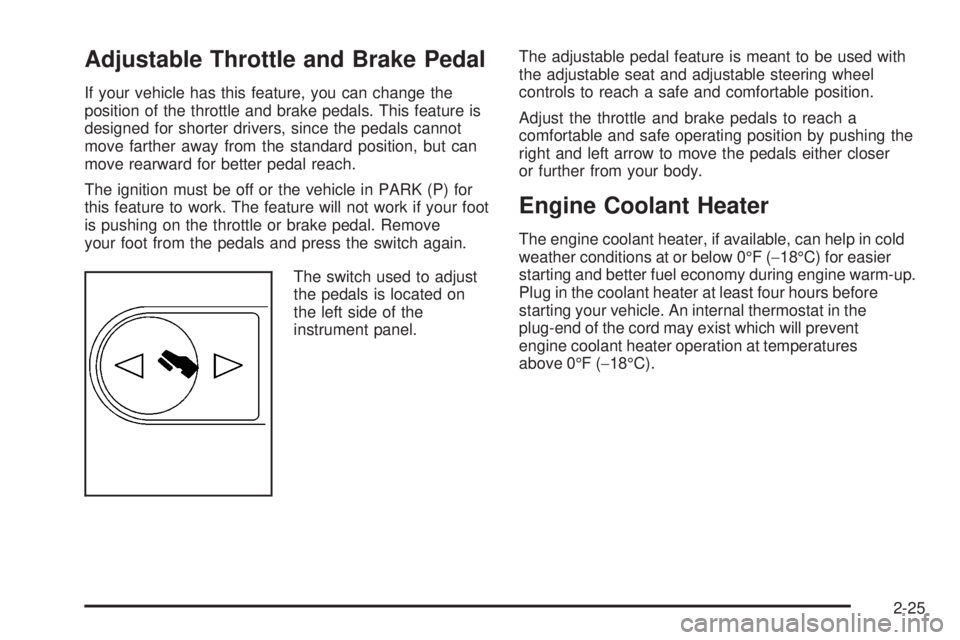
The switch used to adjust
the pedals is located on
the left side of the
instrument panel.The adjustable pedal feature is meant to be used with
the adjustable seat and adjustable steering wheel
controls to reach a safe and comfortable position.
Adjust the throttle and brake pedals to reach a
comfortable and safe operating position by pushing the
right and left arrow to move the pedals either closer
or further from your body.
Engine Coolant Heater
The engine coolant heater, if available, can help in cold
weather conditions at or below 0°F (−18°C) for easier
starting and better fuel economy during engine warm-up.
Plug in the coolant heater at least four hours before
starting your vehicle. An internal thermostat in the
plug-end of the cord may exist which will prevent
engine coolant heater operation at temperatures
above 0°F (−18°C).
2-25
Page 109 of 408
THIRD (3):This position, available on the SE model, is
also used for normal driving. However, it reduces
vehicle speed more than DRIVE (D) without using your
brakes. Here are some times you might choose
THIRD (3) instead of DRIVE (D):
When driving on hilly, winding roads.
When towing a trailer, so there is less shifting
between gears.
When going down a steep hill.
LOW (L):This position, available on the SE model,
reduces vehicle speed more than THIRD (3) without
using your brakes. You can use LOW (L) on hills. It can
help control your speed as you go down steep
mountain roads, but then you would also want to use
your brakes off and on.
You can use LOW (L) on very steep hills, or in deep
snow or mud. If the shift lever is put in LOW (L),
the transmission will not shift into rst gear until the
vehicle is going slowly enough.
Notice:Driving in LOW (L) for more than 25 miles
(40 km) or at speeds over 55 mph (90 km/h) may
damage the transmission. Also, shifting into
LOW (L) at speeds above 65 mph (105 km/h) can
cause damage. Drive in THIRD (3) or DRIVE (D)
instead of LOW (L).Notice:Spinning the tires or holding the vehicle in
one place on a hill using only the accelerator
pedal may damage the transmission. The repair will
not be covered by your warranty. If you are stuck,
do not spin the tires. When stopping on a hill,
use the brakes to hold the vehicle in place.
MANUAL MODE (M):This position, available on the
GT/GXP models, allows you to change gears similar to a
manual transmission. If your vehicle has this feature,
see Manual Shift Mode (MSM) following.
Manual Shift Mode (MSM) (Automatic
Transmission)
To use this feature, do the following:
1. Move the shift lever from DRIVE (D) rearward and
then to the right into the MANUAL MODE (M).
While driving in manual shift mode, the transmission
will remain in the driver gear selected.
2. Press the shift level forward to upshift or rearward
to downshift.
The odometer display on the instrument panel cluster
will change from the vehicle’s mileage to the letter M, for
manual shift mode, and a number indicating the
requested gear range when moving the shift lever
forward or rearward. SeeSpeedometer and Odometer
on page 3-29for more information.
2-29
Page 133 of 408
Instrument Panel Overview...............................3-4
Hazard Warning Flashers................................3-6
Other Warning Devices...................................3-6
Horn.............................................................3-6
Tilt Wheel.....................................................3-6
Turn Signal/Multifunction Lever.........................3-7
Turn and Lane-Change Signals........................3-8
Headlamp High/Low-Beam Changer..................3-8
Flash-to-Pass.................................................3-8
Windshield Wipers..........................................3-9
Windshield Washer.......................................3-10
Cruise Control..............................................3-10
Headlamps..................................................3-13
Headlamps on Reminder................................3-14
Headlamps Off in PARK (P)...........................3-14
Delayed Headlamps......................................3-14
Daytime Running Lamps (DRL).......................3-14
Automatic Headlamp System..........................3-15
Fog Lamps..................................................3-16
Instrument Panel Brightness...........................3-16
Courtesy Lamps...........................................3-16
Dome Lamp.................................................3-17
Entry/Exit Lighting.........................................3-17
Parade Dimming...........................................3-17Overhead Console Reading Lamps.................3-17
Trunk Lamp.................................................3-17
Battery Run-Down Protection..........................3-18
Accessory Power Outlet(s).............................3-18
Climate Controls............................................3-19
Climate Control System.................................3-19
Automatic Climate Control System...................3-23
Outlet Adjustment.........................................3-26
Warning Lights, Gages, and Indicators............3-27
Instrument Panel Cluster...............................
.3-28
Speedometer and Odometer...........................3-29
Trip Odometer..............................................3-29
Tachometer.................................................3-29
Safety Belt Reminders...................................3-30
Airbag Readiness Light..................................3-30
Passenger Airbag Status Indicator...................3-31
Charging System Light..................................3-33
Brake System Warning Light..........................3-34
Antilock Brake System Warning Light...............3-35
Traction Control System (TCS)
Warning Light...........................................3-35
Traction Control System (TCS) Active Light......3-36
StabiliTrak
®Not Ready Light..........................3-36
Section 3 Instrument Panel
3-1
Page 134 of 408
StabiliTrak®Indicator Light..............................3-36
Engine Coolant Temperature Gage..................3-37
Tire Pressure Light.......................................3-37
Malfunction Indicator Lamp.............................3-38
Oil Pressure Light.........................................3-41
Security Light...............................................3-41
Cruise Control Light......................................3-42
Highbeam On Light.......................................3-42
Fuel Gage...................................................3-42
Low Fuel Warning Light.................................3-42
Driver Information Center (DIC).......................3-43
DIC Operation and Displays...........................3-43
DIC Warnings and Messages.........................3-46
DIC Vehicle Personalization............................3-50Audio System(s).............................................3-52
Setting the Clock..........................................3-53
Radio(s)......................................................3-54
XM Radio Messages.....................................3-66
Theft-Deterrent Feature..................................3-67
Audio Steering Wheel Controls.......................3-67
Radio Reception...........................................3-68
Fixed Mast Antenna......................................3-68
Backglass Antenna.......................................3-69
XM™ Satellite Radio Antenna System.............3-69
Section 3 Instrument Panel
3-2
Page 136 of 408
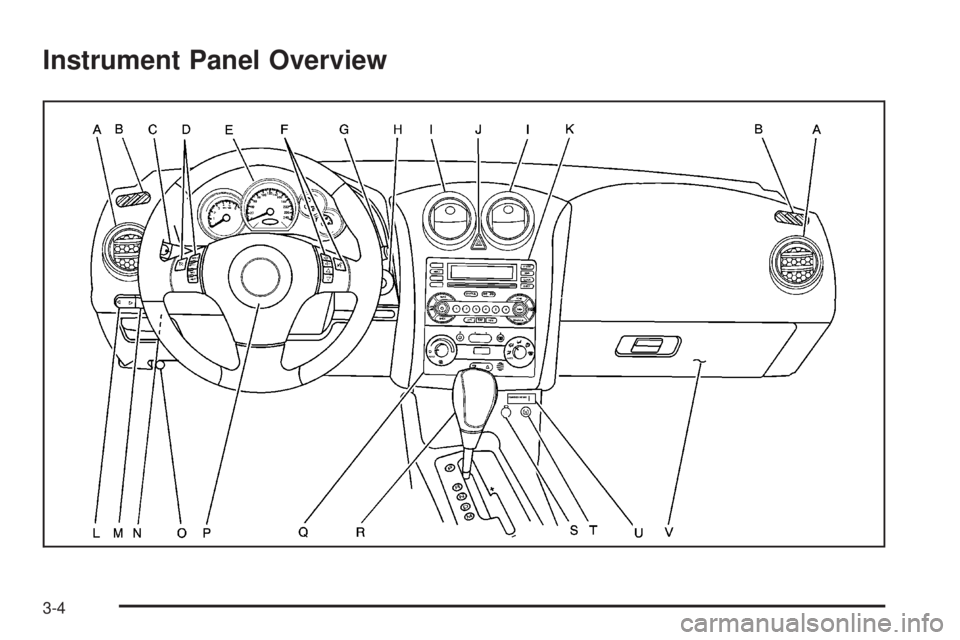
Instrument Panel Overview
3-4
Page 137 of 408
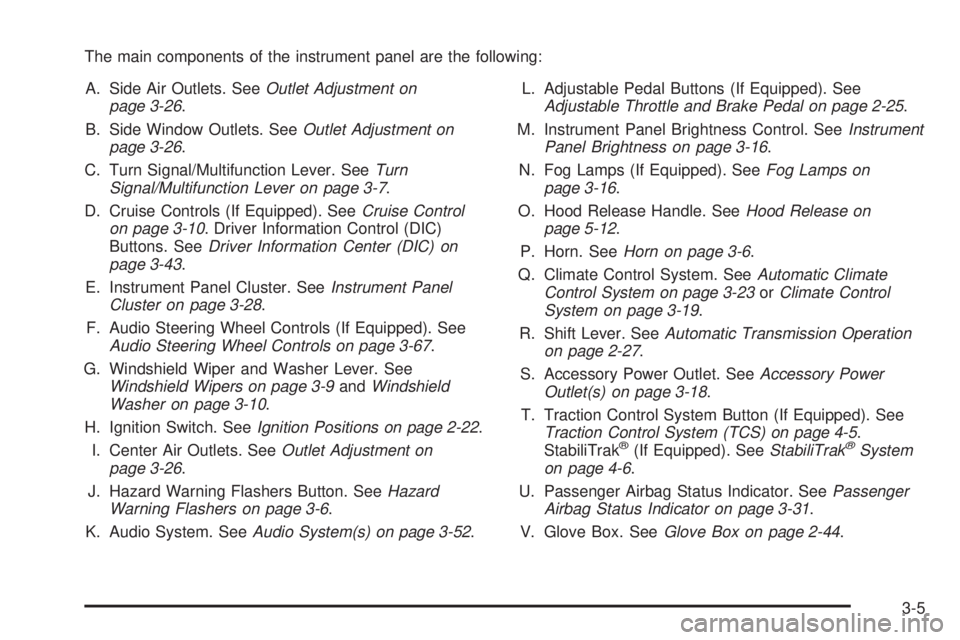
The main components of the instrument panel are the following:
A. Side Air Outlets. SeeOutlet Adjustment on
page 3-26.
B. Side Window Outlets. SeeOutlet Adjustment on
page 3-26.
C. Turn Signal/Multifunction Lever. SeeTurn
Signal/Multifunction Lever on page 3-7.
D. Cruise Controls (If Equipped). SeeCruise Control
on page 3-10. Driver Information Control (DIC)
Buttons. SeeDriver Information Center (DIC) on
page 3-43.
E. Instrument Panel Cluster. SeeInstrument Panel
Cluster on page 3-28.
F. Audio Steering Wheel Controls (If Equipped). See
Audio Steering Wheel Controls on page 3-67.
G. Windshield Wiper and Washer Lever. See
Windshield Wipers on page 3-9andWindshield
Washer on page 3-10.
H. Ignition Switch. SeeIgnition Positions on page 2-22.
I. Center Air Outlets. SeeOutlet Adjustment on
page 3-26.
J. Hazard Warning Flashers Button. SeeHazard
Warning Flashers on page 3-6.
K. Audio System. SeeAudio System(s) on page 3-52.L. Adjustable Pedal Buttons (If Equipped). See
Adjustable Throttle and Brake Pedal on page 2-25.
M. Instrument Panel Brightness Control. SeeInstrument
Panel Brightness on page 3-16.
N. Fog Lamps (If Equipped). SeeFog Lamps on
page 3-16.
O. Hood Release Handle. SeeHood Release on
page 5-12.
P. Horn. SeeHorn on page 3-6.
Q. Climate Control System. SeeAutomatic Climate
Control System on page 3-23orClimate Control
System on page 3-19.
R. Shift Lever. SeeAutomatic Transmission Operation
on page 2-27.
S. Accessory Power Outlet. SeeAccessory Power
Outlet(s) on page 3-18.
T. Traction Control System Button (If Equipped). See
Traction Control System (TCS) on page 4-5.
StabiliTrak
®(If Equipped). SeeStabiliTrak®System
on page 4-6.
U. Passenger Airbag Status Indicator. SeePassenger
Airbag Status Indicator on page 3-31.
V. Glove Box. SeeGlove Box on page 2-44.
3-5
Page 138 of 408
Hazard Warning Flashers
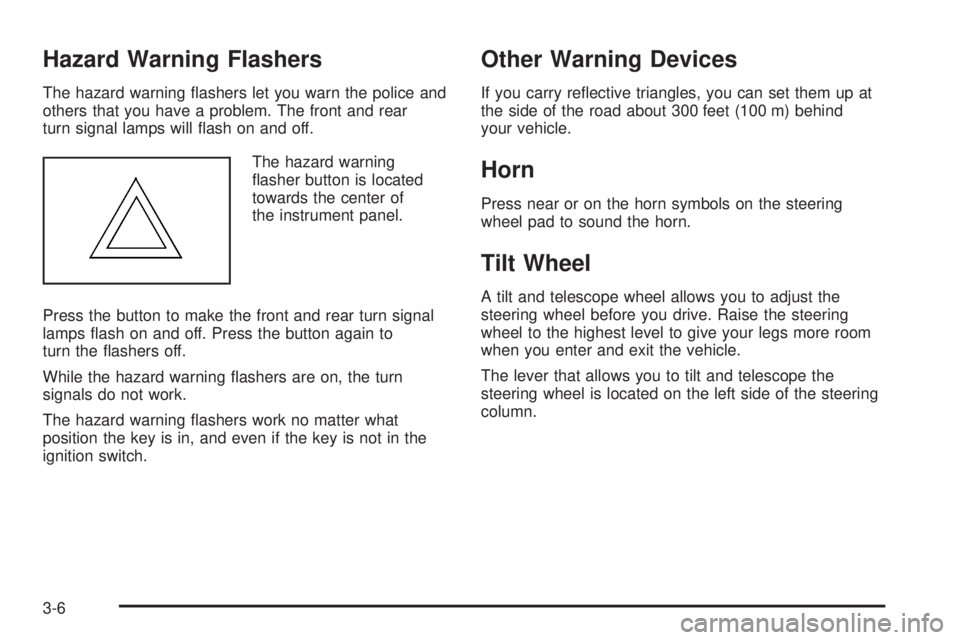
The hazard warning ashers let you warn the police and
others that you have a problem. The front and rear
turn signal lamps will ash on and off.
The hazard warning
asher button is located
towards the center of
the instrument panel.
Press the button to make the front and rear turn signal
lamps ash on and off. Press the button again to
turn the ashers off.
While the hazard warning ashers are on, the turn
signals do not work.
The hazard warning ashers work no matter what
position the key is in, and even if the key is not in the
ignition switch.
Other Warning Devices
If you carry reective triangles, you can set them up at
the side of the road about 300 feet (100 m) behind
your vehicle.
Horn
Press near or on the horn symbols on the steering
wheel pad to sound the horn.
Tilt Wheel
A tilt and telescope wheel allows you to adjust the
steering wheel before you drive. Raise the steering
wheel to the highest level to give your legs more room
when you enter and exit the vehicle.
The lever that allows you to tilt and telescope the
steering wheel is located on the left side of the steering
column.
3-6