ECU PONTIAC G6 2008 Workshop Manual
[x] Cancel search | Manufacturer: PONTIAC, Model Year: 2008, Model line: G6, Model: PONTIAC G6 2008Pages: 408, PDF Size: 5.61 MB
Page 229 of 408

For vehicles that can be dinghy towed with all four
wheels on the ground:
1. Position the vehicle to tow and then secure it.
2. Turn the ignition to LOCK/OFF.
3. Set the parking brake.
4. To prevent your battery from draining while the
vehicle is being towed, remove the following
fuse from the instrument panel fuse block: (IGN
SENSOR). SeeInstrument Panel Fuse Block
on page 5-110for more information.5. Turn the ignition to ACC/ACCESSORY.
6. Shift your transmission to NEUTRAL (N).
7. Release the parking brake.
Notice:If you exceed 65 mph (105 km/h) while
towing your vehicle, it could be damaged. Never
exceed 65 mph (105 km/h) while towing your vehicle.
Notice:Towing your vehicle from the rear could
damage it. Also, repairs would not be covered by
the warranty. Never have your vehicle towed
from the rear.
4-27
Page 232 of 408
Maximum trailer weight is calculated assuming only the
driver is in the tow vehicle and it has all the required
trailering equipment. The weight of additional optional
equipment, passengers and cargo in the tow vehicle
must be subtracted from the maximum trailer weight.
When towing a trailer on long uphill grades and
the outside temperature is above 85°F (29°C), reduce
your vehicle speed to 45 mph (72 km/h) to avoid
overheating the engine cooling system.
Ask your dealer/retailer for additional trailering
information or advice, or write us at our Customer
Assistance Offices. SeeCustomer Assistance Offices on
page 7-5for more information.
Weight of the Trailer Tongue
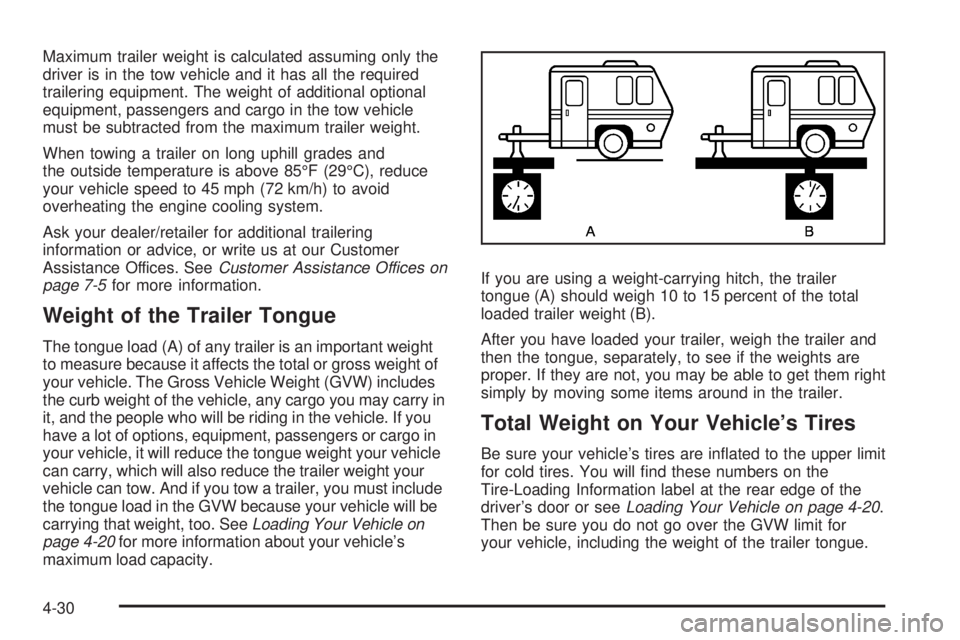
The tongue load (A) of any trailer is an important weight
to measure because it affects the total or gross weight of
your vehicle. The Gross Vehicle Weight (GVW) includes
the curb weight of the vehicle, any cargo you may carry in
it, and the people who will be riding in the vehicle. If you
have a lot of options, equipment, passengers or cargo in
your vehicle, it will reduce the tongue weight your vehicle
can carry, which will also reduce the trailer weight your
vehicle can tow. And if you tow a trailer, you must include
the tongue load in the GVW because your vehicle will be
carrying that weight, too. SeeLoading Your Vehicle on
page 4-20for more information about your vehicle’s
maximum load capacity.If you are using a weight-carrying hitch, the trailer
tongue (A) should weigh 10 to 15 percent of the total
loaded trailer weight (B).
After you have loaded your trailer, weigh the trailer and
then the tongue, separately, to see if the weights are
proper. If they are not, you may be able to get them right
simply by moving some items around in the trailer.
Total Weight on Your Vehicle’s Tires
Be sure your vehicle’s tires are inated to the upper limit
for cold tires. You will nd these numbers on the
Tire-Loading Information label at the rear edge of the
driver’s door or seeLoading Your Vehicle on page 4-20.
Then be sure you do not go over the GVW limit for
your vehicle, including the weight of the trailer tongue.
4-30
Page 234 of 408

During your trip, check occasionally to be sure that the
load is secure, and that the lamps and any trailer
brakes are still working.
Following Distance
Stay at least twice as far behind the vehicle ahead as
you would when driving your vehicle without a trailer.
This can help you avoid situations that require
heavy braking and sudden turns.
Passing
You will need more passing distance up ahead when you
are towing a trailer. And, because you’re a good deal
longer, you’ll need to go much farther beyond the passed
vehicle before you can return to your lane.
Backing Up
Hold the bottom of the steering wheel with one hand.
Then, to move the trailer to the left, just move that hand
to the left. To move the trailer to the right, move your
hand to the right. Always back up slowly and, if possible,
have someone guide you.
Making Turns
Notice:Making very sharp turns while trailering
could cause the trailer to come in contact with the
vehicle. Your vehicle could be damaged. Avoid
making very sharp turns while trailering.
When you are turning with a trailer, make wider turns
than normal. Do this so your trailer will not strike
soft shoulders, curbs, road signs, trees or other objects.
Avoid jerky or sudden maneuvers. Signal well in
advance.
Turn Signals When Towing a Trailer
When you tow a trailer, your vehicle may need a
different turn signal asher and/or extra wiring. Check
with your dealer/retailer. The arrows on your instrument
panel will ash whenever you signal a turn or lane
change. Properly hooked up, the trailer lamps will also
ash, telling other drivers you are about to turn,
change lanes or stop.
When towing a trailer, the arrows on your instrument
panel will ash for turns even if the bulbs on the trailer
are burned out. Thus, you may think drivers behind
you are seeing your signal when they are not. It
is important to check occasionally to be sure the trailer
bulbs are still working.
4-32
Page 269 of 408
Adding Coolant
If you need more coolant, add the proper DEX-COOL®
coolant mixture at the surge tank, but only when the
engine is cool. If the surge tank is empty, a special ll
procedure is necessary. SeeEngine Overheating
on page 5-33andCooling System on page 5-36.
{CAUTION:
You can be burned if you spill coolant on hot
engine parts. Coolant contains ethylene glycol,
and it will burn if the engine parts are hot
enough. Do not spill coolant on a hot engine.
When replacing the pressure cap, make sure it is
hand-tight and fully seated.
Pressure Cap
Notice:If the pressure cap is not tightly installed,
coolant loss and possible engine damage may
occur. Be sure the cap is properly and tightly
secured.
SeeEngine Compartment Overview on page 5-14for
more information on location.
Engine Overheating
There is an engine coolant temperature gage on your
vehicle’s instrument panel. SeeEngine Coolant
Temperature Gage on page 3-37.
5-33
Page 286 of 408

7. Do not let the other end touch metal. Connect it to
the positive (+) terminal of the good battery. Use a
remote positive (+) terminal if the vehicle has one.
8. Now connect the black negative (−) cable to the
negative (−) terminal of the good battery. Use a
remote negative (−) terminal if the vehicle has one.
Do not let the other end touch anything until the
next step. The other end of the negative (−) cable
does not go to the dead battery. It goes to a
heavy, unpainted metal engine part or to a remote
negative (−) terminal on the vehicle with the
dead battery.
9. Connect the other end of the negative (−) cable at
least 18 inches (45 cm) away from the dead battery,
but not near engine parts that move. The electrical
connection is just as good there, and the chance
of sparks getting back to the battery is much less.
If the security light ashes, wait until the light
stops ashing.10. Now start the vehicle with the good battery and run
the engine for a while.
11. Try to start the vehicle that had the dead battery.
If it will not start after a few tries, it probably needs
service.
Notice:If the jumper cables are connected or
removed in the wrong order, electrical shorting may
occur and damage the vehicle. The repairs would
not be covered by your warranty. Always connect
and remove the jumper cables in the correct
order, making sure that the cables do not touch
each other or other metal.
5-50
Page 289 of 408

To replace one of these bulbs:
1. Remove the two screws that secure the headlamp
assembly.
2. Loosen the front fascia by removing the plastic
push pins along the top of the tie bar by prying
under the fasteners with a tool.3. Pull back the front fascia then pull the headlamp
assembly forward, out of the vehicle. You need to
pry the headlamp assembly away from the
fender. This frees the ball stud from its retainer in
the fender bracket.
You might want someone to assist you with the
removal of the headlamp assembly to avoid possible
damage to the vehicle.
4. Remove the bulb access cover by turning it
counterclockwise.
5. Turn the bulb socket counterclockwise and pull out
the bulb assembly.
6. Disconnect the bulb socket from the wiring harness
for headlamps.
For the front turn signal/parking or sidemarker
bulbs, unclip the bulb from the socket.
7. Install a new bulb.
8. Reverse Steps 1 through 4 to reinstall the bulb
assembly and headlamp assembly.
5-53
Page 333 of 408

4. With the valve stem up, place the tire on the
compartment oor with the rear of the tire beneath
the trim panel. The tire may not lay completely at.
5. Line up a the wheel center hole or a wheel nut hole
with the bolt.
6. With the cap in place to prevent the wheel from
being scratched, screw the bolt extension onto
the bolt through the wheel hole aligned with the bolt.
7. Remove the yellow cap from the bolt extension.
8. Secure the tire and wheel with the larger wing nut.
A. Cover
B. Wing Nut
C. Flat Tire (valve stem
up) or Compact
Spare TireD. Extension
E. Nut
F. Jack
G. Bolt
The compact spare is for temporary use only. Replace
the compact spare tire with a full-size tire as soon
as you can. SeeCompact Spare Tire on page 5-99.
5-97
Page 334 of 408

GXP and Retractable Hardtop Models
To store the at tire and jack in the compact spare
tire compartment:
1. Make sure the retractable hardtop is in the up
position.
2. Open the trunk. SeeTrunk on page 2-13for more
information.
3. If you have a retractable hardtop model, unlatch the
trunk cargo cover so that it is in the open position.
4. Remove the bolt extension (in the yellow sleeve)
from the jack and remove the center cap from the
wheel.
5. Place the jack over the bolt (B) on the oor, making
sure it contacts the bolt as shown.
6. Place the extension bolt (A) onto the bolt (B).
7. Thread the jack retainer nut (C) until it is at or near
the end of the threads.
8. While placing the at tire in the wheel tub, reach
under the wheel and lift the extension bolt so that
the threaded end of the bolt passes through
the center hole of the wheel.
9. Remove the yellow cap.
10. Secure the tire and wheel with the larger wing nut.
11. Replace the cover.
5-98
Page 366 of 408

At Least Once a Month
Tire Ination Check
Inspect your vehicle’s tires and make sure they are
inated to the correct pressures. Do not forget to check
the spare tire. SeeInflation - Tire Pressure on
page 5-68. Check to make sure the spare tire is stored
securely. SeeChanging a Flat Tire on page 5-86.
Tire Wear Inspection
Tire rotation may be required for high mileage highway
drivers prior to the Engine Oil Life System service
notication. Check the tires for wear and, if necessary,
rotate the tires. SeeTire Inspection and Rotation on
page 5-77.
At Least Once a Year
Starter Switch Check
{CAUTION:
When you are doing this inspection, the
vehicle could move suddenly. If the vehicle
moves, you or others could be injured.
1. Before you start, be sure you have enough room
around the vehicle.
2. Firmly apply both the parking brake and the regular
brake. SeeParking Brake on page 2-31.
Do not use the accelerator pedal, and be ready to
turn off the engine immediately if it starts.
3. Try to start the engine in each gear. The vehicle
should start only in PARK (P) or NEUTRAL (N). If
the vehicle starts in any other position, contact your
dealer/retailer for service.
6-10
Page 383 of 408

Who is Covered?
Roadside Assistance coverage is for the vehicle
operator, regardless of ownership. In Canada, a person
driving this vehicle without the consent of the owner
is not eligible for coverage.
Services Provided
The following services are provided in the U.S. and
Canada up to 5 years/100,000 miles (160 000 km),
whichever occurs rst, and, in Canada only, up
to a maximum coverage of $100.
Fuel Delivery:Delivery of enough fuel for the
vehicle to get to the nearest service station
(approximately $5 in Canada). In Canada, service
to provide diesel may be restricted. For safety
reasons, propane and other alternative fuels will not
be provided through this service.
Lock-out Service:Lock-out service is covered at
no charge if you are unable to gain entry into
your vehicle. A remote unlock may be available if
you have an active OnStar
®subscription. To ensure
security, the driver must present personal
identication before lock-out service is provided. In
Canada, the vehicle registration is also required.
Emergency Tow From a Public Roadway or
Highway:Tow to the nearest dealership for
warranty service or in the event of a vehicle-disabling
crash. Winch-out assistance is provided when the
vehicle is mired in sand, mud, or snow.
Flat Tire Change:Installation of a spare tire in good
condition, when equipped and properly inated, is
covered at no charge. The customer is responsible
for the repair or replacement of the tire if not covered
by a warrantable failure.
Jump Start:A battery jump start is covered at no
charge if the vehicle does not start.
Trip Routing Service (Canada only):Upon request,
Roadside Assistance will send you detailed,
computer personalized maps, highlighting your
choice of either the most direct route or the most
scenic route to your destination, anywhere in North
America, along with helpful travel information
pertaining to your trip.
Please allow three weeks before your planned
departure date. Trip routing requests will be limited to
six per calendar year.
7-7