ignition PONTIAC G6 2009 Owner's Manual
[x] Cancel search | Manufacturer: PONTIAC, Model Year: 2009, Model line: G6, Model: PONTIAC G6 2009Pages: 410, PDF Size: 2.33 MB
Page 113 of 410

2 (Second)/3 (Third) Gear Start Feature
Notice:If you attempt a third gear start while
trailering or towing a heavy load, you will notice
reduced engine power. This could overheat and
damage your transmission. Do not attempt a third
gear start while trailering or towing your vehicle.
Vehicles with a 6-speed transmission allow 2 (Second)
and 3 (Third) gear starts. When accelerating the vehicle
from a stop in snowy and icy conditions, you may want to
shift into 2 (Second), or 3 (Third) gear. A higher gear, and
light application of the gas pedal, may allow you to gain
more traction on slippery surfaces.
With the MSM, the vehicle can accelerate from a stop in
2 (Second) or 3 (Third).
1. Move the shift lever from D (Drive) into the
M (Manual Mode) position.
2. With the vehicle stopped, move the lever forward
towards the + (plus) to select 2 (Second) or 3 (Third)
gear. The vehicle will start from a stop position in
2 (Second) or 3 (Third) gear.
3. Once the vehicle is moving select the desired
drive gear.
Parking Brake
To set the parking brake, pull up on the parking brake
handle. If the ignition is on, the brake system warning
light will come on. SeeBrake System Warning Light
on page 3-34. GT and GTP Shown, SE Similar
2-31
Page 114 of 410

To release the parking brake:
1. Hold the brake pedal down.
2. Pull the parking brake handle up until you can
press the release button.
3. Hold the release button in as you move the brake
handle all the way down.
Notice:Driving with the parking brake on can
overheat the brake system and cause premature
wear or damage to brake system parts. Make sure
that the parking brake is fully released and the brake
warning light is off before driving.
If you are towing a trailer and you are parking on a hill,
seeTowing a Trailer on page 4-30.Shifting Into Park
{CAUTION:
It can be dangerous to get out of the vehicle if
the shift lever is not fully in P (Park) with the parking
brake rmly set. The vehicle can roll. If you have left
the engine running, the vehicle can move suddenly.
You or others could be injured. To be sure the
vehicle will not move, even when you are on fairly
level ground, use the steps that follow. If you are
pulling a trailer, seeTowing a Trailer on page 4-30.
1. Hold the brake pedal down and set the parking
brake. SeeParking Brake on page 2-31for more
information.
2. Move the shift lever into P (Park) by holding in the
button on the shift lever and pushing the shift lever
all the way toward the front of the vehicle.
3. Turn the ignition key to LOCK/OFF.
4. Remove the key and take it with you. If you can
leave the vehicle with the ignition key in your
hand, the vehicle is in P (Park).
2-32
Page 116 of 410
Shifting Out of Park
This vehicle is equipped with an electronic shift lock
release system. The shift lock release is designed to:
Prevent ignition key removal unless the shift
lever is in P (Park) with the shift lever button fully
released, and
Prevent movement of the shift lever out of
P (Park), unless the ignition is in ON/RUN or ACC/
ACCESSORY and the regular brake pedal is applied.
The shift lock release is always functional except in the
case of an uncharged or low voltage (less than 9 volt)
battery.
If the vehicle has an uncharged battery or a battery with
low voltage, try charging or jump starting the battery.
SeeJump Starting on page 5-46for more information.
To shift out of P (Park) use the following:
1. Apply the brake pedal.
2. Press the shift lever button.
3. Move the shift lever to the desired position.If you still are unable to shift out of P (Park):
1. Fully release the shift lever button.
2. While holding down the brake pedal, press the shift
lever button again.
3. Move the shift lever to the desired position.
If you still cannot move the shift lever from P (Park),
consult your dealer/retailer.
Parking Over Things That Burn
{CAUTION:
Things that can burn could touch hot exhaust
parts under the vehicle and ignite. Do not park
over papers, leaves, dry grass, or other things
that can burn.
2-34
Page 120 of 410
Compass
Compass Operation
PressOor depending on the vehicle, press AUTO/OFF
to turn the compass on or off.
When the ignition and the compass feature are on,
the compass displays the current compass direction
after a few seconds.
Compass Calibration
If after a few seconds the display does not show a
compass direction, (N for North for example), there may
be a strong magnetic eld interfering with the compass.
Interference can be caused by a magnetic antenna
mount, note pad holder, or similar object. If the letter C
appears in the compass window, the compass may need
to be reset or calibrated.
The mirror can be calibrated by driving the vehicle in
circles at 5 mph (8 km/h) or less until the display reads
a direction.
Compass Variance
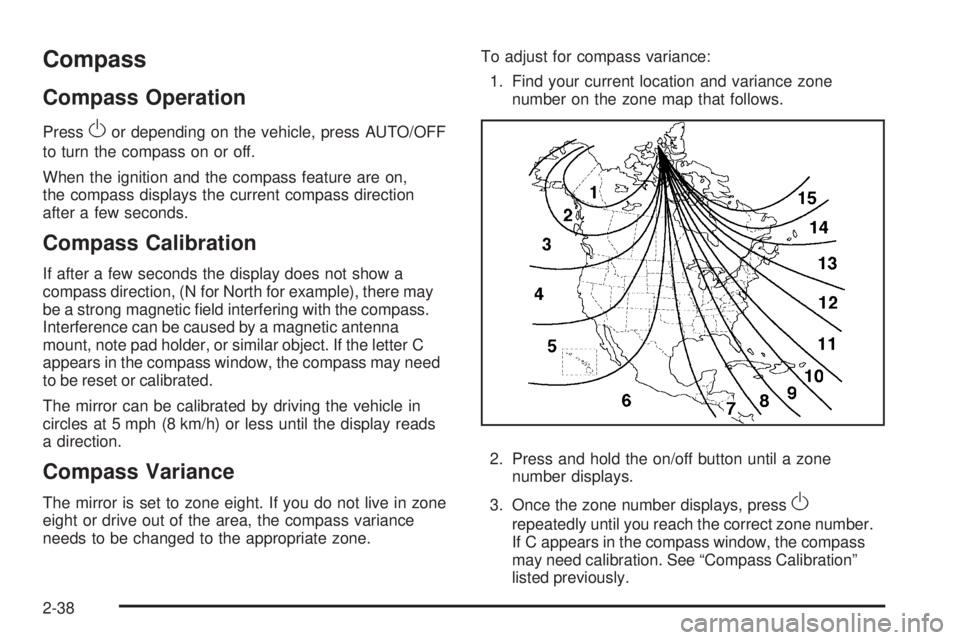
The mirror is set to zone eight. If you do not live in zone
eight or drive out of the area, the compass variance
needs to be changed to the appropriate zone.To adjust for compass variance:
1. Find your current location and variance zone
number on the zone map that follows.
2. Press and hold the on/off button until a zone
number displays.
3. Once the zone number displays, pressO
repeatedly until you reach the correct zone number.
If C appears in the compass window, the compass
may need calibration. See “Compass Calibration”
listed previously.
2-38
Page 125 of 410
Storage Areas
Glove Box
Lift up on the glove box lever to open it.
Cupholders
There are two cupholders in the front center console of
the vehicle and two in the rear of the center console.
Pull down the door on the rear of the center console
to use the rear seat cupholders.
Center Console Storage
The center console has a separate storage area. Pull
up the release handle on the front of the cover to open
the compartment.
In the oor console is a power accessory outlet.
SeeAccessory Power Outlet(s) on page 3-19for
more information.
Convenience Net
Use the convenience net, located in the rear, to store
small loads as far forward as possible. The net should
not be used to store heavy loads.
Sunroof
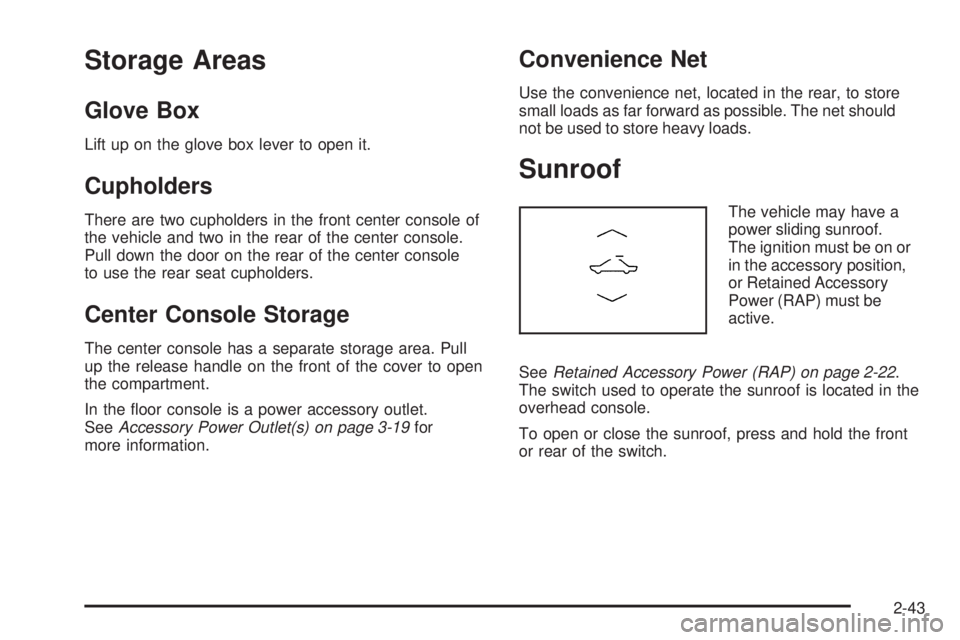
The vehicle may have a
power sliding sunroof.
The ignition must be on or
in the accessory position,
or Retained Accessory
Power (RAP) must be
active.
SeeRetained Accessory Power (RAP) on page 2-22.
The switch used to operate the sunroof is located in the
overhead console.
To open or close the sunroof, press and hold the front
or rear of the switch.
2-43
Page 126 of 410

Sunshade Operation
The sunshade will open automatically when opening the
sunroof.
However, it can manually be pulled shut after the
sunroof is closed. To adjust the sunshade, push it
backward or pull it forward to the desired position.
The sunshade cannot be adjusted further than
the current closed position of the sunroof.
Notice:If you force the sunshade forward of the
sliding glass panel, damage will occur and the
sunroof may not open or close properly. Always
close the glass panel before closing the sunshade.
Do not leave the sunroof open for long periods of
time. Debris can collect in the tracks and possibly
damage the sunroof operation and plug the water
draining system.
Retractable Hardtop
The following procedures explain the proper operation
of the retractable hardtop. The retractable hardtop
will not operate if the trunk cargo cover is not in place.
If the retractable hardtop is lowered or raised multiple
times, the engine should be running while doing
so to prevent drain on the vehicle’s battery.
Lowering the Retractable Hardtop
Notice:Leaving the retractable hardtop down and
exposing the interior of the vehicle to outdoor
conditions may cause damage. Always close the
retractable hardtop if leaving the vehicle outdoors.
Notice:Lowering the top if it is damp, wet, or
dirty can cause stains, mildew, and damage to
the inside of your vehicle. Dry off the top before
lowering it.
Notice:If you lower the retractable hardtop in cold
weather (32°F/0°C or lower), you may damage top
components. Do not lower the retractable hardtop
in cold weather.
1. Park on a level surface, and shift the transmission
into (P) Park. The vehicle must be in (P) Park, and
the engine must be running, or the ignition turned
to the ON/RUN position, to operate the retractable
hardtop.
2-44
Page 127 of 410
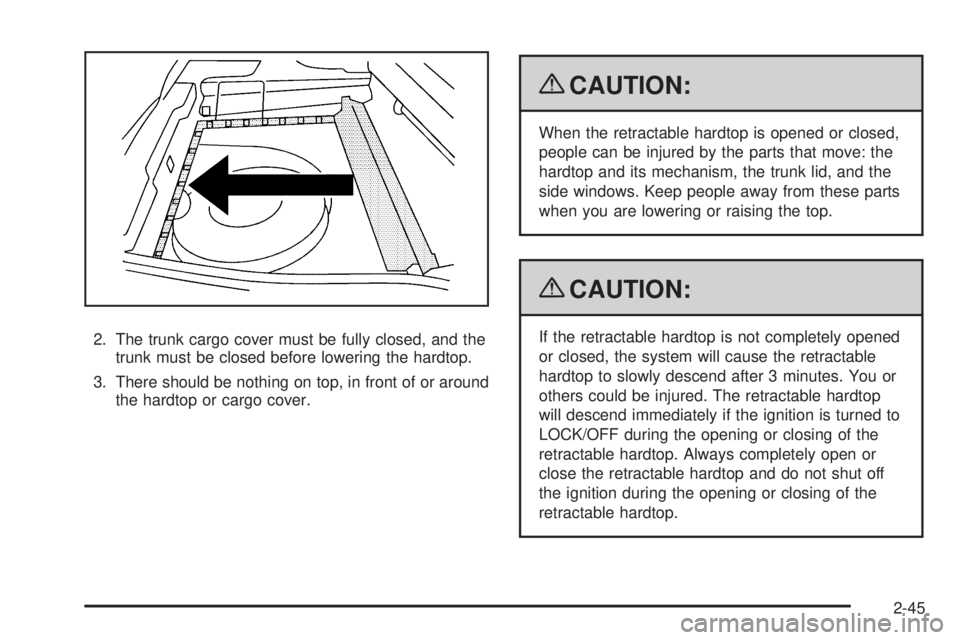
2. The trunk cargo cover must be fully closed, and the
trunk must be closed before lowering the hardtop.
3. There should be nothing on top, in front of or around
the hardtop or cargo cover.
{CAUTION:
When the retractable hardtop is opened or closed,
people can be injured by the parts that move: the
hardtop and its mechanism, the trunk lid, and the
side windows. Keep people away from these parts
when you are lowering or raising the top.
{CAUTION:
If the retractable hardtop is not completely opened
or closed, the system will cause the retractable
hardtop to slowly descend after 3 minutes. You or
others could be injured. The retractable hardtop
will descend immediately if the ignition is turned to
LOCK/OFF during the opening or closing of the
retractable hardtop. Always completely open or
close the retractable hardtop and do not shut off
the ignition during the opening or closing of the
retractable hardtop.
2-45
Page 129 of 410

If pressure is released from the switch before the
hardtop cycle is complete, the cycle will stop and the
Driver Information Center (DIC) will display the TOP
NOT SECURE message. Always press and hold the
switch until a chime sounds, if the engine is on, and the
Driver Information Center (DIC) displays the TOP MOVE
COMPLT to signal the procedure is complete. SeeDIC
Warnings and Messages on page 3-46for more
information.
The hardtop will not operate if the vehicle has an
electrical failure. If an electrical failure occurs, see
your dealer/retailer for service.
If your vehicle has an electrical failure while operating
the hardtop, and must be towed to a dealer/retailer for
service, your vehicle should be towed by atbed with the
vehicle facing backwards. Consult your dealer/retailer or
professional towing service if you need to have your
disabled vehicle towed. SeeRoadside Assistance
Program on page 7-7.Raising the Retractable Hardtop
1. Park on a level surface, and shift the transmission
into (P) Park. The vehicle must be in (P) Park,
and the engine must be running, or the ignition
turned to the ON/RUN position, to operate
the retractable hardtop.
2. The trunk cargo cover must be fully closed, and the
trunk must be closed before raising the hardtop.
2-47
Page 130 of 410
3. Make sure nothing or no one is on or around the
hardtop. Make sure there is no cargo on top of or
in front of the trunk cargo cover.
{CAUTION:
When the retractable hardtop is opened or closed,
people can be injured by the parts that move: the
hardtop and its mechanism, the trunk lid, and the
side windows. Keep people away from these parts
when you are lowering or raising the top.
{CAUTION:
If the retractable hardtop is not completely opened
or closed, the system will cause the retractable
hardtop to slowly descend after 3 minutes. You or
others could be injured. The retractable hardtop
will descend immediately if the ignition is turned to
LOCK/OFF during the opening or closing of the
retractable hardtop. Always completely open or
CAUTION: (Continued)
CAUTION: (Continued)
close the retractable hardtop and do not shut off
the ignition during the opening or closing of the
retractable hardtop.
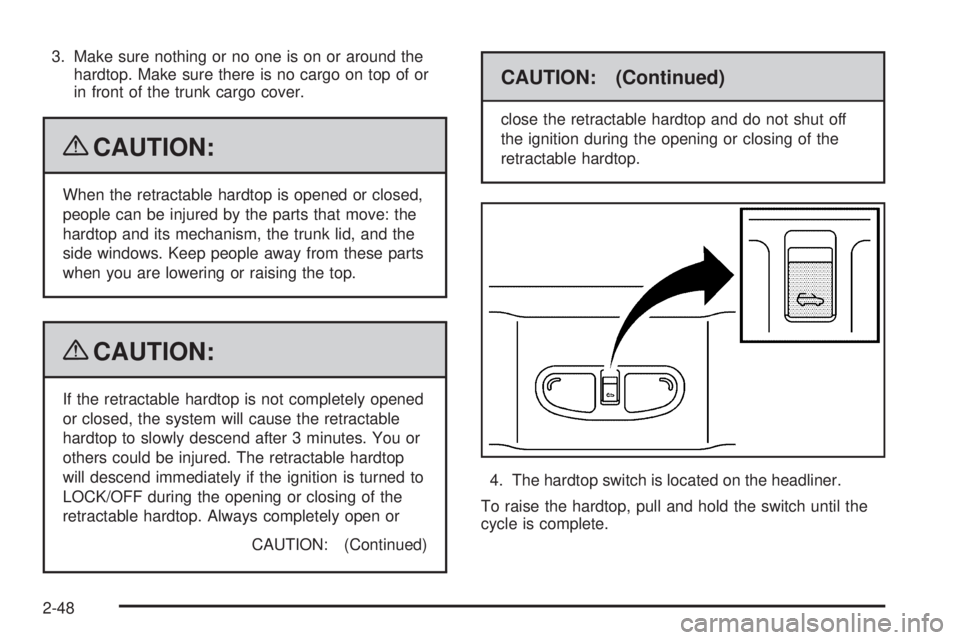
4. The hardtop switch is located on the headliner.
To raise the hardtop, pull and hold the switch until the
cycle is complete.
2-48
Page 137 of 410
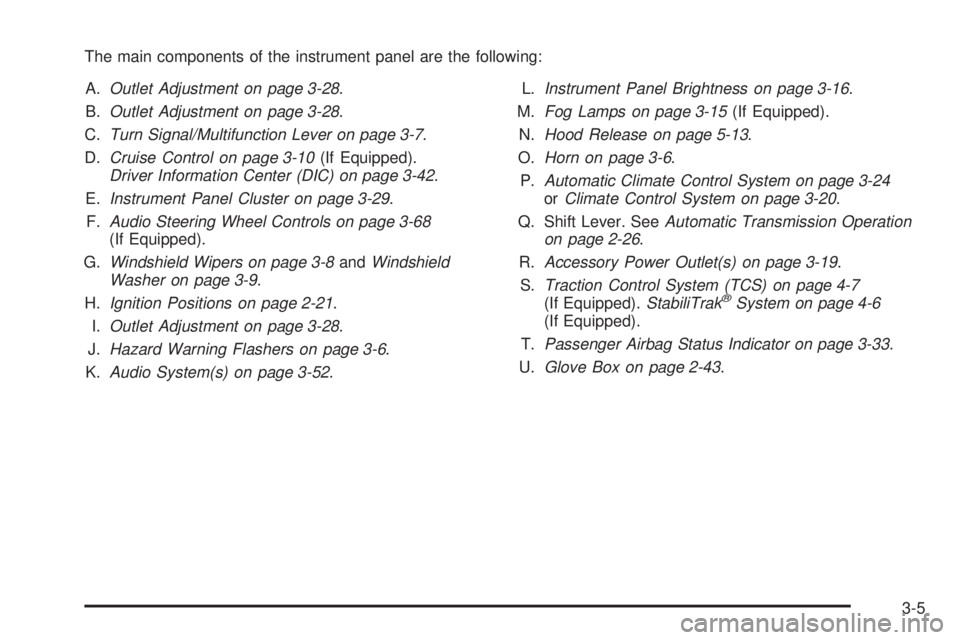
The main components of the instrument panel are the following:
A.Outlet Adjustment on page 3-28.
B.Outlet Adjustment on page 3-28.
C.Turn Signal/Multifunction Lever on page 3-7.
D.Cruise Control on page 3-10(If Equipped).
Driver Information Center (DIC) on page 3-42.
E.Instrument Panel Cluster on page 3-29.
F.Audio Steering Wheel Controls on page 3-68
(If Equipped).
G.Windshield Wipers on page 3-8andWindshield
Washer on page 3-9.
H.Ignition Positions on page 2-21.
I.Outlet Adjustment on page 3-28.
J.Hazard Warning Flashers on page 3-6.
K.Audio System(s) on page 3-52.L.Instrument Panel Brightness on page 3-16.
M.Fog Lamps on page 3-15(If Equipped).
N.Hood Release on page 5-13.
O.Horn on page 3-6.
P.Automatic Climate Control System on page 3-24
orClimate Control System on page 3-20.
Q. Shift Lever. SeeAutomatic Transmission Operation
on page 2-26.
R.Accessory Power Outlet(s) on page 3-19.
S.Traction Control System (TCS) on page 4-7
(If Equipped).StabiliTrak
®System on page 4-6
(If Equipped).
T.Passenger Airbag Status Indicator on page 3-33.
U.Glove Box on page 2-43.
3-5