trailer PONTIAC G6 2009 Owner's Manual
[x] Cancel search | Manufacturer: PONTIAC, Model Year: 2009, Model line: G6, Model: PONTIAC G6 2009Pages: 410, PDF Size: 2.33 MB
Page 268 of 410

How to Check Automatic Transmission
Fluid
Because this operation can be a little difficult, you may
choose to have this done at the dealer/retailer service
department.
If you do it yourself, be sure to follow all the instructions
here or you could get a false reading on the dipstick.
Notice:Too much or too little uid can damage
your transmission. Too much can mean that some
of the uid could come out and fall on hot engine
parts or exhaust system parts, starting a re.
Too little uid could cause the transmission to
overheat. Be sure to get an accurate reading if you
check your transmission uid.Wait at least 30 minutes before checking the
transmission uid level if you have been driving:When outside temperatures are above 90°F (32°C).
At high speed for quite a while.
In heavy traffic — especially in hot weather.
While pulling a trailer.
To get the right reading, the uid should be at normal
operating temperature, which is 180°F to 200°F
(82°C to 93°C).
Get the vehicle warmed up by driving about 15 miles
(24 km) when outside temperatures are above 50°F
(10°C). If it is colder than 50°F (10°C), you may have
to drive longer.
5-30
Page 276 of 410
If Steam Is Coming From The Engine
Compartment
{CAUTION:
Steam from an overheated engine can burn you
badly, even if you just open the hood. Stay away
from the engine if you see or hear steam coming
from it. Turn it off and get everyone away from the
vehicle until it cools down. Wait until there is no sign
of steam or coolant before you open the hood.
If you keep driving when the vehicles engine is
overheated, the liquids in it can catch re. You or
others could be badly burned. Stop the engine if it
overheats, and get out of the vehicle until the
engine is cool.
SeeOverheated Engine Protection Operating Mode
on page 5-39for information on driving to a safe
place in an emergency.
If No Steam Is Coming From The
Engine Compartment
If an engine overheat warning is displayed but no steam
can be seen or heard, the problem may not be too
serious. Sometimes the engine can get a little too hot
when the vehicle:
Climbs a long hill on a hot day.
Stops after high-speed driving.
Idles for long periods in traffic.
Tows a trailer.
If the overheat warning is displayed with no sign of
steam:
1. Turn the air conditioning off.
2. Turn the heater on to the highest temperature and
to the highest fan speed. Open the windows as
necessary.
3. In heavy traffic, let the engine idle in N (Neutral)
while stopped. If it is safe to do so, pull off the road,
shift to P (Park) or N (Neutral) and let the engine idle.
If the temperature overheat gage is no longer in the
overheat zone or an overheat warning no longer displays,
the vehicle can be driven. Continue to drive the vehicle
slow for about 10 minutes. Keep a safe vehicle distance
from the car in front of you. If the warning does not come
back on, continue to drive normally.
5-38
Page 277 of 410
If the warning continues, pull over, stop, and park the
vehicle right away.
If there is no sign of steam, idle the engine for three
minutes while parked. If the warning is still displayed,
turn off the engine until it cools down. Also, see
″Overheated Engine Protection Operating Mode″
next in this section.
Overheated Engine Protection
Operating Mode
This emergency operating mode lets the vehicle be
driven to a safe place in an emergency situation. If an
overheated engine condition exists, an overheat
protection mode which alternates ring groups of
cylinders helps prevent engine damage. In this mode,
there is a signicant loss in power and engine
performance. The temperature gage indicates an
overheat condition exists. Driving extended distances
and/or towing a trailer in the overheat protection
mode should be avoided.Notice:After driving in the overheated engine
protection operating mode, to avoid engine damage,
allow the engine to cool before attempting any
repair. The engine oil will be severely degraded.
Repair the cause of coolant loss, change the oil and
reset the oil life system. SeeEngine Oil on
page 5-21.
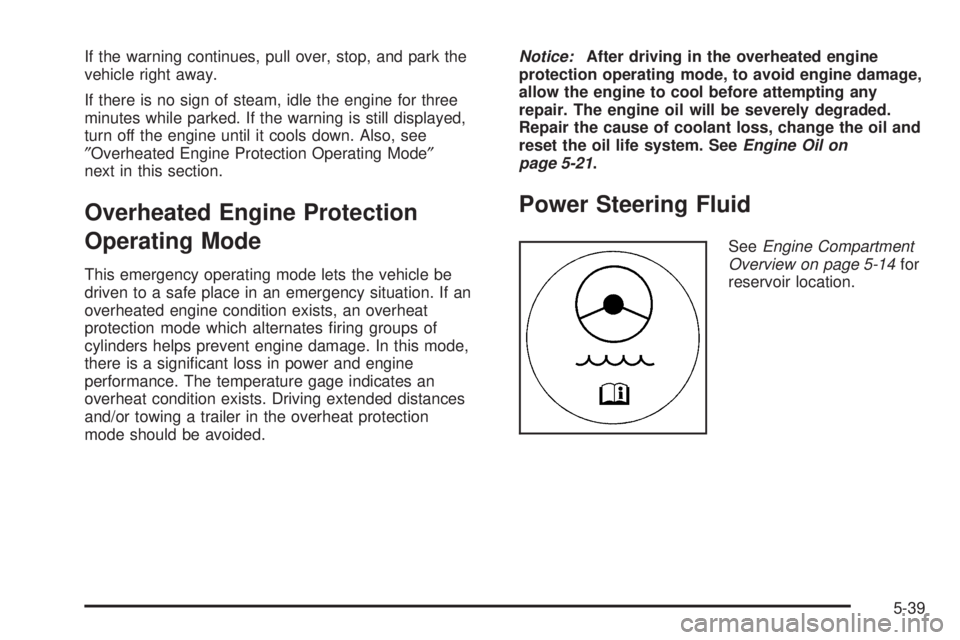
Power Steering Fluid
SeeEngine Compartment
Overview on page 5-14for
reservoir location.
5-39
Page 366 of 410
(c)Visually inspect hoses and have them replaced if they
are cracked, swollen, or deteriorated. Inspect all pipes,
fittings and clamps; replace with genuine parts as
needed. To help ensure proper operation, a pressure test
of the cooling system and pressure cap and cleaning the
outside of the radiator and air conditioning condenser is
recommended at least once a year.
(d)Inspect wiper blades for wear, cracking, or
contamination. Clean the windshield and wiper blades, if
contaminated. Replace wiper blades that are worn or
damaged. See Windshield Wiper Blade Replacement on
page 5-58 and Windshield and Wiper Blades on
page 5-106 for more information.
(e)Make sure the safety belt reminder light and safety
belt assemblies are working properly. Look for any other
loose or damaged safety belt system parts. If you see
anything that might keep a safety belt system from doing
its job, have it repaired. Have any torn or frayed safety
belts replaced. Also see Checking the Restraint Systems
on page 1-76.
(f)Lubricate all key lock cylinders, door hinges and
latches, hood hinges and latches, and trunk lid hinges
and latches. More frequent lubrication may be required
when exposed to a corrosive environment. Applying
silicone grease on weatherstrips with a clean cloth will
make them last longer, seal better, and not stick or
squeak.(g)Check system for interference or binding and for
damaged or missing parts. Replace parts as needed.
Replace any components that have high effort or
excessive wear. Do not lubricate accelerator or cruise
control cables.
(h)Change automatic transmission fluid and filter if the
vehicle is mainly driven under one or more of these
conditions:
In heavy city traffic where the outside temperature
regularly reaches 90°F (32°C) or higher.
In hilly or mountainous terrain.
When doing frequent trailer towing.
Uses such as found in taxi, police, or delivery
service.
(i)Drain, flush, and refill cooling system. This service can
be complex; you should have your dealer/retailer perform
this service. See Engine Coolant on page 5-33 for what to
use. Inspect hoses. Clean radiator, condenser, pressure
cap, and filler neck. Pressure test the cooling system and
pressure cap.
(j)A fluid loss in any vehicle system could indicate a
problem. Have the system inspected and repaired and
the fluid level checked. Add fluid if needed.
(k)If driving regularly under dusty conditions, inspect
the filter at each engine oil change.
6-8
Page 367 of 410

(l)Change automatic transmission fluid if the vehicle is
mainly driven under one or more of these conditions:
In heavy city traffic where the outside temperature
regularly reaches 90°F (32°C) or higher.
In hilly or mountainous terrain.
When doing frequent trailer towing.
Uses such as found in taxi, police, or delivery
service.
(m)Visually inspect belt for fraying, excessive cracks, or
obvious damage. Replace belt if necessary.
Owner Checks and Services
These owner checks and services should be performed
at the intervals specied to help ensure vehicle safety,
dependability, and emission control performance. Your
dealer/retailer can assist with these checks and services.Be sure any necessary repairs are completed at once.
Whenever any uids or lubricants are added to the
vehicle, make sure they are the proper ones, as shown
inRecommended Fluids and Lubricants on page 6-13.
At Each Fuel Fill
It is important to perform these underhood checks at
each fuel fill.
Engine Oil Level Check
Notice:It is important to check the engine oil
regularly and keep it at the proper level. Failure to
keep the engine oil at the proper level can cause
damage to the engine not covered by the vehicle
warranty.
Check the engine oil level and add the proper oil if
necessary. SeeEngine Oil on page 5-21.
6-9
Page 409 of 410

Theft-Deterrent Systems (cont.)
Content Theft-Deterrent................................2-17
PASS-Key
®III+ Electronic Immobilizer............2-19
PASS-Key®III+ Electronic Immobilizer
Operation................................................2-19
Tilt Wheel........................................................ 3-6
Time, Setting..................................................3-53
Tire
Pressure Light.............................................3-37
Tires.............................................................5-59
Aluminum Wheels, Cleaning........................5-107
Buying New Tires........................................5-78
Chains.......................................................5-84
Changing a Flat Tire....................................5-86
Cleaning...................................................5-107
Compact Spare Tire...................................5-101
Different Size..............................................5-80
High-Speed Operation..................................5-68
If a Tire Goes Flat.......................................5-85
Ination - Tire Pressure................................5-67
Inspection and Rotation................................5-76
Installing the Spare Tire................................5-89
Pressure Monitor Operation...........................5-71
Pressure Monitor System..............................5-69
Removing the Flat Tire.................................5-89
Removing the Spare Tire and Tools...............5-87Tires (cont.)
Storing a Flat or Spare Tire and Tools............5-94
Tire Sidewall Labeling..................................5-61
Tire Terminology and Denitions....................5-64
Uniform Tire Quality Grading.........................5-80
Wheel Alignment and Tire Balance.................5-82
Wheel Replacement.....................................5-83
When It Is Time for New Tires......................5-77
Winter Tires................................................5-60
Towing
Recreational Vehicle.....................................4-26
Towing a Trailer..........................................4-30
Your Vehicle...............................................4-26
Traction
Control System Active Light
..........................3-36
Control System (TCS).................................... 4-7
Control System Warning Light.......................3-36
Stabilitrak
®System........................................ 4-6
Transmission
Fluid, Automatic...........................................5-29
Transmission Operation, Automatic....................2-26
Trip Odometer................................................3-30
Trunk............................................................2-12
Trunk Lamps..................................................3-17
Turn and Lane-Change Signals.......................... 3-7
Turn Signal/Multifunction Lever........................... 3-7
13