engine oil PONTIAC G6 2010 Owner's Manual
[x] Cancel search | Manufacturer: PONTIAC, Model Year: 2010, Model line: G6, Model: PONTIAC G6 2010Pages: 448, PDF Size: 2.5 MB
Page 292 of 448

Engine Oil Additives / Engine Oil
Flushes
Do not add anything to the oil. The recommended
oils with the starburst symbol that meet GM Standard
GM6094M are all that is needed for good performance
and engine protection.
Engine oil system flushes are not recommended and
could cause engine damage not covered by the vehicle
warranty.
Engine Oil Life System
When to Change Engine Oil
This vehicle has a computer system that indicates when
to change the engine oil and filter. This is based on
engine revolutions and engine temperature, and not on
mileage. Based on driving conditions, the mileage at
which an oil change is indicated can vary considerably.
For the oil life system to work properly, the system must
be reset every time the oil is changed.When the system has calculated that oil life has been
diminished, it indicates that an oil change is necessary.
A CHANGE OIL SOON message comes on. SeeDIC
Warnings and Messages on page 4-42. Change the oil
as soon as possible within the next 600 miles (1 000 km).
It is possible that, if driving under the best conditions, the
oil life system might not indicate that an oil change is
necessary for over a year. However, the engine oil and
filter must be changed at least once a year and at this
time the system must be reset. Your dealer/retailer has
trained service people who will perform this work using
genuine parts and reset the system. It is also important to
check the oil regularly and keep it at the proper level.
If the system is ever reset accidentally, the oil must be
changed at 3,000 miles (5 000 km) since the last oil
change. Remember to reset the oil life system whenever
the oil is changed.
6-24
Page 293 of 448

How to Reset the Engine Oil Life
System
The Engine Oil Life System calculates when to change
the engine oil and filter based on vehicle use. Whenever
the oil is changed, reset the system so it can calculate
when the next oil change is required. If a situation occurs
where the oil is changed prior to a CHANGE OIL SOON
message being turned on, reset the system.
After changing the engine oil and filter, the system must
be reset. To reset the oil life system:
1. With the CHANGE OIL SOON message displayed,
press any of the three DIC buttons to clear the
CHANGE OIL SOON message. SeeDIC Warnings
and Messages on page 4-42.
2. Display OIL LIFE RESET on the DIC.
3. Press and hold the ENTER button for at least
one second. An ACKNOWLEDGED display
message will appear for three seconds or until the
next button is pressed. This tells you the system
has been reset. SeeDIC Vehicle Personalization
on page 4-47.
4. Turn the ignition to LOCK/OFF.
If the CHANGE OIL SOON message comes back on
when the vehicle is started, the engine oil life system
has not reset. Repeat the procedure.
What to Do with Used Oil
Used engine oil contains certain elements that can be
unhealthy for your skin and could even cause cancer.
Do not let used oil stay on your skin for very long. Clean
your skin and nails with soap and water, or a good hand
cleaner. Wash or properly dispose of clothing or rags
containing used engine oil. See the manufacturer’s
warnings about the use and disposal of oil products.
Used oil can be a threat to the environment. If you
change your own oil, be sure to drain all the oil from the
filter before disposal. Never dispose of oil by putting it
in the trash, pouring it on the ground, into sewers, or into
streams or bodies of water. Recycle it by taking it to a
place that collects used oil.
6-25
Page 294 of 448
Engine Air Cleaner/Filter
When to Inspect the Engine Air
Cleaner/Filter
Inspect the air cleaner/filter at the MaintenanceII
intervals and replace it at the first oil change after
each 80 000 km (50,000 mile) interval. SeeScheduled
Maintenance on page 7-3for more information. If you are
driving in dusty/dirty conditions, inspect the filter at each
engine oil change.
How to Inspect the Engine Air
Cleaner/Filter
SeeEngine Compartment Overview on page 6-16for
the location of the engine air cleaner/filter.
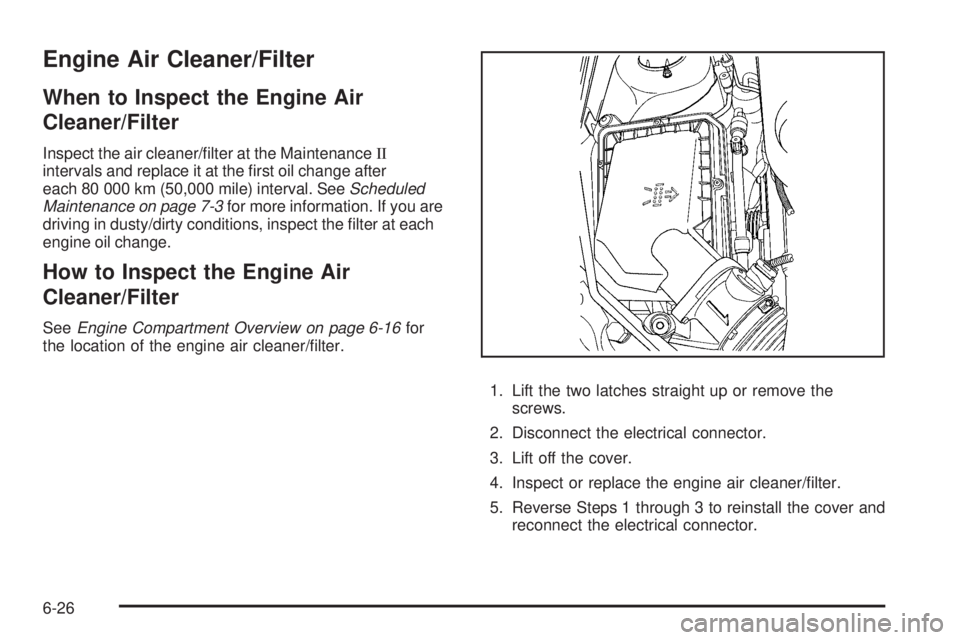
1. Lift the two latches straight up or remove the
screws.
2. Disconnect the electrical connector.
3. Lift off the cover.
4. Inspect or replace the engine air cleaner/filter.
5. Reverse Steps 1 through 3 to reinstall the cover and
reconnect the electrical connector.
6-26
Page 296 of 448

Automatic Transmission Fluid
(3.9L V6 Engine)
When to Check and Change Automatic
Transmission Fluid
A good time to check the automatic transmission fluid
level is when the engine oil is changed.
Change the fluid and filter at the intervals listed in
Scheduled Maintenance on page 7-3and be sure to
use the transmission fluid listed inRecommended
Fluids and Lubricants on page 7-10.
How to Check Automatic Transmission
Fluid
Because this operation can be a little difficult, you may
choose to have this done at the dealer/retailer service
department.
If you do it yourself, be sure to follow all the instructions
here or you could get a false reading on the dipstick.Notice:Too much or too little uid can damage your
transmission. Too much can mean that some of the
uid could come out and fall on hot engine parts or
exhaust system parts, starting a re. Too little uid
could cause the transmission to overheat. Be sure
to get an accurate reading if you check your
transmission uid.
Wait at least 30 minutes before checking the
transmission fluid level if you have been driving:
•When outside temperatures are above 32°C (90°F).
•At high speed for quite a while.
•In heavy traffic — especially in hot weather.
•While pulling a trailer.
To get the right reading, the fluid should be at
normal operating temperature, which is 82°C to 93°C
(180°F to 200°F).
Get the vehicle warmed up by driving about
24 km (15 miles) when outside temperatures are
above 10°C (50°F). If it is colder than 10°C (50°F),
you may have to drive longer.
6-28
Page 300 of 448
What to Use
{WARNING:
Adding only plain water to the cooling system can
be dangerous. Plain water, or some other liquid
such as alcohol, can boil before the proper coolant
mixture will. The vehicle’s coolant warning system
is set for the proper coolant mixture. With plain
water or the wrong mixture, the engine could get
too hot but you would not get the overheat
warning. The engine could catch fire and you or
others could be burned. Use a 50/50 mixture of
clean, drinkable water and DEX-COOL
®coolant.
Use a 50/50 mixture of clean, drinkable water and
DEX-COOL
®coolant. If using this mixture, nothing
else needs to be added. This mixture:
•Gives freezing protection down to−37°C (−34°F),
outside temperature.
•Gives boiling protection up to 129°C (265°F),
engine temperature.
•Protects against rust and corrosion.
•Will not damage aluminum parts.
•Helps keep the proper engine temperature.Notice:If an improper coolant mixture is used,
the engine could overheat and be badly damaged.
The repair cost would not be covered by the vehicle
warranty. Too much water in the mixture can freeze
and crack the engine, radiator, heater core, and
other parts.
Notice:If extra inhibitors and/or additives are used
in the vehicle’s cooling system, the vehicle could
be damaged. Use only the proper mixture of
the engine coolant listed in this manual for the
cooling system. SeeRecommended Fluids and
Lubricants on page 7-10for more information.
Checking Coolant
The vehicle must be on a level surface when checking
the coolant level.
Check to see if coolant is visible in the coolant recovery
tank. If the coolant inside the coolant recovery tank
is boiling, do not do anything else until it cools down.
If coolant is visible but the coolant level is not at or above
the FULL COLD mark, add a 50/50 mixture of clean,
drinkable water and DEX-COOL
®coolant at the coolant
recovery tank, but be sure the cooling system is cool
before this is done. See Engine Coolant for more
information.
The coolant level should be at or above the FULL COLD
mark on the coolant surge tank. If it is not, you may have
a leak in the cooling system.
6-32
Page 305 of 448
Overheated Engine Protection
Operating Mode
This emergency operating mode lets the vehicle
be driven to a safe place in an emergency situation.
If an overheated engine condition exists, an overheat
protection mode which alternates firing groups of
cylinders helps prevent engine damage. In this mode,
there is a significant loss in power and engine
performance. The temperature gage indicates an
overheat condition exists. Driving extended distances
and/or towing a trailer in the overheat protection mode
should be avoided.
Notice:After driving in the overheated engine
protection operating mode, to avoid engine damage,
allow the engine to cool before attempting any
repair. The engine oil will be severely degraded.
Repair the cause of coolant loss, change the oil
and reset the oil life system. SeeEngine Oil
on page 6-21.
Power Steering Fluid
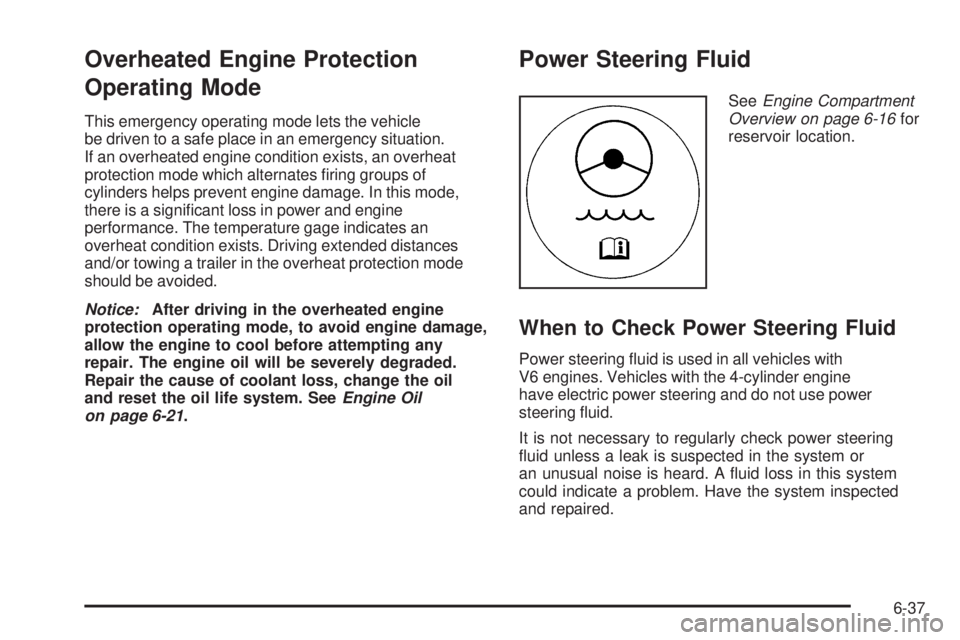
SeeEngine Compartment
Overview on page 6-16for
reservoir location.
When to Check Power Steering Fluid
Power steering fluid is used in all vehicles with
V6 engines. Vehicles with the 4-cylinder engine
have electric power steering and do not use power
steering fluid.
It is not necessary to regularly check power steering
fluid unless a leak is suspected in the system or
an unusual noise is heard. A fluid loss in this system
could indicate a problem. Have the system inspected
and repaired.
6-37
Page 308 of 448
Do not top off the brake fluid. Adding fluid does not
correct a leak. If fluid is added when the linings are worn,
there will be too much fluid when new brake linings are
installed. Add or remove brake fluid, as necessary, only
when work is done on the brake hydraulic system.
{WARNING:
If too much brake fluid is added, it can spill on
the engine and burn, if the engine is hot enough.
You or others could be burned, and the vehicle
could be damaged. Add brake fluid only when
work is done on the brake hydraulic system.
When the brake fluid falls to a low level, the BRAKE
FLUID message in the Driver Information Center (DIC)
displays. SeeDIC Warnings and Messages on
page 4-42.
What to Add
Use only new DOT 3 brake fluid from a sealed container.
SeeRecommended Fluids and Lubricants on page 7-10.
Always clean the brake fluid reservoir cap and the
area around the cap before removing it. This helps keep
dirt from entering the reservoir.
{WARNING:
With the wrong kind of fluid in the brake hydraulic
system, the brakes might not work well. This could
cause a crash. Always use the proper brake fluid.
Notice:
Using the wrong uid can badly damage brake
hydraulic system parts. For example, just a few
drops of mineral-based oil, such as engine oil, in
the brake hydraulic system can damage brake
hydraulic system parts so badly that they will
have to be replaced. Do not let someone put in
the wrong kind of uid.
If brake uid is spilled on the vehicle’s painted
surfaces, the paint nish can be damaged.
Be careful not to spill brake uid on the vehicle.
If you do, wash it off immediately. SeeWashing
Your Vehicle on page 6-110.
6-40
Page 389 of 448

Fuses Usage
7 Left Headlamp Low Beam
8 Horn
9 Right Headlamp Low Beam
10 Front Fog Lamps
11 Left Headlamp High Beam
12 Right Headlamp High Beam
13 Engine Control Module (Battery)
14 Windshield Wiper
15 Antilock Brake System (IGN 1)
16 Engine Control Module (IGN 1)
17 Cooling Fan 1
18 Cooling Fan 2
19Run Relay, Heating, Ventilation,
Air Conditioning Blower
20 Body Control Module 1
21 Body Control Module Run/Crank
22 Rear Electrical Center 1
23 Rear Electrical Center 2
24 Antilock Brake System
25 Body Control Module 2Fuses Usage
26 Starter
41 Electric Power Steering
42Transmission Control Module
Battery
43Ignition Module (LE5, LE9, LZ4,
LZE, LZ9), Odd Cylinder
Injectors/Ignition Coils (LY7)
44Injectors (LE5, LE9, LZ4, LZE, LZ9),
Even Cylinder Injectors/Ignition
Coils (LY7)
45Rear Oxygen Sensors
(LZ4, LZE, LZ9, LY7)
46 Daytime Running Lamps
47 Center High-Mounted Stoplamp
50Front Power Windows Coupe/
Retractable Hardtop
51 Not Used
52 AIR Solenoid
54 Regulated Voltage Control
55 Antilock Brake System (Battery)
6-121
Page 394 of 448

ApplicationCapacities
Metric English
Cooling System
2.4L L4 Engine 7.1 L 7.5 qt
3.5L, 3.6L, 3.9L V6 Engines 9.2 L 9.7 qt
Engine Oil with Filter
2.4L L4 Engine 4.7 L 5.0 qt
3.5L and 3.9L V6 Engines 3.8 L 4.0 qt
3.6L V6 Engine 5.2 L 5.5 qt
Fuel Tank 61.7 L 16.3 gal
Wheel Nut Torque 140Y100 lb ft
*Transmission fluid capacity is approximate. SeeAutomatic Transmission Fluid (2.4L L4, 3.5L V6 and
3.6L V6 Engines) on page 6-27orAutomatic Transmission Fluid (3.9L V6 Engine) on page 6-28for
information on checking fluid level.
All capacities are approximate. When adding, be sure to fill to the approximate level, as recommended in this
manual.
6-126
Page 399 of 448
Rotation of New Tires
To maintain ride, handling, and performance of the
vehicle, it is important that the first rotation service
for new tires be performed when they have
8 000 to 13 000 km (5,000 to 8,000 miles).
SeeTire Inspection and Rotation on page 6-73.
Scheduled Maintenance
When the Change Oil Soon Message
Displays
Change engine oil and filter. SeeEngine Oil on
page 6-21.An Emission Control Service.
When the Change Oil Soon message displays, service
is required for the vehicle as soon as possible, within
the next 1 000 km/600 miles. If driving under the
best conditions, the engine oil life system might not
indicate the need for vehicle service for more than a
year. The engine oil and filter must be changed at
least once a year and the oil life system must be reset.
Your dealer/retailer has trained service technicians
who will perform this work and reset the system. If the
engine oil life system is reset accidentally, service
the vehicle within 5 000 km/3,000 miles since the last
service. Reset the oil life system whenever the oil
is changed. SeeEngine Oil Life System on page 6-24.When the Change Oil Soon message displays, certain
services, checks, and inspections are required. The
services described for MaintenanceIshould be
performed at every engine oil change. The services
described for MaintenanceIIshould be performed when:
•MaintenanceIwas performed the last time the
engine oil was changed.
•It has been 10 months or more since the Change
Oil Soon message has displayed or since the last
service.
MaintenanceI
•Change engine oil and filter. SeeEngine Oil on
page 6-21.An Emission Control Service.
•Engine coolant level check. SeeEngine Coolant on
page 6-31.
•Windshield washer fluid level check. SeeWindshield
Washer Fluid on page 6-38.
•Tire inflation check. SeeInation - Tire Pressure on
page 6-64.
•Tire wear inspection. SeeTire Inspection and
Rotation on page 6-73.
•Rotate tires. SeeTire Inspection and Rotation on
page 6-73.
7-3