tires PONTIAC G6 2010 Workshop Manual
[x] Cancel search | Manufacturer: PONTIAC, Model Year: 2010, Model line: G6, Model: PONTIAC G6 2010Pages: 448, PDF Size: 2.5 MB
Page 349 of 448

Tire Chains
{WARNING:
Do not use tire chains, there is not enough
clearance.
Tire chains used on a vehicle without the proper
amount of clearance can cause damage to the
brakes, suspension or other vehicle parts. The area
damaged by the tire chains could cause you to lose
control of your vehicle and you or others may be
injured in a crash.
Use another type of traction device only if its
manufacturer recommends it for use on your
vehicle and tire size combination and road
conditions. Follow that manufacturer’s instructions.
To help avoid damage to your vehicle, drive slowly,
re-adjust or remove the device if is contacting your
vehicle, and do not spin your wheels.
If you do find traction devices that will fit, install
them on the front tires.
If a Tire Goes Flat
It is unusual for a tire to blowout while you are driving,
especially if you maintain your vehicle’s tires properly.
If air goes out of a tire, it is much more likely to leak
out slowly. But if you should ever have a blowout, here
are a few tips about what to expect and what to do:
If a front tire fails, the flat tire creates a drag that pulls
the vehicle toward that side. Take your foot off the
accelerator pedal and grip the steering wheel firmly.
Steer to maintain lane position, and then gently brake
to a stop well out of the traffic lane.
A rear blowout, particularly on a curve, acts much
like a skid and may require the same correction you
would use in a skid. In any rear blowout remove your
foot from the accelerator pedal. Get the vehicle under
control by steering the way you want the vehicle to go.
6-81
Page 374 of 448

Compact Spare Tire
{WARNING:
Driving with more than one compact spare tire at a
time could result in loss of braking and handling.
This could lead to a crash and you or others could
be injured. Use only one compact spare tire at
a time.
If this vehicle has a compact spare tire it was fully
inflated when the vehicle was new, however, it can lose
air after a time. Check the inflation pressure regularly.
It should be 60 psi (420 kPa).
After installing the compact spare on the vehicle, stop as
soon as possible and make sure the spare tire is correctly
inflated. The compact spare is made to perform well at
speeds up to 65 mph (105 km/h) for distances up to3,000 miles (5 000 km), so you can finish your trip and
have the full-size tire repaired or replaced at your
convenience. Of course, it is best to replace the spare
with a full-size tire as soon as possible. The spare tire
will last longer and be in good shape in case it is needed
again.
Notice:When the compact spare is installed,
do not take the vehicle through an automatic car
wash with guide rails. The compact spare can
get caught on the rails which can damage the tire,
wheel and other parts of the vehicle.
Do not use the compact spare on other vehicles.
Do not mix the compact spare tire or wheel with other
wheels or tires. They will not fit. Keep the spare tire and
its wheel together.
Notice:Tire chains will not t the compact spare.
Using them can damage the vehicle and can damage
the chains too. Do not use tire chains on the
compact spare.
6-106
Page 381 of 448

Tires
To clean the tires, use a stiff brush with tire cleaner.
Notice:Using petroleum-based tire dressing
products on the vehicle may damage the paint nish
and/or tires. When applying a tire dressing, always
wipe off any overspray from all painted surfaces
on the vehicle.
Sheet Metal Damage
If the vehicle is damaged and requires sheet metal
repair or replacement, make sure the body repair shop
applies anti-corrosion material to parts repaired or
replaced to restore corrosion protection.
Original manufacturer replacement parts will provide
the corrosion protection while maintaining the vehicle
warranty.
Finish Damage
Any stone chips, fractures or deep scratches in the
finish should be repaired right away. Bare metal
will corrode quickly and may develop into major
repair expense.
Minor chips and scratches can be repaired with touch-up
materials available from your dealer/retailer. Larger areas
of finish damage can be corrected in your dealer’s/
retailer’s body and paint shop.
Underbody Maintenance
Chemicals used for ice and snow removal and dust
control can collect on the underbody. If these are
not removed, corrosion and rust can develop on the
underbody parts such as fuel lines, frame, floor pan,
and exhaust system even though they have corrosion
protection.
6-113
Page 399 of 448
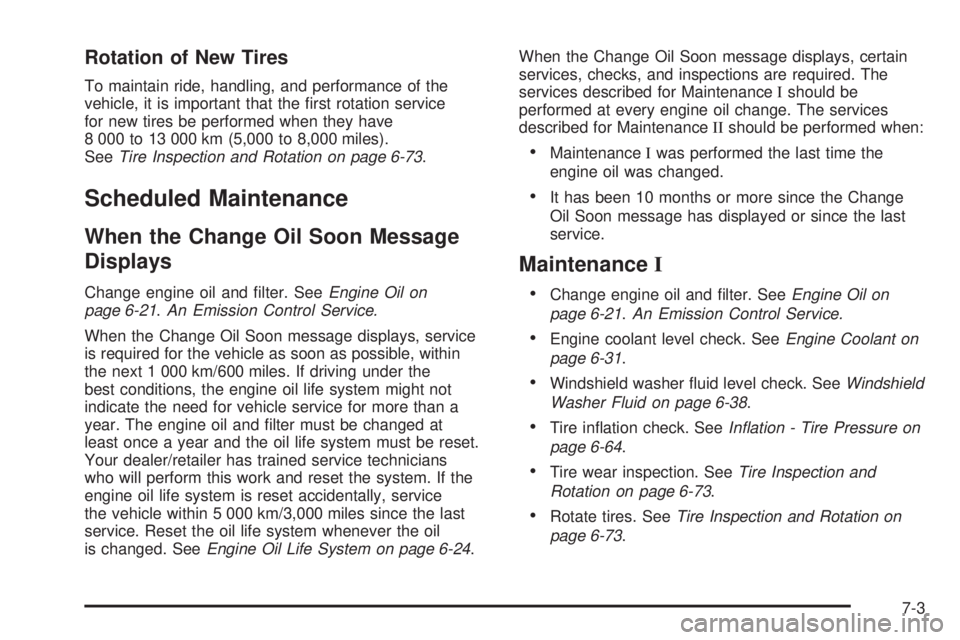
Rotation of New Tires
To maintain ride, handling, and performance of the
vehicle, it is important that the first rotation service
for new tires be performed when they have
8 000 to 13 000 km (5,000 to 8,000 miles).
SeeTire Inspection and Rotation on page 6-73.
Scheduled Maintenance
When the Change Oil Soon Message
Displays
Change engine oil and filter. SeeEngine Oil on
page 6-21.An Emission Control Service.
When the Change Oil Soon message displays, service
is required for the vehicle as soon as possible, within
the next 1 000 km/600 miles. If driving under the
best conditions, the engine oil life system might not
indicate the need for vehicle service for more than a
year. The engine oil and filter must be changed at
least once a year and the oil life system must be reset.
Your dealer/retailer has trained service technicians
who will perform this work and reset the system. If the
engine oil life system is reset accidentally, service
the vehicle within 5 000 km/3,000 miles since the last
service. Reset the oil life system whenever the oil
is changed. SeeEngine Oil Life System on page 6-24.When the Change Oil Soon message displays, certain
services, checks, and inspections are required. The
services described for MaintenanceIshould be
performed at every engine oil change. The services
described for MaintenanceIIshould be performed when:
•MaintenanceIwas performed the last time the
engine oil was changed.
•It has been 10 months or more since the Change
Oil Soon message has displayed or since the last
service.
MaintenanceI
•Change engine oil and filter. SeeEngine Oil on
page 6-21.An Emission Control Service.
•Engine coolant level check. SeeEngine Coolant on
page 6-31.
•Windshield washer fluid level check. SeeWindshield
Washer Fluid on page 6-38.
•Tire inflation check. SeeInation - Tire Pressure on
page 6-64.
•Tire wear inspection. SeeTire Inspection and
Rotation on page 6-73.
•Rotate tires. SeeTire Inspection and Rotation on
page 6-73.
7-3
Page 403 of 448
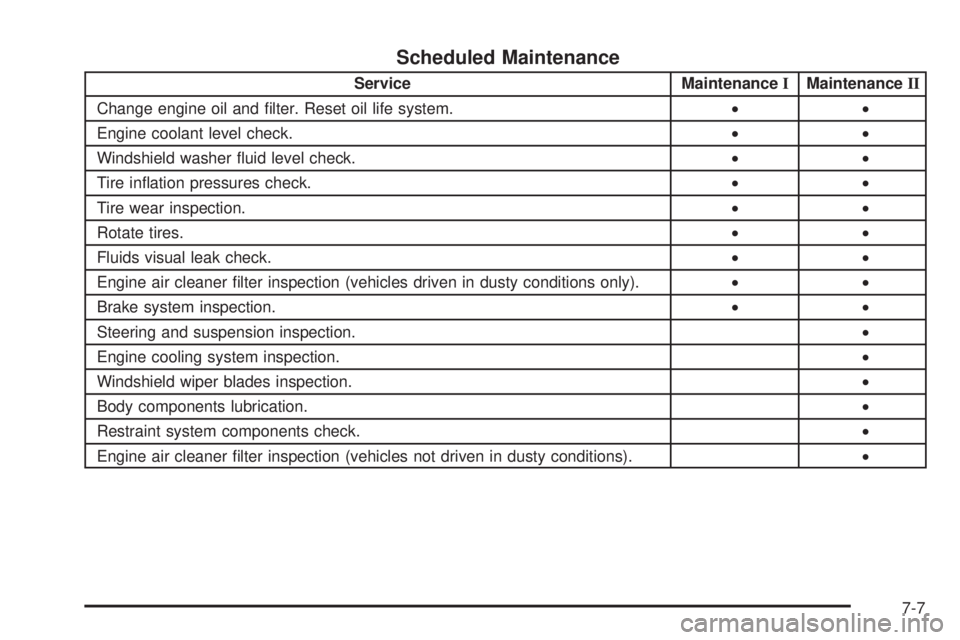
Scheduled Maintenance
Service MaintenanceIMaintenanceII
Change engine oil and filter. Reset oil life system.••
Engine coolant level check.••
Windshield washer fluid level check.••
Tire inflation pressures check.••
Tire wear inspection.••
Rotate tires.••
Fluids visual leak check.••
Engine air cleaner filter inspection (vehicles driven in dusty conditions only).••
Brake system inspection.••
Steering and suspension inspection.•
Engine cooling system inspection.•
Windshield wiper blades inspection.•
Body components lubrication.•
Restraint system components check.•
Engine air cleaner filter inspection (vehicles not driven in dusty conditions).•
7-7
Page 421 of 448
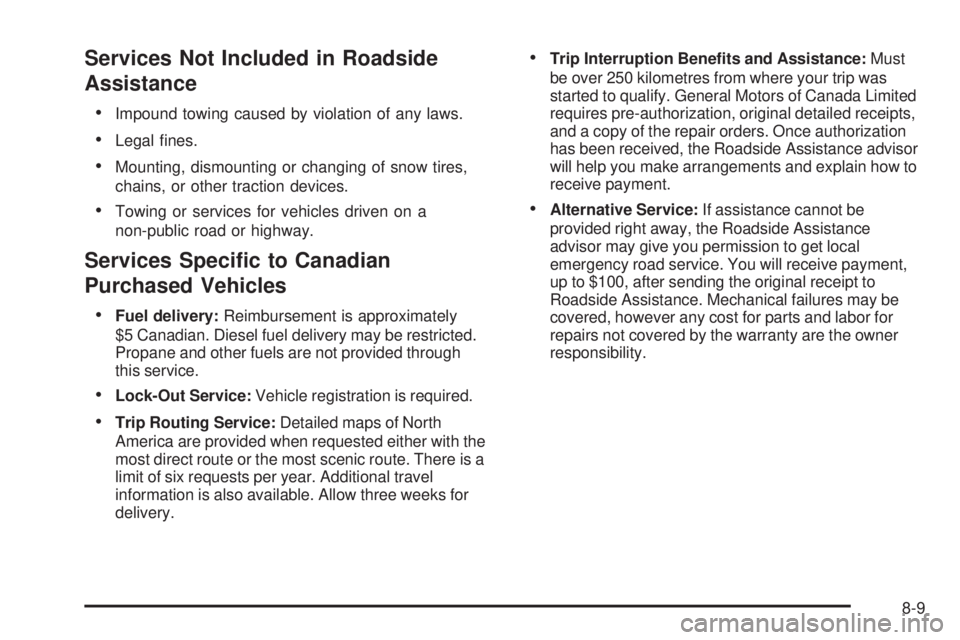
Services Not Included in Roadside
Assistance
•Impound towing caused by violation of any laws.
•Legal fines.
•Mounting, dismounting or changing of snow tires,
chains, or other traction devices.
•Towing or services for vehicles driven on a
non-public road or highway.
Services Specic to Canadian
Purchased Vehicles
•Fuel delivery:Reimbursement is approximately
$5 Canadian. Diesel fuel delivery may be restricted.
Propane and other fuels are not provided through
this service.
•Lock-Out Service:Vehicle registration is required.
•Trip Routing Service:Detailed maps of North
America are provided when requested either with the
most direct route or the most scenic route. There is a
limit of six requests per year. Additional travel
information is also available. Allow three weeks for
delivery.
•Trip Interruption Benets and Assistance:Must
be over 250 kilometres from where your trip was
started to qualify. General Motors of Canada Limited
requires pre-authorization, original detailed receipts,
and a copy of the repair orders. Once authorization
has been received, the Roadside Assistance advisor
will help you make arrangements and explain how to
receive payment.
•Alternative Service:If assistance cannot be
provided right away, the Roadside Assistance
advisor may give you permission to get local
emergency road service. You will receive payment,
up to $100, after sending the original receipt to
Roadside Assistance. Mechanical failures may be
covered, however any cost for parts and labor for
repairs not covered by the warranty are the owner
responsibility.
8-9
Page 431 of 448

A
Accessories and Modifications............................ 6-4
Accessory Power............................................3-21
Accessory Power Outlets.................................4-15
Adding Washer Fluid.......................................6-38
Additional Factors Affecting System Operation.....2-71
Additional Program Information.........................8-11
Additional Required Services.............................. 7-4
Additives, Fuel................................................. 6-8
Add-On Electrical Equipment...........................6-115
Adjusting the Speakers (Balance/Fade)..............4-58
Air Cleaner/Filter, Engine.................................6-26
Air Conditioning..............................................4-16
Airbag
Adding Equipment to Your Airbag-Equipped
Vehicle...................................................2-72
Airbag System
How Does an Airbag Restrain?......................2-65
Passenger Sensing System...........................2-67
Servicing Your Airbag-Equipped Vehicle..........2-72
What Makes an Airbag Inflate?......................2-65
What Will You See After an Airbag Inflates?....2-65
When Should an Airbag Inflate?....................2-63
Where Are the Airbags?...............................2-61
Airbags.........................................................2-74
Passenger Status Indicator...........................4-29
Readiness Light..........................................4-28
System Check.............................................2-59AM ...............................................................4-83
Antenna
Backglass...................................................4-84
Fixed Mast.................................................4-84
Antenna, XM™ Satellite Radio Antenna
System......................................................4-84
Antilock Brake System (ABS)............................. 5-4
Warning Light.............................................4-31
Appearance Care
Aluminum Wheels......................................6-112
Care of Safety Belts...................................6-110
Chemical Paint Spotting..............................6-114
Cleaning Exterior Lamps/Lenses
..................6-111
Fabric/Carpet............................................6-108
Finish Care...............................................6-111
Finish Damage..........................................6-113
Instrument Panel, Vinyl, and Other Plastic
Surfaces...............................................6-109
Interior Cleaning........................................6-107
Leather....................................................6-109
Sheet Metal Damage..................................6-113
Tires........................................................6-113
Underbody Maintenance.............................6-113
Washing Your Vehicle.................................6-110
Weatherstrips............................................6-110
Windshield and Wiper Blades......................6-112
Arming the System.........................................3-16
Assistance Program, Roadside........................... 8-7
1
Page 432 of 448

Audio System.........................................4-53, 4-72
Audio Steering
Wheel Controls........................................4-82
Radio Reception..........................................4-83
Setting the Clock.........................................4-53
Theft-Deterrent Feature................................4-81
XM™ Satellite Radio Antenna System............4-84
Audio System(s).............................................4-54
Automatic Climate Control System.....................4-20
Automatic Dimming Mirror Operation..................3-34
Automatic Door Lock......................................... 3-9
Automatic Headlamp System............................4-12
Automatic Transmission
Fluid..................................................6-27, 6-28
Operation...................................................3-24
Automatic Transmission Shift Lock Control
System Check.............................................. 7-8
B
Backglass Antenna..........................................4-84
Backing Up....................................................5-31
Battery..........................................................6-42
Electric Power Management..........................4-14
Run-Down Protection...................................4-15
Battery Replacement......................................... 3-5
Belt Routing, Engine.......................................7-12
Bench Seat, Split (60/40).................................2-13Blizzard Conditions..........................................5-16
Bluetooth Controls...........................................4-72
Bluetooth
®.....................................................4-71
Brake
Emergencies................................................ 5-5
Brake Adjustment............................................6-41
Brake Fluid....................................................6-39
Brake Pedal Travel.........................................6-41
Brake Wear...................................................6-41
Brakes..........................................................6-39
Antilock....................................................... 5-4
Parking......................................................3-29
System Warning Light..................................4-30
Braking........................................................... 5-3
Braking in Emergencies..................................... 5-5
Break-In, New Vehicle.....................................3-20
Bulb Replacement...........................................6-54
Center High-Mounted Stoplamp
(CHMSL) ........................................6-49, 6-50
Fog Lamps .................................................4-12
Halogen Bulbs............................................6-47
Headlamp Aiming........................................6-47
Headlamps.................................................6-47
Headlamps, Front Turn Signal, Sidemarker,
and Parking Lamps..................................6-48
License Plate Lamps....................................6-54
Taillamps, Turn Signal, Sidemarker, Stoplamps,
and Back-Up Lamps.................6-50, 6-51, 6-53
Buying New Tires...........................................6-75
2
Page 433 of 448

C
Calibration.....................................................3-35
California
Perchlorate Materials Requirements................. 6-5
Warning....................................................... 6-5
California Fuel.................................................. 6-7
Call Waiting...................................................4-78
Calling for Assistance........................................ 8-7
Canada — Customer Assistance......................... 8-6
Canadian Owners............................................... iii
Canadian Owners (Propriétaires Canadiens)........... iii
Canceling a Remote Start.................................. 1-5
Capacities and Specifications..........................6-125
Carbon Monoxide
Engine Exhaust...........................................3-32
Trunk.........................................................3-11
Winter Driving.............................................5-15
Care of
Safety Belts..............................................6-110
Care of CDs ..................................................4-61
Care of the CD Player.....................................4-62
CD Messages................................................4-61
CD, MP3 .......................................................4-63
Cellular Phone Usage......................................4-83
Center Console Storage...................................3-37
Center High-Mounted Stoplamp (CHMSL)....6-49, 6-50
Certification Label...........................................5-22
Chains, Tire...................................................6-81Changing a Tire When Trailer Towing................5-33
Charging System Light....................................4-30
Check
Engine Lamp..............................................4-34
Check Engine Light.........................................4-34
Checking Coolant............................................6-32
Checking Engine Oil........................................6-21
Checking Things Under the Hood......................6-14
Chemical Paint Spotting.................................6-114
Child Restraints
Infants and Young Children...........................2-39
Lower Anchors and Tethers for Children..........2-46
Older Children.............................................2-36
Securing a Child Restraint in a Rear
Seat Position...........................................2-54
Securing a Child Restraint in the Right
Front Seat Position...................................2-56
Systems.....................................................2-42
Where to Put the Restraint...........................2-44
Cleaning
Aluminum Wheels......................................6-112
Exterior Lamps/Lenses................................6-111
Fabric/Carpet............................................6-108
Finish Care...............................................6-111
Instrument Panel, Vinyl, and Other
Plastic Surfaces.....................................6-109
Interior.....................................................6-107
Leather....................................................6-109
Tires........................................................6-113
3
Page 438 of 448

H
Halogen Bulbs................................................6-47
Hazard Warning Flashers................................... 4-3
Head Restraints............................................... 2-2
Headlamps....................................................4-10
Aiming .......................................................6-47
Bulb Replacement.......................................6-47
Daytime Running Lamps (DRL).....................4-11
Delayed.....................................................4-11
Flash-to-Pass............................................... 4-5
Headlamps, Front Turn Signal, Sidemarker,
and Parking Lamps..................................6-48
High/Low Beam Changer................................ 4-5
On Reminder..............................................4-10
Headlamps Off in Park....................................4-11
Heated Seats................................................... 2-6
Heater...........................................................4-16
Engine Coolant...........................................3-23
Highbeam On Light.........................................4-38
High-Speed Operation, Tires.............................6-66
Highway Hypnosis...........................................5-13
Hill and Mountain Roads..................................5-14
Hitches..........................................................5-30
Hood
Checking Things Under................................6-14
Release.....................................................6-15Horn ............................................................... 4-3
How OnStar Service Works..............................1-22
How the System Alarm is Activated...................3-17
How to Add Automatic Transmission Fluid..........6-30
How to Add Coolant to the Coolant
Surge Tank.................................................6-33
How to Check................................................6-65
How to Check Automatic Transmission Fluid.......6-28
How to Check Power Steering Fluid..................6-38
How to Detect a Tamper Condition....................3-18
How to Inspect the Engine Air Cleaner/Filter.......6-26
How to Reset the Engine Oil Life System...........6-25
How to Turn Off the System Alarm....................3-17
How to Wear Safety Belts Properly
...................2-20
Hydraulic Power Steering................................... 5-8
Hydroplaning..................................................5-12
I
If a Crash Occurs...........................................8-13
If No Steam Is Coming From The Engine
Compartment..............................................6-36
If Steam Is Coming From The Engine
Compartment..............................................6-35
If the Off Indicator is Lit for an Adult-Size
Occupant...................................................2-70
8