tow PONTIAC G8 2008 Owner's Guide
[x] Cancel search | Manufacturer: PONTIAC, Model Year: 2008, Model line: G8, Model: PONTIAC G8 2008Pages: 334, PDF Size: 2.99 MB
Page 251 of 334
11. Unplug the air compressor
accessory plug (B) from the
accessory power outlet in
the vehicle.
12. Turn the sealant/air hose (E)
counterclockwise to remove.
13. Replace the tire valve
stem cap.
14. Stow the sealant/air hose (E)
and air compressor accessory
plug (B) in their original
locations.
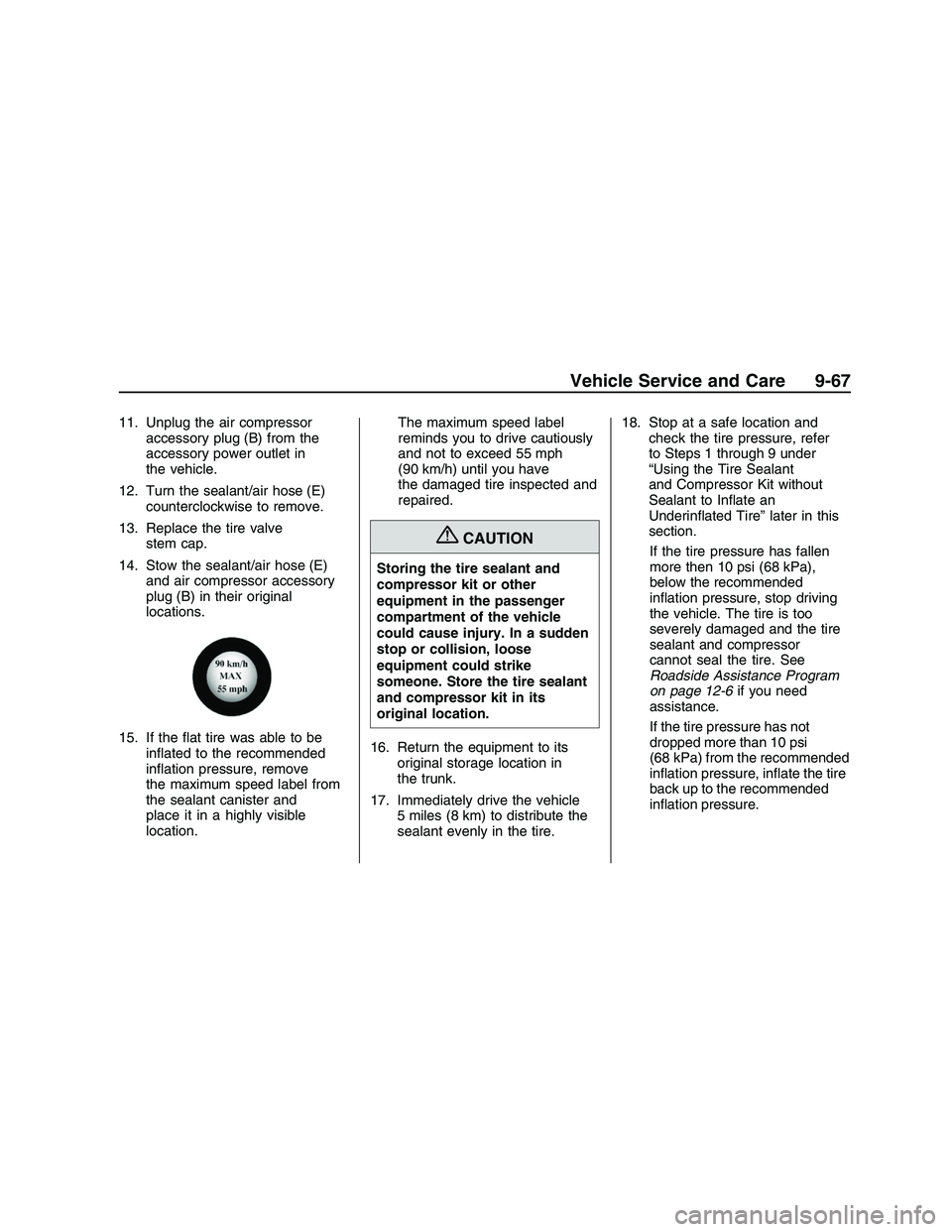
15. If the at tire was able to be
inated to the recommended
ination pressure, remove
the maximum speed label from
the sealant canister and
place it in a highly visible
location.The maximum speed label
reminds you to drive cautiously
and not to exceed 55 mph
(90 km/h) until you have
the damaged tire inspected and
repaired.
{CAUTION
Storing the tire sealant and
compressor kit or other
equipment in the passenger
compartment of the vehicle
could cause injury. In a sudden
stop or collision, loose
equipment could strike
someone. Store the tire sealant
and compressor kit in its
original location.
16. Return the equipment to its
original storage location in
the trunk.
17. Immediately drive the vehicle
5 miles (8 km) to distribute the
sealant evenly in the tire.18. Stop at a safe location and
check the tire pressure, refer
to Steps 1 through 9 under
“Using the Tire Sealant
and Compressor Kit without
Sealant to Inate an
Underinated Tire” later in this
section.
If the tire pressure has fallen
more then 10 psi (68 kPa),
below the recommended
ination pressure, stop driving
the vehicle. The tire is too
severely damaged and the tire
sealant and compressor
cannot seal the tire. See
Roadside Assistance Program
on page 12-6if you need
assistance.
If the tire pressure has not
dropped more than 10 psi
(68 kPa) from the recommended
ination pressure, inate the tire
back up to the recommended
ination pressure.
Vehicle Service and Care 9-67
2008 - Pontiac G8 Owner Manual
Page 253 of 334
{CAUTION
Idling the engine in a closed-in
place or with the climate
control system off can cause
deadly carbon monoxide (CO).
SeeEngine Exhaust on
page 8-12.
5. Start the vehicle. The vehicle
must be running while using
the air compressor.
{CAUTION
Overination could cause the
tire to rupture, and you or
others could be injured. Be
sure to read the inator
instructions, and inate the tire
to its recommended pressure.
Do not exceed 36 psi (248 kPa).6. Push the On/Off switch (G) to the
I (on) position.
Check the pressure gage (F). If
there is not a pressure reading
while the compressor is running,
check for leaks at the connection
between the hose and the tire
valve stem.
7. Inate the tire up to the
recommended ination pressure
using the air pressure gage (F)
on the top of the unit. See
Inflation - Tire Pressure on
page 9-46.
The pressure gage (F) reads
slightly high while the compressor
is on. Turn the compressor off to
get an accurate reading. The
compressor may be turned on
and off until the correct pressure
is reached.
8. Push the On/Off switch (G) to the
O (off) position.
Be careful while handling the tire
sealant and compressor kit as
they could be hot after usage.9. Unplug the air compressor
accessory plug (A) from the
accessory power outlet in the
vehicle and stow it in its original
location.
10. Disconnect the air-only hose (E)
from the tire valve stem and
stow it back in its original
location.
11. Replace the tire valve stem cap.
{CAUTION
Storing the tire sealant and
compressor kit or other
equipment in the passenger
compartment of the vehicle
could cause injury. In a sudden
stop or collision, loose
equipment could strike
someone. Store the tire sealant
and compressor kit in its
original location.
12. Place the equipment in the
original location in the trunk
of your vehicle.
Vehicle Service and Care 9-69
2008 - Pontiac G8 Owner Manual
Page 254 of 334
Removal and Installation of
the Sealant Canister
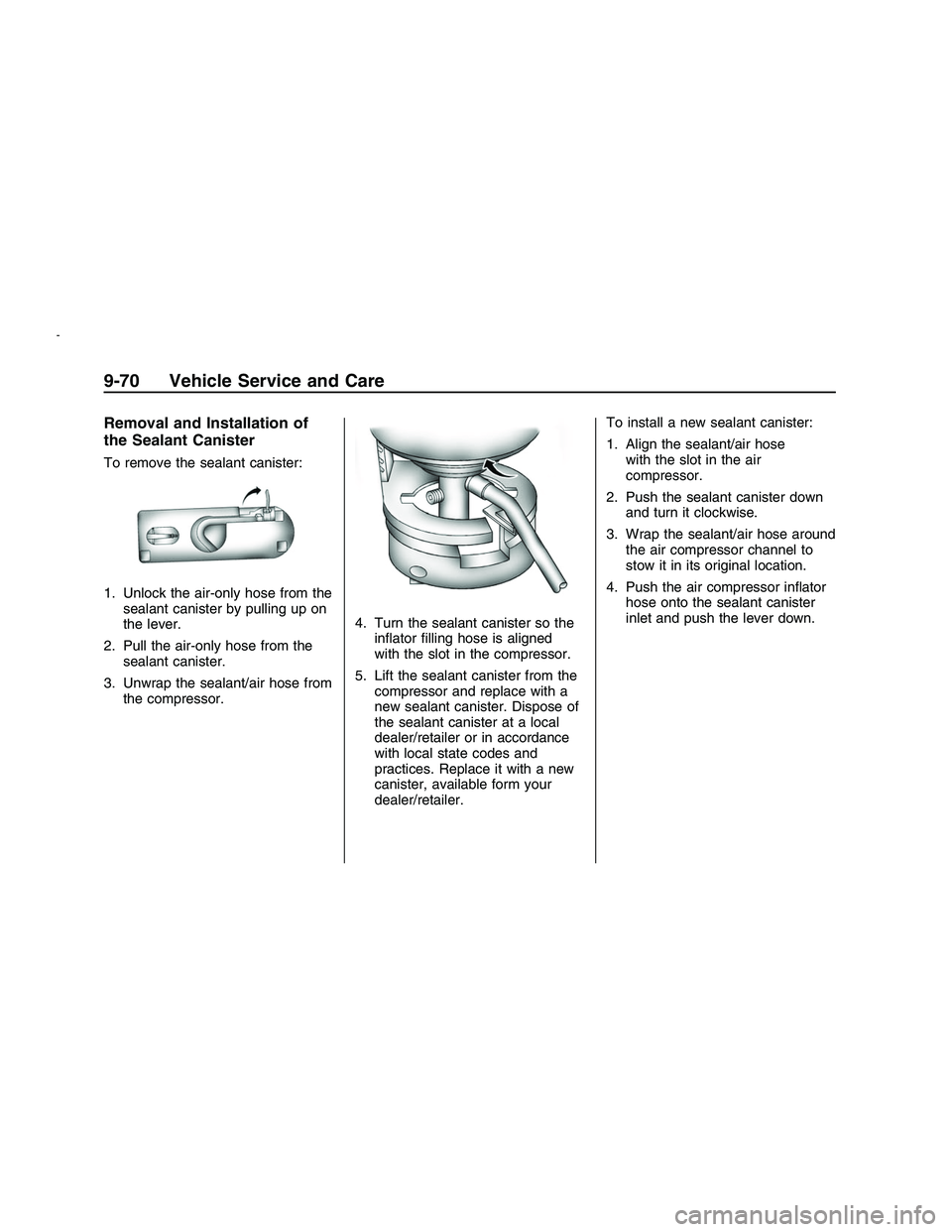
To remove the sealant canister:
1. Unlock the air-only hose from the
sealant canister by pulling up on
the lever.
2. Pull the air-only hose from the
sealant canister.
3. Unwrap the sealant/air hose from
the compressor.4. Turn the sealant canister so the
inator lling hose is aligned
with the slot in the compressor.
5. Lift the sealant canister from the
compressor and replace with a
new sealant canister. Dispose of
the sealant canister at a local
dealer/retailer or in accordance
with local state codes and
practices. Replace it with a new
canister, available form your
dealer/retailer.To install a new sealant canister:
1. Align the sealant/air hose
with the slot in the air
compressor.
2. Push the sealant canister down
and turn it clockwise.
3. Wrap the sealant/air hose around
the air compressor channel to
stow it in its original location.
4. Push the air compressor inator
hose onto the sealant canister
inlet and push the lever down.
9-70 Vehicle Service and Care
2008 - Pontiac G8 Owner Manual
Page 259 of 334
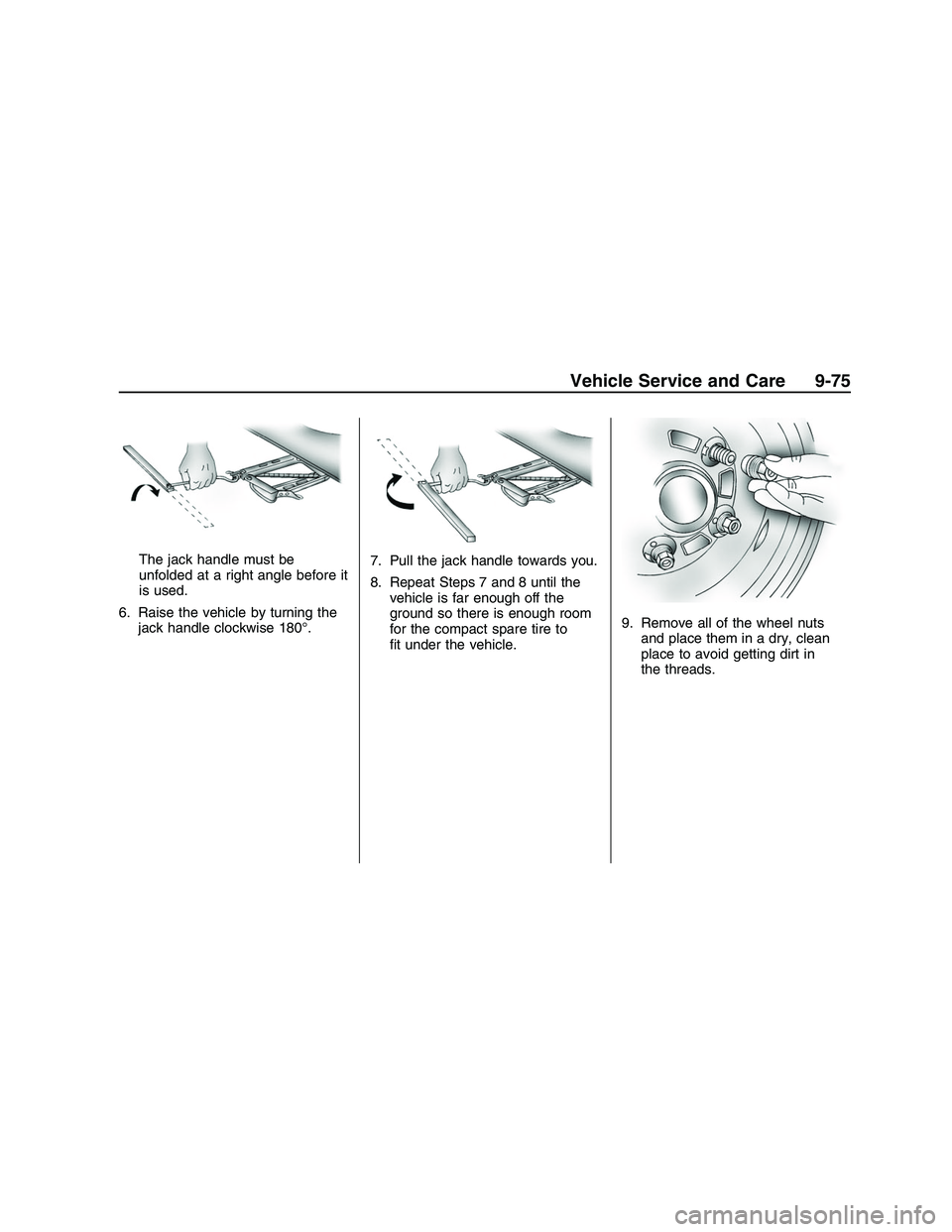
The jack handle must be
unfolded at a right angle before it
is used.
6. Raise the vehicle by turning the
jack handle clockwise 180°.7. Pull the jack handle towards you.
8. Repeat Steps 7 and 8 until the
vehicle is far enough off the
ground so there is enough room
for the compact spare tire to
t under the vehicle.9. Remove all of the wheel nuts
and place them in a dry, clean
place to avoid getting dirt in
the threads.
Vehicle Service and Care 9-75
2008 - Pontiac G8 Owner Manual
Page 260 of 334
{CAUTION
Rust or dirt on a wheel, or on
the parts to which it is
fastened, can make wheel nuts
become loose after time. The
wheel could come off and
cause an accident. When you
change a wheel, remove any
rust or dirt from places where
the wheel attaches to the
vehicle. In an emergency, you
can use a cloth or a paper
towel to do this; but be sure to
use a scraper or wire brush
later, if needed, to get all the
rust or dirt off. SeeChanging a
Flat Tire (V6 Engine) on
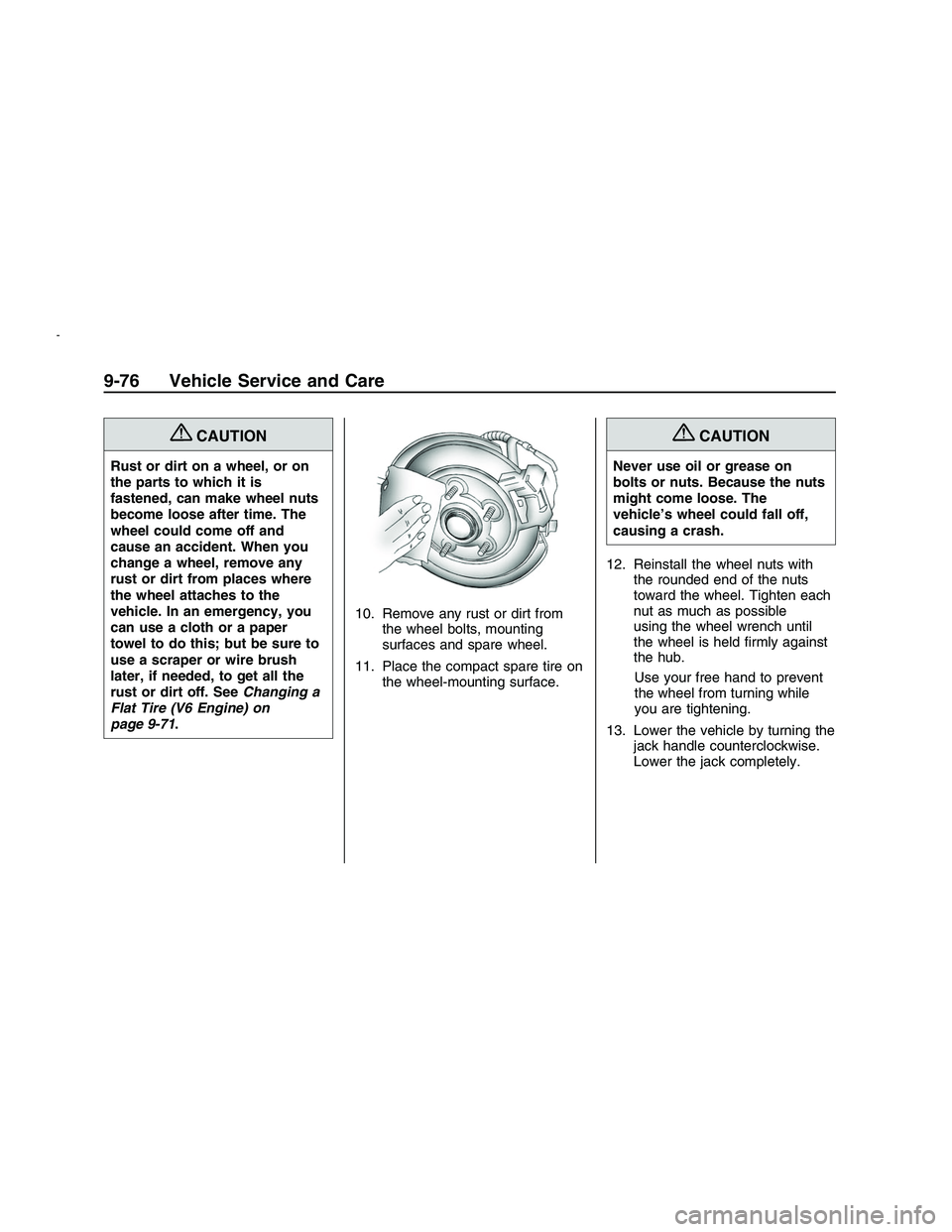
page 9-71.10. Remove any rust or dirt from
the wheel bolts, mounting
surfaces and spare wheel.
11. Place the compact spare tire on
the wheel-mounting surface.
{CAUTION
Never use oil or grease on
bolts or nuts. Because the nuts
might come loose. The
vehicle’s wheel could fall off,
causing a crash.
12. Reinstall the wheel nuts with
the rounded end of the nuts
toward the wheel. Tighten each
nut as much as possible
using the wheel wrench until
the wheel is held rmly against
the hub.
Use your free hand to prevent
the wheel from turning while
you are tightening.
13. Lower the vehicle by turning the
jack handle counterclockwise.
Lower the jack completely.
9-76 Vehicle Service and Care
2008 - Pontiac G8 Owner Manual
Page 268 of 334
Towing
Towing Your Vehicle
Consult your dealer/retailer or a
professional towing service if
you need to have your disabled
vehicle towed. SeeRoadside
Assistance Program on page 12-6.
Shift Lock Manual
Release
The transmission has an electric
park lock called a shift lock manual
release. The key must be in the
ON/RUN position, and the brake
pedal pressed so the transmission
gear selector can be moved from the
P (Park) position. If the battery
has lost power, the selector cannot
be moved to neutral for towing
unless the shift lock manual release
is disengaged manually.To access the shift lock manual
release:
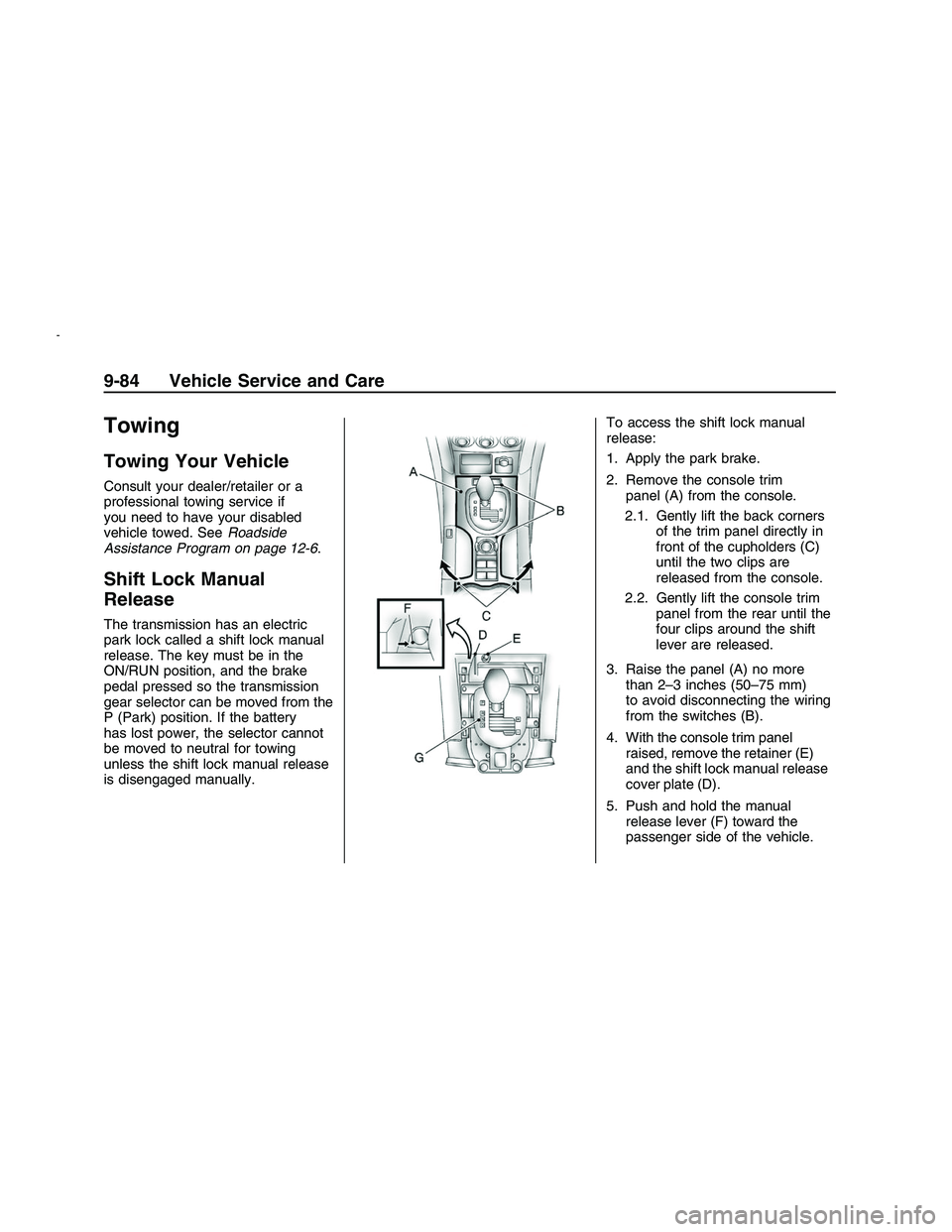
1. Apply the park brake.
2. Remove the console trim
panel (A) from the console.
2.1. Gently lift the back corners
of the trim panel directly in
front of the cupholders (C)
until the two clips are
released from the console.
2.2. Gently lift the console trim
panel from the rear until the
four clips around the shift
lever are released.
3. Raise the panel (A) no more
than 2–3 inches (50–75 mm)
to avoid disconnecting the wiring
from the switches (B).
4. With the console trim panel
raised, remove the retainer (E)
and the shift lock manual release
cover plate (D).
5. Push and hold the manual
release lever (F) toward the
passenger side of the vehicle.
9-84 Vehicle Service and Care
2008 - Pontiac G8 Owner Manual
Page 269 of 334
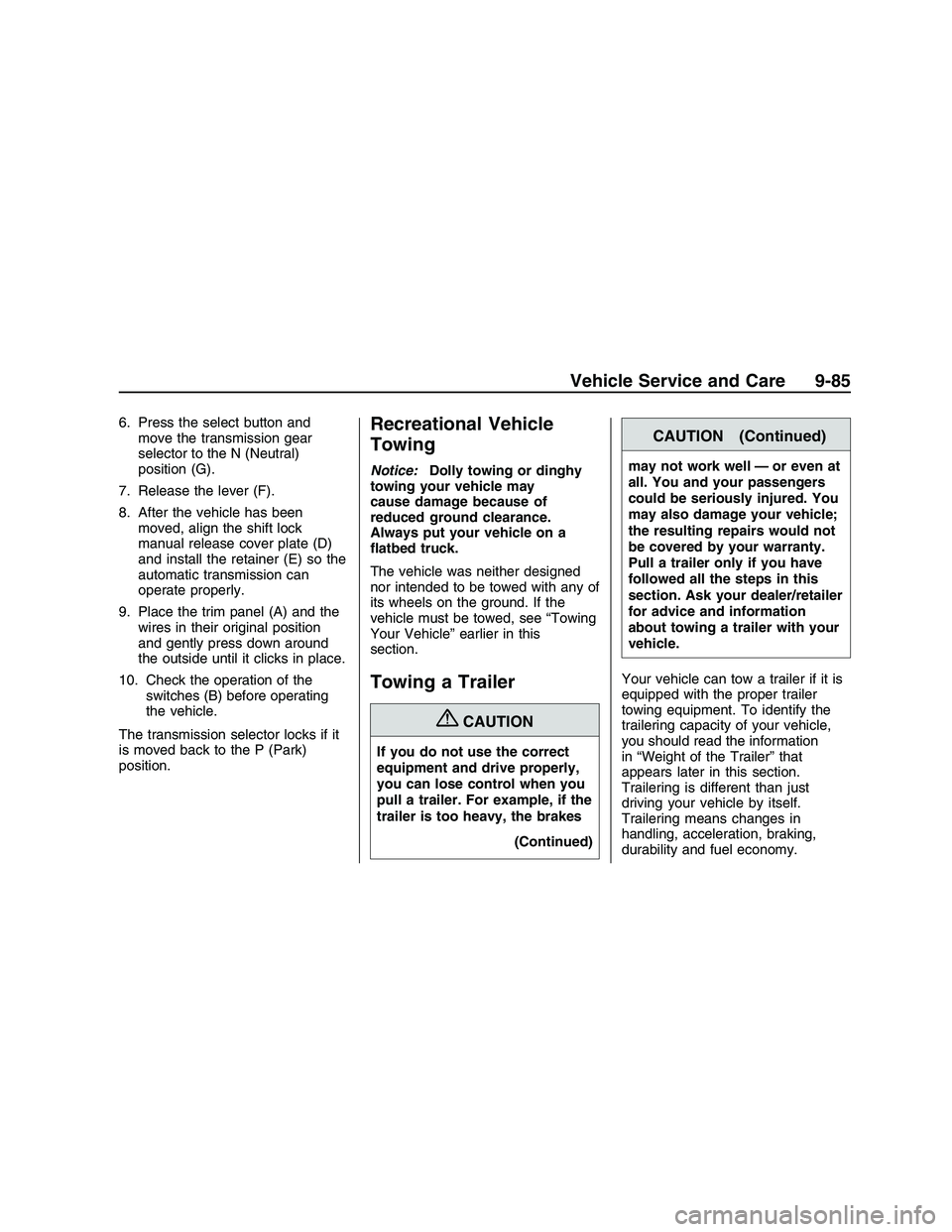
6. Press the select button and
move the transmission gear
selector to the N (Neutral)
position (G).
7. Release the lever (F).
8. After the vehicle has been
moved, align the shift lock
manual release cover plate (D)
and install the retainer (E) so the
automatic transmission can
operate properly.
9. Place the trim panel (A) and the
wires in their original position
and gently press down around
the outside until it clicks in place.
10. Check the operation of the
switches (B) before operating
the vehicle.
The transmission selector locks if it
is moved back to the P (Park)
position.Recreational Vehicle
Towing
Notice:Dolly towing or dinghy
towing your vehicle may
cause damage because of
reduced ground clearance.
Always put your vehicle on a
atbed truck.
The vehicle was neither designed
nor intended to be towed with any of
its wheels on the ground. If the
vehicle must be towed, see “Towing
Your Vehicle” earlier in this
section.
Towing a Trailer
{CAUTION
If you do not use the correct
equipment and drive properly,
you can lose control when you
pull a trailer. For example, if the
trailer is too heavy, the brakes
(Continued)
CAUTION (Continued)
may not work well — or even at
all. You and your passengers
could be seriously injured. You
may also damage your vehicle;
the resulting repairs would not
be covered by your warranty.
Pull a trailer only if you have
followed all the steps in this
section. Ask your dealer/retailer
for advice and information
about towing a trailer with your
vehicle.
Your vehicle can tow a trailer if it is
equipped with the proper trailer
towing equipment. To identify the
trailering capacity of your vehicle,
you should read the information
in “Weight of the Trailer” that
appears later in this section.
Trailering is different than just
driving your vehicle by itself.
Trailering means changes in
handling, acceleration, braking,
durability and fuel economy.
Vehicle Service and Care 9-85
2008 - Pontiac G8 Owner Manual
Page 270 of 334
Successful, safe trailering takes
correct equipment, and it has to be
used properly.
That is the reason for this part. In it
are many time-tested, important
trailering tips and safety rules. Many
of these are important for your
safety and that of your passengers.
So please read this section
carefully before you pull a trailer.
Load-pulling components such
as the engine, transmission, wheel
assemblies and tires are forced
to work harder against the drag of
the added weight. The engine
is required to operate at relatively
higher speeds and under greater
loads, generating extra heat.
Also, the trailer adds considerably to
wind resistance, increasing the
pulling requirements.If You Do Decide To Pull A
Trailer
If you do, here are some important
points:
There are many different laws,
including speed limit restrictions,
having to do with trailering.
Make sure your rig will be legal,
not only where you live but
also where you will be driving. A
good source for this information
can be state or provincial police.
Consider using a sway control.
You can ask a hitch dealer
about sway controls.
Do not tow a trailer at all during
the rst 1,000 miles (1 600 km)
your new vehicle is driven.
Your engine, axle or other parts
could be damaged.
Then, during the rst 500 miles
(800 km) that you tow a trailer, do
not drive over 50 mph (80 km/h)
and do not make starts at fullthrottle. This helps your engine
and other parts of your vehicle
wear in at the heavier loads.
Use the Sport Shift mode and the
cruise control when towing. The
Active Select (A/S) may also be
used under light load conditions.
Obey speed limit restrictions
when towing a trailer. Do not drive
faster than the maximum posted
speed for trailers, or no more than
55 mph (90 km/h), to save wear
on your vehicle’s parts.
Three important considerations have
to do with weight:
The weight of the trailer.
The weight of the trailer tongue.
The total weight on your
vehicle’s tires.
9-86 Vehicle Service and Care
2008 - Pontiac G8 Owner Manual
Page 271 of 334
Weight of the Trailer
How heavy can a trailer safely be?
It should never weigh more than
2,000 lbs (907 kg). But even
that can be too heavy.
It depends on how you plan to use
your rig. For example, speed,
altitude, road grades, outside
temperature and how much your
vehicle is used to pull a trailer are all
important. It can also depend on
any special equipment that you have
on your vehicle, and the amount
of tongue weight the vehicle
can carry. See “Weight of the Trailer
Tongue” later in this section for
more information.
Maximum trailer weight is calculated
assuming only the driver is in the
tow vehicle and it has all the
required trailering equipment. The
weight of additional optional
equipment, passengers and cargo in
the tow vehicle must be subtracted
form the maximum trailer weight.You can ask your dealer/retailer for
our trailering information or
advice, or you can write us at our
Customer Assistance Offices.
SeeCustomer Assistance Offices
on page 12-4for more information.
Weight of the Trailer Tongue
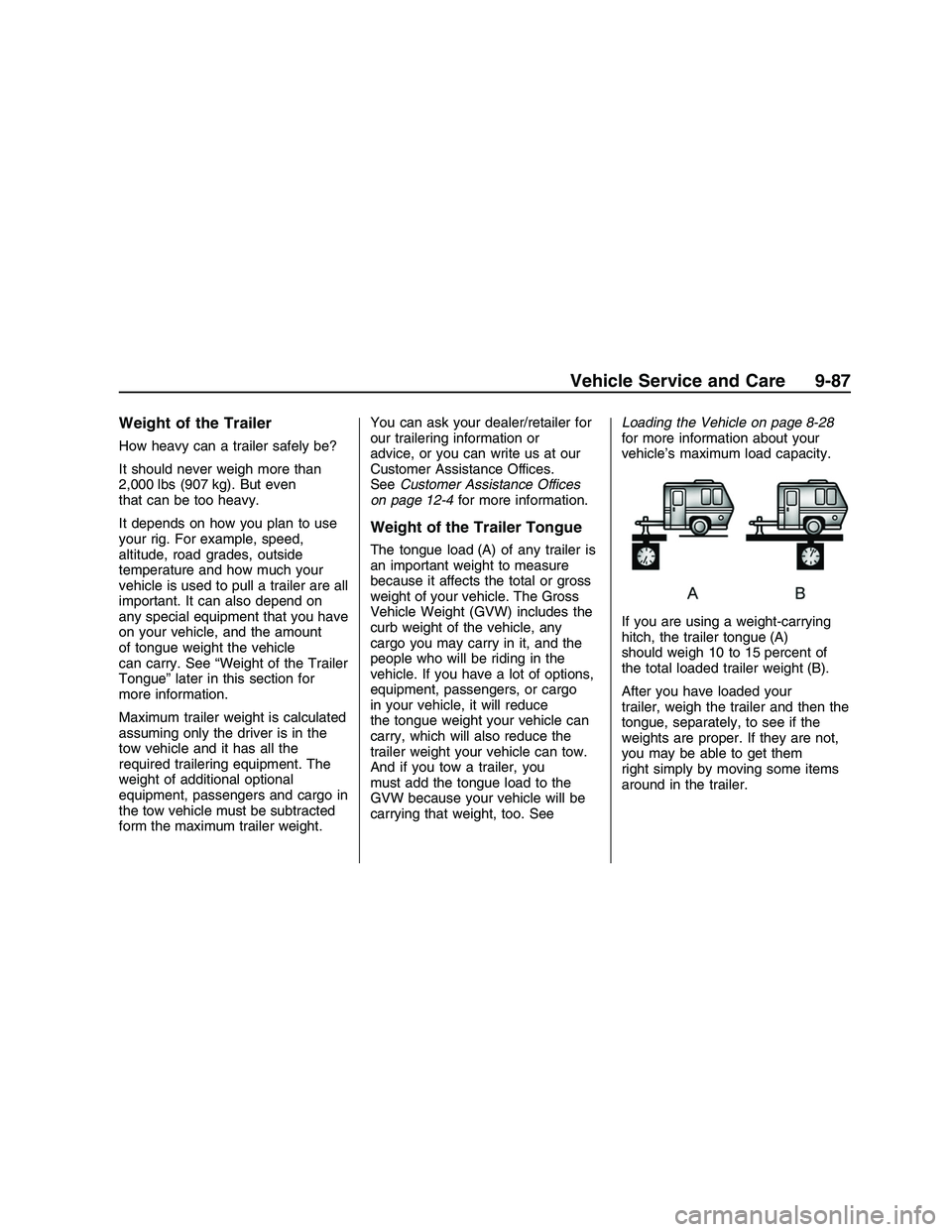
The tongue load (A) of any trailer is
an important weight to measure
because it affects the total or gross
weight of your vehicle. The Gross
Vehicle Weight (GVW) includes the
curb weight of the vehicle, any
cargo you may carry in it, and the
people who will be riding in the
vehicle. If you have a lot of options,
equipment, passengers, or cargo
in your vehicle, it will reduce
the tongue weight your vehicle can
carry, which will also reduce the
trailer weight your vehicle can tow.
And if you tow a trailer, you
must add the tongue load to the
GVW because your vehicle will be
carrying that weight, too. SeeLoading the Vehicle on page 8-28
for more information about your
vehicle’s maximum load capacity.
If you are using a weight-carrying
hitch, the trailer tongue (A)
should weigh 10 to 15 percent of
the total loaded trailer weight (B).
After you have loaded your
trailer, weigh the trailer and then the
tongue, separately, to see if the
weights are proper. If they are not,
you may be able to get them
right simply by moving some items
around in the trailer.
Vehicle Service and Care 9-87
2008 - Pontiac G8 Owner Manual
Page 273 of 334
Driving with a Trailer
Towing a trailer requires a certain
amount of experience. Before setting
out for the open road, you will want to
get to know your rig. Acquaint
yourself with the feel of handling and
braking with the added weight of the
trailer. And always keep in mind that
the vehicle you are driving is now a
good deal longer and not nearly as
responsive as your vehicle is by
itself.
Before you start, check all trailer
hitch parts and attachments, safety
chains, electrical connector,
lamps, tires and mirror adjustment.
If the trailer has electric brakes,
start your vehicle and trailer moving
and then apply the trailer brake
controller by hand to be sure
the brakes are working. This lets
you check your electrical connection
at the same time.
During your trip, check occasionally
to be sure that the load is secure,
and that the lamps and any
trailer brakes are still working.
Towing with the Electronic
Stability Program (ESP®)
When towing, the sound of the ESP
modulator might be heard. The
ESP is reacting to the vehicle
movement caused by the trailer,
which mainly occurs during
cornering. This is normal when
towing heavier trailers.
Following Distance
Stay at least twice as far behind the
vehicle ahead as when driving
your vehicle without a trailer. This
can help avoid situations that require
heavy braking and sudden turns.
Passing
More passing distance is needed up
ahead when you are towing a
trailer. And, because the vehicle is
longer, it is necessary to go
much farther beyond the passed
vehicle before returning to the lane.
Backing Up
Hold the bottom of the steering
wheel with one hand. Then, to move
the trailer to the left, just move
that hand to the left. To move the
trailer to the right, move the hand to
the right. Always back up slowly
and, if possible, have someone
guide you.
Making Turns
Notice:Making very sharp turns
while trailering could cause
the trailer to come in contact with
the vehicle. Your vehicle could
be damaged. Avoid making
very sharp turns while trailering.
When you are turning with a
trailer, make wider turns than
normal. Do this so your trailer will
not strike soft shoulders, curbs, road
signs, trees or other objects.
Avoid jerky or sudden maneuvers.
Signal well in advance.
Vehicle Service and Care 9-89
2008 - Pontiac G8 Owner Manual