brake PONTIAC G8 2008 Service Manual
[x] Cancel search | Manufacturer: PONTIAC, Model Year: 2008, Model line: G8, Model: PONTIAC G8 2008Pages: 334, PDF Size: 2.99 MB
Page 246 of 334
Tire Chains
{CAUTION
Do not use tire chains. There is
not enough clearance. Tire
chains used on a vehicle
without the proper amount of
clearance can cause damage to
the brakes, suspension or other
vehicle parts. The area
damaged by the tire chains
could cause you to lose control
of the vehicle and you or others
may be injured in a crash.
(Continued)
CAUTION (Continued)
Use another type of traction
device only if its manufacturer
recommends it for use on the
vehicle and tire size
combination and road
conditions. Follow that
manufacturer’s instructions. To
help avoid damage to the
vehicle, drive slowly, readjust
or remove the device if it is
contacting the vehicle, and do
not spin the vehicle’s wheels. If
you do nd traction devices
that will t, install them on the
front tires.
Tire Changing
If a Tire Goes Flat
It is unusual for a tire to blowout
while you are driving, especially if
you maintain your tires properly. See
Tires on page 9-39. If air goes out
of a tire, It is much more likely
to leak out slowly. But if you should
ever have a blowout, here are a
few tips about what to expect
and what to do:
If a front tire fails, the at tire will
create a drag that pulls the vehicle
toward that side. Take your foot
off the accelerator pedal and grip the
steering wheel rmly. Steer to
maintain lane position, and then
gently brake to a stop well out of the
traffic lane.
9-62 Vehicle Service and Care
2008 - Pontiac G8 Owner Manual
Page 247 of 334
A rear blowout, particularly on a
curve, acts much like a skid
and may require the same correction
you would use in a skid. In any
rear blowout, remove your foot from
the accelerator pedal. Get the
vehicle under control by steering the
way you want the vehicle to go. It
may be very bumpy and noisy,
but you can still steer. Gently brake
to a stop, well off the road if
possible.
If a tire goes at, and your vehicle
has a compact spare tire, see
Changing a Flat Tire (V6 Engine) on
page 9-71. This information shows
you how to use the vehicle’s
tire changing equipment and how to
change a at tire safely.{CAUTION
Lifting a vehicle and getting
under it to do maintenance or
repairs is dangerous without the
appropriate safety equipment
and training. The jack provided
with your vehicle is designed
only for changing a at tire. If it
is used for anything else, you or
others could be badly injured or
killed if the vehicle slips off the
jack. Use the jack provided with
your vehicle only for changing a
at tire.
Tire Sealant and
Compressor Kit
If your vehicle has a factory installed
Tire Sealant and Compressor kit,
there is no spare tire, no tire
changing equipment and no place to
store a tire.If a tire goes at, avoid further tire
and wheel damage by driving slowly
to a level place and stopping.
1. Turn on the hazard warning
ashers. SeeHazard Warning
Flashers on page 4-4.
2. Park your vehicle. Set the
parking brake rmly and put the
shift lever in PARK (P). See
Shifting Into Park (Automatic
Transmission) on page 8-10.
3. Turn off the engine.
4. Inspect the at tire.
If the tire has been separated from
the wheel, has damaged sidewalls,
or has a puncture larger than a
14inch (6 mm), the tire is too
severely damaged for the tire
sealant and compressor kit to be
effective. SeeRoadside Assistance
Program on page 12-6.
If the tire has a puncture less than a
14inch (6 mm) in the tread area
of the tire, seeTire Sealant
and Compressor Kit (V8 Engine) on
page 9-64.
Vehicle Service and Care 9-63
2008 - Pontiac G8 Owner Manual
Page 255 of 334
Changing a Flat Tire
(V6 Engine)
If a tire goes at, avoid further tire
and wheel damage by driving slowly
to a level place. Turn on the
hazard warning ashers.
{CAUTION
Changing a tire can be
dangerous. The vehicle can slip
off the jack and roll over or fall
on you or other people. You
and they could be badly injured
or even killed. Find a level
place to change your tire. To
help prevent the vehicle from
moving:
1. Set the parking brake
rmly.
2. Put the shift lever in
PARK (P).
(Continued)
CAUTION (Continued)
3. Turn off the engine and do
not restart while the
vehicle is raised.
4. Do not allow passengers to
remain in the vehicle.
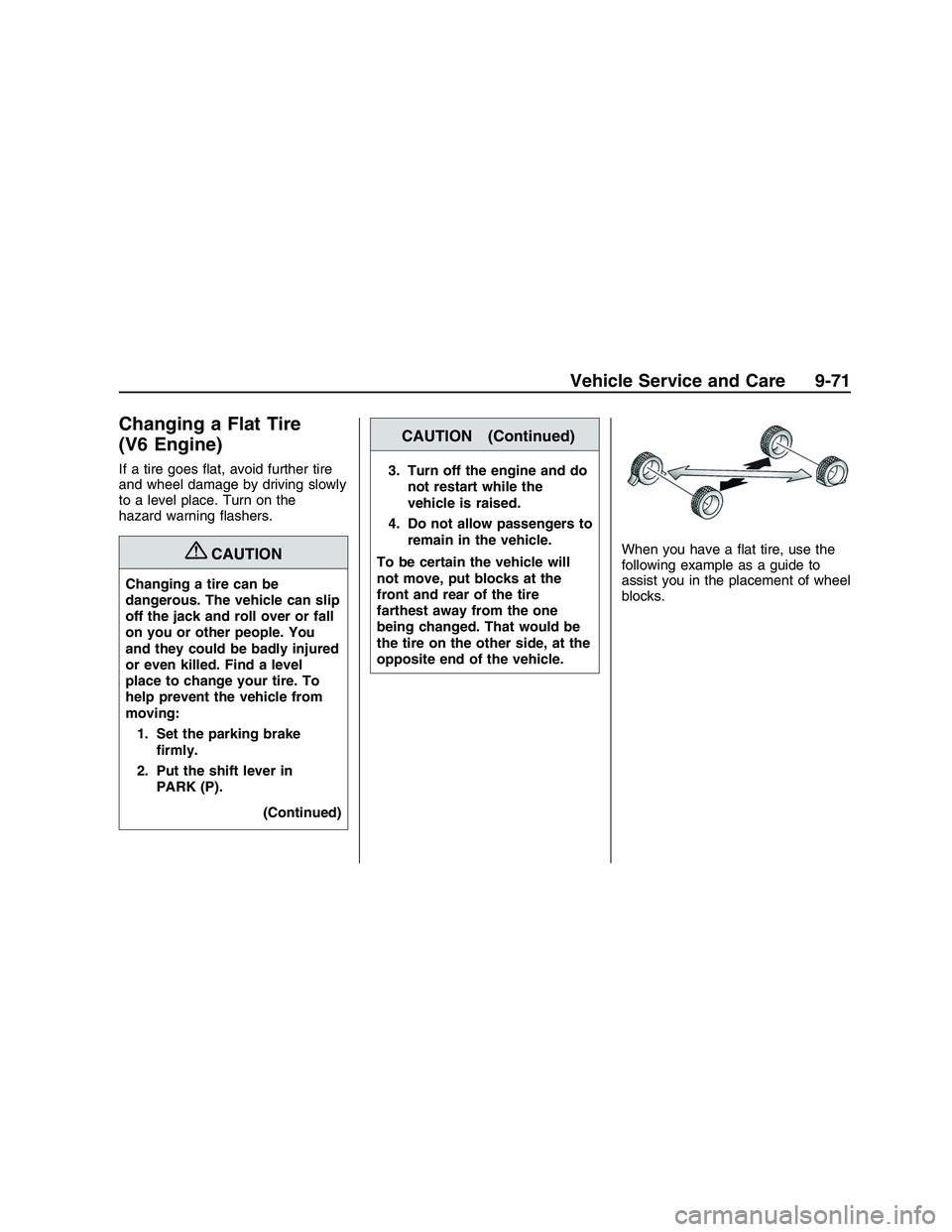
To be certain the vehicle will
not move, put blocks at the
front and rear of the tire
farthest away from the one
being changed. That would be
the tire on the other side, at the
opposite end of the vehicle.When you have a at tire, use the
following example as a guide to
assist you in the placement of wheel
blocks.
Vehicle Service and Care 9-71
2008 - Pontiac G8 Owner Manual
Page 261 of 334

14. Tighten the wheel nuts rmly in
a crisscross sequence, as
shown.{CAUTION
Incorrect or improperly
tightened wheel nuts can cause
the wheel to come loose and
even come off. This could lead
to a crash. If you have to replace
them, be sure to get new original
equipment wheel nuts. Stop
somewhere as soon as you can
and have the nuts tightened with
a torque wrench to the proper
torque specication. See
Capacities and Specifications
on page 10-2for wheel nut
torque specication.Notice:Improperly tightened
wheel nuts can lead to brake
pulsation and rotor damage. To
avoid expensive brake repairs,
evenly tighten the wheel nuts in
the proper sequence and to
the proper torque specication.
SeeCapacities and Specifications
on page 10-2for the wheel nut
torque specication.
Vehicle Service and Care 9-77
2008 - Pontiac G8 Owner Manual
Page 265 of 334
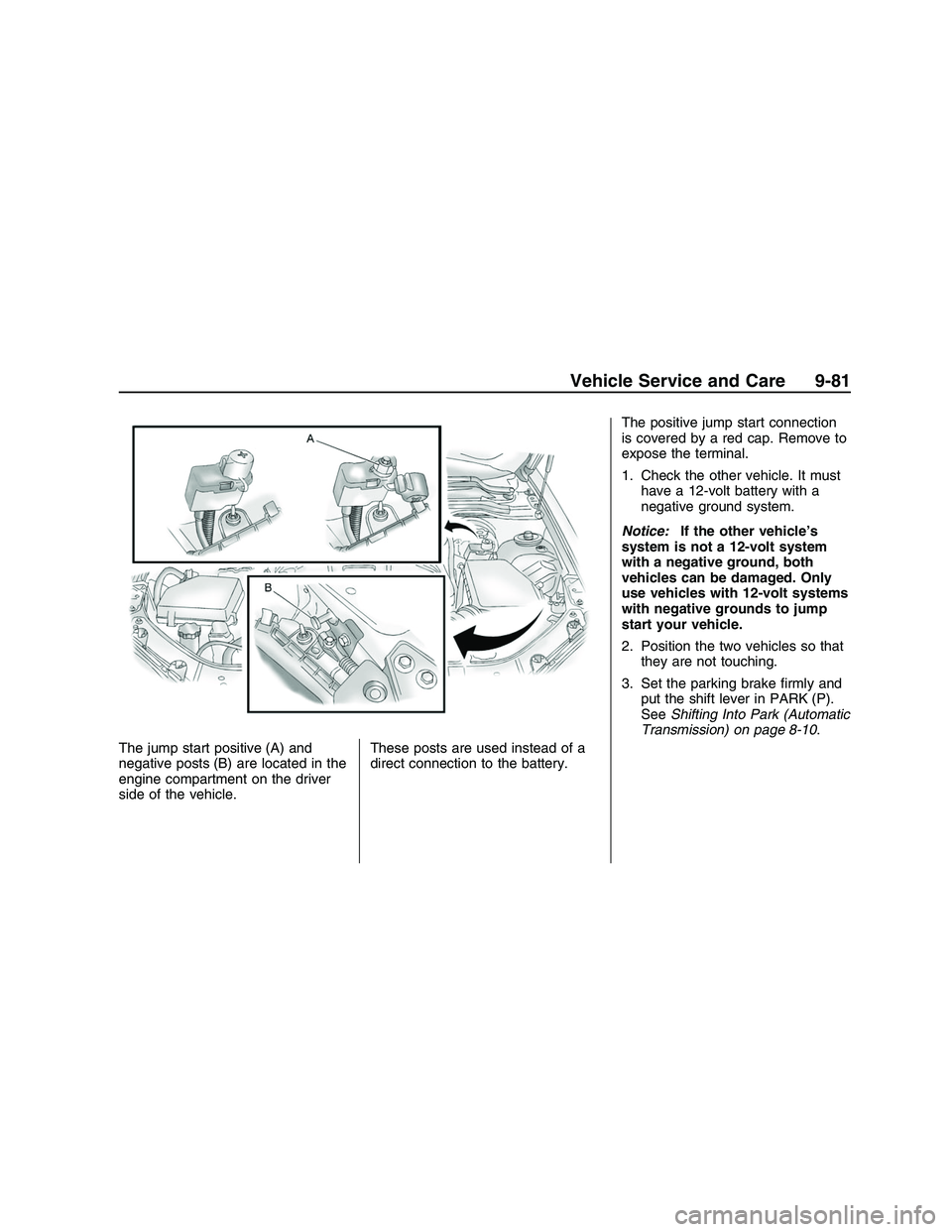
The jump start positive (A) and
negative posts (B) are located in the
engine compartment on the driver
side of the vehicle.These posts are used instead of a
direct connection to the battery.The positive jump start connection
is covered by a red cap. Remove to
expose the terminal.
1. Check the other vehicle. It must
have a 12-volt battery with a
negative ground system.
Notice: If the other vehicle’s
system is not a 12-volt system
with a negative ground, both
vehicles can be damaged. Only
use vehicles with 12-volt systems
with negative grounds to jump
start your vehicle.
2. Position the two vehicles so that they are not touching.
3. Set the parking brake rmly and put the shift lever in PARK (P).
See Shifting Into Park (Automatic
Transmission) on page 8-10 .
Vehicle Service and Care 9-81
2008 - Pontiac G8 Owner Manual
Page 268 of 334
Towing
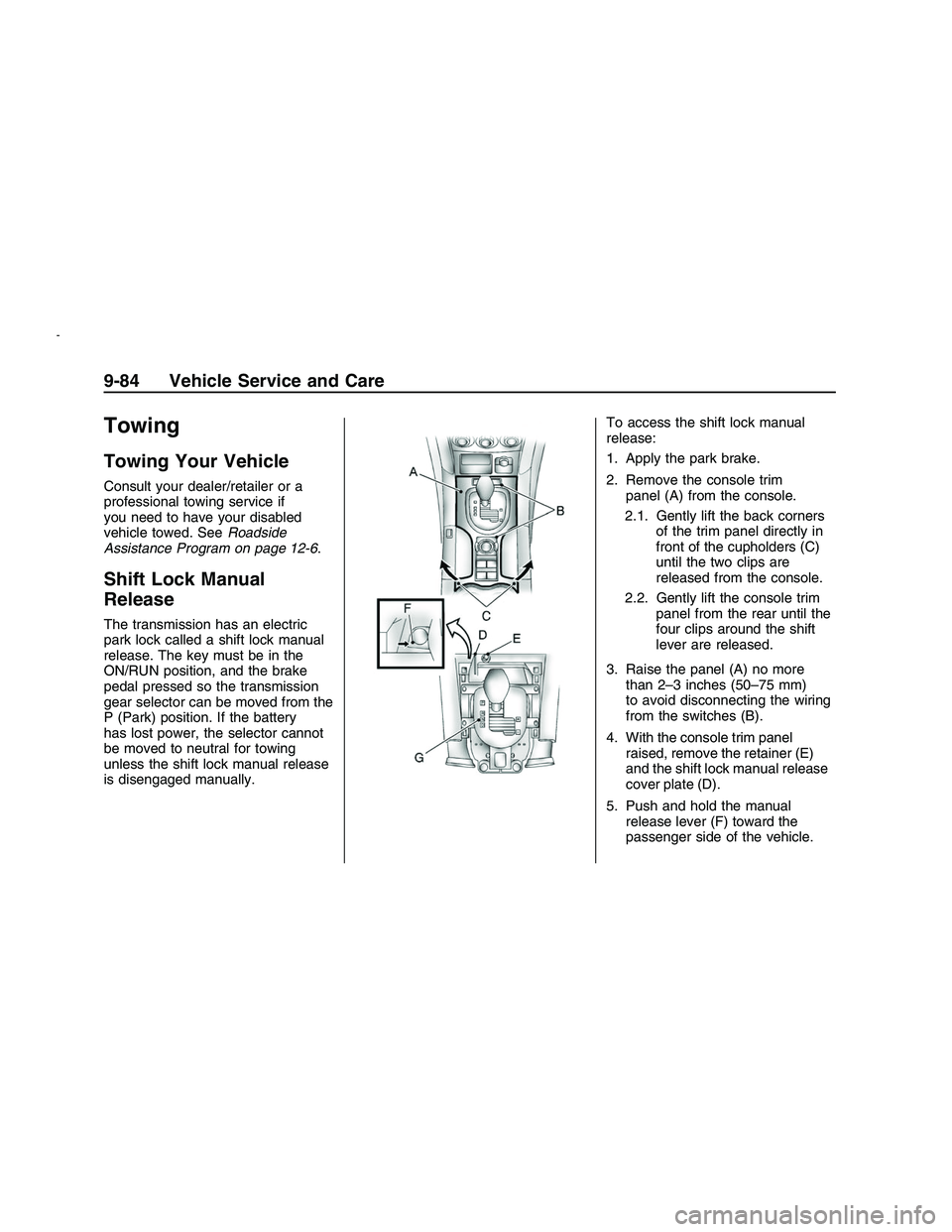
Towing Your Vehicle
Consult your dealer/retailer or a
professional towing service if
you need to have your disabled
vehicle towed. SeeRoadside
Assistance Program on page 12-6.
Shift Lock Manual
Release
The transmission has an electric
park lock called a shift lock manual
release. The key must be in the
ON/RUN position, and the brake
pedal pressed so the transmission
gear selector can be moved from the
P (Park) position. If the battery
has lost power, the selector cannot
be moved to neutral for towing
unless the shift lock manual release
is disengaged manually.To access the shift lock manual
release:
1. Apply the park brake.
2. Remove the console trim
panel (A) from the console.
2.1. Gently lift the back corners
of the trim panel directly in
front of the cupholders (C)
until the two clips are
released from the console.
2.2. Gently lift the console trim
panel from the rear until the
four clips around the shift
lever are released.
3. Raise the panel (A) no more
than 2–3 inches (50–75 mm)
to avoid disconnecting the wiring
from the switches (B).
4. With the console trim panel
raised, remove the retainer (E)
and the shift lock manual release
cover plate (D).
5. Push and hold the manual
release lever (F) toward the
passenger side of the vehicle.
9-84 Vehicle Service and Care
2008 - Pontiac G8 Owner Manual
Page 269 of 334
6. Press the select button and
move the transmission gear
selector to the N (Neutral)
position (G).
7. Release the lever (F).
8. After the vehicle has been
moved, align the shift lock
manual release cover plate (D)
and install the retainer (E) so the
automatic transmission can
operate properly.
9. Place the trim panel (A) and the
wires in their original position
and gently press down around
the outside until it clicks in place.
10. Check the operation of the
switches (B) before operating
the vehicle.
The transmission selector locks if it
is moved back to the P (Park)
position.Recreational Vehicle
Towing
Notice:Dolly towing or dinghy
towing your vehicle may
cause damage because of
reduced ground clearance.
Always put your vehicle on a
atbed truck.
The vehicle was neither designed
nor intended to be towed with any of
its wheels on the ground. If the
vehicle must be towed, see “Towing
Your Vehicle” earlier in this
section.
Towing a Trailer
{CAUTION
If you do not use the correct
equipment and drive properly,
you can lose control when you
pull a trailer. For example, if the
trailer is too heavy, the brakes
(Continued)
CAUTION (Continued)
may not work well — or even at
all. You and your passengers
could be seriously injured. You
may also damage your vehicle;
the resulting repairs would not
be covered by your warranty.
Pull a trailer only if you have
followed all the steps in this
section. Ask your dealer/retailer
for advice and information
about towing a trailer with your
vehicle.
Your vehicle can tow a trailer if it is
equipped with the proper trailer
towing equipment. To identify the
trailering capacity of your vehicle,
you should read the information
in “Weight of the Trailer” that
appears later in this section.
Trailering is different than just
driving your vehicle by itself.
Trailering means changes in
handling, acceleration, braking,
durability and fuel economy.
Vehicle Service and Care 9-85
2008 - Pontiac G8 Owner Manual
Page 272 of 334
Total Weight on Your Vehicle’s
Tires
Be sure your vehicle’s tires are
inated to the upper limit for cold
tires. You will nd these numbers on
the Tire-Loading Information label.
SeeLoading the Vehicle on
page 8-28. Then be sure you do not
go over the GVW limit for your
vehicle, including the weight of the
trailer tongue.
Hitches
It is important to have the correct
hitch equipment. Crosswinds,
large trucks going by and rough
roads are a few reasons why
you will need the right hitch. Here
are some rules to follow:
The rear bumper on your vehicle
is not intended for hitches. Do
not attach rental hitches or other
bumper-type hitches to it. Use
only a frame-mounted hitch
that does not attach to the
bumper.
Will you have to make any holes
in the body of your vehicle when
you install a trailer hitch? If you
do, then be sure to seal the holes
later when you remove the hitch.
If you do not seal them, deadly
carbon monoxide (CO) from your
exhaust can get into your vehicle.
SeeEngine Exhaust on
page 8-12. Dirt and water can
also enter the vehicle.
Safety Chains
You should always attach chains
between your vehicle and your
trailer. Cross the safety chains under
the tongue of the trailer so that the
tongue will not drop to the road if it
becomes separated from the hitch.
Instructions about safety chains
may be provided by the hitch
manufacturer or by the trailer
manufacturer. Follow the
manufacturer’s recommendation for
attaching safety chains and do not
attach them to the bumper. Alwaysleave just enough slack so you can
turn with your rig. And, never allow
safety chains to drag on the ground.
Trailer Brakes
Does your trailer have its own
brakes? Be sure to read and follow
the instructions for the trailer
brakes so you will be able to install,
adjust and maintain them properly.
Because you have anti-lock brakes,
do not tap into your vehicle’s brake
system. If you do, both brake
systems will not work well, or at all.
Trailer Wiring Harness
All of the electrical circuits required
for your trailer lighting system
can be accessed at the driver’s side
rear lamp connector. This connector
is located under the carpet on
the rear corner of the trunk
compartment.
9-88 Vehicle Service and Care
2008 - Pontiac G8 Owner Manual
Page 273 of 334
Driving with a Trailer
Towing a trailer requires a certain
amount of experience. Before setting
out for the open road, you will want to
get to know your rig. Acquaint
yourself with the feel of handling and
braking with the added weight of the
trailer. And always keep in mind that
the vehicle you are driving is now a
good deal longer and not nearly as
responsive as your vehicle is by
itself.
Before you start, check all trailer
hitch parts and attachments, safety
chains, electrical connector,
lamps, tires and mirror adjustment.
If the trailer has electric brakes,
start your vehicle and trailer moving
and then apply the trailer brake
controller by hand to be sure
the brakes are working. This lets
you check your electrical connection
at the same time.
During your trip, check occasionally
to be sure that the load is secure,
and that the lamps and any
trailer brakes are still working.
Towing with the Electronic
Stability Program (ESP®)
When towing, the sound of the ESP
modulator might be heard. The
ESP is reacting to the vehicle
movement caused by the trailer,
which mainly occurs during
cornering. This is normal when
towing heavier trailers.
Following Distance
Stay at least twice as far behind the
vehicle ahead as when driving
your vehicle without a trailer. This
can help avoid situations that require
heavy braking and sudden turns.
Passing
More passing distance is needed up
ahead when you are towing a
trailer. And, because the vehicle is
longer, it is necessary to go
much farther beyond the passed
vehicle before returning to the lane.
Backing Up
Hold the bottom of the steering
wheel with one hand. Then, to move
the trailer to the left, just move
that hand to the left. To move the
trailer to the right, move the hand to
the right. Always back up slowly
and, if possible, have someone
guide you.
Making Turns
Notice:Making very sharp turns
while trailering could cause
the trailer to come in contact with
the vehicle. Your vehicle could
be damaged. Avoid making
very sharp turns while trailering.
When you are turning with a
trailer, make wider turns than
normal. Do this so your trailer will
not strike soft shoulders, curbs, road
signs, trees or other objects.
Avoid jerky or sudden maneuvers.
Signal well in advance.
Vehicle Service and Care 9-89
2008 - Pontiac G8 Owner Manual
Page 274 of 334
Turn Signals When Towing a
Trailer
When you tow a trailer, your vehicle
may need a different turn signal
asher and/or extra wiring. Check
with your dealer/retailer. The arrows
on your instrument panel will
ash whenever you signal a turn or
lane change. Properly hooked
up, the trailer lamps will also ash,
telling other drivers you are
about to turn, change lanes or stop.
When towing a trailer, the arrows
on your instrument panel will
ash for turns even if the bulbs on
the trailer are burned out. Thus, you
may think drivers behind you are
seeing your signal when they
are not. It is important to check
occasionally to be sure the trailer
bulbs are still working.
Your vehicle has bulb warning
lights. When you plug a trailer
lighting system into your vehicle’s
lighting system, its bulb warning
lights may not let you know if one of
your lamps goes out. So, whenyou have a trailer lighting system
plugged in, be sure to check
your vehicle and trailer lamps from
time to time to be sure they are
all working. Once you disconnect the
trailer lamps, the bulb warning
lights again can tell you if one of
your vehicle lamps is out.
Driving On Grades
Reduce speed and shift to a lower
gearbeforeyou start down a
long or steep downgrade. If you do
not shift down, you might have
to use your brakes so much
that they would get hot and no
longer work well.
On a long uphill grade, shift down to
a lower gear and reduce your
speed to around 45 mph (70 km/h)
to reduce the possibility of engine
and transmission overheating.
Parking on Hills
{CAUTION
You really should not park your
vehicle, with a trailer attached,
on a hill. If something goes
wrong, your rig could start to
move. People can be injured,
and both your vehicle and the
trailer can be damaged.
But if you ever have to park your rig
on a hill, here is how to do it:
1. Apply your regular brakes, but do
not shift into P (Park) yet.
2. Have someone place chocks
under the trailer wheels.
3. When the wheel chocks are in
place, release the regular
brakes until the chocks absorb
the load.
4. Reapply the regular brakes.
Then apply your parking
brake, and then shift to P (Park).
5. Release the regular brakes.
9-90 Vehicle Service and Care
2008 - Pontiac G8 Owner Manual