check engine PONTIAC GRAND-AM 1993 User Guide
[x] Cancel search | Manufacturer: PONTIAC, Model Year: 1993, Model line: GRAND-AM, Model: PONTIAC GRAND-AM 1993Pages: 306, PDF Size: 15.39 MB
Page 153 of 306
your urwlng and the Road
Highway Hypnosis (CONI)
Keep your eyes moving. Scan the road
ahead and to the sides. Check your
rearview mirrors frequently and your
instruments from time to time. This
can help you avoid a fixed stare.
Wear good sunglasses in bright light.
Glare can cause drowsiness. But don’t
wear sunglasses at night. They will
drastically reduce your overall vision
at the very time you need all the
seeing power you have.
If you get sleepy, pull off the road into
a rest, service, or parking area and
take a nap, get some exercise, or both.
For safety, treat drowsiness on the
highway as an emergency.
As in any driving situation, keep pace
with traffic and allow adequate
following distances.
I CAUTION
d
Hill and Mountain Roads
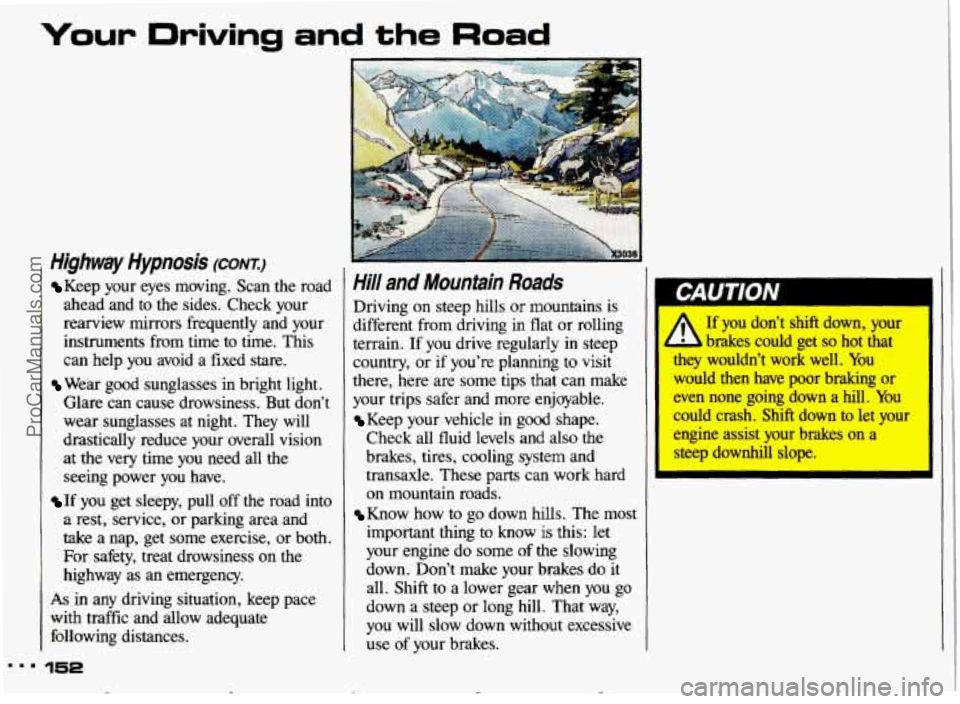
Driving on steep hills or mountains is
different from driving in flat or rolling
terrain. If
you drive regularly in steep
country, or
if you’re planning to visit
there, here are
some tips that can make
your trips safer and more enjoyable.
Keep your vehicle in good shape.
Check all fluid levels and also the
brakes, tires, cooling system and
transaxle. These parts can work hard
on mountain roads.
Know how to go down hills. The most
important thing to know
is this: let
your engine do some of the slowing
down. Don’t make your brakes
do it
all. Shift to a lower gear when
you go
down a steep or long hill. That way,
you will slow down without excessive
use of your brakes.
A
If you don’t shift down, your
brakes could get
so hot that
they wouldn’t work well.
You
would then have poor braking or
even none going down a hill. You
could crash. Shift down to let your
engine assist your brakes on
a
steep downhill slope.
ProCarManuals.com
Page 159 of 306
lf bu’re Caught in a Bliuard
(CONZ)
Put on extra clothing or wrap a
blanket around you.
If you have no
blankets or extra clothing, make body
insulators from newspapers, burlap
bags, rags, floor mats-anything you
can wrap around yourself or tuck
under your clothing to keep warm.
You can run the engine to keep warm,
but be careful.
158
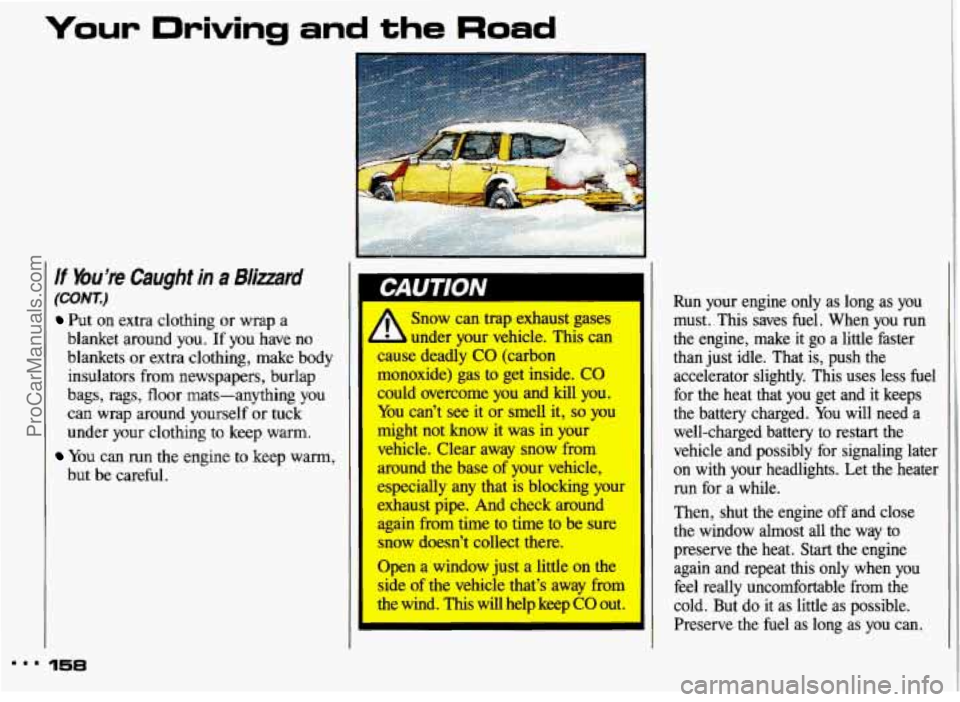
cause deadly CO (carbon
monoxide) gas to get inside.
CO
could overcome you and kill you.
You can’t see it or smell it,
so you
might not know it was
in your
vehicle. Clear away snow from
around the base of your vehicle,
especially any that
is blocking your
exhaust pipe. And check around
again from time to time to be sure
snow doesn’t collect there.
Open a window just a little on the
side
of the vehicle that’s away from
the wind.
This will help keep CO out. Run your engine only as long as you
must. This saves fuel. When you
run
the engine, make it go
a little faster
than just idle. That is, push the
accelerator slightly. This uses less fuel
for the heat that you get and it keeps
the battery charged. You will need a
well-charged battery to restart the
vehicle and possibly for signaling later
on with your headlights.
Let the heater
run for a while.
Then, shut the engine off and close
the window almost all the way to
preserve the heat.
Start the engine
again and repeat this only when you
feel really uncomfortable from the
cold. But do it as little as possible.
Preserve the fuel as long as you can.
ProCarManuals.com
Page 166 of 306
Turn Signals When Towing a ’Railer
When you tow a trailer, your vehicle has
to have a different turn signal flasher
and extra wiring. The green arrows on
your instrument panel will flash
whenever you signal a
turn or lane
change. Properly hooked up, the trailer
lights will also flash, telling other drivers you’re about to turn, change
lanes or stop.
When towing a trailer, the green arrows
on your instrument panel will flash for
turns even if the bulbs on the trailer are
burned out. Thus, you may think drivers
behind you are seeing your signal when
they are not. It’s important to check occasionally to be sure the trailer bulbs
are still working.
Driving On Grades
Reduce speed and shift to a lower gear
before you start down a long or steep
downgrade. If you don’t shift down, you
might have to use your brakes
so much
that they would get hot and no longer work well.
On a long uphill grade, use the highest
gear possible. If you cannot maintain
posted speeds, driving at a lower speed
may help avoid overheating your engine
and transaxle.
If you have a manual transaxle with
fifth
gear, it’s better not to use fifth gear. Just
drive in fourth gear (or, as you need to,
a lower gear).
Parking on Hills
You really should not park your vehicle,
with a trailer attached,
on a hill. If
something goes wrong, your rig could
start to move. People can be injured,
and both your vehicle and the trailer can
be damaged.
But if you ever have to park your rig on
a hill, here’s how to do it:
1. Apply your regular brakes, but don’t
shift into
P (Park) yet, or into gear
for a manual transaxle.
2. Have someone place chocks under
the trailer wheels.
3. When the wheel chocks are in place,
release the regular brakes until the chocks absorb the load.
165 DDD
ProCarManuals.com
Page 167 of 306
Your Driving and the Road
Driving with a mailer (CONT.)
4. Reapply the regular brakes. Then
apply your parking brake, and then shift to
P (Park), or R (Reverse) for a
manual transaxle.
5. Release the regular brakes.
When You Are Ready to Leave After
Parking on a
Hill
1. Apply your regular brakes and hold
the pedal down while you:
Start your engine;
Shift into a gear; and
Release the parking brake.
2. Let up on the brake pedal.
3. Drive slowly until the trailer is clear
4. Stop and have someone pick up and
of the chocks.
store the chocks.
Maintenance When Tmiler Towing
Your vehicle will need service more
often when you’re pulling a trailer. See
the Maintenance Schedule for more on
this. Things that are especially important in trailer operation are
automatic transaxle fluid (don’t overfiil),
engine oil, belts, cooling system, and
brake adjustment. Each
of these is
covered
in this manual, and the Ida
will help you find them quickly. If
you’re trailering, it’s a good idea to
review these sections before you
start
your trip.
Check periodically to see that all hitch
nuts and bolts are tight.
m.. 166
ProCarManuals.com
Page 174 of 306
A
1 I water. Using
a match near
a battery
can cause battery
gas to
explode. ,People have been hurt
doing
this, and some have been
blinded.
Use a flashlight if you
need more light.
Be sure the battery has enough
You don’t need to add water to the
Delco Freedom@ battery installed
in every new GM vehicle. But if a
battery has fdler caps, be sure the
right amount of fluid is there.
If it
is low, add water to take care
of
that first. If you don’t, explosive
gas could be present.
Battery fluid contains acid that
can
burn you. Don’t get it on you. If
you accidentally get it in your eyes
or on your skin, flush the place
with water and get medical help
immediately.
1
5. Check that the jumper cables don’t
have loose or missing insulation.
If
they do, you could get a shock. The
vehicles could be damaged, too.
Before you connect the cables, here are
some things you should know. Positive
(+) will go to positive (+) and negative
(-) will go to negative (-) or a metal
engine part.
Don’t connect
(+) to (-) or you’ll get a
short that would damage the battery and
maybe other parts, too. Fans
or other moving engine
parts can injure you badly.
Keep your hands away from
moving parts once the engines are
running.
173 =
ProCarManuals.com
Page 182 of 306
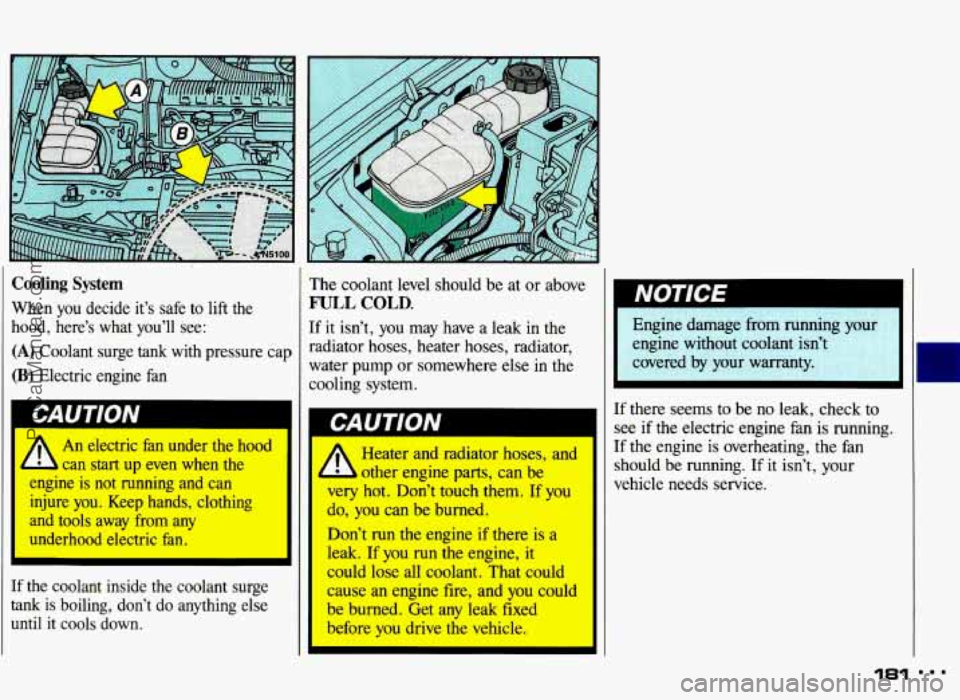
Cooling System
When you decide it’s safe to lift the
hood, here’s what you’ll see:
(A) Coolant surge tank with pressure cap
(B) Electric engine fan
bAU I IVIV
1 /r An electric fan under the hood
- b can start up even when the
engine is not running and can injure you. Keep hands, clothing
and tools away from any
underhood electric fan.
[f the coolant inside the coolant surge
tank is boiling, don’t do anything else
until
it cools down.
’he coolant level should be at or above
TJLL COLD.
f it isn’t, you may have a leak in the
adiator hoses, heater hoses, radiator,
dater pump or somewhere else
in the
ooling system.
A
Heater and radiator hoses, and
other engine parts, can be
very hot. Don’t touch them.
If you
do, you can be burned.
Don’t run the engine if there is a
leak. If
you run the engine, it
could lose all coolant. That could
cause an engine fire, and you could
be burned. Get any leak fixed
before
you drive the vehicle. Engine damage
from
runni
engine without coolant isn’
covered by your warranty.
there seems to be no leak, check
to
x if the electric engine fan is running.
C the engine is overheating, the fan
hould be running.
If it isn’t, your
chicle needs service.
181
ProCarManuals.com
Page 198 of 306
Part 6
... N604
Here you will find information
about the care of your Pontiac
. This
part begins with service and fuel
information. and then it shows how
to check important fluid and
lubricant levels
. There is also
technical information about your
vehicle. and a section devoted to its
appearance care
.
Service & Appearance Care
Service ................ .................................. 198
Fuel
........................................................... 199
HoodRelease .................................................... 205
Engineoil
...................................................... 209
Aircleaner
...................................................... 214
Transaxle Fluid
.................................................. 216
Engine Coolant
.................................................. 221
Power Steering Fluid
.............................................. 224
Windshield Washer Fluid
........................................... 224
Brakes
......................................................... 225
Battery
......................................................... 227
BulbReplacement
................................................ 228
Windshield Wiper Blade Replacement
................................. 230
Loading Your Vehicle
............................................. 230
Tires
.......................................................... 232
Appearancecare
................................................. 239
Vehicle Identification Number (VIN)
................................. 247
Add-on Electrical Equipment
....................................... 248
Fuses
& Circuit Breakers ........................................... 248
Capacities
& Specifications ......................................... 251
Fluids
& Lubricants ............................................... 253
Replacement Bulbs
............................................... 254
Normal Maintenance Replacement
Parts ............................. 257
197
ProCarManuals.com
Page 210 of 306
Engine Oil
It’s a good idea to check your engine oil
every time you get fuel. In order to get
an accurate reading, the
oil must be
warm and the vehicle must be
on level
ground. Turn
off the engine and give the
oil a few minutes to drain back into the
oil pan. If you don’t, the oil dipstick
might not show the actual level.
To Check Engine Oil:
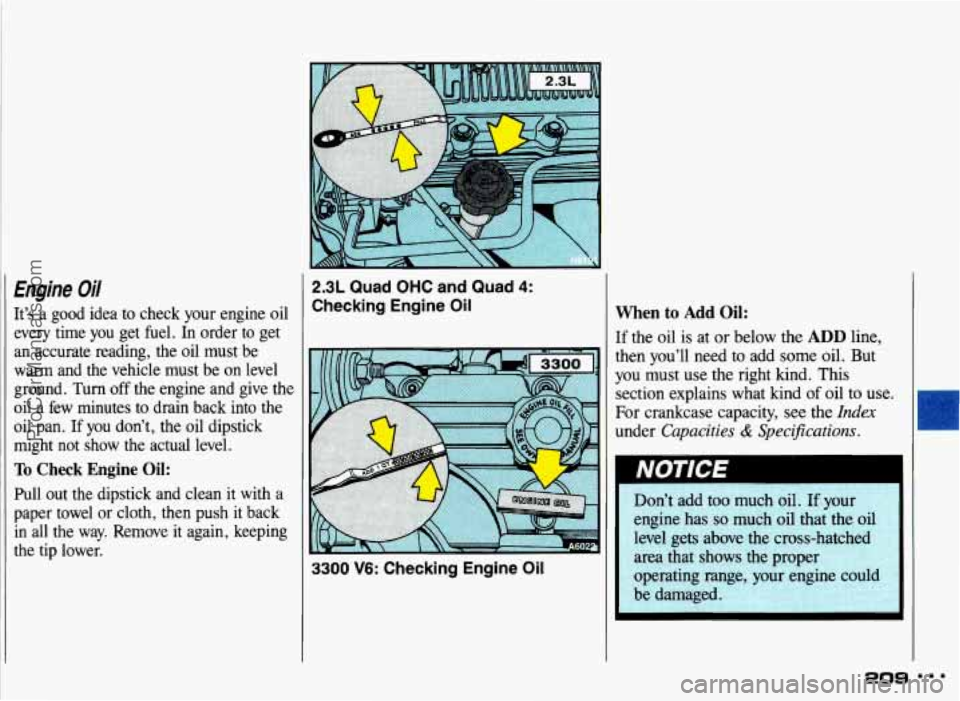
Pull out the dipstick and clean it with a
paper towel or cloth, then push
it back
in all the way. Remove it again, keeping
the tip lower.
2.3L Quad OHC and Quad 4:
Checking Engine Oil
3300 V6: Checking Engine Oil
When to Add Oil:
If the oil is at or below the ADD line,
then
you’ll need to add some oil. But
you must use the right kind. This
section explains what kind
of oil to use.
For crankcase capacity, see the Index
under Capacities & Spec$kations.
20s
ProCarManuals.com
Page 214 of 306
I
Engine Oil Additives
Don't add anything to your oil. Your
Pontiac dealer is ready to advise
if you
think something should be added.
When to Change Engine Oil
See if any one of these is true for you:
Most trips are less than 4 miles (6 km).
It's below freezing outside and most
trips are less than
10 miles (16 km).
The engine is at low speed most of the
time
(as in door-to-door delivery, or in
stop-and-go traffic).
You tow a trailer often.
Most trips are through dusty places.
If any one of these is true for your
vehicle, then you need to change your
oil and fdter every 3,000 miles
(5 0oO km) or 3 months-whichever
comes first. (See the
Index under Check
Oil Light.)
If none of them is true, change the oil
every
7,500 miles (12 500 km) or 12
months-whichever comes first. Change
the filter at the first oil change and at
every other
oil change after that.
Engine Block Heater
An engine block heater can be a big
help if you have to park outside
in very
cold weather,
0" F (-18°C) or colder. If
your vehicle has this option, see the
Index under Engine Block Heater.
213 I..
ProCarManuals.com
Page 217 of 306
...
Service & Appearance Care
Air Cleaner (CONI)
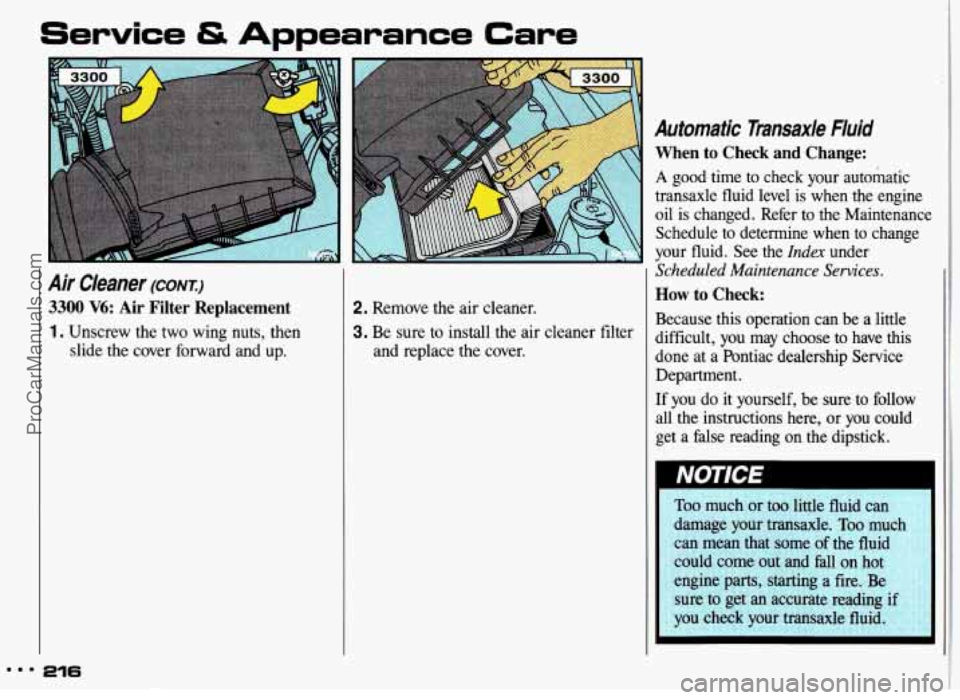
3300 V6: Air Filter Replacement
1. Unscrew the two wing nuts, then
slide
the cover forward and up.
216
2. Remove the air cleaner.
3. Be sure to install the air cleaner filter
and replace the cover.
Automatic Tmnsax/e Fluid
When to Check and Change:
A good time to check your automatic
transaxle fluid level is when the engine
oil is changed. Refer
to the Maintenance
Schedule to determine when to change
your fluid. See the
Index under
Scheduled Maintenance Services.
How to Check:
Because this operation can be a little
difficult, you may choose to have this
done at a Pontiac dealership Service
Department.
If you do it yourself, be sure to follow
all the instructions here, or you could
get a false reading on the dipstick.
ProCarManuals.com