engine PONTIAC GRAND-AM 1993 User Guide
[x] Cancel search | Manufacturer: PONTIAC, Model Year: 1993, Model line: GRAND-AM, Model: PONTIAC GRAND-AM 1993Pages: 306, PDF Size: 15.39 MB
Page 59 of 306
Features & Controls
Park (CONT.)
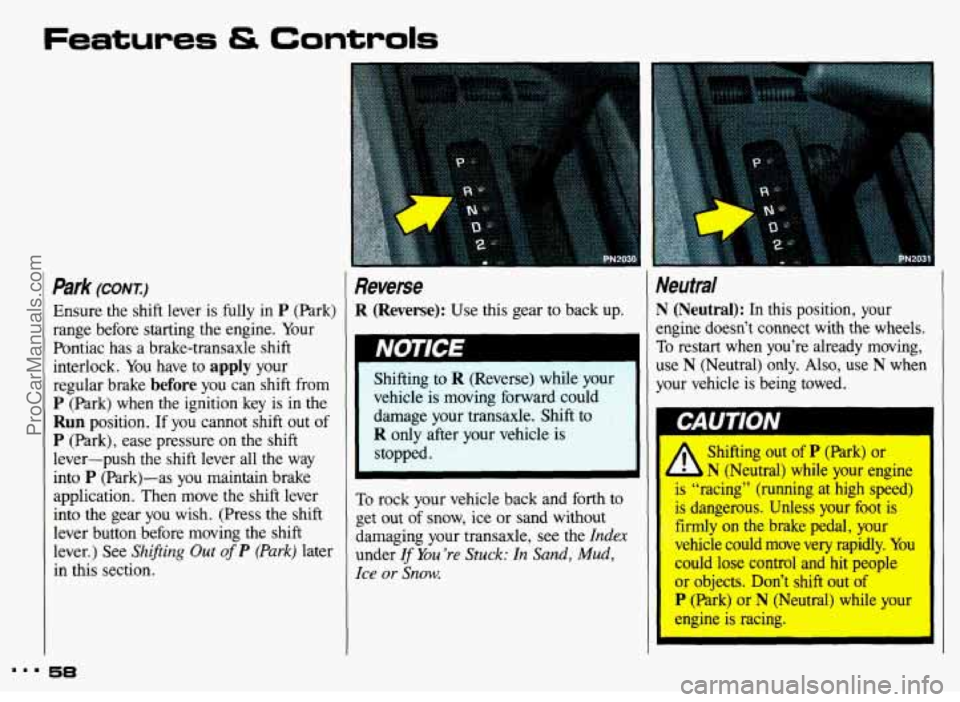
Ensure the shift lever is fully in P (Park)
range before starting the engine. Your
Pontiac has a brake-transaxle shift
interlock. You have
to apply your
regular brake
before you can shift from
P (Park) when the ignition key is in the
Run position. If you cannot shift out of
P (Park), ease pressure on the shift
lever-push the shift lever all the way
into
P (Park)-as you maintain brake
application. Then move the shift lever
into the gear you wish. (Press the shift
lever button before moving the shift
lever,) See
Shifting Out of P (Park) later
in this section.
Reverse
R (Reverse): Use this gear to back up.
Shifting to
R (Reverse) while your
vehicle
is moving forward could
damage your transaxle. Shift
to
R only after your vehicle is
stopped.
To rock your vehicle back and forth to
get out of
snow, ice or sand without
damaging your transaxle,
see the Index
under If You ’re Stuck: In Sand, Mud,
Ice or Snow.
Neutral
N (Neutral): In this position, your
engine doesn’t connect with the wheels.
To restart when you’re already moving,
use
N (Neutral) only. Also, use N when
your vehicle is being towed.
A Shifting out of P (Park) or
1 N (Neutral) while your engine I
‘racing” (running at high speed)
is dangerous. Unless your foot is
firmly on the brake pedal, your
vehicle could move very rapidly. You
could lose control and hit people
or objects. Don’t shift out
of
P (Park) or N (Neutral) while your
engine is racing.
I.. 58
ProCarManuals.com
Page 62 of 306

1 3 5
2 4 R
This is your shift pattern. Here’s how to
operate your transaxle:
1 (First Gear): Press the clutch pedal
and shift into
1. Then, slowly let up on
the clutch pedal as you press the accelerator pedal.
You can shift into
1 when you’re going
less than
20 mph (32 km/h). If you’ve
come to a complete stop and it’s hard to
shift into
1, put the shift lever in
N (Neutral) and let up on the clutch.
Press the clutch pedal back down. Then
shift into
1.
2 (Second Gear): Press the clutch pedal
as you let up on the accelerator pedal
and shift into
2. Then, slowly let up on
the clutch pedal as you press the
accelerator pedal.
3,4 and 5 (Third, Fourth and Fifth
Gears): Shift into 3, 4 and 5 the same
way you do for
2. Slowly let up on the
clutch pedal as you press the accelerator
pedal.
To Stop: Let up on the accelerator pedal
and press the brake pedal. Just before
the vehicle stops, press the clutch pedal and the brake pedal, and shift into
N (Neutral).
N (Neutral): Use this position when
you
start or idle your engine.
R (Reverse): To back up, press the
clutch pedal and shift into
R. Let up on
the clutch pedal slowly while pressing
the accelerator pedal.
Shift to
R (Reverse) only after your
vehicle is stopped. Shifting to
R (Reverse) while your vehicle is
moving could damage your
transaxle.
Also, use
R (Reverse), along with the
parking brake, for parking your vehicle.
ProCarManuals.com
Page 63 of 306

Features & Controls
Shift Light (MANUAL TRANSAXLE)
If you have a manual transaxle, you have
a SHIFT light. This light will show you
when to shift to the next higher gear for
best fuel economy.
When this light comes
on, you can shift
to the next higher gear if weather, road
and traffic conditions let you. For the
best fuel economy, accelerate slowly and
shift when the light comes on.
While you accelerate, it is normal for
the light to go on and off if you quickly
change the position of the accelerator.
Ignore the
SHIFT light when you
downshift.
Shift Speeds (MANUAL TRANSAXLE)
This chart shows when to shift to the
next higher gear for best fuel economy.
Acceleration Shift Speeds for 2.3L
OHC and 2.3L High Output Quad 4
Engines (Codes 3 and A):
Ist to 2nd 15 mph (24 km/h)
2nd to 3rd 25 mph (40 km/h)
3rd to 4th 40 mph
(64 km/h)
4th to 5th 45 mph (72 km/h)
If your speed drops below 20 mph
(32 km/h), or if the engine is not
running smoothly, you should downshift
to the next lower gear. You may have to
downshift two or more gears to keep the
engine running smoothly or for good
performance.
If you skip more than one gear
when you downshift, or
if you race
the engine when
you downshift,
you can damage the clutch
or
transaxle.
ProCarManuals.com
Page 65 of 306
Shifting Into P (Park)
(AUTOMATIC TRANSAXLE)
A
It can be dangerous to get out
of your vehicle if the shift
I
lever is not fully in P (Park) with
the parking brake firmly set. Your
vehicle can roll.
If you have left the engine running
the vehicle can move suddenly.
You or others could be injured.
Tc
be sure your vehicle won’t move,
when you’re on fairly level ground,
use the steps that follow. If you arc
parking on a hill, or if you’re
I
pulling a trailer, also see the Inden
under ParkinP 01 lills or %wing .
“rail
I
1. Hold the brake pedal down with your
right foot and set the parking brake.
8.. 64
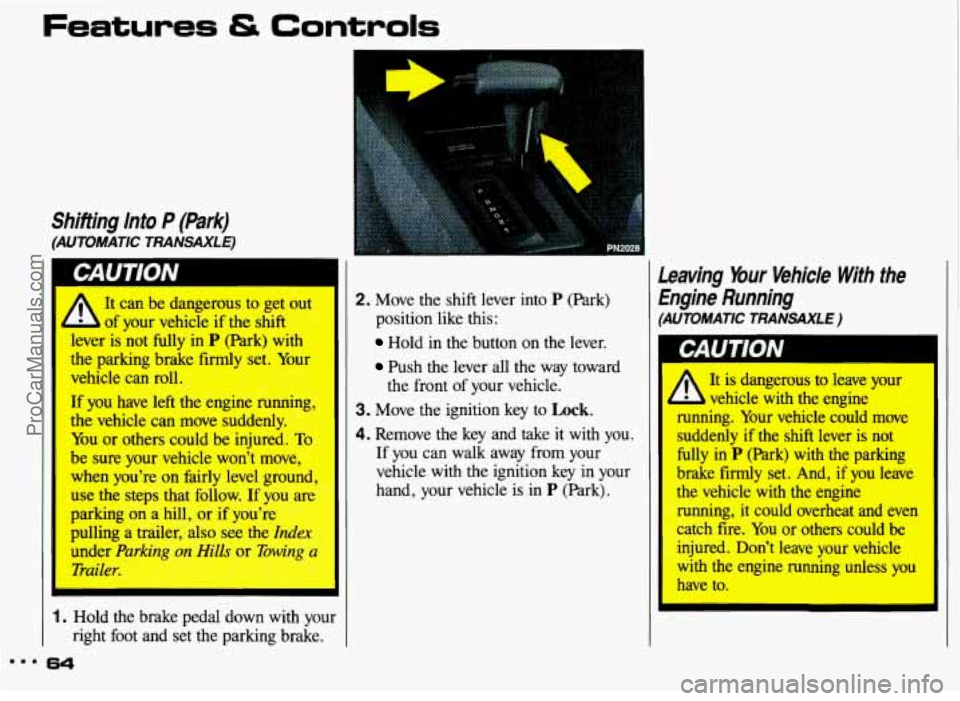
2. Move the shift lever into P (Park)
position like this:
Hold in the button on the lever.
Push the lever all the way toward
the front of your vehicle.
3. Move the ignition key to Lock.
4. Remove the key and take it with you.
If you can walk away from your
vehicle
with the ignition key in your
hand, your vehicle is in
P (Park).
Leaving Your Vehicle With the
Engine Running
(AUTOMATIC TRANSAXLE)
It is dangerous to leave your
running. Your vehicle could move
suddenly
if the shift lever is not
fully
in P (Park) with the parking
brake firmly set. And,
if you leave
the vehicle
with the engine
running,
it could overheat and even
catch fire. You or others could be
injured. Don’t leave your vehicle
with the engine
rumins unless you,
have to.
h- *2-- ;,a,&#:+h .u ’ -. :.
L vehicle with the engine
i- ’-
ProCarManuals.com
Page 66 of 306

If you have to leave your vehicle with
the engine running, be sure your vehicle
is in
P (Park) and your parking brake is
firmly set before you leave it. After
you’ve moved the
shift lever into the
P (Park) position, hold the regular brake
pedal down. Then, see if you can move
the shift lever away from
P (Park)
without first pushing the button.
If you can, it means that the shift lever
wasn’t fully locked into
P (Park).
Shifting Out of P (Park)
(AUTOMATIC TRANSAXLE)
Your Pontiac has a brake-transaxle shift
interlock. You have to
apply your
regular brake
before you can shift from
P (Park) when the ignition is in the Run
position. See the Index under Automatic
Transaxle.
If you cannot shift out of P (Park), ease
pressure on the shift lever-push the
shift lever all the way into
P (hrk)- as
you maintain brake application. Then
move the shift lever into the gear you
wish. (Press the shift lever button before
moving the shift lever.) If you ever hold the
brake pedal down
but still can’t shift out
of P (Park), try
this:
1. Turn the key to Off.
2. Apply and hold the brake until the
3. Shift to N (Neutral).
4. Start the vehicle and then shift to the
drive gear you want.
5. Have the vehicle fixed as soon as you
can. end of Step
4.
65
ProCarManuals.com
Page 67 of 306
Features & Controls
Parking Your Vehicle
(MANUL TRANSAXLE)
Before you get out of your vehicle, put
your manual transaxle in
R (Reverse)
and firmly apply the parking brake.
If you are parking on a hill, or if your
vehicle
is equipped to tow a trailer, see
the Index under Parking on Hills or
i%w*ng a Trailer.
36
1 Engine Exhaust
I
Parking Over Things That Burn
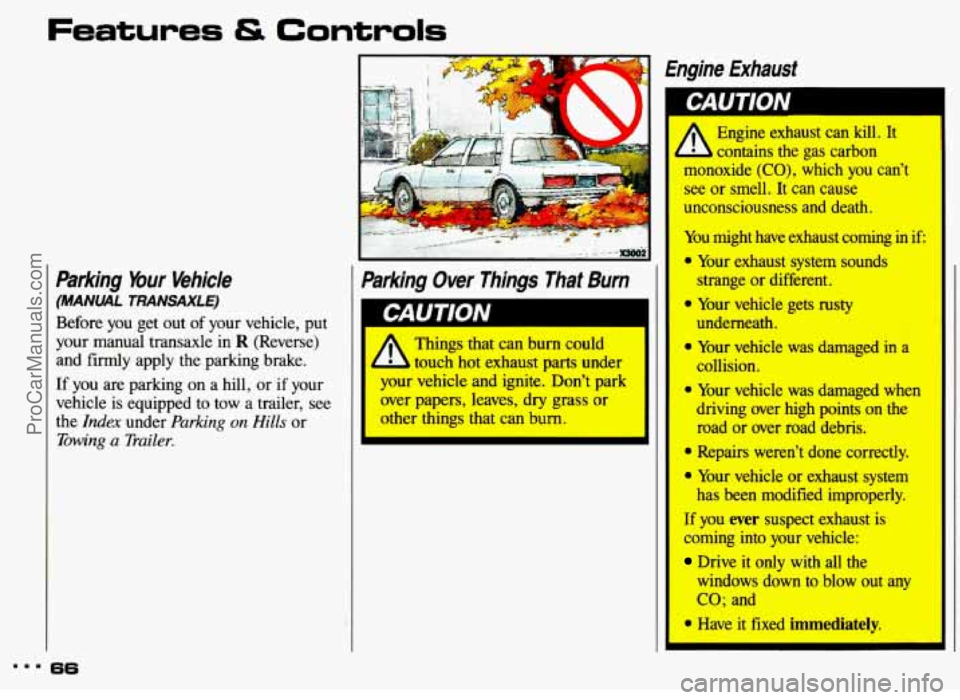
Things that can burn could
touch hot exhaust parts under
your vehicle
and ignite. Don’t park
over papers, leaves, dry grass or
other things that can burn.
Engine exhaust can kill. It
contains the gas carbon
monoxide
(CO), which you can’t
see or smelt It can cause
unconsciousness and death.
You might have exhaust coming
in if:
* Your exhaust system sounds
strange or different.
* Your vehicle gets rusty
undemath.
* Your vehicle was damaged in a
collision.
* Your vehicle was damaged when
driving over high points on the
road or over road debris.
* Repairs weren’t done correctly.
* Your vehicle or exhaust systkm
has been modified improperly.
If you eys suspect exhaust is
~rrmi@ into your vehicle:
Drive it only wifh all the
windows down to blow out any
co; and
* Have it -fixed immediately.
ProCarManuals.com
Page 68 of 306
Running Your Engine While You’re Parked (AuToMmc TRANSAXLE)
It’s better not to park with the engine running. But if you ever have to, here are
some things to know.
A Idling the engine with the air system control OFF could allow dangerous
1 exhaust into your vehicle (see the earlier CAUTION under Engine
Exhaust).
Also, idling in a closed-in place can let deadly carbon monoxide (CO) into
your vehicle even if the
hn switch is at tne highest setting. One place this can
happen is a garage. Exhaust-with CO-can come
in easily. Never park in a
garage with the engine running.
Another closed-in place can be
a blizzard. (See the Index under Blizzard.)
It can be dangerous to get out of your vehicle if the shift lever is not fully in
P (Park) with the parking brake firmly set. Your vehicle can roll. Don’t leave
your vehicle when the engine is running unless you have
to. If you’ve left the
engine ruhing, the vehicle can move suddenly. You or others could be
injured.
To be sure your vehicle won’t move, even when you’re on fairly level\
ground, always set your parking brake and move the shift lever to J’ (Park). .
If you are parking on a hill, or if you’re pulling a trailer, also see the Index
under Parking on Hills or Towing a Trailer.
I’
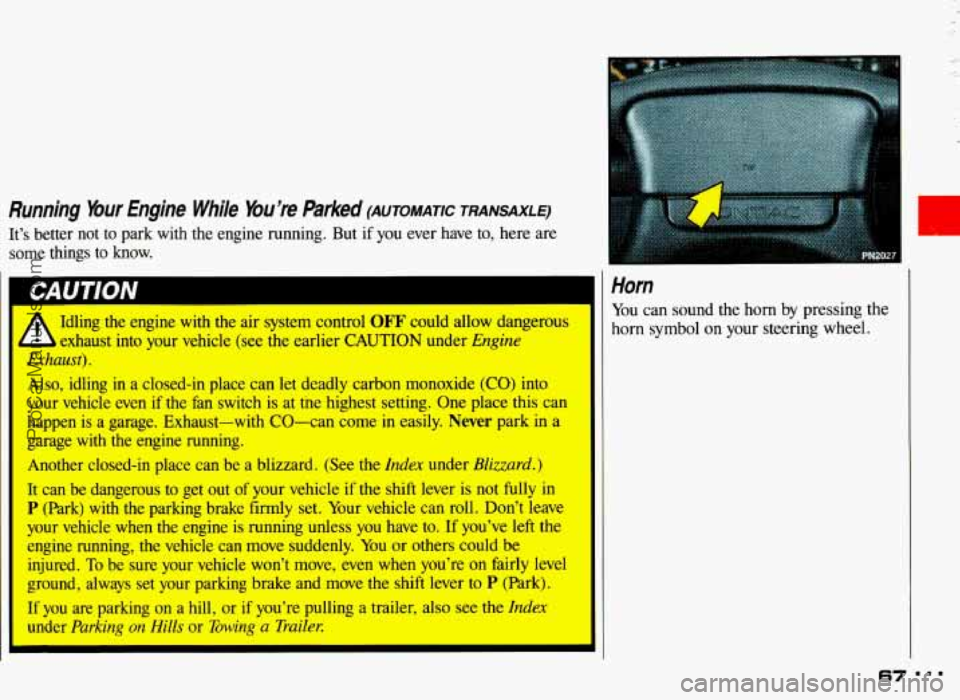
Horn
You can sound the horn by pressing the
horn symbol on your steering wheel.
67
ProCarManuals.com
Page 92 of 306
Warning Lights,
Gages
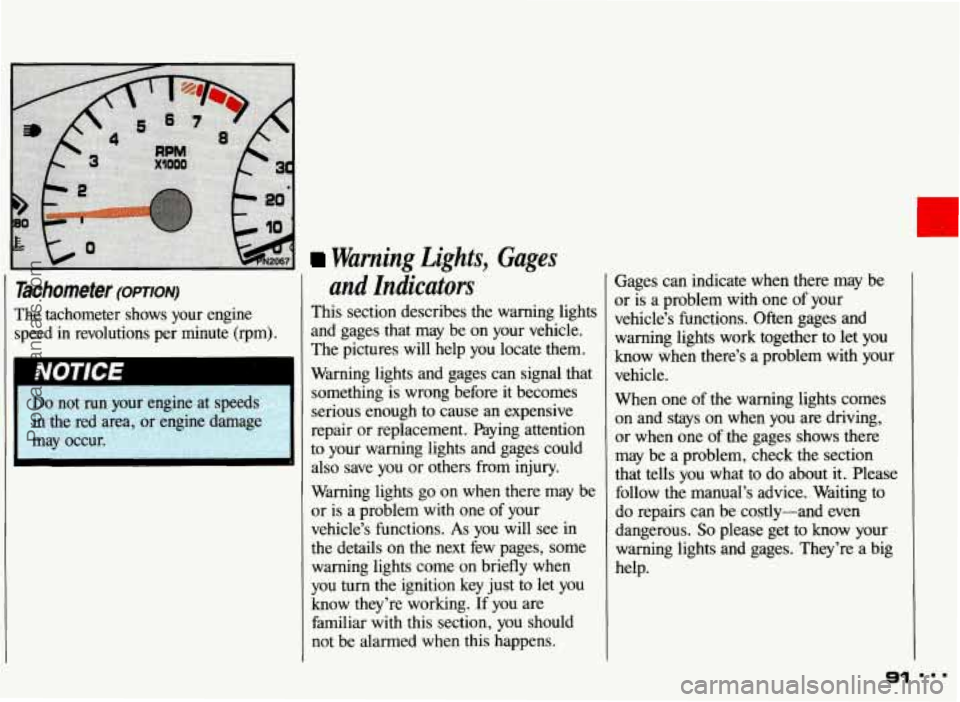
Tachometer (omtoN)
The tachometer shows your engine
speed in revolutions per minute (rpm).
and Indicators
This section describes the warning lights
and gages that may be on your vehicle.
The pictures will help you locate them.
Warning lights and gages can signal that something is wrong before it becomes
serious enough to cause
an expensive
repair or replacement. Paying attention
to your warning
lights and gages could
also save you or others from injury.
Warning lights go on when there may be
or is a problem with one of your
vehicle’s functions.
As you will see in
the details on the next few pages, some
warning lights come on briefly when
you turn the ignition key just to let you
know they’re working. If you are
familiar with this section, you should
not be alarmed when this happens. Gages can indicate
when there
may be
or is a problem with one of your
vehicle’s functions. Often gages and warning lights work together to let you
know when there’s
a problem with your
vehicle.
When one of the warning lights comes
on and stays
on when you are driving,
or when one of the gages shows there
may
be a problem, check the section
that tells you what to do about it. Please
follow the manual’s advice. Waiting to
do repairs can be costly-and even
dangerous.
So please get to know your
warning lights and gages. They’re a big
help.
91
ProCarManuals.com
Page 93 of 306
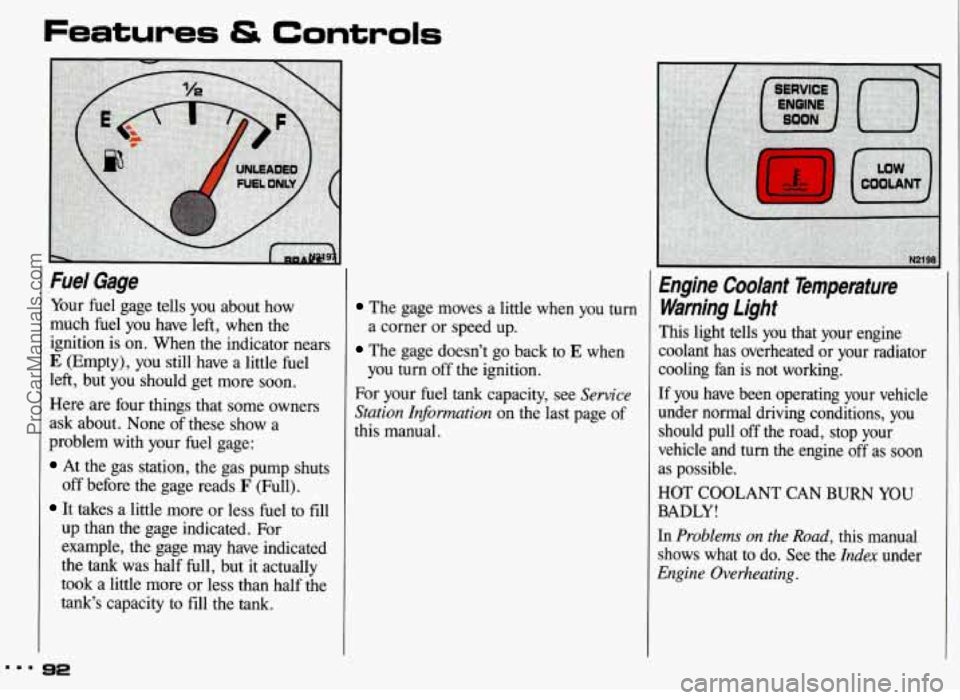
Fuel Gage
Your fuel gage tells you about how
much fuel you have left, when the
ignition is on. When the indicator nears
E (Empty), you still have a little fuel
left, but you should get more soon.
Here are four things that some owners
ask about. None
of these show a
problem with
your fuel gage:
At the gas station, the gas pump shuts
off before the gage reads
F (Full).
It takes a little more or less fuel to fill
up than the gage indicated. For
example, the gage may have indicated
the
tank was half full, but it actually
took a little more or less than half the
tank’s capacity to fill the tank.
The gage moves a little when you turn
The gage doesn’t go back to E when
For your fuel tank capacity, see
Service
Station Information
on the last page of
this manual. a
corner or speed up.
you turn off the ignition.
Engine Coolant Temperature
Warning Light
This light tells you that your engine
coolant has overheated or your radiator
cooling fan is not working.
If you have been operating your vehicle
under normal driving conditions, you
should pull off the road, stop your
vehicle and turn the engine
off as soon
as possible.
HOT
COOLANT CAN BURN YOU
BADLY!
In Problems on the Road, this manual
shows what to do. See the
Index under
Engine Overheating.
ProCarManuals.com
Page 94 of 306
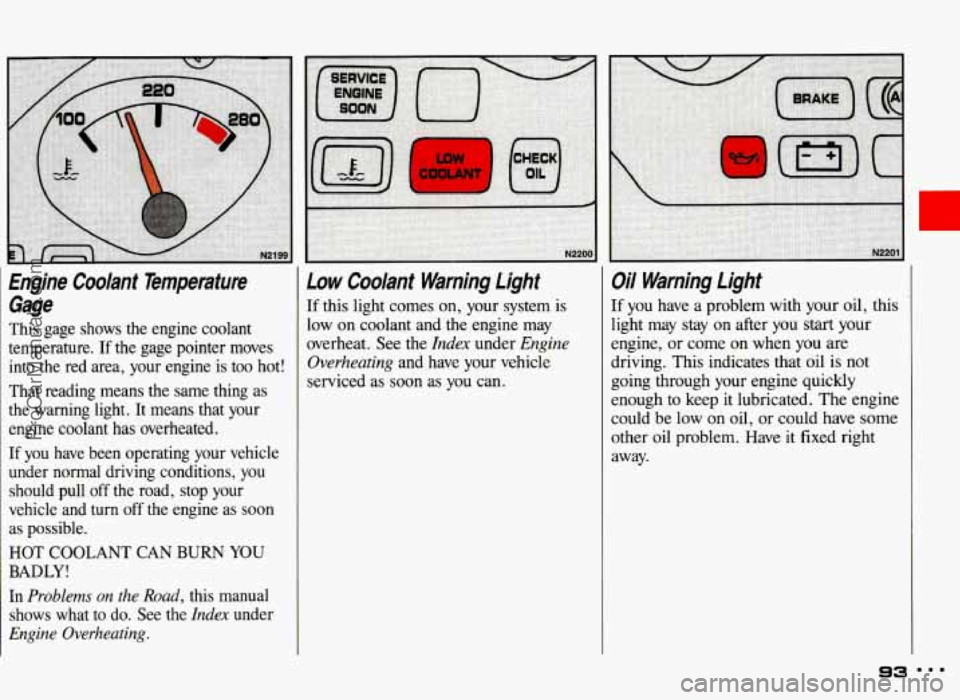
Engine Coolant Temperature Gage
This gage shows the engine coolant
temperature. If the gage pointer moves
into the red area, your engine is too hot!
That reading means the same thing as
the warning light. It means that your
engine coolant has overheated.
If you have been operating your vehicle
under normal driving conditions, you
should pull
off the road, stop your
vehicle and
turn off the engine as soon
as possible.
HOT
COOLANT CAN BURN YOU
BADLY!
In Problems on the Road, this manual
shows what to do. See the
Index under
Engine Overheating.
Low Coolant Warning light
If this light comes on, your system is
low on coolant and the engine may
overheat. See the
Index under Engine
Overheating
and have your vehicle
serviced as
soon as you can.
Oil Warning Llght
If you have a problem with your oil, this
light may stay on after you
start your
engine, or come
on when you are
driving. This indicates that
oil is not
going through your engine quickly
enough to keep it lubricated. The engine
could be low on oil, or could have some
other
oil problem. Have it fixed right
away.
93
ProCarManuals.com