warning light PONTIAC GRAND-AM 1993 User Guide
[x] Cancel search | Manufacturer: PONTIAC, Model Year: 1993, Model line: GRAND-AM, Model: PONTIAC GRAND-AM 1993Pages: 306, PDF Size: 15.39 MB
Page 93 of 306
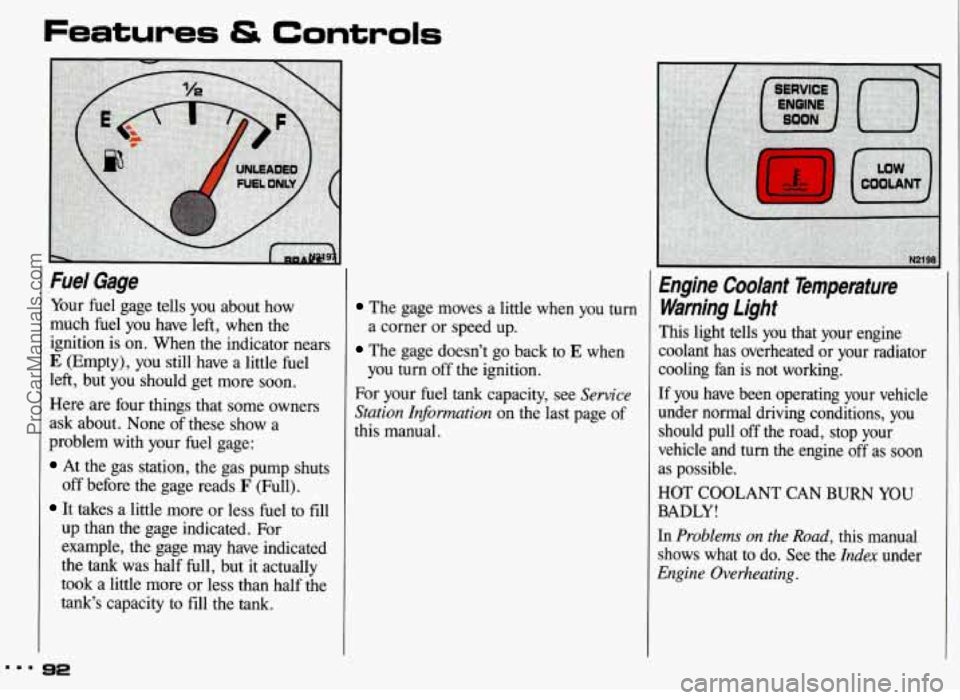
Fuel Gage
Your fuel gage tells you about how
much fuel you have left, when the
ignition is on. When the indicator nears
E (Empty), you still have a little fuel
left, but you should get more soon.
Here are four things that some owners
ask about. None
of these show a
problem with
your fuel gage:
At the gas station, the gas pump shuts
off before the gage reads
F (Full).
It takes a little more or less fuel to fill
up than the gage indicated. For
example, the gage may have indicated
the
tank was half full, but it actually
took a little more or less than half the
tank’s capacity to fill the tank.
The gage moves a little when you turn
The gage doesn’t go back to E when
For your fuel tank capacity, see
Service
Station Information
on the last page of
this manual. a
corner or speed up.
you turn off the ignition.
Engine Coolant Temperature
Warning Light
This light tells you that your engine
coolant has overheated or your radiator
cooling fan is not working.
If you have been operating your vehicle
under normal driving conditions, you
should pull off the road, stop your
vehicle and turn the engine
off as soon
as possible.
HOT
COOLANT CAN BURN YOU
BADLY!
In Problems on the Road, this manual
shows what to do. See the
Index under
Engine Overheating.
ProCarManuals.com
Page 94 of 306
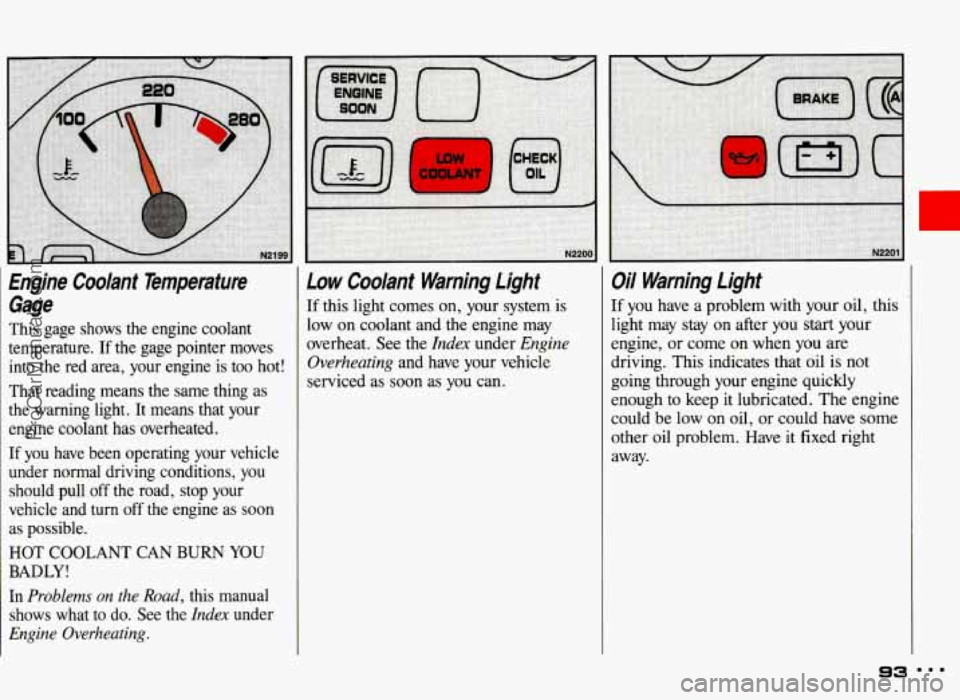
Engine Coolant Temperature Gage
This gage shows the engine coolant
temperature. If the gage pointer moves
into the red area, your engine is too hot!
That reading means the same thing as
the warning light. It means that your
engine coolant has overheated.
If you have been operating your vehicle
under normal driving conditions, you
should pull
off the road, stop your
vehicle and
turn off the engine as soon
as possible.
HOT
COOLANT CAN BURN YOU
BADLY!
In Problems on the Road, this manual
shows what to do. See the
Index under
Engine Overheating.
Low Coolant Warning light
If this light comes on, your system is
low on coolant and the engine may
overheat. See the
Index under Engine
Overheating
and have your vehicle
serviced as
soon as you can.
Oil Warning Llght
If you have a problem with your oil, this
light may stay on after you
start your
engine, or come
on when you are
driving. This indicates that
oil is not
going through your engine quickly
enough to keep it lubricated. The engine
could be low on oil, or could have some
other
oil problem. Have it fixed right
away.
93
ProCarManuals.com
Page 95 of 306
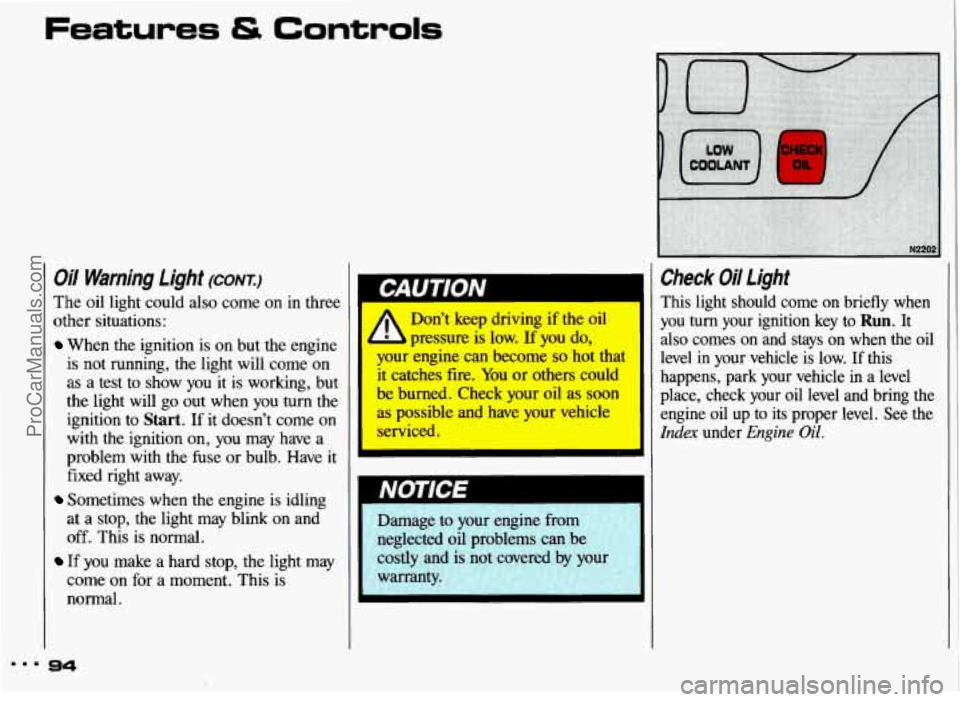
Oil Warning Light (CONT.)
The oil light could also come on in three
other situations:
When the ignition is on but the engine
is not running, the light will come on
as a test to show you it is working, but
the light will
go out when you turn the
ignition to
Start. If it doesn’t come on
with the ignition on, you may have a
problem with the fuse or bulb. Have
it
fixed right away.
Sometimes when the engine is idling
at a stop, the light may blink on and
off. This is normal.
If you make a hard stop, the light may
come on for a moment. This is
normal.
I
Don’t keep driving if the oil
your engine can become so hot that
it catches fire. You or others could
’ ; burned. Check your oil as soon
ab possible and have your vehicle
serviced.
E pressure is low. If you do,
‘CHECK I
OIL
,4-;, Damage to your engine from
;; neglected oil problems can be
,’: costly and is not covered -1 by your
i:.. warranty. , 1.
I
1
Check Oil Light
This light should come on briefly when
you
turn your ignition key to Run. It
also comes on and stays on when the oil
level in your vehicle is low. If this
happens, park your vehicle
in a level
place, check your
oil level and bring the
engine
oil up to its proper level. See the
Index under Engine Oil.
ProCarManuals.com
Page 96 of 306
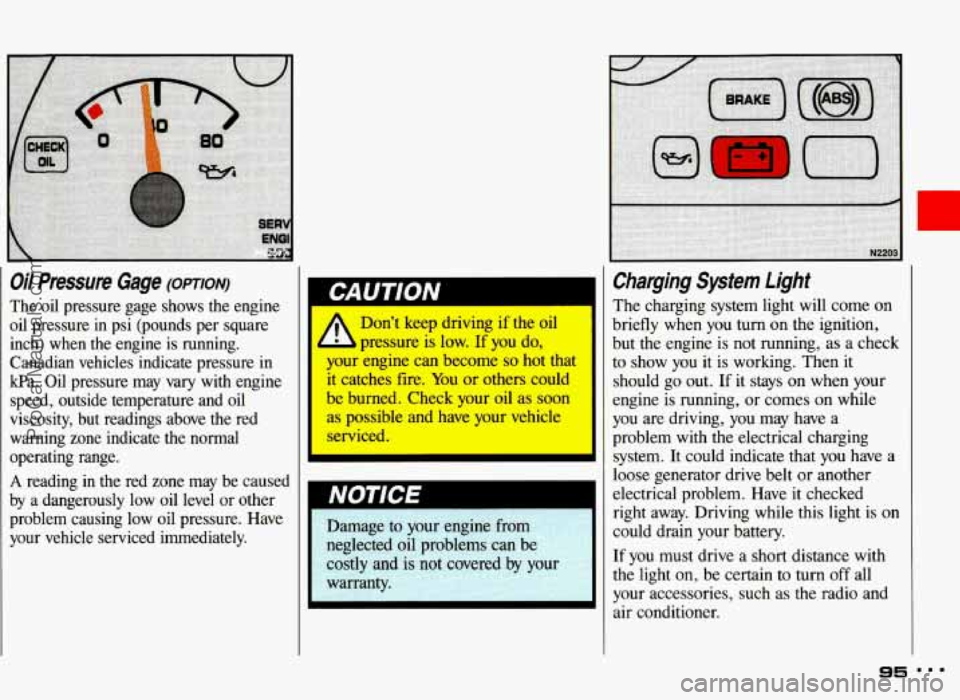
Oil Pressure Gage (omrorv)
The oil pressure gage shows the engine
oil pressure in psi (pounds per square
inch) when the engine is running.
Canadian vehicles indicate pressure in
kPa. Oil pressure may vary with engine
speed, outside temperature and
oil
viscosity, but readings above the red warning zone indicate the normal
operating range.
A reading in the red zone may be caused
by a dangerously low oil level
or other
problem causing low oil pressure. Have
your vehicle serviced immediately.
A
Don’t keep driving if the oil
pressure is low.
If you do,
your engine can become
so hot that
it catches fire. You or others could
be burned. Check your oil as soon
as possible and have your vehicle
serviced.
Charging System Light
The charging system light will come on
briefly when you
turn on the ignition,
but the engine is not running, as a check
to show you it is working. Then it
should go out.
If it stays on when your
engine is running, or comes on while
you are driving, you may have a
problem with the electrical charging
system. It could indicate that
you have a
loose generator drive belt or another
electrical problem. Have it checked
right away. Driving while this light is on
could drain your battery.
If you must drive a short distance with
the light on, be certain to
turn off all
your accessories, such as the radio and
air conditioner.
95
ProCarManuals.com
Page 97 of 306
Features & Controls
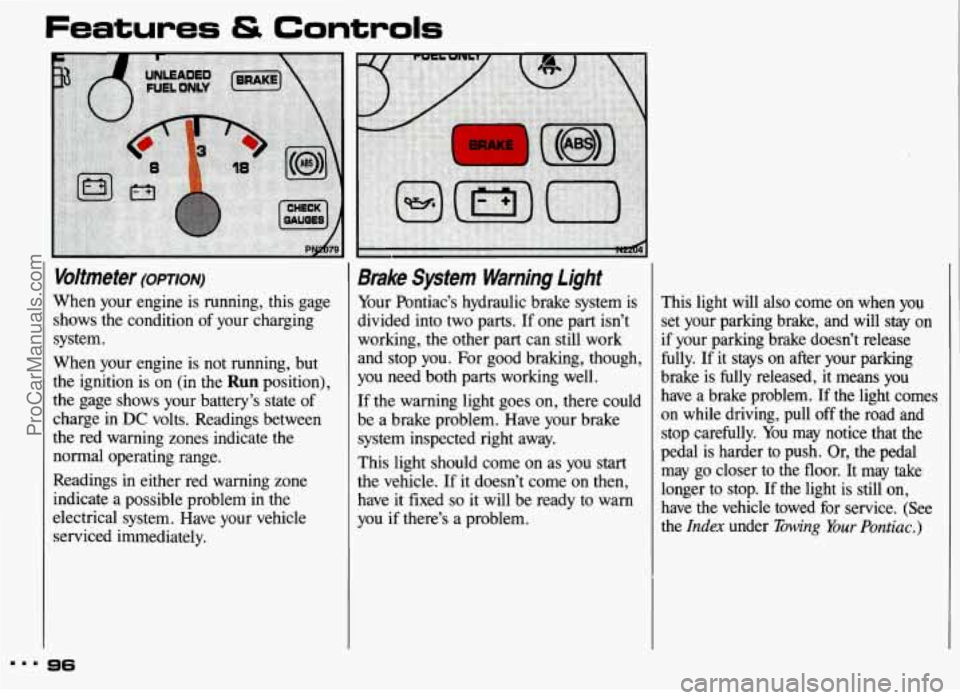
Voltmeter (omoN)
When your engine is running, this gage
shows the condition of your charging
system.
When your engine is not running, but
the ignition is on (in the
Run position),
the gage shows your battery’s state of
charge in
DC volts. Readings between
the red warning zones indicate the
normal operating range.
Readings in either red warning zone
indicate a possible problem in the
electrical system. Have your vehicle
serviced immediately.
Brake System Warning Light
Your Pontiac’s hydraulic brake system is
divided into two parts. If one part isn’t
working, the other part can still work
and stop you. For good braking, though,
you need both parts working well.
If the warning light goes on, there could
be a brake problem. Have your brake
system inspected right away.
This light should come on as you start
the vehicle. If it doesn’t come
on then,
have it fixed
so it will be ready to warn
you if there’s a problem, This
light will
also come on when you
set your parking brake, and will stay on if your parking brake doesn’t release
fully. If it stays on after your parking
brake is
fully released, it means you
have a brake problem.
If the light comes
on while driving, pull off the road and
stop carefully. You may notice that the
pedal is harder to push. Or, the pedal
may
go closer to the floor. It may take
longer to stop. If the light is still on,
have the vehicle towed for service. (See
the
Index under Bwing Your Pontiac.)
m.. 96
ProCarManuals.com
Page 98 of 306
I CAUTION Anti-lock Brake Sptetn Warning
Light A Your brake system may not be
working properly if the brake
warning light is on. Driving with
the brake warning light on can lead
to
an accident. If the light is still
on after you’ve pulled off the road
and stopped carefully, have the
vehicle towed for service. Vith
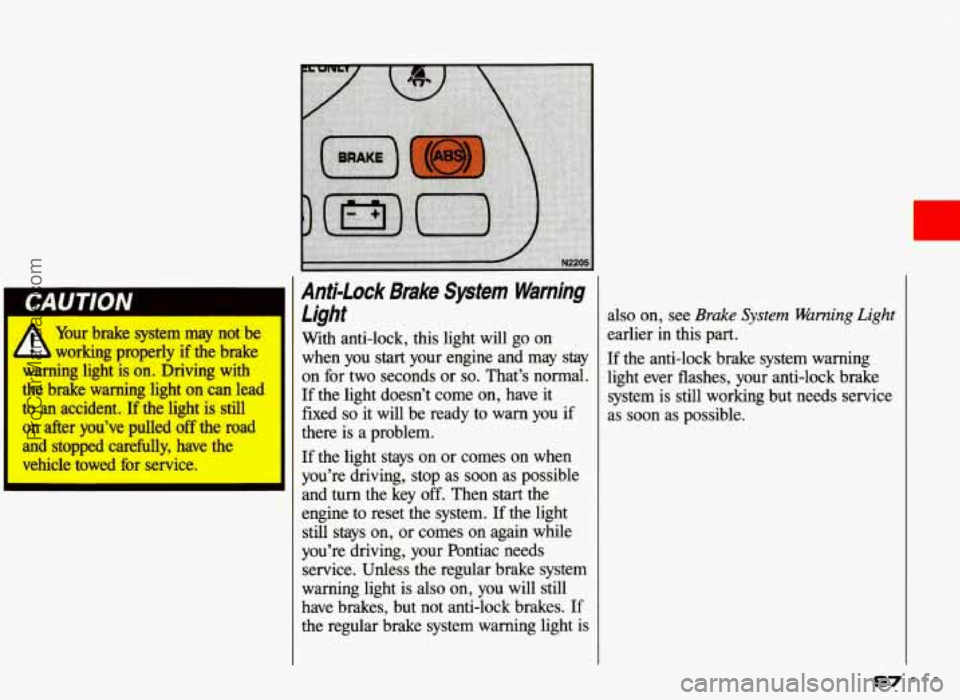
anti-lock, this light will
go on
when you start your engine and may stay
on for two seconds or so. That’s normal.
If the light doesn’t come on, have it
fixed so it will be ready to warn you if
there is a problem.
If the light
stays on or comes on when
you’re driving, stop
as soon as possible
and turn the key off. Then start the
engine to reset the system.
If the light
still
stays on, or comes on again while
you’re driving, your Pontiac needs
service. Unless the regular brake system
warning light
is also on, you will still
have brakes, but not anti-lock brakes.
If
the regular brake system warning light is
also on, see Brake System Warning Light
earlier in this part.
If the anti-lock brake system warning
light ever flashes, your anti-lock brake
system
is still working but needs service
as soon as possible.
ProCarManuals.com
Page 100 of 306
. .. . ..
Check Gauges Light (opTIoN)
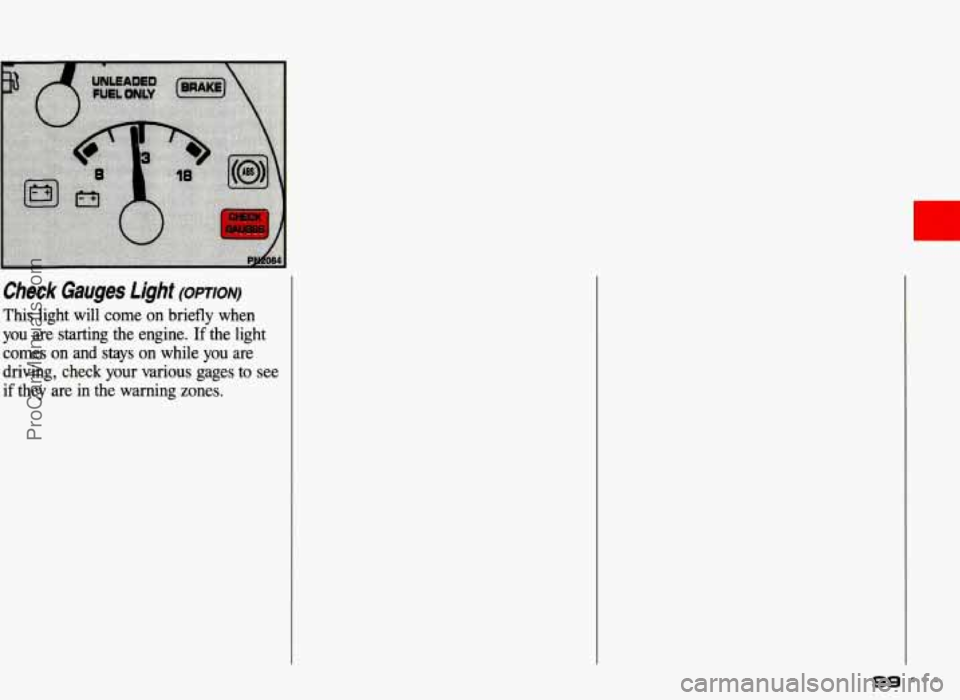
This light will come on briefly when
you are starting the engine. If the light
comes
on and stays on while you are
driving, check your various gages to see
if they are in the warning zones.
c
99 === ProCarManuals.com
Page 126 of 306
REVERSIBLE tANE ON MULTtlANE ROADWAY
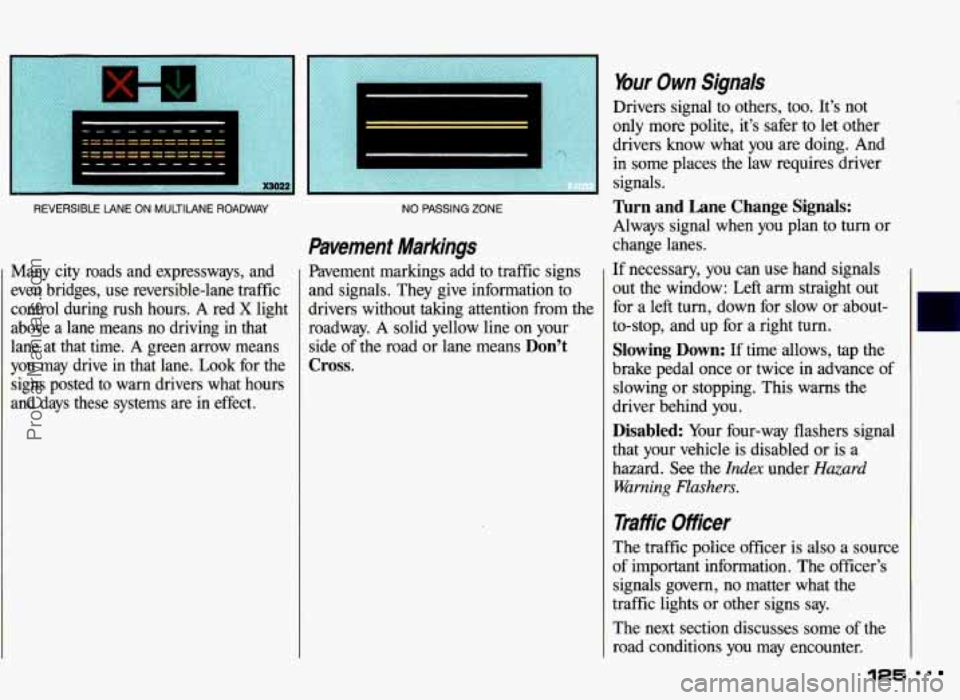
Many city roads and expressways, and
even bridges, use reversible-lane traffic
control during rush hours.
A red X light
above a lane means no driving in that
lane at that time.
A green arrow means
you may drive in that lane. Look for the
signs posted to warn drivers what hours
and days these systems are in effect.
NO PASSING ZONE
Pavement Markings
Pavement markings add to traffic signs
and signals. They give information to
drivers without taking attention from the
roadway.
A solid yellow line on your
side of the road or lane means
Don’t
Cross.
bur Own Signals
Drivers signal to others, too. It’s not
only more polite, it’s safer to let other
drivers
know what you are doing. And
in some places the law requires driver
signals.
Turn and Lane Change Signals:
Always signal when you plan to turn or
change lanes.
If necessary,
you can use hand signals
out the window:
Left arm straight out
for
a left turn, down for slow or about-
to-stop, and up for a right turn.
Slowing Down: If time allows, tap the
brake pedal once or twice
in advance of
slowing
or stopping. This warns the
driver behind you.
Disabled: Your four-way flashers signal
that your vehicle is disabled
or is a
hazard. See the
Index under Hazard
Warning Flashers.
liffk Ofiiceer
The traffic police officer is also a source
of important information. The officer’s
signals govern, no matter what the
traffic lights or other signs
say.
The next section discusses some of the
road conditions you may encounter.
125
ProCarManuals.com
Page 133 of 306
...
Your Driving and the Road
Anti-Lock Brakes (CONT.)
After an ABS stop, you may also hear a
clicking noise the next time the vehicle
reaches about
4 mph (6 km/h).
If there’s a problem with the anti-lock
brake system, the anti-lock brake system
warning light will stay
on or flash.
See the
Index under Anti-Lock Brake
System Warning Light.
132
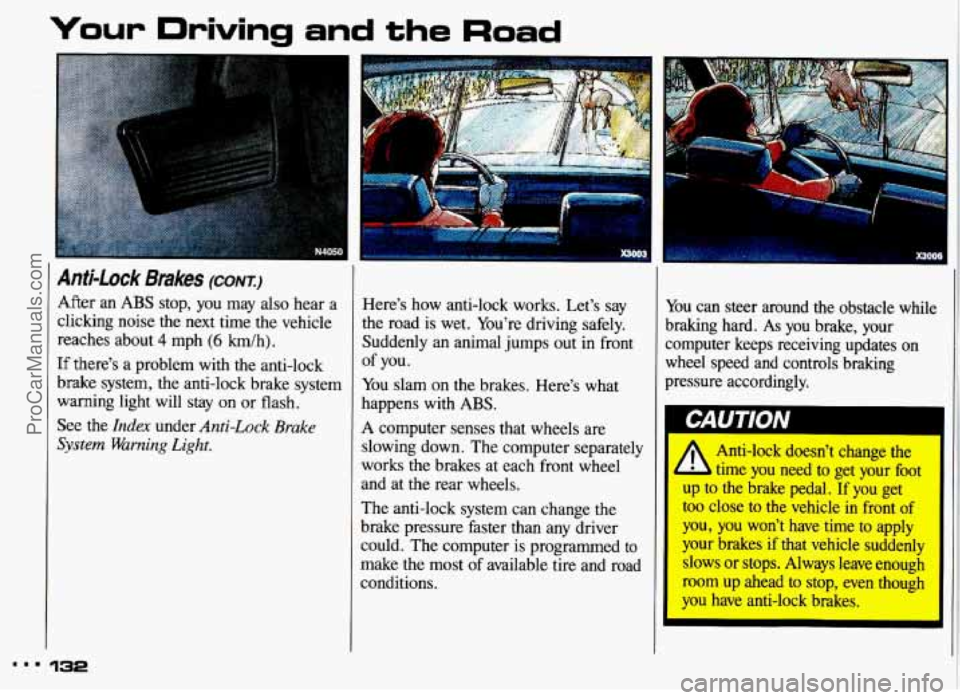
Here’s how anti-lock works. Let’s say
the road is wet. You’re driving safely.
Suddenly an animal jumps out in front
You slam on the brakes. Here’s what
happens with ABS.
A computer senses that wheels are
slowing down. The computer separately
works the brakes at each front wheel
and at the rear wheels.
The anti-lock system can change the
of you.
brake pressure faster than any driver
could. The computer
is programmed to
make the most
of available tire and road
conditions. You
can steer around the obstacle while
braking hard.
As you brake, your
computer keeps receiving updates on
wheel speed and controls braking
pressure accordingly.
Anti-lock doesn’t change the
time you need
to get your foot
the brake pedal. If you get
too close to the vehicle in front
of
I you, you won’t have time to apply
your brakes
if that vehicle suddenly
slows or stops. Always leave enough
room up ahead to stop, even though
you have anti-lock brakes.
ProCarManuals.com
Page 148 of 306
Tips on Driving in Fbg
If you get caught in fog, turn your
headlights on low beam, even in
daytime, You’ll see-and be seen-
better. Use your fog lights.
Don’t use your high beams. The light
will bounce
off the water droplets that
make up fog and reflect back at you.
Use your defogger.
In high humidity,
even a light build-up of moisture
on the
inside of the glass will cut down
on your
already limited visibility.
Run your
windshield wipers and washer occasionally. Moisture can build up on
the outside glass, and what seems to be fog may actually be moisture on the
outside of your windshield.
Treat dense fog as
an emergency. Try to
find a place to pull off the road. Of course
you want to respect another’s
property, but you might need to put something between you and moving
vehicles-space, trees, telephone poles,
a private driveway, anything that
removes you from other traffic.
If visibility is near zero and you must
stop but are unsure whether you are
away from the road,
turn your lights on,
start your hazard warning flashers, and
sound your horn at intervals or when
you hear approaching traffic.
Pass other vehicles in fog only if you
can see far enough ahead to pass safely.
Even then, be prepared to delay your
pass if you suspect the fog is worse
up
ahead. If other vehicles try to pass you,
make it easy for them.
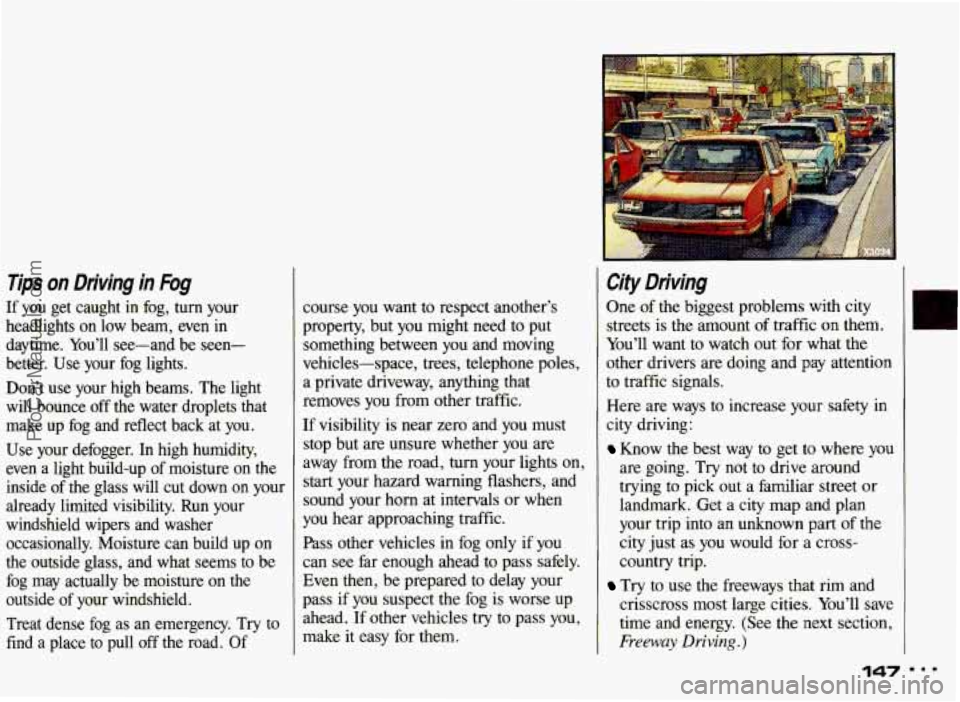
City Driving
One of the biggest problems with city
streets is the amount of traffic on them.
You’ll want to watch out for what the
other drivers are doing and pay attention
to traffic signals.
Here are ways to increase your safety in
city driving:
Know the best way to get to where you
are going. Try not to drive around
trying to pick out a familiar street or
landmark. Get a city map and plan
your trip into
an unknown part of the
city just as you would for
a cross-
country trip.
Try to use the freeways that rim and
crisscross most large cities. You’ll save
time and energy. (See the next section,
Freeway Driving.
147
... . -
ProCarManuals.com