light PONTIAC GRAND-AM 1993 Repair Manual
[x] Cancel search | Manufacturer: PONTIAC, Model Year: 1993, Model line: GRAND-AM, Model: PONTIAC GRAND-AM 1993Pages: 306, PDF Size: 15.39 MB
Page 157 of 306
Your Driving and the Road
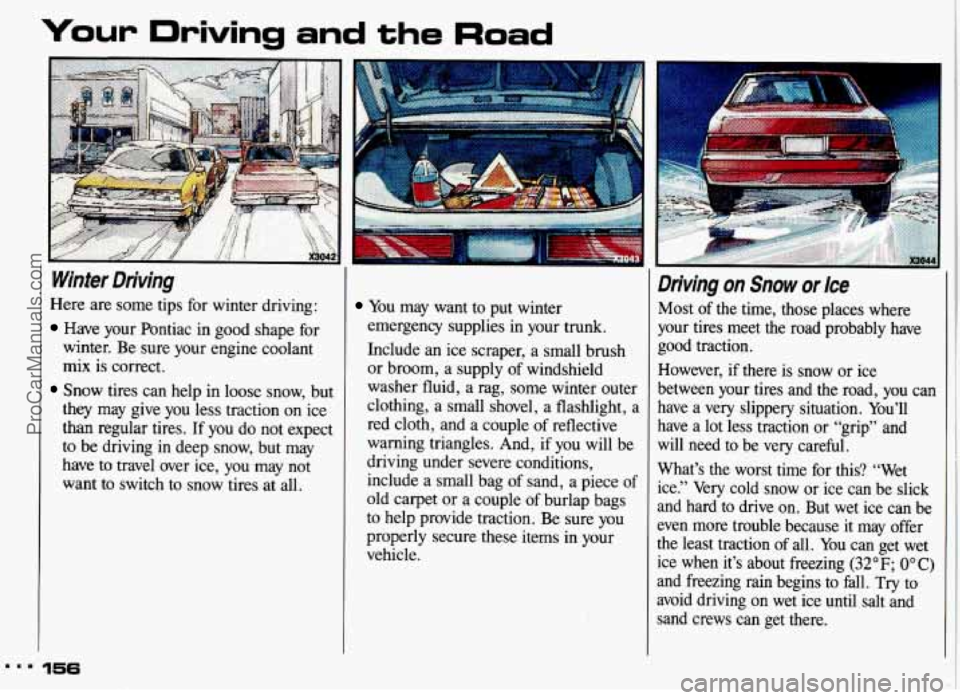
Winter Driving
Here are some tips for winter driving:
Have your Pontiac in good shape for
winter. Be sure your engine coolant
mix is correct.
Snow tires can help in loose snow, but
they may give you less traction on ice
than regular tires. If you do not expect
to be driving in deep snow, but may
have to travel over ice, you may not
want to switch to snow tires at all.
.a. 156
You may want to put winter
emergency supplies in your trunk.
Include an ice scraper, a small brush
or broom, a supply of windshield
washer fluid, a rag, some winter outer
clothing, a small shovel, a flashlight, a
red cloth, and a couple of reflective
warning triangles. And, if
you will be
driving under severe conditions,
include a small bag of sand, a piece of
old carpet or a couple of burlap bags
to help provide traction. Be sure you
properly secure these items in your
vehicle.
Driving on Snow or Ice
Most of the time, those places where
your tires meet the road probably have
good traction.
However, if there is snow or ice
between your tires and
the road, you can
have a very slippery situation. You’ll
have a lot less traction
or “grip” and
will need to be very careful.
What’s the
worst time for this? “Wet
ice.” Very cold snow or ice can be slick
and hard to drive on. But wet ice can be
even more trouble because it may offer
the least traction of all. You can get wet
ice when it’s about freezing
(32°F; OOC)
and freezing rain begins to fall. Try to
avoid driving on wet ice until salt and
sand crews can get there.
ProCarManuals.com
Page 159 of 306
lf bu’re Caught in a Bliuard
(CONZ)
Put on extra clothing or wrap a
blanket around you.
If you have no
blankets or extra clothing, make body
insulators from newspapers, burlap
bags, rags, floor mats-anything you
can wrap around yourself or tuck
under your clothing to keep warm.
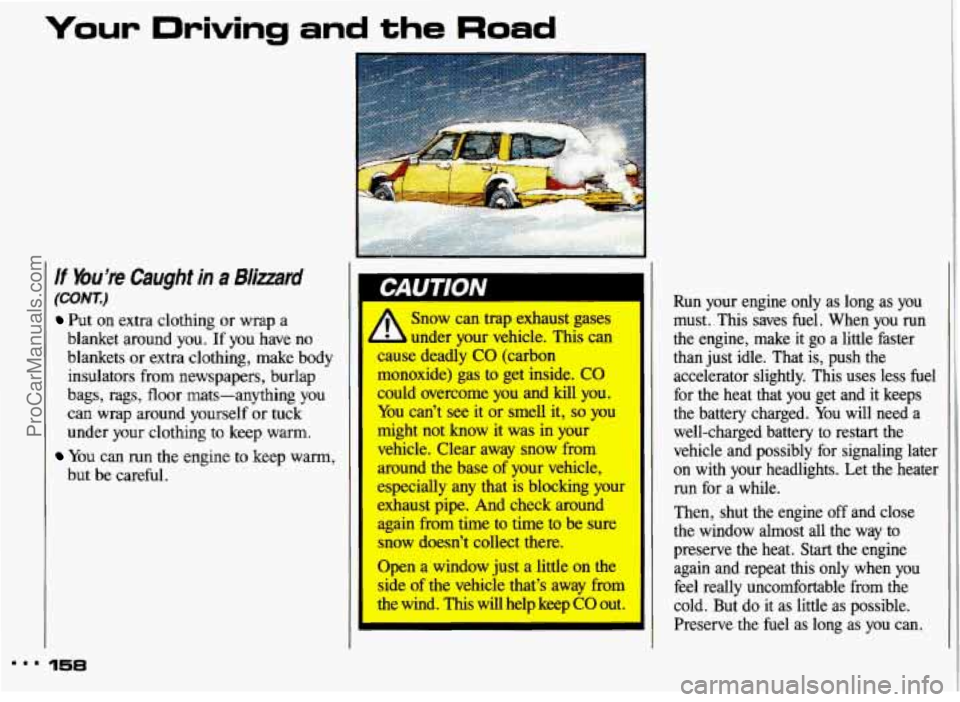
You can run the engine to keep warm,
but be careful.
158
cause deadly CO (carbon
monoxide) gas to get inside.
CO
could overcome you and kill you.
You can’t see it or smell it,
so you
might not know it was
in your
vehicle. Clear away snow from
around the base of your vehicle,
especially any that
is blocking your
exhaust pipe. And check around
again from time to time to be sure
snow doesn’t collect there.
Open a window just a little on the
side
of the vehicle that’s away from
the wind.
This will help keep CO out. Run your engine only as long as you
must. This saves fuel. When you
run
the engine, make it go
a little faster
than just idle. That is, push the
accelerator slightly. This uses less fuel
for the heat that you get and it keeps
the battery charged. You will need a
well-charged battery to restart the
vehicle and possibly for signaling later
on with your headlights.
Let the heater
run for a while.
Then, shut the engine off and close
the window almost all the way to
preserve the heat.
Start the engine
again and repeat this only when you
feel really uncomfortable from the
cold. But do it as little as possible.
Preserve the fuel as long as you can.
ProCarManuals.com
Page 165 of 306
Your Driving and the Road
Driving with a lbiler
Towing a trailer requires a certain
amount of experience. Before setting out
for the open road, you’ll want to get to
know your rig. Acquaint yourself with
the feel of handling and braking with the
added weight of the trailer. And always
keep
in mind that the vehicle you are
driving is now a good deal longer and
not nearly
so responsive as your vehicle
is by itself.
Before you start, check the trailer hitch
and platform, safety chains, electrical
connector, lights, tires and mirror
adjustment.
If the trailer has electric
brakes, start your vehicle and trailer
moving and then apply the trailer brake
controller by
hand to be sure the brakes
are working.
This lets you check your
electrical connection at the same time.
164
During your trip, check occasionally to
be sure that the load is secure, and that
the lights and any trailer brakes are still
working.
Following Distance
Stay at least twice as far behind the
vehicle ahead as you would when
driving your vehicle without a trailer.
This can help you avoid situations that
require heavy braking and sudden
turns.
Passing
You’ll need more passing distance up
ahead when you’re towing a trailer.
And, because you’re a good deal longer,
you’ll need to go much farther beyond
the passed vehicle before you can return
to your lane.
Backing Up
Hold the bottom of the steering wheel
with one hand. Then, to move the trailer
to the left, just move that hand to the
left.
To move the trailer to the right,
move your hand to the right. Always
back up slowly and,
if possible, have
someone guide you.
Making Turns
When you’re turning with a trailer,
make wider turns than normal.
Do this
so your trailer won’t strike soft
shoulders, curbs, road signs, trees, or
other objects. Avoid jerky
or sudden
maneuvers. Signal well in advance.
ProCarManuals.com
Page 166 of 306
Turn Signals When Towing a ’Railer
When you tow a trailer, your vehicle has
to have a different turn signal flasher
and extra wiring. The green arrows on
your instrument panel will flash
whenever you signal a
turn or lane
change. Properly hooked up, the trailer
lights will also flash, telling other drivers you’re about to turn, change
lanes or stop.
When towing a trailer, the green arrows
on your instrument panel will flash for
turns even if the bulbs on the trailer are
burned out. Thus, you may think drivers
behind you are seeing your signal when
they are not. It’s important to check occasionally to be sure the trailer bulbs
are still working.
Driving On Grades
Reduce speed and shift to a lower gear
before you start down a long or steep
downgrade. If you don’t shift down, you
might have to use your brakes
so much
that they would get hot and no longer work well.
On a long uphill grade, use the highest
gear possible. If you cannot maintain
posted speeds, driving at a lower speed
may help avoid overheating your engine
and transaxle.
If you have a manual transaxle with
fifth
gear, it’s better not to use fifth gear. Just
drive in fourth gear (or, as you need to,
a lower gear).
Parking on Hills
You really should not park your vehicle,
with a trailer attached,
on a hill. If
something goes wrong, your rig could
start to move. People can be injured,
and both your vehicle and the trailer can
be damaged.
But if you ever have to park your rig on
a hill, here’s how to do it:
1. Apply your regular brakes, but don’t
shift into
P (Park) yet, or into gear
for a manual transaxle.
2. Have someone place chocks under
the trailer wheels.
3. When the wheel chocks are in place,
release the regular brakes until the chocks absorb the load.
165 DDD
ProCarManuals.com
Page 171 of 306
Problems on the Road
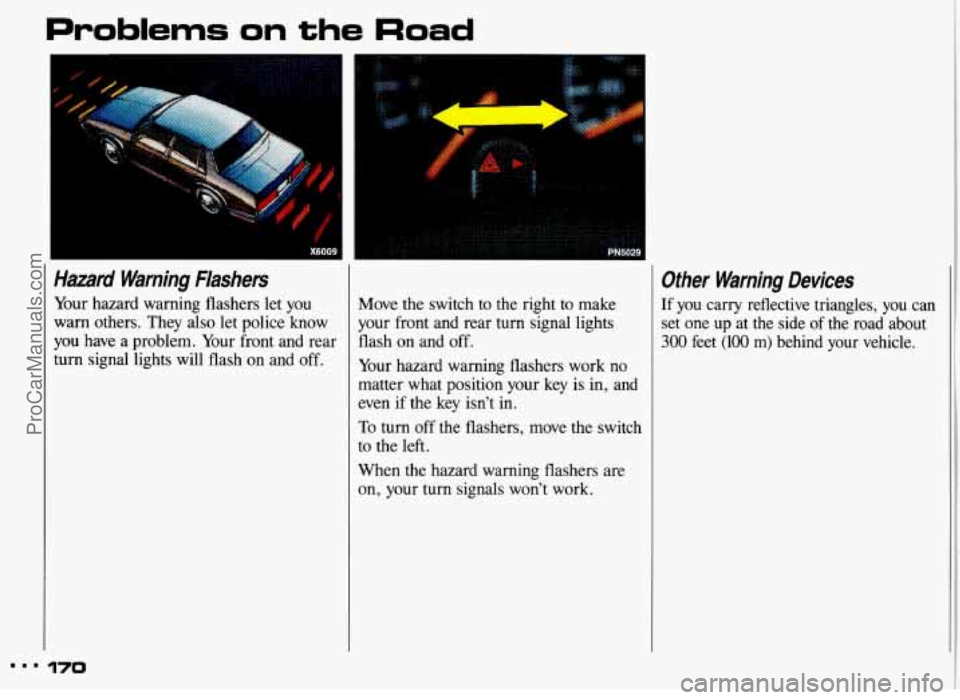
Hazard Warning Flashers
Your hazard warning flashers let you
warn others. They also let police know
you have a problem. Your front and rear
turn signal lights will flash
on and off.
170
Move the switch to the right to make
your front and rear turn signal lights flash on and off.
Your hazard warning flashers work no
matter what position your key is in, and
even if the key isn’t in.
To turn off the flashers, move the switch
to the left.
When the hazard warning flashers are
on, your turn signals won’t work.
Other Warning Devices
If you carry reflective triangles, you can
set one up at the side of the road about
300 feet (100 m) behind your vehicle.
ProCarManuals.com
Page 173 of 306
Jump Starting (CONTJ
2. Get the vehicles close enough so the
jumper cables can reach, but be sure
the vehicles aren’t touching each
other.
If they are, it could cause a
ground connection you don’t want.
You wouldn’t be able to
start your
Pontiac, and the bad grounding could
damage the electrical systems.
I; vehicles roll. Set the parking
brake
firmly on each vehicle. Put
an automatic transaxle in
P (Park)
or a manual transaxle in
N (Neutral). I I
3. Turn off the ignition on both
vehicles. Turn
off all lights that aren’t
needed, and radios.
This will avoid
sparks and help save both batteries.
And it could save your radio!
. 8. r ~
I If you leave your radio on, it could
4. Open the hoods and locate the batteries.
An electric fan can start up
e engine is not
running and can injure you. Keep
hands, clothing and tools away
from any underhood electric fan.
Find the positive (+) and negative
(-) terminals on each battery,
I.. 172
ProCarManuals.com
Page 174 of 306
A
1 I water. Using
a match near
a battery
can cause battery
gas to
explode. ,People have been hurt
doing
this, and some have been
blinded.
Use a flashlight if you
need more light.
Be sure the battery has enough
You don’t need to add water to the
Delco Freedom@ battery installed
in every new GM vehicle. But if a
battery has fdler caps, be sure the
right amount of fluid is there.
If it
is low, add water to take care
of
that first. If you don’t, explosive
gas could be present.
Battery fluid contains acid that
can
burn you. Don’t get it on you. If
you accidentally get it in your eyes
or on your skin, flush the place
with water and get medical help
immediately.
1
5. Check that the jumper cables don’t
have loose or missing insulation.
If
they do, you could get a shock. The
vehicles could be damaged, too.
Before you connect the cables, here are
some things you should know. Positive
(+) will go to positive (+) and negative
(-) will go to negative (-) or a metal
engine part.
Don’t connect
(+) to (-) or you’ll get a
short that would damage the battery and
maybe other parts, too. Fans
or other moving engine
parts can injure you badly.
Keep your hands away from
moving parts once the engines are
running.
173 =
ProCarManuals.com
Page 180 of 306
Engine Overheating
You will find a coolant temperature gage
or the warning light about
a hot engine
on your Pontiac’s instrument panel. See
the
Index under Coolant Temperature
Gage
and Coolant Temperature Warning
Light.
You will also find a low coolant warning
light on your Pontiac’s instrument panel.
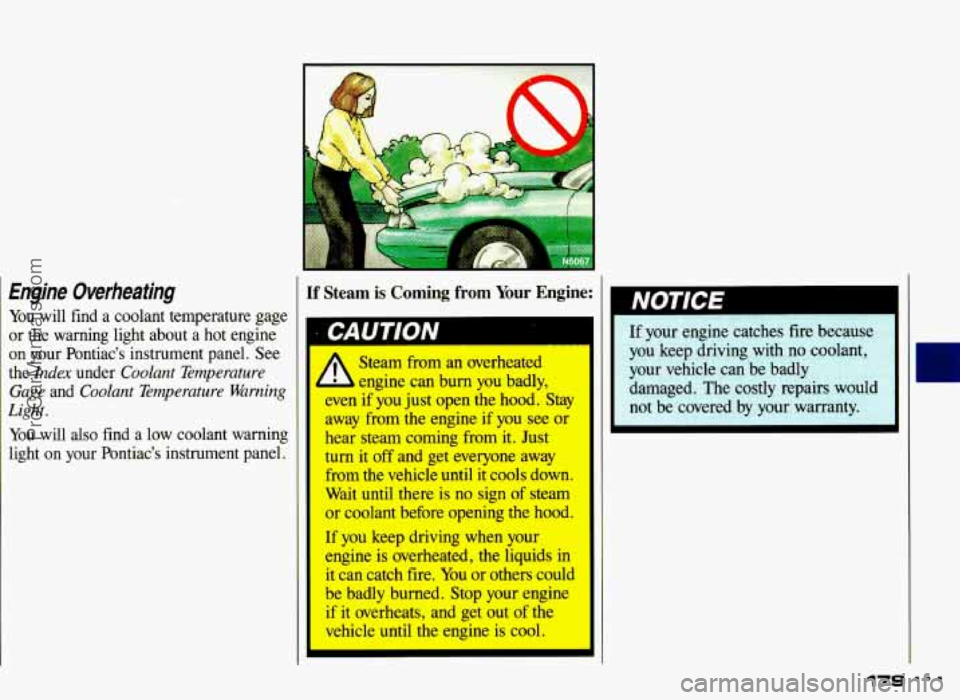
If Steam is Coming from Your Engine:
/1 Steam from an overheated
L L engine can burn you badly,
even
if you just open the hood. Stay
away from the engine if you see or
hear steam coming from
it. Just
turn it off and get everyone away
from the vehicle
until it cools down.
Wait until there is no sign of steam
or coolant before opening the hood.
If you keep driving when your
engine
is overheated, the liquids in
it can catch fire. You or others could
be badly burned. Stop your engine
if it overheats, and get out of the
vehicle until the engine is cool.
179
ProCarManuals.com
Page 193 of 306
Changing a Flat Tire (corvr)
14. Store the flat tire in the compact
spare
tire compartment, and secure
with the
wing bolt and extension.
Store the jack and wheel wrench in
their compartment, also.
I A Storing a jack, a tire, or other
- equipment in the passenger
ompartment
of the vehicle could I
cause injury. In a sudden stop or
collision, loose equipment could strike someone. Store all these in
the proper place.
i
Compact Spare Tire
Although the compact spare was fully
inflated when your vehicle was new, it can lose air after a time. Check the
inflation pressure regularly. It should be
60 psi (420 Wa). The compact spare is
made to go up to
3,000 miles (5 O00 km),
so you can finish your trip and have
your full-size tire repaired or replaced
where you want.
Of course, it’s best to
replace your spare with a full-size tire as
soon
as you can. Your spare will last
longer and be in good shape
in case you
need it again.
Your anti-lock brake system warning
light may come on when you are driving
with a compact spare. See the
Idex
under Anti-Lock Brake System Warning
Light.
192
Don’t take your compact spare
through
an automatic vehicle wash I
with guide rails. The compact spare can get caught on the rails.
That can damage the tire and
wheel, and maybe other parts
of
your vehicle.
)on? use your compact spare on some
)ther vehicle.
ind don’t
mix your compact spare or
vheel with other wheels or tires. They
von’t
fit. Keep your spare and its wheel
ogether.
ProCarManuals.com
Page 195 of 306
Problems on the Road
If Mu’re Stuck: In Sand, Mud,
Ice or Snow (CONXI
Spinning your wheels can dest
parts
of your vehicle as well as
tires.
If you spin the wheels too
fast while shifting your transaxle
back and forth,
your transaxle.
__
OY
194
Rocking Your Vehicle to Get it Out:
First, turn your steering wheel left and
right. That will clear the area around
your front wheels. Then shift back and
forth between
R (Reverse) and a
forward gear, or with a manual
transaxle, between
1 or 2 and R (Reverse),
spinning the wheels as little as possible.
Release the accelerator pedal while you
shift, and press lightly on the
accelerator pedal when the transaxle is
in gear. If that doesn’t get you out after a
few tries, you may need to be towed out.
If you do need to be towed out, see the
Index under Towing Your Pontiac.
ProCarManuals.com