check engine light PONTIAC GRAND-AM 1993 Owners Manual
[x] Cancel search | Manufacturer: PONTIAC, Model Year: 1993, Model line: GRAND-AM, Model: PONTIAC GRAND-AM 1993Pages: 306, PDF Size: 15.39 MB
Page 92 of 306
Warning Lights,
Gages
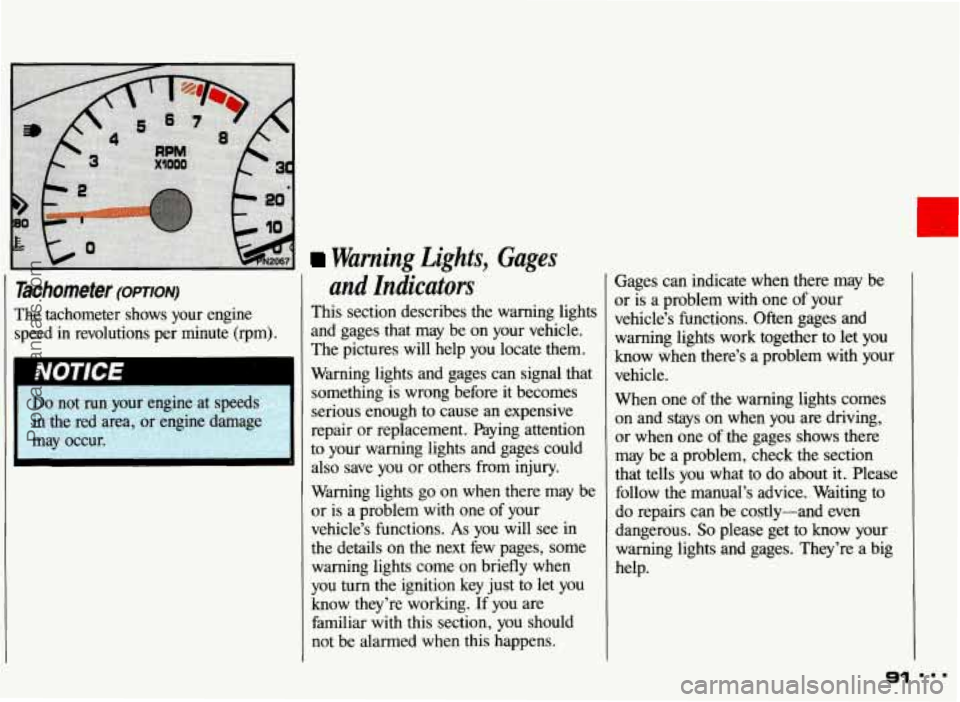
Tachometer (omtoN)
The tachometer shows your engine
speed in revolutions per minute (rpm).
and Indicators
This section describes the warning lights
and gages that may be on your vehicle.
The pictures will help you locate them.
Warning lights and gages can signal that something is wrong before it becomes
serious enough to cause
an expensive
repair or replacement. Paying attention
to your warning
lights and gages could
also save you or others from injury.
Warning lights go on when there may be
or is a problem with one of your
vehicle’s functions.
As you will see in
the details on the next few pages, some
warning lights come on briefly when
you turn the ignition key just to let you
know they’re working. If you are
familiar with this section, you should
not be alarmed when this happens. Gages can indicate
when there
may be
or is a problem with one of your
vehicle’s functions. Often gages and warning lights work together to let you
know when there’s
a problem with your
vehicle.
When one of the warning lights comes
on and stays
on when you are driving,
or when one of the gages shows there
may
be a problem, check the section
that tells you what to do about it. Please
follow the manual’s advice. Waiting to
do repairs can be costly-and even
dangerous.
So please get to know your
warning lights and gages. They’re a big
help.
91
ProCarManuals.com
Page 95 of 306
Oil Warning Light (CONT.)
The oil light could also come on in three
other situations:
When the ignition is on but the engine
is not running, the light will come on
as a test to show you it is working, but
the light will
go out when you turn the
ignition to
Start. If it doesn’t come on
with the ignition on, you may have a
problem with the fuse or bulb. Have
it
fixed right away.
Sometimes when the engine is idling
at a stop, the light may blink on and
off. This is normal.
If you make a hard stop, the light may
come on for a moment. This is
normal.
I
Don’t keep driving if the oil
your engine can become so hot that
it catches fire. You or others could
’ ; burned. Check your oil as soon
ab possible and have your vehicle
serviced.
E pressure is low. If you do,
‘CHECK I
OIL
,4-;, Damage to your engine from
;; neglected oil problems can be
,’: costly and is not covered -1 by your
i:.. warranty. , 1.
I
1
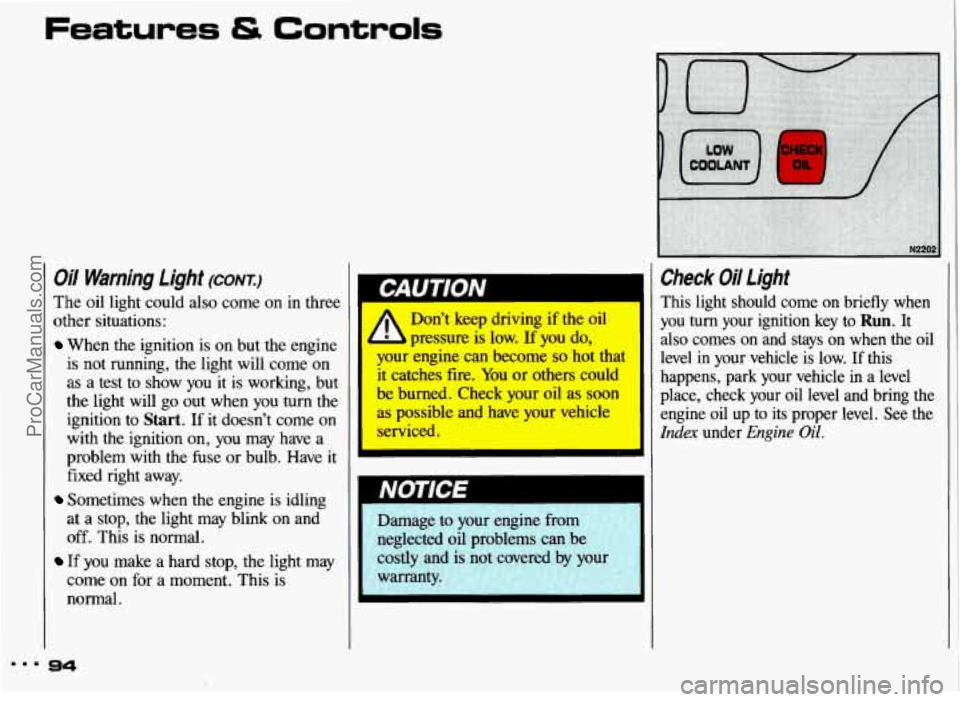
Check Oil Light
This light should come on briefly when
you
turn your ignition key to Run. It
also comes on and stays on when the oil
level in your vehicle is low. If this
happens, park your vehicle
in a level
place, check your
oil level and bring the
engine
oil up to its proper level. See the
Index under Engine Oil.
ProCarManuals.com
Page 96 of 306
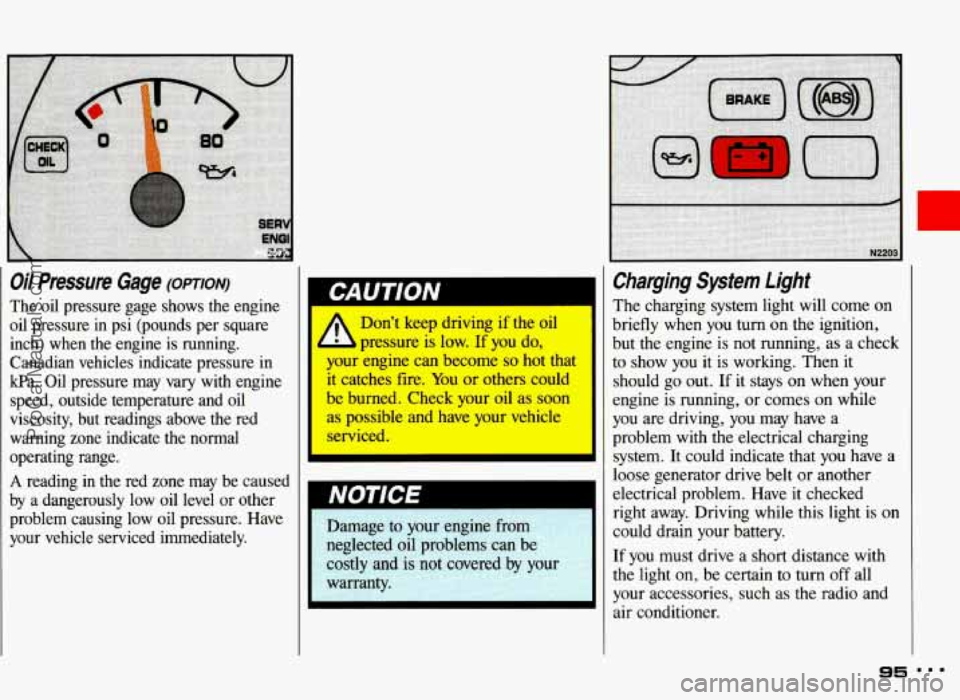
Oil Pressure Gage (omrorv)
The oil pressure gage shows the engine
oil pressure in psi (pounds per square
inch) when the engine is running.
Canadian vehicles indicate pressure in
kPa. Oil pressure may vary with engine
speed, outside temperature and
oil
viscosity, but readings above the red warning zone indicate the normal
operating range.
A reading in the red zone may be caused
by a dangerously low oil level
or other
problem causing low oil pressure. Have
your vehicle serviced immediately.
A
Don’t keep driving if the oil
pressure is low.
If you do,
your engine can become
so hot that
it catches fire. You or others could
be burned. Check your oil as soon
as possible and have your vehicle
serviced.
Charging System Light
The charging system light will come on
briefly when you
turn on the ignition,
but the engine is not running, as a check
to show you it is working. Then it
should go out.
If it stays on when your
engine is running, or comes on while
you are driving, you may have a
problem with the electrical charging
system. It could indicate that
you have a
loose generator drive belt or another
electrical problem. Have it checked
right away. Driving while this light is on
could drain your battery.
If you must drive a short distance with
the light on, be certain to
turn off all
your accessories, such as the radio and
air conditioner.
95
ProCarManuals.com
Page 99 of 306
Features tS Controls
!
-
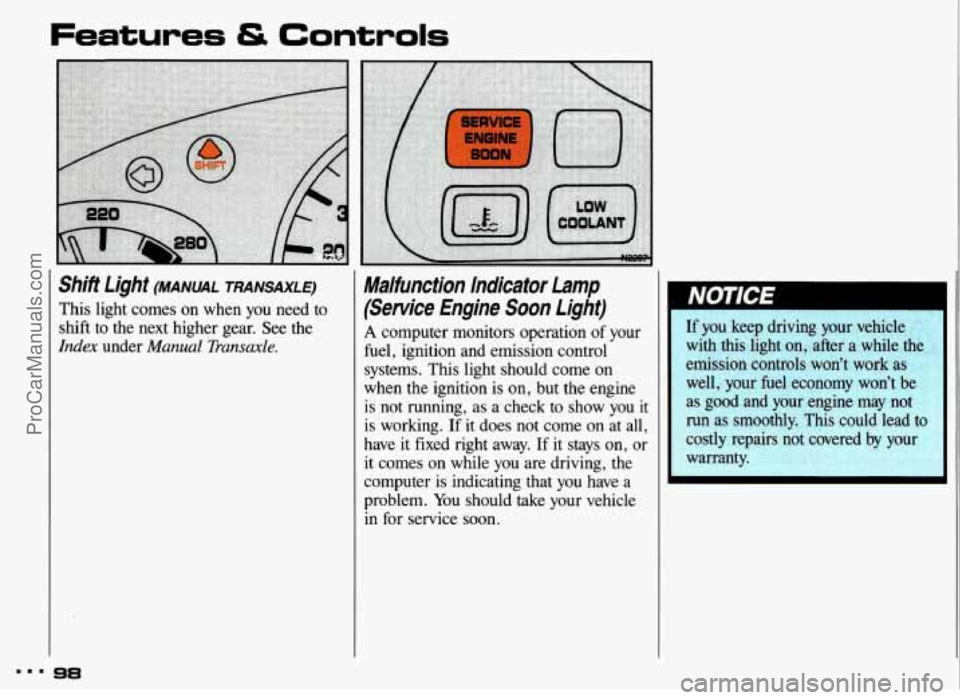
Shift Light (MANUAL TRANSAXLE)
This light comes on when you need to
shift to the next higher gear. See the
Index under Manual Transaxle.
98
Malfunction Indicator Lamp
(Service Engine Soon Light)
A computer monitors operation of your
fuel, ignition and emission control
systems. This light should come on
when the ignition is on, but the engine
is not running, as a check to show you
it
is working. If it does not come on at all,
have it fixed right away.
If it stays on, or
it comes on while you are driving, the
computer is indicating that
you have a
problem. You should take your vehicle
in for service soon.
If you keep driving your vehicle
with this light on, after a while the
emission controls won’t work as
well, your fuel economy won’t be
as good and your engine may not
run as smoothly. This could lead to
costly repairs not covered by your
warranty.
ProCarManuals.com
Page 100 of 306
. .. . ..
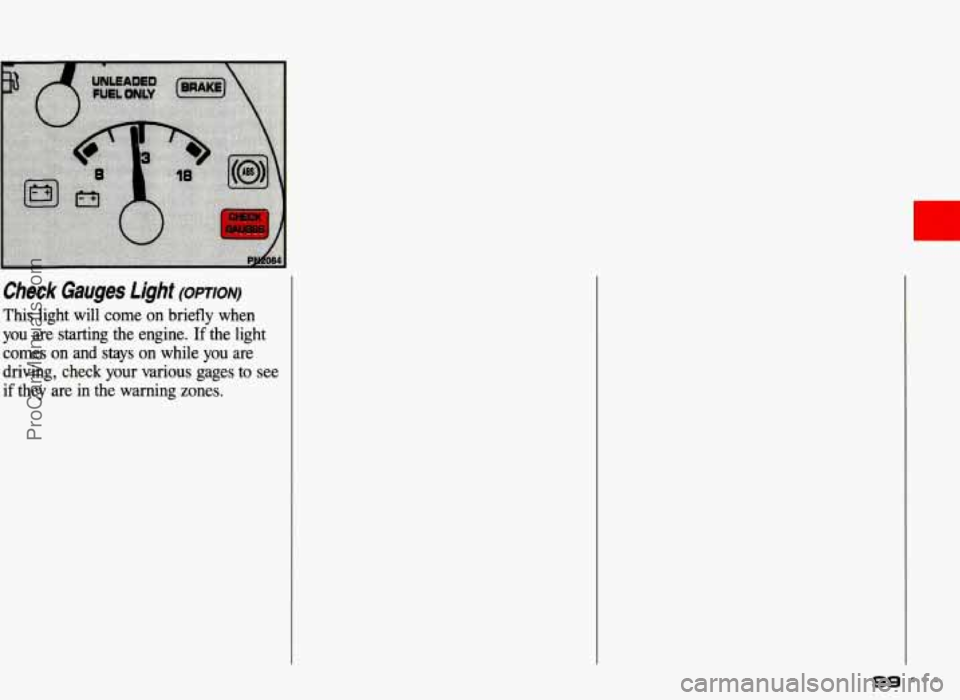
Check Gauges Light (opTIoN)
This light will come on briefly when
you are starting the engine. If the light
comes
on and stays on while you are
driving, check your various gages to see
if they are in the warning zones.
c
99 === ProCarManuals.com
Page 132 of 306
“Riding” the brakes wears them
out much faster. You would need
costly brake replacement
much
sooner than normal, and it also reduces fuel economy. If you keep pace with the traffic and
allow realistic following distances,
you
will eliminate a lot of unnecessary
braking. That means better braking and
longer brake life. If your engine ever stops while you’re
driving, brake normally but don’t
pump your brakes. If you do, the pedal
may get harder to push down. If your
engine stops, you will still have some
power brake assist. But
you will use it
when you brake. Once the power
assist is used up, it may take longer
to
stop and the brake pedal will be
harder to push.
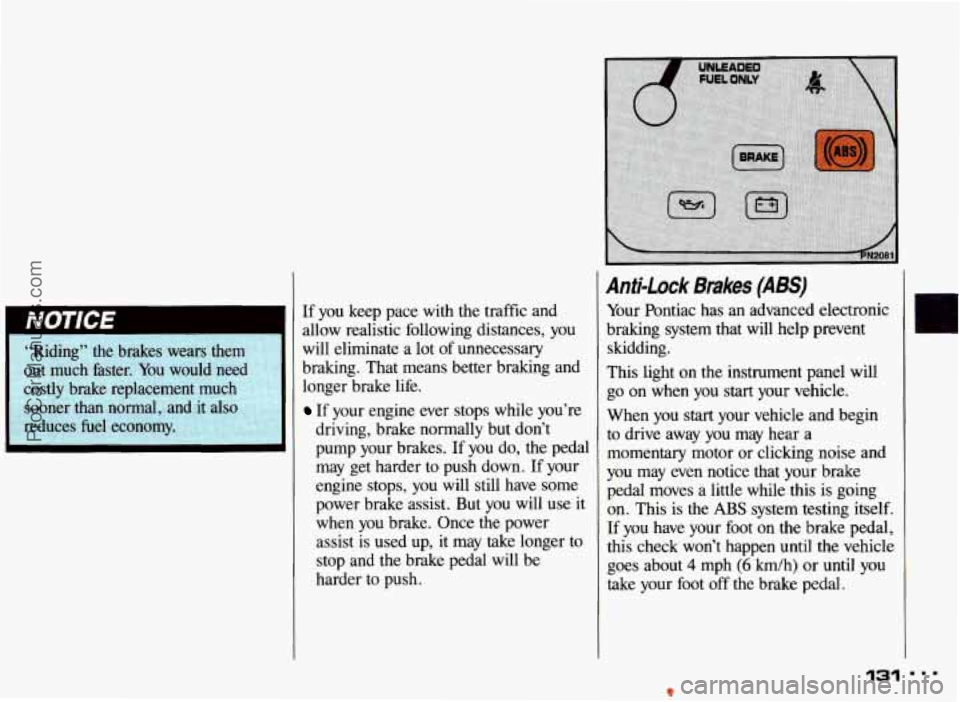
Anti-Lock Bmkes (ABS)
Your Pontiac has an advanced electronic
braking system that will help prevent
skidding.
This light on the instrument panel will
go on when you start your vehicle.
When you
start your vehicle and begin
to drive away you may hear a
momentary motor or clicking noise
and
you may even notice that your brake
pedal moves a little while this is going
on. This is the ABS system testing itself.
If you have your foot on the brake
pedal,
this check won’t happen until the vehicle
goes about
4 mph (6 km/h) or until you
take your foot off the brake pedal.
131
ProCarManuals.com
Page 152 of 306
Here are some things you can check
before a trip:
Windshield Washer Fluid: Is the
reservoir full? Are all windows clean
inside and outside?
shape?
Have you checked all levels?
lenses clean?
safe, trouble-free trip.
Is the tread
good enough for long-distance
driving? Are the tires all inflated to
the recommended pressure?
weather outlook along your route? Should you delay your trip a short
time to avoid a major storm system?
Maps: Do you have up-to-date maps?
Wiper Blades: Are they in good
Fuel, Engine Oil, Other Fluids:
Lights: Are they all working? Are the
Tires: They are vitally important to a
Weather Forecasts: What’s the
On the Road
Unless you are the only driver, it is
good to share the driving task with
others. Limit
turns behind the wheel to
about
100 miles (160 km) or two hours
at a sitting. Then, either change drivers
or stop for some refreshment like coffee,
tea or
soft drinks and some. limbering
up. But do stop and move around. Eat
lightly along the way. Heavier meals
tend to make some people sleepy.
On two-lane highways or undivided
multilane highways that do not have
controlled access, you’ll want to watch
for some situations not usually found on
freeways. Examples are: stop signs and
signals, shopping centers with direct
access to the highway, no passing zones
and school zones, vehicles turning left
and right off the road, pedestrians,
cyclists, parked vehicles, and even
animals.
Highway Hypnosis
Is there actually such a condition as
“highway hypnosis”? Or is it just plain
falling asleep at the wheel?
Call it
highway hypnosis, lack of awareness, or
whatever.
There is something about an easy stretch
of road with the same scenery, along
with the hum of the tires on the road,
the drone of the engine, and the rush
of
the wind against the vehicle that can
make you sleepy. Don’t let it happen
to
you! If it does, your vehicle can leave
the road
in less than a second, and you
could crash and be injured.
What can you do about highway
hypnosis? First, be aware that it can
happen.
Then here are some tips:
Make sure your vehicle is well
ventilated, with a comfortably cool
interior.
151 ...
ProCarManuals.com
Page 153 of 306
your urwlng and the Road
Highway Hypnosis (CONI)
Keep your eyes moving. Scan the road
ahead and to the sides. Check your
rearview mirrors frequently and your
instruments from time to time. This
can help you avoid a fixed stare.
Wear good sunglasses in bright light.
Glare can cause drowsiness. But don’t
wear sunglasses at night. They will
drastically reduce your overall vision
at the very time you need all the
seeing power you have.
If you get sleepy, pull off the road into
a rest, service, or parking area and
take a nap, get some exercise, or both.
For safety, treat drowsiness on the
highway as an emergency.
As in any driving situation, keep pace
with traffic and allow adequate
following distances.
I CAUTION
d
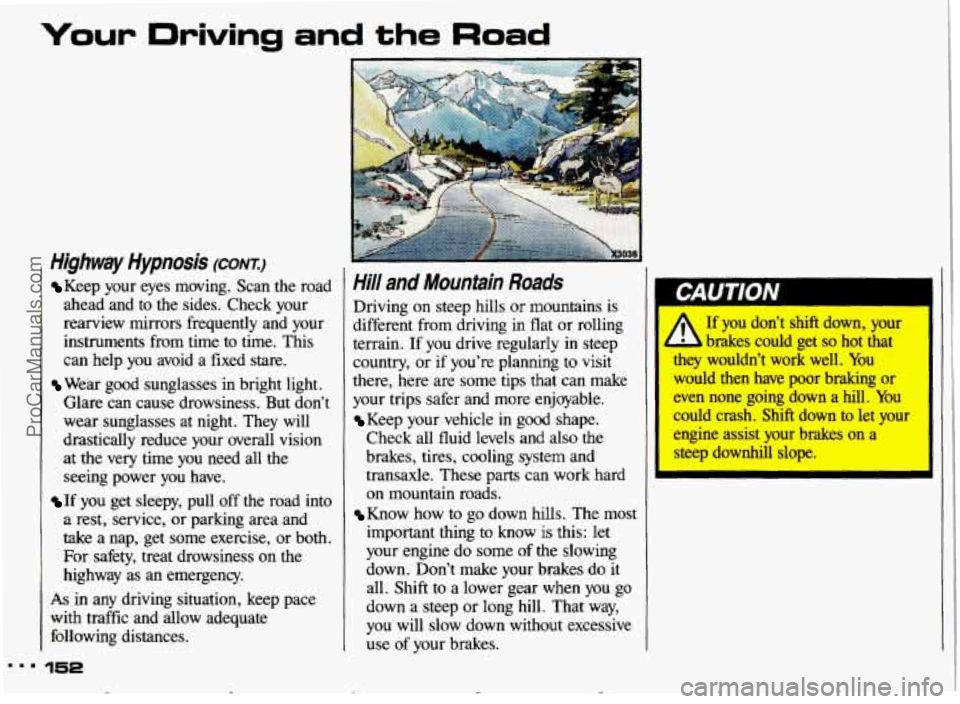
Hill and Mountain Roads
Driving on steep hills or mountains is
different from driving in flat or rolling
terrain. If
you drive regularly in steep
country, or
if you’re planning to visit
there, here are
some tips that can make
your trips safer and more enjoyable.
Keep your vehicle in good shape.
Check all fluid levels and also the
brakes, tires, cooling system and
transaxle. These parts can work hard
on mountain roads.
Know how to go down hills. The most
important thing to know
is this: let
your engine do some of the slowing
down. Don’t make your brakes
do it
all. Shift to a lower gear when
you go
down a steep or long hill. That way,
you will slow down without excessive
use of your brakes.
A
If you don’t shift down, your
brakes could get
so hot that
they wouldn’t work well.
You
would then have poor braking or
even none going down a hill. You
could crash. Shift down to let your
engine assist your brakes on
a
steep downhill slope.
ProCarManuals.com
Page 159 of 306
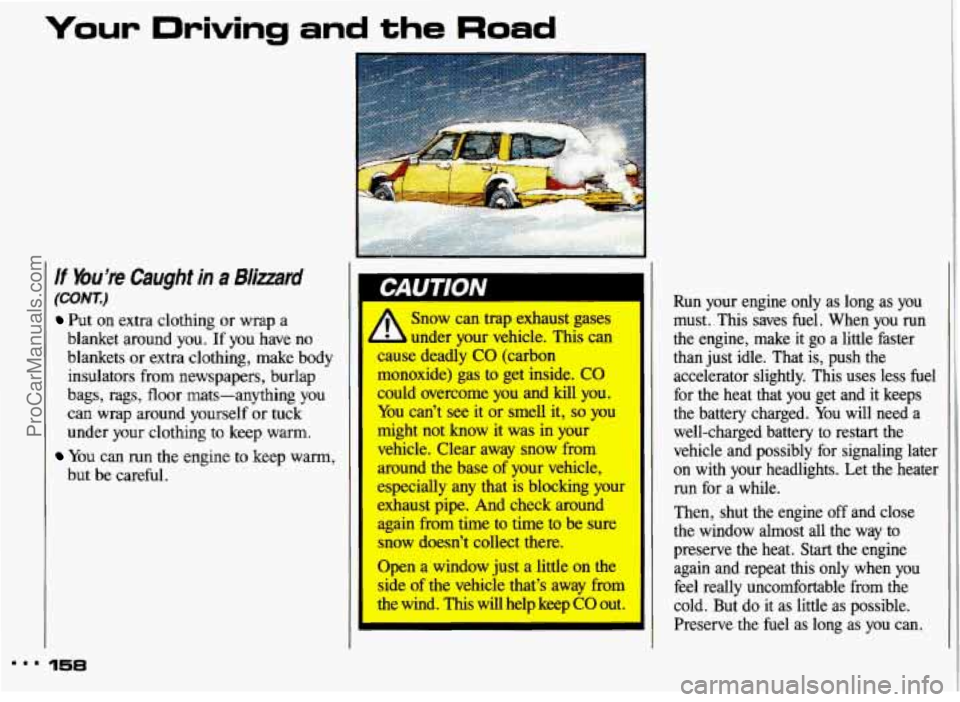
lf bu’re Caught in a Bliuard
(CONZ)
Put on extra clothing or wrap a
blanket around you.
If you have no
blankets or extra clothing, make body
insulators from newspapers, burlap
bags, rags, floor mats-anything you
can wrap around yourself or tuck
under your clothing to keep warm.
You can run the engine to keep warm,
but be careful.
158
cause deadly CO (carbon
monoxide) gas to get inside.
CO
could overcome you and kill you.
You can’t see it or smell it,
so you
might not know it was
in your
vehicle. Clear away snow from
around the base of your vehicle,
especially any that
is blocking your
exhaust pipe. And check around
again from time to time to be sure
snow doesn’t collect there.
Open a window just a little on the
side
of the vehicle that’s away from
the wind.
This will help keep CO out. Run your engine only as long as you
must. This saves fuel. When you
run
the engine, make it go
a little faster
than just idle. That is, push the
accelerator slightly. This uses less fuel
for the heat that you get and it keeps
the battery charged. You will need a
well-charged battery to restart the
vehicle and possibly for signaling later
on with your headlights.
Let the heater
run for a while.
Then, shut the engine off and close
the window almost all the way to
preserve the heat.
Start the engine
again and repeat this only when you
feel really uncomfortable from the
cold. But do it as little as possible.
Preserve the fuel as long as you can.
ProCarManuals.com
Page 166 of 306
Turn Signals When Towing a ’Railer
When you tow a trailer, your vehicle has
to have a different turn signal flasher
and extra wiring. The green arrows on
your instrument panel will flash
whenever you signal a
turn or lane
change. Properly hooked up, the trailer
lights will also flash, telling other drivers you’re about to turn, change
lanes or stop.
When towing a trailer, the green arrows
on your instrument panel will flash for
turns even if the bulbs on the trailer are
burned out. Thus, you may think drivers
behind you are seeing your signal when
they are not. It’s important to check occasionally to be sure the trailer bulbs
are still working.
Driving On Grades
Reduce speed and shift to a lower gear
before you start down a long or steep
downgrade. If you don’t shift down, you
might have to use your brakes
so much
that they would get hot and no longer work well.
On a long uphill grade, use the highest
gear possible. If you cannot maintain
posted speeds, driving at a lower speed
may help avoid overheating your engine
and transaxle.
If you have a manual transaxle with
fifth
gear, it’s better not to use fifth gear. Just
drive in fourth gear (or, as you need to,
a lower gear).
Parking on Hills
You really should not park your vehicle,
with a trailer attached,
on a hill. If
something goes wrong, your rig could
start to move. People can be injured,
and both your vehicle and the trailer can
be damaged.
But if you ever have to park your rig on
a hill, here’s how to do it:
1. Apply your regular brakes, but don’t
shift into
P (Park) yet, or into gear
for a manual transaxle.
2. Have someone place chocks under
the trailer wheels.
3. When the wheel chocks are in place,
release the regular brakes until the chocks absorb the load.
165 DDD
ProCarManuals.com