towing PONTIAC GRAND-AM 1993 Owners Manual
[x] Cancel search | Manufacturer: PONTIAC, Model Year: 1993, Model line: GRAND-AM, Model: PONTIAC GRAND-AM 1993Pages: 306, PDF Size: 15.39 MB
Page 55 of 306
Features & Controls
Both Transax/es (CONTI
Holding your key in Start for
longer than
15 seconds at a time
will cause your battery
to be
drained much sooner. And the
excessive heat can damage your
starter motor.
4. If your engine still won’t start (or
starts but then stops), it could be
flooded with too much gasoline.
Try
pushing your accelerator pedal all tht
way to the floor and holding it there
as you hold the key in
Start for abou
three seconds. This clears
the extra
gasoline from the engine. If the
vehicle
starts briefly but then stops
again, do the same thing, but this
time keep the pedal about one-
quarter of the way down for five or
six seconds. Your
engine is designed to work
with the electronics in
your
vehicle. If you add electrical parts
or accessories, you could change
the way the
fuel injection system
operates. Before adding electrical
equipment, check with your dealer.
If
you don’t, your engine might not
perform properly.
If you ever have to have your
vehicle towed, see the part of this
manual that tells how to
do it
without damaging your vehicle. See the
Index under Towing Your
Pontiac.
To Start Your 3300 V6 Engine
(Code N):
1. Don’t push the accelerator pedal
before starting your engine. In some
other vehicles you might need to
do
this, but because of your vehicle’s
computer systems, you don’t.
2. Turn your ignition key to Start.
When the engine starts, let go of the
key. The idle speed will go down as
your engine gets warm.
3. If it doesn’t start right away, push the accelerator pedal about one-quarter of the way down while you
turn the
key to
Start. Do this until the engine
starts.
As soon as it does, let go of
the key and the accelerator pedal.
m.. 54
ProCarManuals.com
Page 56 of 306
NOTICE
Holding your key in Start for
longer than
15 seconds at a time
will cause your battery to be
drained much sooner. And the excessive heat can damage your starter motor.
4. If your engine still won’t start (or
starts but then stops), it could be
flooded
with too much gasoline. Try
pushing your accelerator pedal all thl
way to the floor and holding
it there
as you hold the key
in Start for abou
15 seconds. This clears the extra
gasoline from the engine.
Turn the
ignition key to
Off. Wait 10 seconds:
then repeat step
3.
1lL
Your engine is designed to work
with the electronics in your
vehicle.
If you add electrical parts
or accessories, you could change
the way the fuel injection system
operates. Before adding electrical
equipment, check with your dealer.
If you don’t, your engine might not
perform properly.
If you ever have to have your
vehicle towed, see the part of this
manual that tells how to do it
without damaging your vehicle.
See the
Index under Towing bur
Pontiac.
Triving Through Deep Standing
Vater
NOTICE I
If you drive too quickly through
deep puddles or standing water,
water can come in through your
engine’s air intake and badly
damage your engine. If you can’t
avoid deep puddles or standing
water, drive through them very
slowly.
5E ...
ProCarManuals.com
Page 64 of 306
1.
Parking Brake
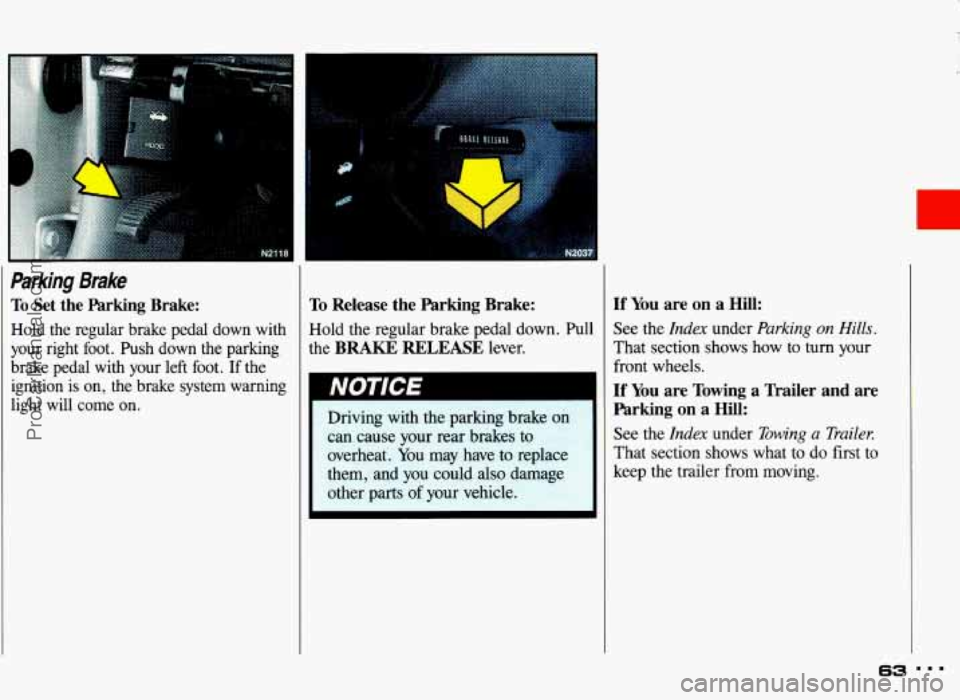
To Set the Parking Brake:
Hold the regular brake pedal down with
your right foot. Push down the parking
brake pedal with your left foot.
If the
ignition is
on, the brake system warning
light will come on.
To Release the Parking Brake:
Hold the regular brake pedal down. Pull
the
BRAKE RELEASE lever.
%riving with the parking
can cause your
rear
overheat. You may have to replace
them,
and you could also damage
other parts of your vehicle.
If You are on a Hill:
See the Index under Parking on Hills.
That section shows how to turn your
front wheels.
If You are Towing a Trailer and are
Parking on a Hill:
See the Index under Towing a Trailer.
That section shows what to do first to
keep the trailer from moving.
ProCarManuals.com
Page 68 of 306
Running Your Engine While You’re Parked (AuToMmc TRANSAXLE)
It’s better not to park with the engine running. But if you ever have to, here are
some things to know.
A Idling the engine with the air system control OFF could allow dangerous
1 exhaust into your vehicle (see the earlier CAUTION under Engine
Exhaust).
Also, idling in a closed-in place can let deadly carbon monoxide (CO) into
your vehicle even if the
hn switch is at tne highest setting. One place this can
happen is a garage. Exhaust-with CO-can come
in easily. Never park in a
garage with the engine running.
Another closed-in place can be
a blizzard. (See the Index under Blizzard.)
It can be dangerous to get out of your vehicle if the shift lever is not fully in
P (Park) with the parking brake firmly set. Your vehicle can roll. Don’t leave
your vehicle when the engine is running unless you have
to. If you’ve left the
engine ruhing, the vehicle can move suddenly. You or others could be
injured.
To be sure your vehicle won’t move, even when you’re on fairly level\
ground, always set your parking brake and move the shift lever to J’ (Park). .
If you are parking on a hill, or if you’re pulling a trailer, also see the Index
under Parking on Hills or Towing a Trailer.
I’
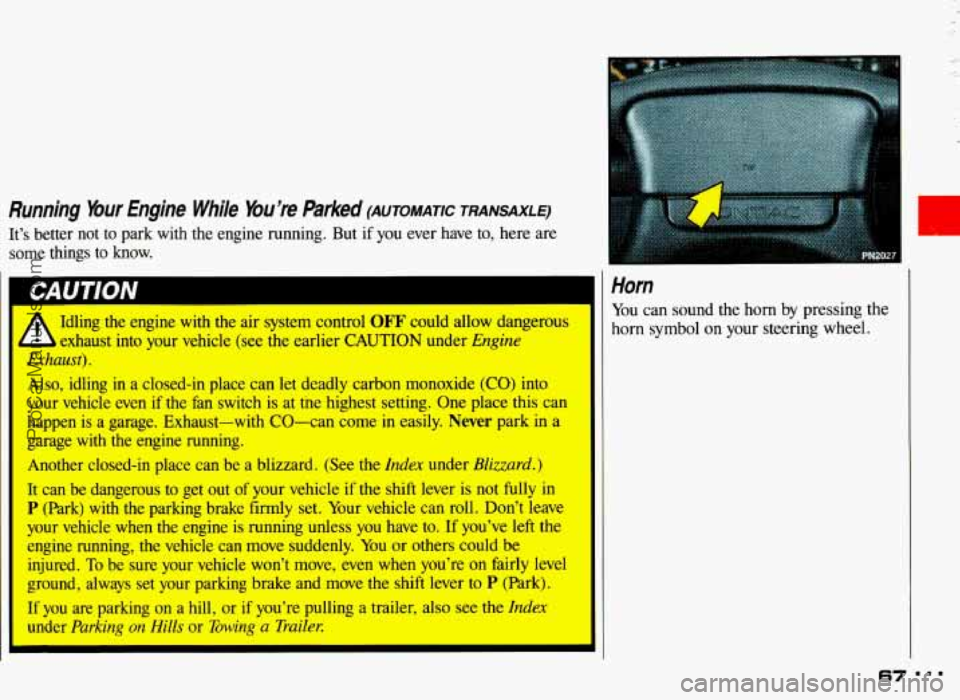
Horn
You can sound the horn by pressing the
horn symbol on your steering wheel.
67
ProCarManuals.com
Page 122 of 306
Part 4
Your Driving and the Road
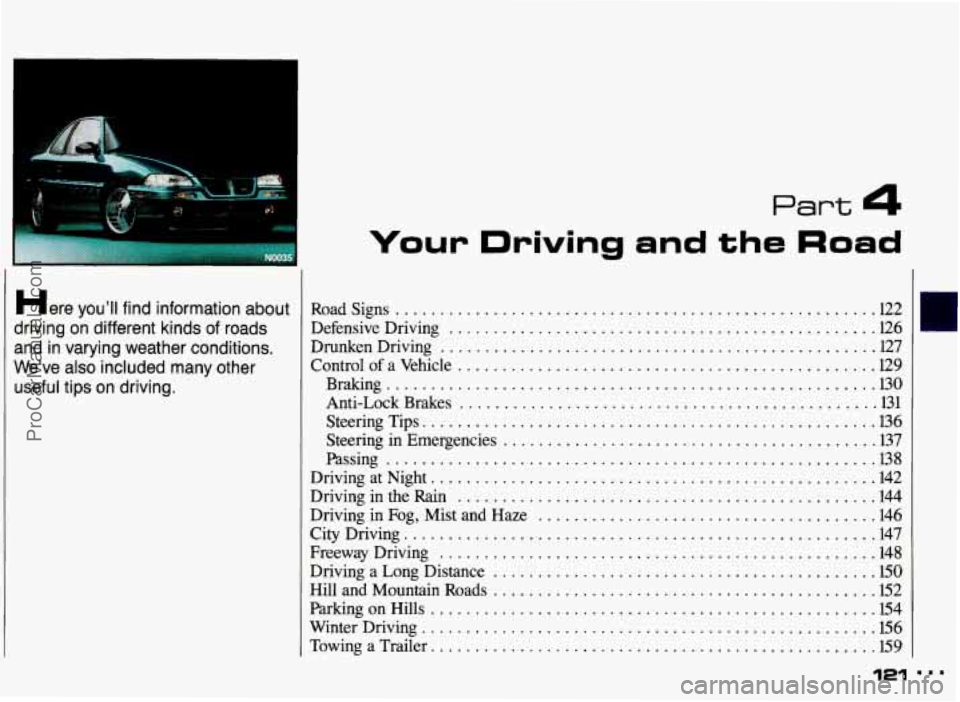
Here you’ll find information about
driving on different kinds of roads
and in varying weather conditions
.
We’ve also included many other
useful tips on driving
.
Roadsigns ...................................................... 122
Defensive Driving ................................................ 126
Drunken Driving ................................................. 127
Control of a Vehicle ............................................... 129
Steering Tips
................................................... 136
Steering in Emergencies .......................................... 137
DrivingatNight
.................................................. 142
Driving in the Rain
............................................... 144
Driving in
Fog, Mist and Haze ...................................... 146
Freeway Driving
................................................. 148
Driving a Long Distance ........................................... EO
Hill and Mountain Roads ........................................... 152
ParkingonHills .................................................. 154
Winter Driving
................................................... E6
Towing a Trailer ..................... ......................... 159
Braking
....................................................... 130
Anti-LockBrakes
............................................... 131
Passing
....................................................... 138
CityDriving ..................................................... 147
121
ProCarManuals.com
Page 160 of 306
To help keep warm, you can get out of
the vehicle and do some fairly
vigorous exercises every half-hour or
so until help comes.
If You're Stuck in Deep Snow
This manual explains how to get the
vehicle out of deep snow without
damaging it. See the
Index under
Rocking Your Ehicle.
Towing a nailer
A
If you don't use the correct
equipment and drive properly,
you can lose control when you pull
a trailer. For example, if the trailer
is too heavy, the brakes may not
work well-or even at
all. You and
your passengers could be seriously
injured. Pull a trailer
only if you
have followed all the steps in
this
section.
I
ProCarManuals.com
Page 161 of 306
Your Driving and the Road
Towing a mailer (CONTJ
Pulling a trailer improperly can :i+-a .,, >
damage your vehicle and result inf. i,$i
costly repairs not covered by you$.<; .:
warranty. To pull a trailer correct&$; ’:
follow the advice in this section. ,,
’ ,,, . .
, , :i!
Do not tow a trailer if your vehicle is
equipped with the
2.3L OHC or Quad
4 Engine (Code 3 or D).
Your vehicle can tow a trailer if it is
equipped with the
2.3L High Output
Quad
4 (Code A) or 3300 V6 (Code N)
engine and proper trailer towing
equipment. To identify what the vehicle
trailering capacity is for your vehicle,
you should read the information
in
Weight of the Trailer that appears later in
this section. But trailering is different
than just driving your vehicle by itself.
Trailering means changes in handling,
durability, and fuel economy. Successful, safe trailering
takes correct equipment,
and it has to be used properly. That’s the reason for this section.
In it
are many time-tested, important
trailering tips and safety rules. Many
of
these are important for your safety and
that of your passengers.
So please read
this section carefully before you pull a
trailer.
Load-pulling components such as the
engine, transaxle, wheel assemblies, and
tires are forced to work harder against
the drag
of the added weight. The engine
is required to operate at relatively higher
speeds and under greater loads, generating
extra heat. What’s more, the trailer adds
considerably to wind resistance,
increasing the pulling requirements.
... 160
ProCarManuals.com
Page 165 of 306
Your Driving and the Road
Driving with a lbiler
Towing a trailer requires a certain
amount of experience. Before setting out
for the open road, you’ll want to get to
know your rig. Acquaint yourself with
the feel of handling and braking with the
added weight of the trailer. And always
keep
in mind that the vehicle you are
driving is now a good deal longer and
not nearly
so responsive as your vehicle
is by itself.
Before you start, check the trailer hitch
and platform, safety chains, electrical
connector, lights, tires and mirror
adjustment.
If the trailer has electric
brakes, start your vehicle and trailer
moving and then apply the trailer brake
controller by
hand to be sure the brakes
are working.
This lets you check your
electrical connection at the same time.
164
During your trip, check occasionally to
be sure that the load is secure, and that
the lights and any trailer brakes are still
working.
Following Distance
Stay at least twice as far behind the
vehicle ahead as you would when
driving your vehicle without a trailer.
This can help you avoid situations that
require heavy braking and sudden
turns.
Passing
You’ll need more passing distance up
ahead when you’re towing a trailer.
And, because you’re a good deal longer,
you’ll need to go much farther beyond
the passed vehicle before you can return
to your lane.
Backing Up
Hold the bottom of the steering wheel
with one hand. Then, to move the trailer
to the left, just move that hand to the
left.
To move the trailer to the right,
move your hand to the right. Always
back up slowly and,
if possible, have
someone guide you.
Making Turns
When you’re turning with a trailer,
make wider turns than normal.
Do this
so your trailer won’t strike soft
shoulders, curbs, road signs, trees, or
other objects. Avoid jerky
or sudden
maneuvers. Signal well in advance.
ProCarManuals.com
Page 166 of 306
Turn Signals When Towing a ’Railer
When you tow a trailer, your vehicle has
to have a different turn signal flasher
and extra wiring. The green arrows on
your instrument panel will flash
whenever you signal a
turn or lane
change. Properly hooked up, the trailer
lights will also flash, telling other drivers you’re about to turn, change
lanes or stop.
When towing a trailer, the green arrows
on your instrument panel will flash for
turns even if the bulbs on the trailer are
burned out. Thus, you may think drivers
behind you are seeing your signal when
they are not. It’s important to check occasionally to be sure the trailer bulbs
are still working.
Driving On Grades
Reduce speed and shift to a lower gear
before you start down a long or steep
downgrade. If you don’t shift down, you
might have to use your brakes
so much
that they would get hot and no longer work well.
On a long uphill grade, use the highest
gear possible. If you cannot maintain
posted speeds, driving at a lower speed
may help avoid overheating your engine
and transaxle.
If you have a manual transaxle with
fifth
gear, it’s better not to use fifth gear. Just
drive in fourth gear (or, as you need to,
a lower gear).
Parking on Hills
You really should not park your vehicle,
with a trailer attached,
on a hill. If
something goes wrong, your rig could
start to move. People can be injured,
and both your vehicle and the trailer can
be damaged.
But if you ever have to park your rig on
a hill, here’s how to do it:
1. Apply your regular brakes, but don’t
shift into
P (Park) yet, or into gear
for a manual transaxle.
2. Have someone place chocks under
the trailer wheels.
3. When the wheel chocks are in place,
release the regular brakes until the chocks absorb the load.
165 DDD
ProCarManuals.com
Page 167 of 306
Your Driving and the Road
Driving with a mailer (CONT.)
4. Reapply the regular brakes. Then
apply your parking brake, and then shift to
P (Park), or R (Reverse) for a
manual transaxle.
5. Release the regular brakes.
When You Are Ready to Leave After
Parking on a
Hill
1. Apply your regular brakes and hold
the pedal down while you:
Start your engine;
Shift into a gear; and
Release the parking brake.
2. Let up on the brake pedal.
3. Drive slowly until the trailer is clear
4. Stop and have someone pick up and
of the chocks.
store the chocks.
Maintenance When Tmiler Towing
Your vehicle will need service more
often when you’re pulling a trailer. See
the Maintenance Schedule for more on
this. Things that are especially important in trailer operation are
automatic transaxle fluid (don’t overfiil),
engine oil, belts, cooling system, and
brake adjustment. Each
of these is
covered
in this manual, and the Ida
will help you find them quickly. If
you’re trailering, it’s a good idea to
review these sections before you
start
your trip.
Check periodically to see that all hitch
nuts and bolts are tight.
m.. 166
ProCarManuals.com