trailer PONTIAC GRAND-AM 1993 Owners Manual
[x] Cancel search | Manufacturer: PONTIAC, Model Year: 1993, Model line: GRAND-AM, Model: PONTIAC GRAND-AM 1993Pages: 306, PDF Size: 15.39 MB
Page 58 of 306

Shifting the Automatic Transaxle
Your automatic transaxle has a shift
lever located on the console between the
seats.
There are several different positions for
your shift lever. In this manual, these
are referred
to by the commonly used
symbols in the right column below:
Park P
Reverse R
Neutral N
Drive D
Second 2
First 1
Park
P (hrk): This locks your front wheels.
It’s the best position to use when you
start your engine because your vehicle
can’t move easily.
I I
It can be dangerous to get out
b of your vehicle if the shift
hever is not fully in
P (Park) with
the parking brake firmly
set v-*7
vehicle can roll
Don’t leave your venue
WI I me
engine is running unless you llavr
to. If you have left the engine
running, the vehicle can move
suddenly. You or others could be
injured. To be sure your vehicle
won’t move, when you’re on fair1
level ground, always set your
parking brake and move the shift
lever to
P (Park). See the Index
under Shifting into P (Park). If you
are parking
on a hill, or if you’re
pulling a trailer, also see the
Index
under Parking on Hills or %wing a
Trailer.
ProCarManuals.com
Page 64 of 306
1.
Parking Brake
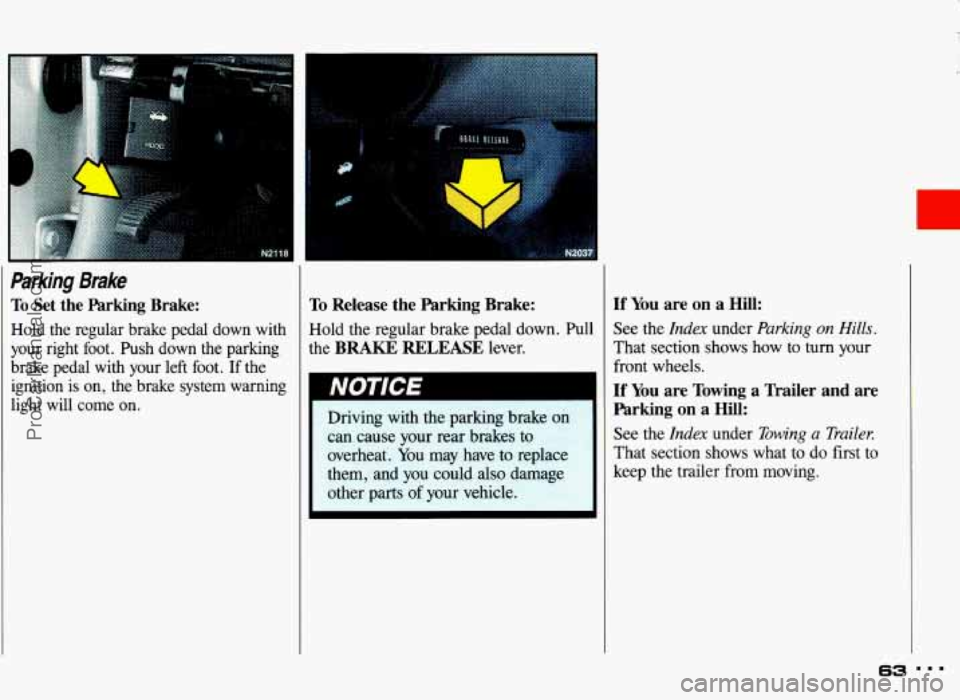
To Set the Parking Brake:
Hold the regular brake pedal down with
your right foot. Push down the parking
brake pedal with your left foot.
If the
ignition is
on, the brake system warning
light will come on.
To Release the Parking Brake:
Hold the regular brake pedal down. Pull
the
BRAKE RELEASE lever.
%riving with the parking
can cause your
rear
overheat. You may have to replace
them,
and you could also damage
other parts of your vehicle.
If You are on a Hill:
See the Index under Parking on Hills.
That section shows how to turn your
front wheels.
If You are Towing a Trailer and are
Parking on a Hill:
See the Index under Towing a Trailer.
That section shows what to do first to
keep the trailer from moving.
ProCarManuals.com
Page 65 of 306
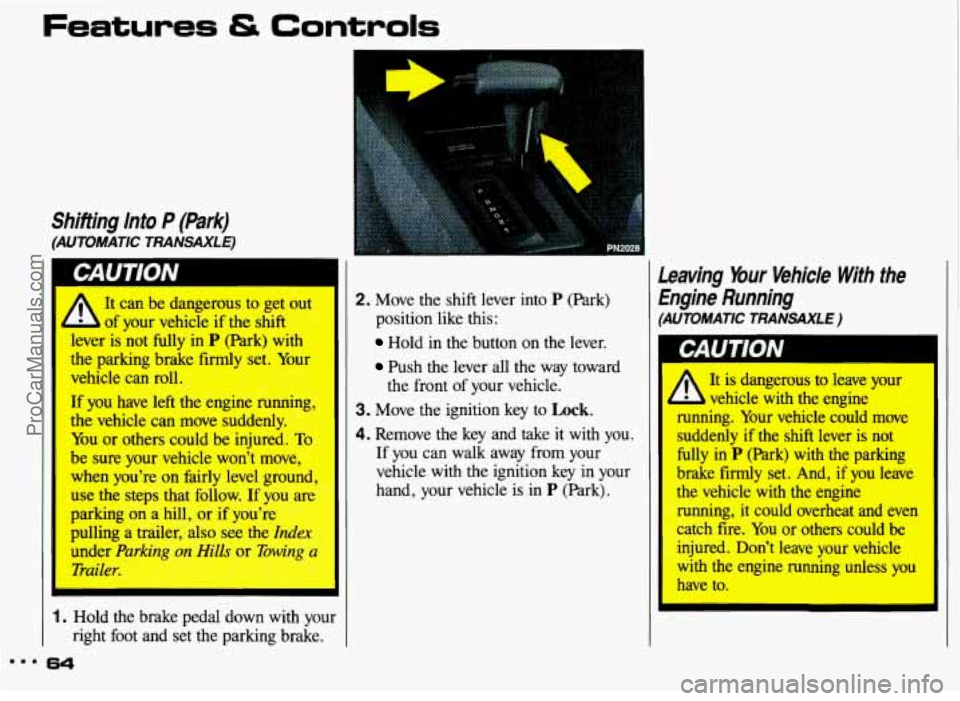
Shifting Into P (Park)
(AUTOMATIC TRANSAXLE)
A
It can be dangerous to get out
of your vehicle if the shift
I
lever is not fully in P (Park) with
the parking brake firmly set. Your
vehicle can roll.
If you have left the engine running
the vehicle can move suddenly.
You or others could be injured.
Tc
be sure your vehicle won’t move,
when you’re on fairly level ground,
use the steps that follow. If you arc
parking on a hill, or if you’re
I
pulling a trailer, also see the Inden
under ParkinP 01 lills or %wing .
“rail
I
1. Hold the brake pedal down with your
right foot and set the parking brake.
8.. 64
2. Move the shift lever into P (Park)
position like this:
Hold in the button on the lever.
Push the lever all the way toward
the front of your vehicle.
3. Move the ignition key to Lock.
4. Remove the key and take it with you.
If you can walk away from your
vehicle
with the ignition key in your
hand, your vehicle is in
P (Park).
Leaving Your Vehicle With the
Engine Running
(AUTOMATIC TRANSAXLE)
It is dangerous to leave your
running. Your vehicle could move
suddenly
if the shift lever is not
fully
in P (Park) with the parking
brake firmly set. And,
if you leave
the vehicle
with the engine
running,
it could overheat and even
catch fire. You or others could be
injured. Don’t leave your vehicle
with the engine
rumins unless you,
have to.
h- *2-- ;,a,&#:+h .u ’ -. :.
L vehicle with the engine
i- ’-
ProCarManuals.com
Page 67 of 306
Features & Controls
Parking Your Vehicle
(MANUL TRANSAXLE)
Before you get out of your vehicle, put
your manual transaxle in
R (Reverse)
and firmly apply the parking brake.
If you are parking on a hill, or if your
vehicle
is equipped to tow a trailer, see
the Index under Parking on Hills or
i%w*ng a Trailer.
36
1 Engine Exhaust
I
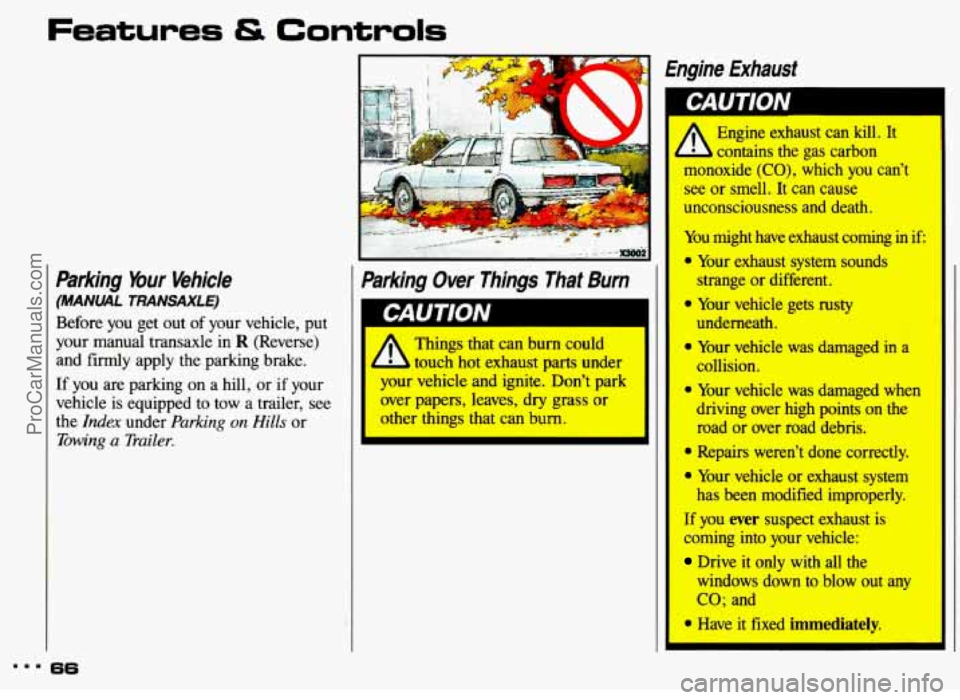
Parking Over Things That Burn
Things that can burn could
touch hot exhaust parts under
your vehicle
and ignite. Don’t park
over papers, leaves, dry grass or
other things that can burn.
Engine exhaust can kill. It
contains the gas carbon
monoxide
(CO), which you can’t
see or smelt It can cause
unconsciousness and death.
You might have exhaust coming
in if:
* Your exhaust system sounds
strange or different.
* Your vehicle gets rusty
undemath.
* Your vehicle was damaged in a
collision.
* Your vehicle was damaged when
driving over high points on the
road or over road debris.
* Repairs weren’t done correctly.
* Your vehicle or exhaust systkm
has been modified improperly.
If you eys suspect exhaust is
~rrmi@ into your vehicle:
Drive it only wifh all the
windows down to blow out any
co; and
* Have it -fixed immediately.
ProCarManuals.com
Page 68 of 306
Running Your Engine While You’re Parked (AuToMmc TRANSAXLE)
It’s better not to park with the engine running. But if you ever have to, here are
some things to know.
A Idling the engine with the air system control OFF could allow dangerous
1 exhaust into your vehicle (see the earlier CAUTION under Engine
Exhaust).
Also, idling in a closed-in place can let deadly carbon monoxide (CO) into
your vehicle even if the
hn switch is at tne highest setting. One place this can
happen is a garage. Exhaust-with CO-can come
in easily. Never park in a
garage with the engine running.
Another closed-in place can be
a blizzard. (See the Index under Blizzard.)
It can be dangerous to get out of your vehicle if the shift lever is not fully in
P (Park) with the parking brake firmly set. Your vehicle can roll. Don’t leave
your vehicle when the engine is running unless you have
to. If you’ve left the
engine ruhing, the vehicle can move suddenly. You or others could be
injured.
To be sure your vehicle won’t move, even when you’re on fairly level\
ground, always set your parking brake and move the shift lever to J’ (Park). .
If you are parking on a hill, or if you’re pulling a trailer, also see the Index
under Parking on Hills or Towing a Trailer.
I’
Horn
You can sound the horn by pressing the
horn symbol on your steering wheel.
67
ProCarManuals.com
Page 122 of 306
Part 4
Your Driving and the Road
Here you’ll find information about
driving on different kinds of roads
and in varying weather conditions
.
We’ve also included many other
useful tips on driving
.
Roadsigns ...................................................... 122
Defensive Driving ................................................ 126
Drunken Driving ................................................. 127
Control of a Vehicle ............................................... 129
Steering Tips
................................................... 136
Steering in Emergencies .......................................... 137
DrivingatNight
.................................................. 142
Driving in the Rain
............................................... 144
Driving in
Fog, Mist and Haze ...................................... 146
Freeway Driving
................................................. 148
Driving a Long Distance ........................................... EO
Hill and Mountain Roads ........................................... 152
ParkingonHills .................................................. 154
Winter Driving
................................................... E6
Towing a Trailer ..................... ......................... 159
Braking
....................................................... 130
Anti-LockBrakes
............................................... 131
Passing
....................................................... 138
CityDriving ..................................................... 147
121
ProCarManuals.com
Page 160 of 306
To help keep warm, you can get out of
the vehicle and do some fairly
vigorous exercises every half-hour or
so until help comes.
If You're Stuck in Deep Snow
This manual explains how to get the
vehicle out of deep snow without
damaging it. See the
Index under
Rocking Your Ehicle.
Towing a nailer
A
If you don't use the correct
equipment and drive properly,
you can lose control when you pull
a trailer. For example, if the trailer
is too heavy, the brakes may not
work well-or even at
all. You and
your passengers could be seriously
injured. Pull a trailer
only if you
have followed all the steps in
this
section.
I
ProCarManuals.com
Page 161 of 306
Your Driving and the Road
Towing a mailer (CONTJ
Pulling a trailer improperly can :i+-a .,, >
damage your vehicle and result inf. i,$i
costly repairs not covered by you$.<; .:
warranty. To pull a trailer correct&$; ’:
follow the advice in this section. ,,
’ ,,, . .
, , :i!
Do not tow a trailer if your vehicle is
equipped with the
2.3L OHC or Quad
4 Engine (Code 3 or D).
Your vehicle can tow a trailer if it is
equipped with the
2.3L High Output
Quad
4 (Code A) or 3300 V6 (Code N)
engine and proper trailer towing
equipment. To identify what the vehicle
trailering capacity is for your vehicle,
you should read the information
in
Weight of the Trailer that appears later in
this section. But trailering is different
than just driving your vehicle by itself.
Trailering means changes in handling,
durability, and fuel economy. Successful, safe trailering
takes correct equipment,
and it has to be used properly. That’s the reason for this section.
In it
are many time-tested, important
trailering tips and safety rules. Many
of
these are important for your safety and
that of your passengers.
So please read
this section carefully before you pull a
trailer.
Load-pulling components such as the
engine, transaxle, wheel assemblies, and
tires are forced to work harder against
the drag
of the added weight. The engine
is required to operate at relatively higher
speeds and under greater loads, generating
extra heat. What’s more, the trailer adds
considerably to wind resistance,
increasing the pulling requirements.
... 160
ProCarManuals.com
Page 162 of 306
If Bu Do Decide to Pull a Trailer
If you do, here are some important
points.
There are many different laws having
to do with trailering. Make sure your rig will be legal, not only where you
live but
also where you’ll be driving.
A good source for this information can
be state or provincial police.
Consider using a sway control. You
can ask a hitch dealer about sway
controls.
a Don’t tow a trailer at all during the
first
500 miles (804 km) your new
vehicle is driven. Your engine, axle or
other parts could
be damaged.
Then, during the first 500 miles
(804
km) that you tow a trailer, don’t
drive over
50 mph (80 km/h) and
don’t make
starts at full throttle. This
helps your engine and other parts of
your vehicle wear in at the heavier
loads.
Three important considerations have
to do with weight:
161
I. Weight of the Trailer
How heavy can a trailer safely be? It
should never weigh more than
1,OOO
pounds (450 kg).
But even that can be too heavy. It
depends on how you plan to use your
rig. For example, speed, altitude, road
grades, outside temperature and how
much your vehicle is used to pull a
trailer are
all important. And, it can
also depend on any special equipment
that you have
on your vehicle.
...
ProCarManuals.com
Page 163 of 306
Your Driving and the Road
If bu Do Decide to Pull a nailer
(COrvT)
You can ask your dealer for our
trailering information or advice, or
you can write us at:
Pontiac Customer Services
One Pontiac Plaza Pontiac, Michigan
48340-2952
General Motors of Canada Limited
Customer Assistance Center 1908 Colonel
Sam Drive
Oshawa, Ontario, L1H 8P7
Department
In Canada, write to:
162
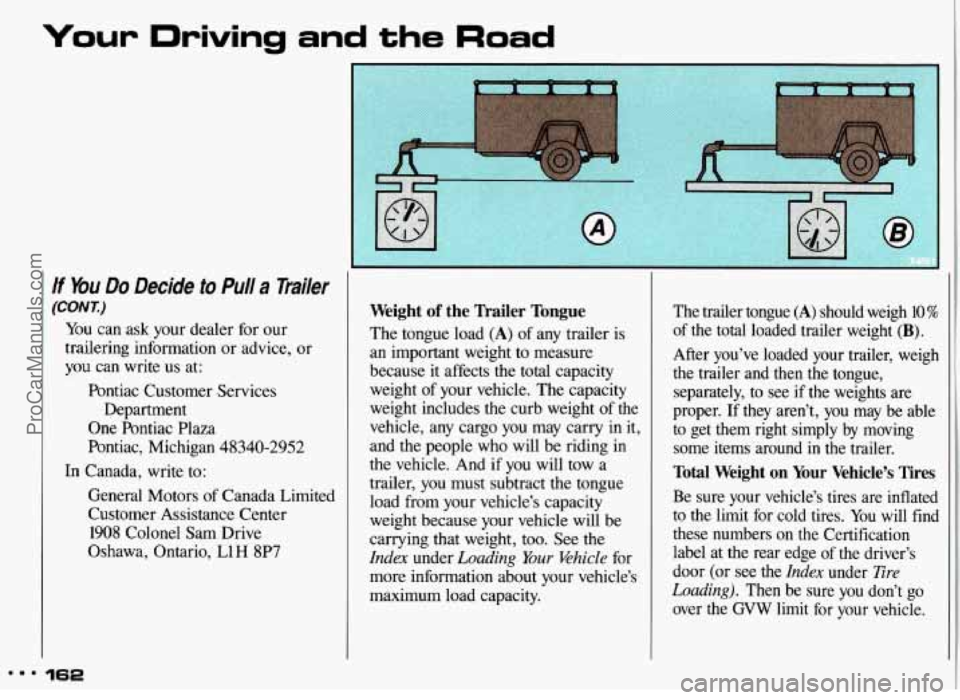
Weight of the Trailer Tongue
The
tongue load (A) of any trailer is
an
important weight to measure
because it affects the total capacity
weight
of your vehicle. The capacity
weight includes the curb weight of the
vehicle, any cargo you may carry in it,
and the people who will be riding
in
the vehicle. And if you will tow a
trailer, you must subtract the tongue
load from your vehicle’s capacity
weight because your vehicle will be carrying that weight, too. See the
Index under Loading Your Vehicle for
more information about your vehicle’s
maximum load capacity. The trailer tongue
(A) should weigh 10 %
of the total loaded trailer weight (B).
After you’ve loaded your trailer, weigh
the trailer and then the tongue, separately, to
see if the weights are
proper. If they aren’t, you may be able
to get them right simply by moving
some items around in the trailer.
Total Weight on Your Vehicle’s Tires
Be sure your vehicle’s tires are inflated
to the limit for cold tires. You will find
these numbers on the Certification
label at the rear edge of the driver’s
door
(or see the Index under Ere
Loading). Then be sure you don’t go
over the
GVW limit for your vehicle.
ProCarManuals.com