steering PONTIAC GRAND-AM 1994 Owner's Manual
[x] Cancel search | Manufacturer: PONTIAC, Model Year: 1994, Model line: GRAND-AM, Model: PONTIAC GRAND-AM 1994Pages: 274, PDF Size: 15.01 MB
Page 169 of 274
Problems on the Road
NOTICE:
Spinning your wheels can destroy
parts of your vehicle
as well as the
tires. If you spin the wheels too fast
while shifting your transaxle back
and forth, you can destroy your
transaxle.
..
locking Your Vehicle to Get it Out:
‘irst, turn your steering wheel left and
ight. That will clear the area around your
ront wheels. Then shift back and forth
letween REVERSE (R) and a forward
ear (or with a manual transaxle, between
IRST
(1) or SECOND (2) and
.EVERSE
(R)), spinning the wheels as
ttle as possible. Release
the accelerator
edal while you shift, and press lightly
on
le accelerator pedal when the transaxle is
1 gear. If that doesn’t get you out after a
:w tries, you may need to be towed out.
F you do need to be towed out, see
Towing Your Pontiac”
in the Index.
ProCarManuals.com
Page 178 of 274
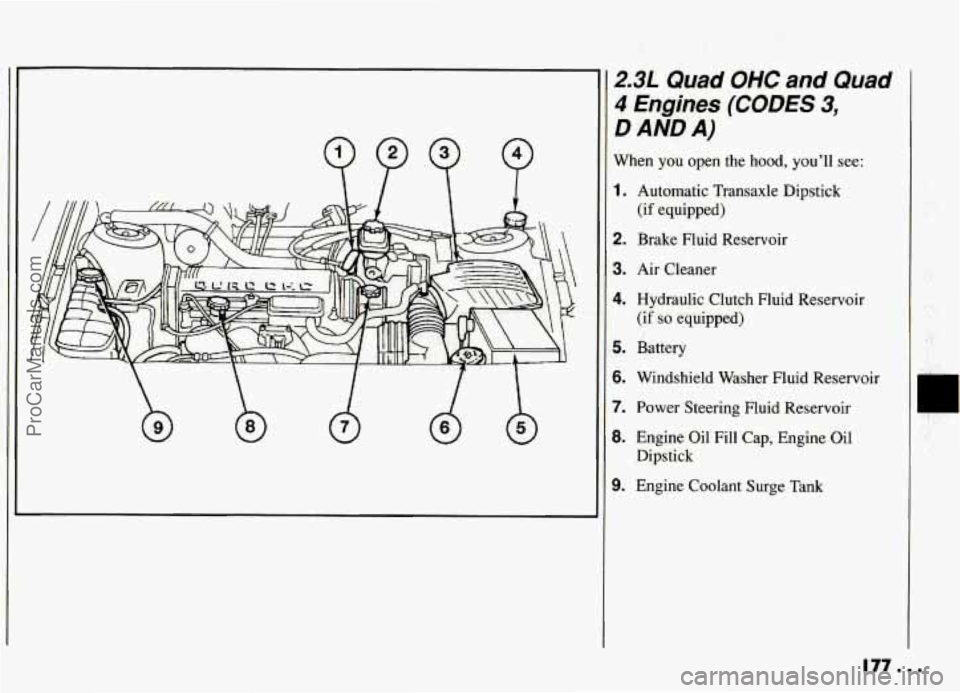
2.3L Quad OHC and Quad
4 Engines (CODES 3,
D AND A)
When you open the hood, you'll see:
1. Automatic Transaxle Dipstick
(if'equipped)
2. Brake Fluid Reservoir
3. Air Cleaner
4. Hydraulic Clutch Fluid Reservoir
(if so equipped)
5. Battery
6. Windshield Washer Fluid Reservoir
7. Power Steering Fluid Reservoir
B. Engine Oil Fill Cap, Engine Oil
Dipstick
3. Engine Coolant Surge Tank
ProCarManuals.com
Page 179 of 274
Service & Appearance Care
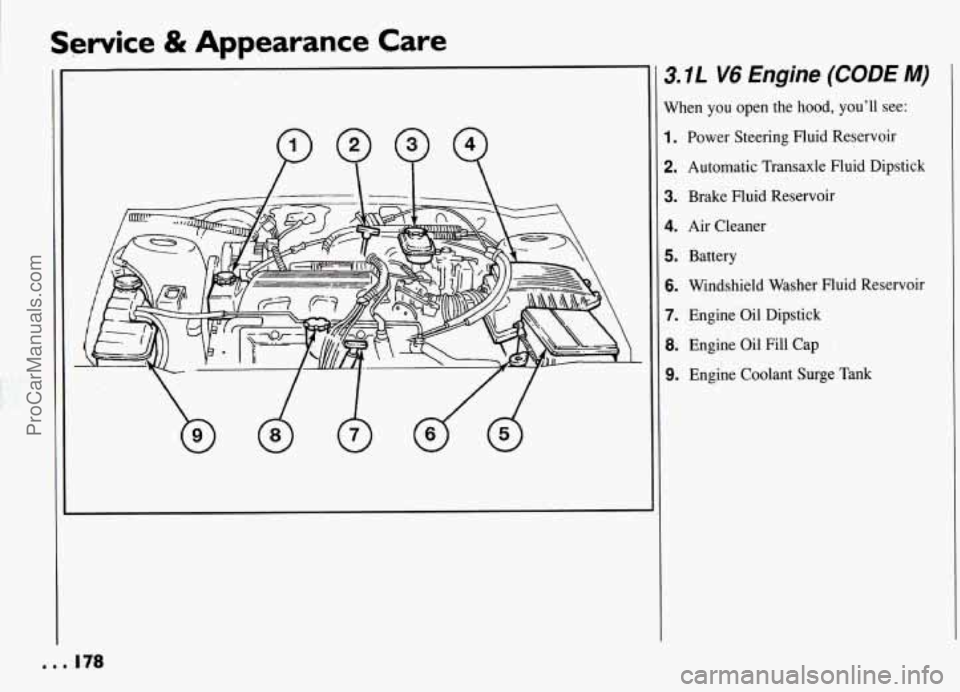
3.IL V6 Engine (CODE M)
When you open the hood, you’ll see:
1. Power Steering Fluid Reservoir
2. Automatic Transaxle Fluid Dipstick
3. Brake Fluid Reservoir
4. Air Cleaner
5. Battery
6. Windshield Washer Fluid Reservoir
7. Engine Oil Dipstick
8. Engine Oil Fill Cap
9. Engine Coolant Surge Tank
ProCarManuals.com
Page 191 of 274
Service & Appearance Care
V
P
I
E
b
S’
C
C.
P
A
I Surge Tank Pressure
Cap
NOTICE:
Your pressure cap is an 18 psi
( 124 kPa) pressure-type cap and
must be tightly installed to prevent
coolant
loss and possible engine
damage from overheating.
irhen you replace your surge tank
ressure cap, a GM cap is recommended.
I Thermostat
lngine coolant temperature is controlled
y a thermostat in the engine coolant
ystem. The thermostat stops the flow
of
oolant through the radiator until the
oolant reaches a preset temperature.
Jhen you replace your thermostat, an
.C@ thermostat is recommended.
Power Steering Fluid
How To Check Power
Steering Fluid
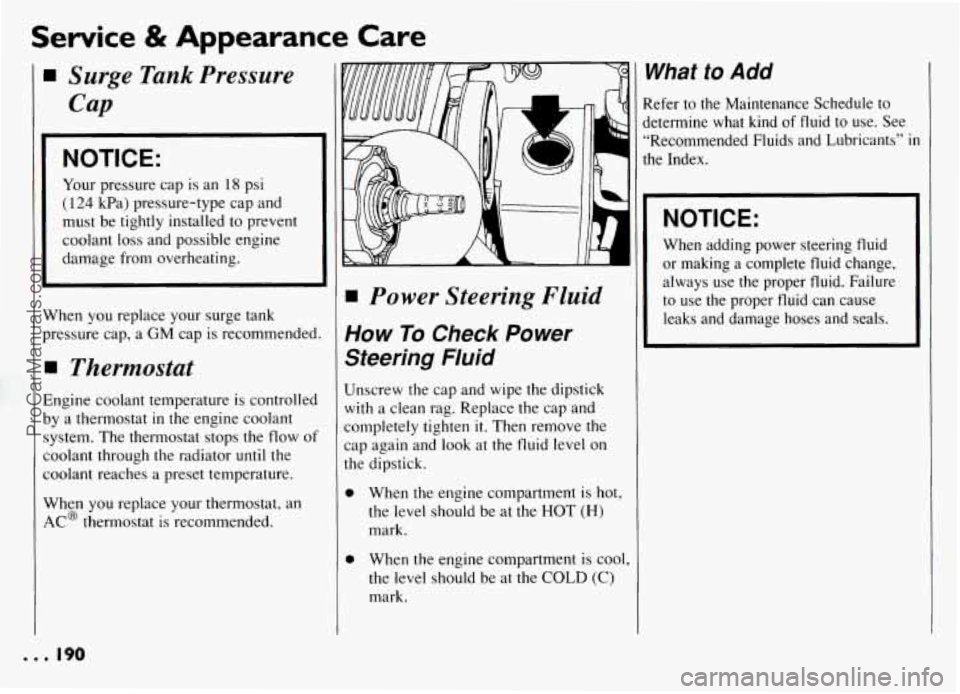
Unscrew the cap and wipe the dipstick
with a clean rag. Replace the cap and
completely tighten
it. Then remove the
cap again and
look at the fluid level on
the dipstick.
0
0
When the engine compartment is hot,
the level should be at the HOT
(H)
mark.
When the engine compartment is cool,
the level should be at the
COLD (C)
mark.
1
I
1
What to Add
Refer to the Maintenance Schedule to
jetermine what kind
of fluid to use. See
“Recommended Fluids and Lubricants”
in
the Index.
NOTICE:
When adding power steering fluid
or making a complete fluid change,
always use the proper fluid. Failure
to use the proper fluid can cause
leaks and damage hoses and seals.
... 190
ProCarManuals.com
Page 217 of 274
Service & Appearance Care
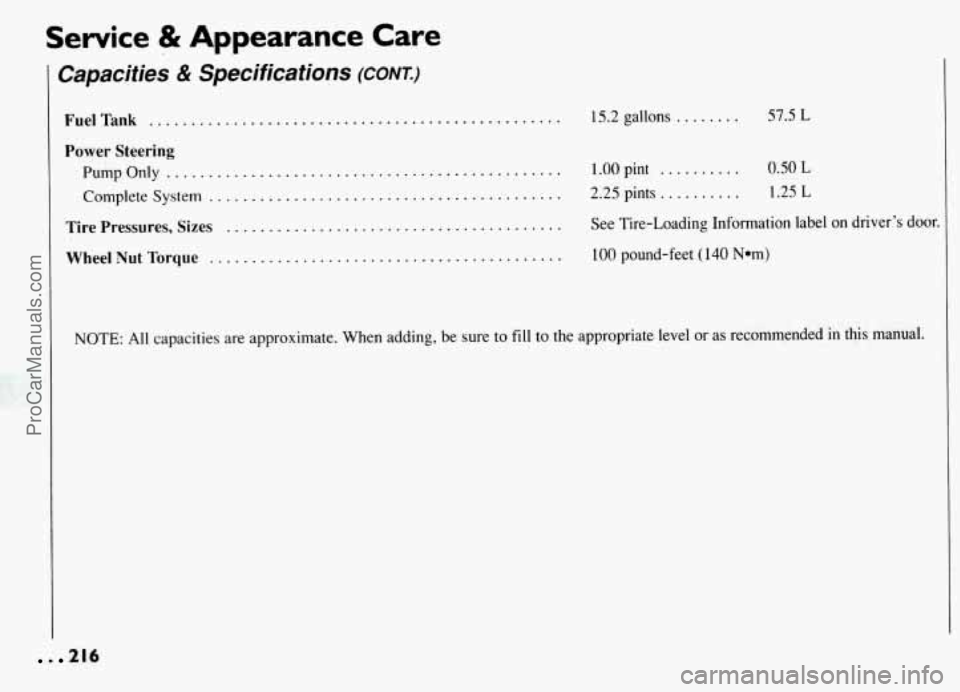
Capacities & Specifications (CONT.)
Complete System . .
Tire Pressures, Sizes
Wheel
Nut Torque . .
FuelTank .................................................
Power Steering
PumpOnly ...............................................
......................................
........................................
........................................
15.2 gallons ........ 57.5 L
1.00 pint .......... 0.50 L
2.25 pints .......... 1.25 L
See Tire-Loading Information label on driver’s door.
100 pound-feet ( 140 N*m)
NOTE: All capacities are approximate. When adding, be sure to fill to the appropriate level or as recommended in this manual.
. 216
ProCarManuals.com
Page 231 of 274
Maintenance Schedule
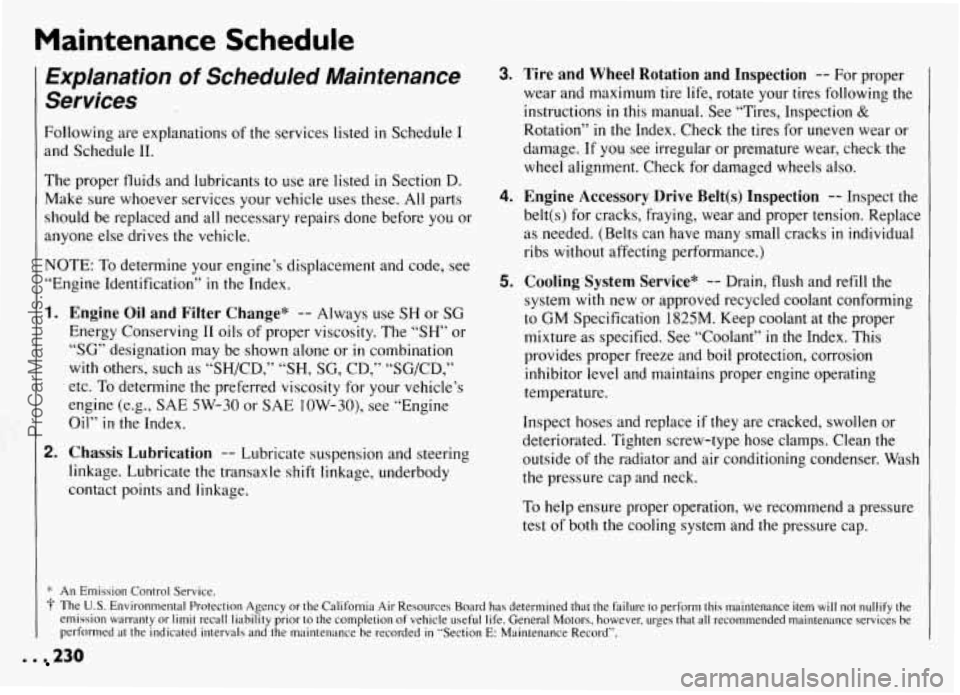
Explanation of Scheduled Maintenance
Services
Following are explanations of the services listed in Schedule I
and Schedule 11.
The proper fluids and lubricants to use are listed in Section D.
Make sure whoever services your vehicle uses these. All parts
should be replaced and all necessary repairs done before you or
anyone else drives the vehicle.
NOTE: To determine your engine’s displacement and code, see
“Engine Identification”
in the Index.
1.
2.
Engine Oil and Filter Change* -- Always use SH or SG
Energy Conserving I1 oils of proper viscosity. The “SH” or
“SG” designation may be shown alone or in combination
with others, such as “SH/CD,” “SH, SG, CD,” “SG/CD,”
etc. To determine the preferred viscosity for your vehicle’s
engine (e.g., SAE 5W-30 or SAE 10W-30), see “Engine
Oil”
in the Index.
Chassis Lubrication -- Lubricate suspension and steering
linkage. Lubricate the transaxle shift linkage, underbody
contact points and linkage.
3.
4.
5.
Tire and Wheel Rotation and Inspection -- For proper
wear and maximum tire life, rotate your tires following the
instructions
in this manual. See “Tires, Inspection &
Rotation” in the Index. Check the tires for uneven wear or
damage. If you see irregular or premature wear, check the
wheel alignment, Check for damaged wheels also.
Engine Accessory Drive Belt(s) Inspection -- Inspect the
belt(s) for cracks, fraying, wear and proper tension. Replace
as needed. (Belts can have many small cracks
in individual
ribs without affecting performance.)
Cooling System Service* -- Drain, flush and refill the
system with new or approved recycled coolant conforming
to
GM Specification 1825M. Keep coolant at the proper
mixture as specified. See “Coolant”
in the Index. This
provides proper freeze and boil protection, corrosion
inhibitor level and maintains proper engine operating
temperature.
Inspect hoses and replace if they are cracked, swollen or
deteriorated. Tighten screw-type hose clamps. Clean the
outside of the radiator and air conditioning condenser. Wash
the pressure cap and neck.
To help ensure proper operation, we recommend a pressure
test of both the cooling system and the pressure cap.
. . 230
ProCarManuals.com
Page 236 of 274
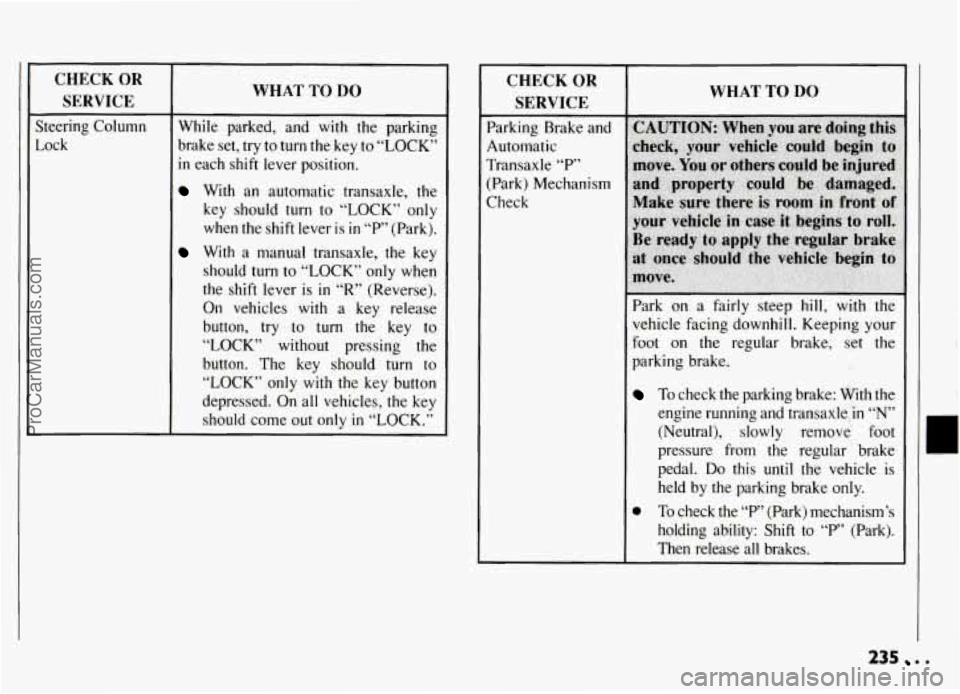
CHECK OR
SERVICE
Steering Column
Lock
WHAT TO DO
While parked, and with the parking
brake set, try to
turn the key to “LOCK”
in each shift lever position.
With an automatic transaxle, the
key should turn to “LOCK” only
when
the shift lever is in “P’ (Park).
With a manual transaxle, the key
should turn to “LOCK” only when
the shift lever is in “R” (Reverse).
On vehicles with a key release
button, try to turn the key to
“LOCK” without pressing the
button. The
key should turn to
“LOCK” only with the key button
depressed.
On all vehicles, the key
should come out only
in “LOCK.”
CHECK OR
SERVICE
Parking Brake and
Automatic
Transaxle
T“
(Park) Mechanism
Check
WHAT TO DO
cAuyoN:when, y.ou~are~~~doing.,~his’
check, your vehicle could begin to.
move. You or others could be injured:
and property
could be damaged.
Make sure there
is room in front of,
your vehicle in case it begins to roll.,:
Re ready to apply the regular brake
Park on a fairly steep hill, with the
vehicle facing downhill. Keeping your
foot
on the regular brake, set the
parking brake.
To check the parking brake: With the
engine running and transaxle in “N”
(Neutral), slowly remove foot
pressure from the regular brake
pedal.
Do this until the vehicle is
held by the parking brake only.
To check the “P’ (Park) mechanism’s
holding ability: Shift to
“P” (Park).
Then release all brakes.
235
ProCarManuals.com
Page 237 of 274
Maintenance Schedule
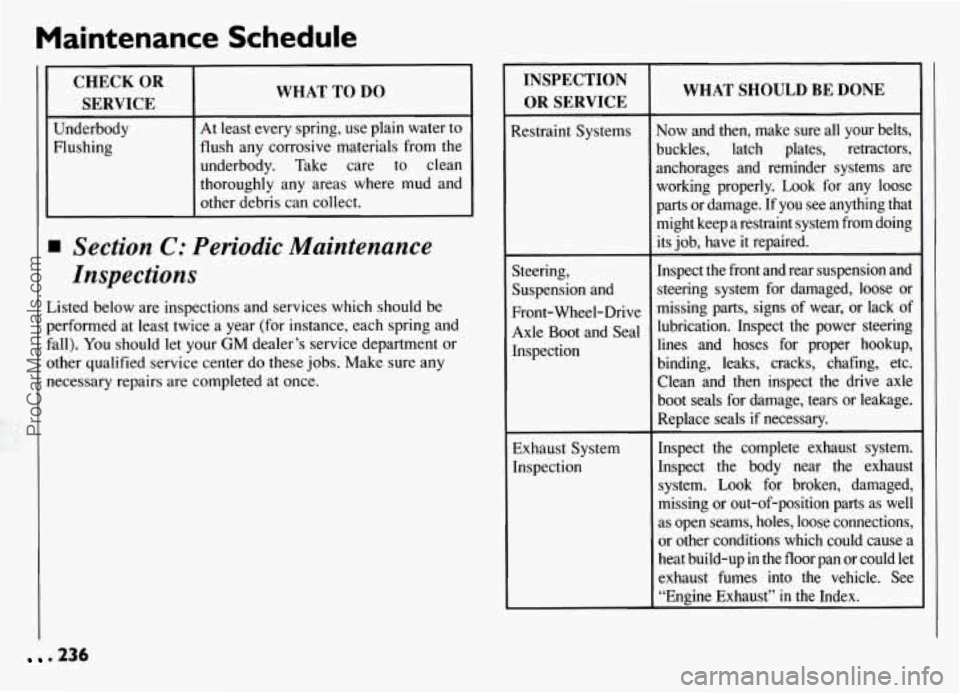
CHECK OR SERVICE
Underbody Flushing
WHAT TO DO
At least every spring, use plain water to
flush any corrosive materials from the
underbody. Take care to clean
thoroughly any areas where mud and
other debris can collect.
Section C: Periodic Maintenance
Inspections
hted below are inspections and services which should be
Ierformed at least twice a year (for instance, each spring and
all). You should let your
GM dealer’s service department or
Ither qualified service center do these jobs. Make sure any
lecessary repairs are completed at once.
INSPECTION
OR SERVICE
testraint Systems
Steering,
Suspension and
?ront-Wheel-Drive
4xle Boot and Seal
[nspection
Exhaust System
[nspection
WHAT SHOULD BE DONE
Now and then, make sure all your belts,
buckles, latch plates, retractors,
anchorages and reminder systems are
working properly. Look for any loose
parts or damage. If you see anything that
might keep a restraint system from doing
its job, have it repaired.
Inspect the front and rear suspension and
steering system for damaged, loose or
missing parts, signs of wear, or lack of
lubrication. Inspect the power steering
lines and hoses for proper hookup,
binding, leaks, cracks, chafing, etc.
Clean and then inspect the drive axle
boot seals for damage, tears or leakage.
Replace seals
if necessary.
Inspect the complete exhaust system.
Inspect the body near the exhaust
system.
Look for broken, damaged,
missing or out-of-position parts as well
as open seams, holes, loose connections,
or other conditions which could cause a
heat build-up
in the floor pan or could let
exhaust fumes into the vehicle. See “Engine Exhaust”
in the Index.
236
ProCarManuals.com
Page 239 of 274
Maintenance Schedule
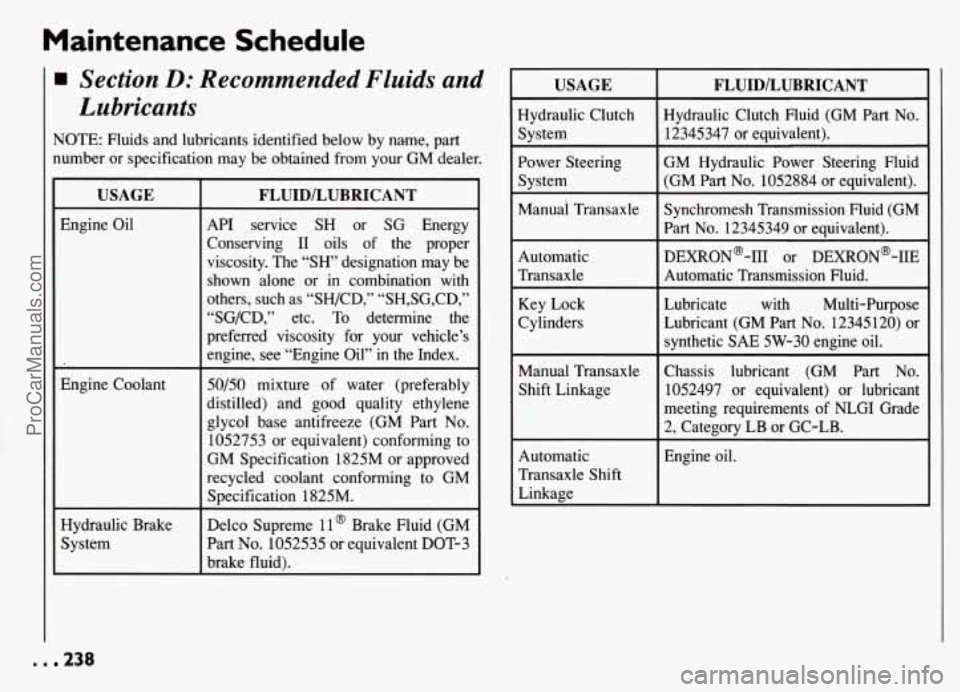
Section D: Recommended Fluids and
Lubricants
NOTE: Fluids and lubricants identified below by name, part
number or specification may be obtained from your GM dealer.
USAGE
Engine Oil
Engine Coolant
Hydraulic Brake
System
FLUIDlLUBRICANT
API service SH or SG Energy
Conserving I1 oils of the proper
viscosity. The
“SH’ designation may be
shown alone or
in combination with
others, such as “SH/CD,” “SH,SG,CD,”
“SG/CD,” etc. To determine the
preferred viscosity for your vehicle’s engine, see “Engine Oil” in the Index.
50/50 mixture of water (preferably
distilled) and good quality ethylene
glycol base antifreeze (GM Part No.
1052753 or equivaleot) conforming to
GM Specification 1825M or approved
recycled coolant conforming to GM
Specification 1825M.
Delco Supreme 11’ Brake Fluid (GM
Part No. 1052535 or equivalent DOT-3
brake fluid).
USAGE
Hydraulic Clutch
System
Power Steering
System
Automatic
Transaxle
Key Lock
Cylinders
Manual Transaxle
Shift Linkage
Automatic
Transaxle Shift
Linkage
FLUIDlLUBRICANT
Hydraulic Clutch Fluid (GM Part No.
12345347 or equivalent).
GM Hydraulic Power Steering Fluid
(GM Part No. 1052884 or equivalent). Synchromesh Transmission Fluid (GM
Part
No. 12345349 or equivalent).
DEXRON@-111 or DEXRON@-IIE
Automatic Transmission Fluid.
Lubricate with Multi-Purpose
Lubricant (GM Part
No. 12345 120) or
synthetic SAE 5W-30 engine oil.
Chassis lubricant (GM Part No.
1052497 or equivalent) or lubricant
meeting requirements of NLGI Grade
2, Category LB or GC-LB.
Engine oil.
. . 238
ProCarManuals.com
Page 264 of 274
Index
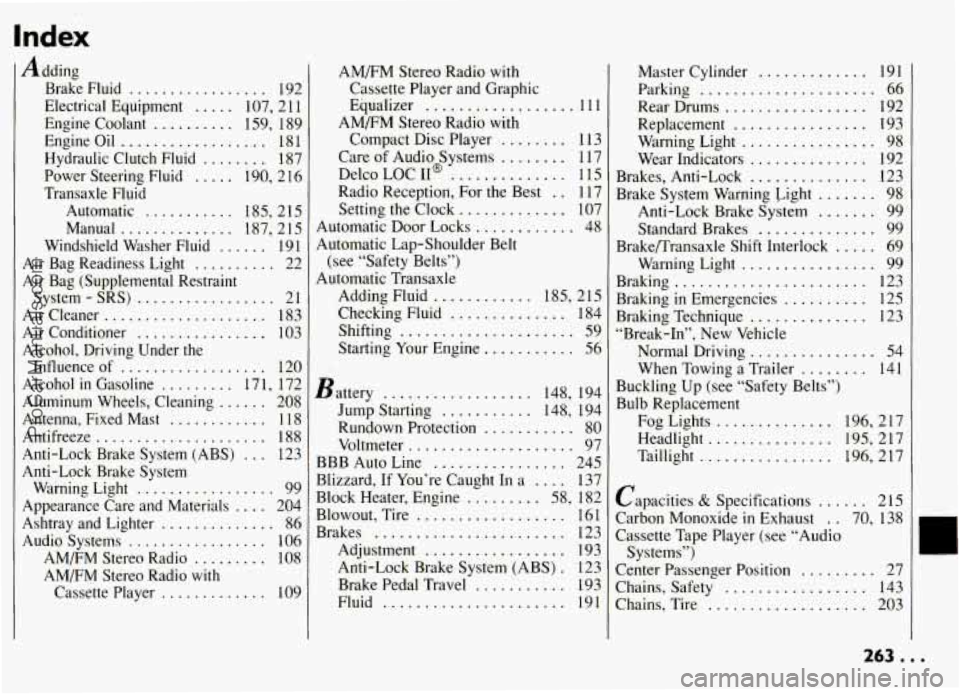
Adding
Brake Fluid ................. 192
Electrical Equipment
..... 107. 2 11
Engine Coolant
.......... 159. 189
Engine Oil
.................. 18 1
Hydraulic Clutch Fluid ........ 187
Power Steering Fluid
..... 190. 216
Transaxle Fluid
Automatic ........... 185. 215
Manual
.............. 187. 215
Windshield Washer Fluid
...... 191
Air Bag Readiness Light .......... 22
Air Bag (Supplemental Restraint
System - SRS) ................. 21
Air Cleaner .................... 183
Air Conditioner
................ 103
Alcohol. Driving Under the
Influence of .................. 120
Alcohol
in Gasoline ......... 17 1. 172
Aluminum Wheels. Cleaning ...... 208
Antenna. Fixed
Mast ............ 118
Antifreeze
..................... 188
Anti-Lock Brake System (ABS)
... 123
Anti-Lock Brake System
Warning Light ................. 99
Appearance Care and Materials
.... 204
Ashtray and Lighter
.............. 86
Audio Systems
................. 106
AM/FM Stereo Radio ......... 108
AM/FM Stereo Radio
with
Cassette Player ............. 109
AM/FM Stereo Radio with
Cassette Player and Graphic
Equalizer
.................. 11 1
AM/FM Stereo Radio with
Compact Disc Player ........ 11 3
Care of Audio Systems
........ 11 7
Delco LOC II@
.............. 115
Radio Reception. For the Best
. . 117
Setting the Clock
............. 107
Automatic Door Locks ............ 48
Automatic Lap-Shoulder Belt
(see “Safety Belts”)
Automatic Transaxle
Adding Fluid ............ 185. 215
Checking Fluid
.............. 184
Shifting
..................... 59
Starting Your Engine
........... 56
Battery .................. 148. 194
Jump Starting
........... 148. 194
Rundown Protection
........... 80
Voltmeter
.................... 97
BBB Auto Line
................ 245
Blizzard. If You’re Caught In a
.... 137
Block Heater. Engine
......... 58. 182
Blowout. Tire
.................. 16 1
Brakes
....................... 123
Adjustment ................. 193
Anti-Lock Brake System (ABS)
. 123
Brake Pedal Travel
........... 193
Fluid
...................... 191
Master Cylinder ............. 191
Parking
..................... 66
Rear Drums
................. 192
Replacement
................ 193
Warning Light
................ 98
Wear Indicators
.............. 192
Brakes. Anti-Lock .............. 123
Brake System Warning Light
....... 98
Anti-Lock Brake System
....... 99
Standard Brakes
.............. 99
Brakenramaxle Shift Interlock
..... 69
Warning Light
................ 99
Braking
....................... 123
Braking in Emergencies
.......... 125
,‘Break-in", New Vehicle
Braking Technique .............. 123
Normal Driving ............... 54
When Towing a Trailer ........ 141
Buckling Up (see “Safety Belts”)
Bulb Replacement
Fog Lights .............. 196. 217
Headlight
............... 195. 217
Taillight
................ 196. 217
Capacities & Specifications ...... 215
Carbon Monoxide
in Exhaust . . 70. 138
Cassette Tape Player (see “Audio
Center Passenger Position ......... 27
Chains. Safety
................. 143
Chains. Tire
................... 203
Systems”) C
263 ...
ProCarManuals.com