window PONTIAC GRAND-AM 1994 Owners Manual
[x] Cancel search | Manufacturer: PONTIAC, Model Year: 1994, Model line: GRAND-AM, Model: PONTIAC GRAND-AM 1994Pages: 274, PDF Size: 15.01 MB
Page 6 of 274
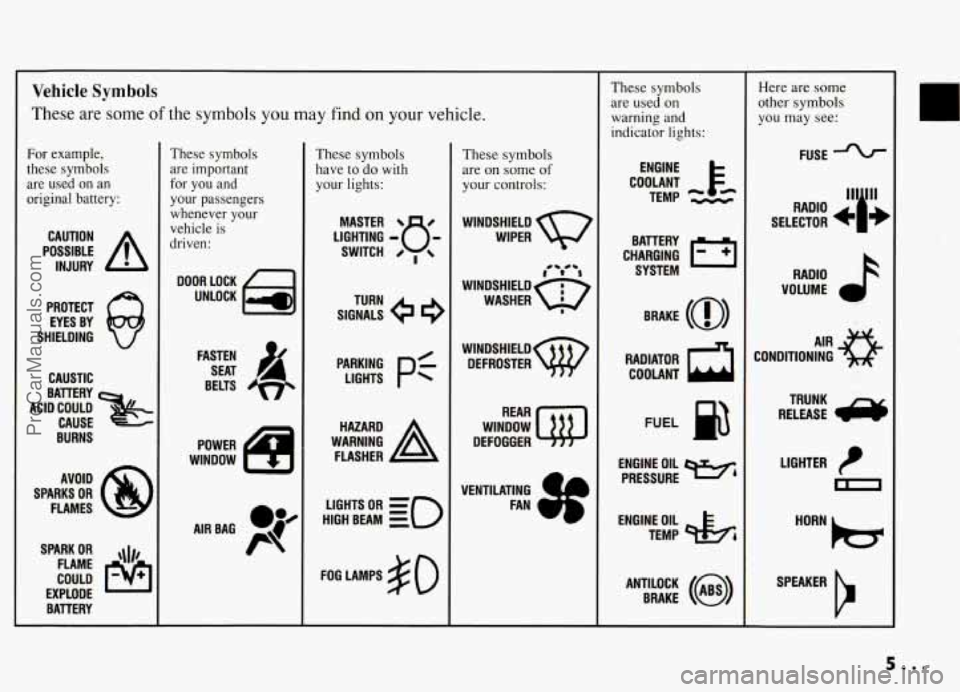
Vehicle Symbols
These are some of the symbols you may find on your vehicle.
For example,
these symbols
are used on an
original battery:
PROTECT
EYES BY
SHIELDING
CAUSTIC
BURNS
AVOID
SPARKS
OR
FLAMES
SPARK OR ,\I/,
COULD FLAME
EXPLODE BATTERY
These symbols
are important
for you and
your passengers
whenever your
vehicle is
driven:
DOOR LOCK
UNLOCK
FASTEN SEAT 4
BELTS
POWER
WINDOW
These symbols
have
to do with
your lights:
SIGNALS e
TURN
HIGH BEAM OR = =o
FOG LAMPS $0
These symbols
are
on some of
your controls:
WIPER Q
WINDSHIELD
WASHER
wlNDSHIELDw DEFROSTER
WINDOW REAR
DEFOGGER.
VENTILATING ca
FAN c.
These symbols
are used
on
warning and
indicator lights:
COOLANT F-
TEMP --
ENGINE
CHARGING BATTERY
SYSTEM
BRAKE (0)
RADIATOR a
COOLANT
FUEL
ENGINE OIL
PRESSURE
-4
TEMP OIL &
ANTILOCK (e)
BRAKE
Here are some
other symbols
you may
see:
FUSE *
RADIO
VOLUME
AIR
CONDITIONING
RELEASE TRUNK
LIGHTER
SPEAKER
b
ProCarManuals.com
Page 25 of 274
Seats & Restraint Systems
How The Air Bag System
Works (CONT)
What will you see after an air bag
inflation?
After the air bag has inflated, it will then
quickly deflate, This occurs
so quickly
that some people may not even realize
that the air bag inflated. Some
components of the air bag module
in the
steering wheel hub may be hot for a short
time, but the portion of the bag that comes
into contact with you will not be hot to
the touch. There will be small amounts of
smoke and dust coming from vents in the
deflated air bag. The air bag will
not
impede the driver’s vision or ability to
steer the vehicle, nor will it hinder the
occupants from exiting the vehicle.
0 The air bag is designed to inflate only
once. After it inflates, you’ll need
some new parts for your air bag
system. If you don’t get them, the air
bag system won’t be there to help
protect you in another crash.
A new
system will include the air bag module
and possibly other parts. The service
manual has information about the
need to replace other parts.
Your vehicle is equipped with a
diagnostic module, which records
information about the air bag system
if the air bag deploys during a crash.
The module records information about
the readiness .of the system, which
sensors activated the deployment, and
whether the driver’s safety belt was in
use.
Let only qualified technicians work on
your air bag system. Improper service
can mean that your air bag system
won’t work properly. See your dealer
for service.
NOTICE:
If you damage the cover for the
driver’s air bag, it may not work
properly. You may have to replace
the air bag on the steering wheel.
Do not open or break the air bag
cover.
Is the smoke from an air bag inflation
harmful?
The particles emitted during air bag
inflation are not harmful to most people.
Some people with respiratory ailments
may experience difficulty breathing if
they’stay in the vehicle with the windows
closed’after air bag inflation.
So, if your
air bag inflates, you and any passengers
should exit the vehicle if and when it is
safe’to do
so. If you or your passengers
can’t get out of the vehicle, try to get
fresh air by opening a window, turning on
the fan, or opening
a door.
... 24
ProCarManuals.com
Page 29 of 274
Seats & Restraint Systems
U
Pear Seat Outside
Dassenger Positions
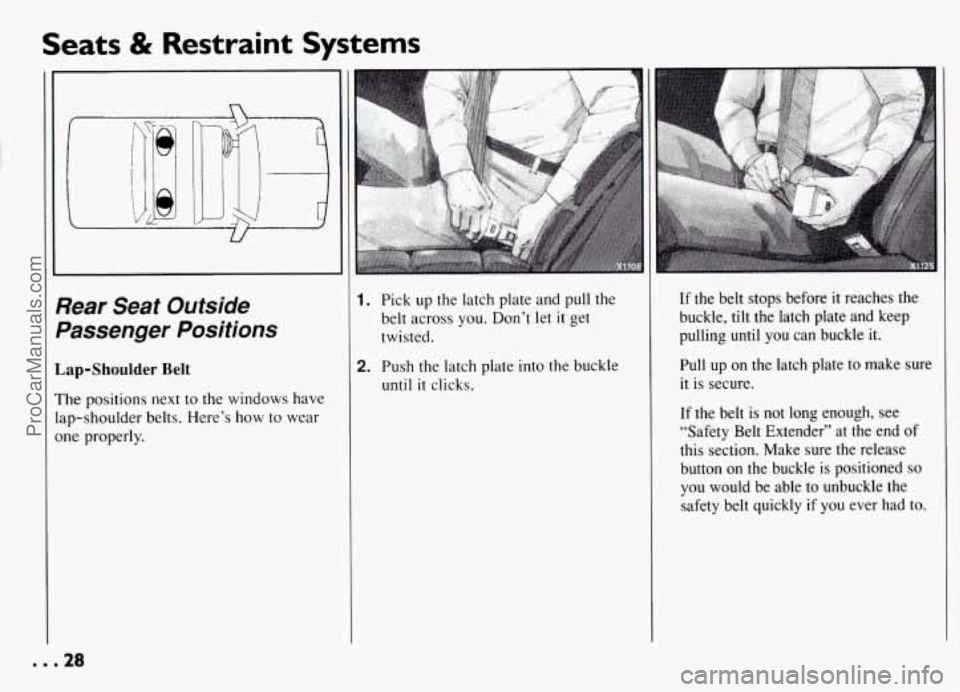
,ap-Shoulder Belt
’he positions next to the windows have
sp-shoulder belts. Here’s how to wear
me properly.
1, Pick up the latch plate and pull the
belt across you. Don’t let
it get
twisted.
2. Push the latch plate into the buckle
until it clicks.
I
If the belt stops before it reaches the
buckle, tilt the latch plate and keep
pulling until you can buckle
it.
Pull up on the latch plate to make sure
it is secure.
If the belt is not long enough, see
“Safety Belt Extender” at the end of
this section. Make sure the release
button
on the buckle is positioned so
you would be able to unbuckle the
safety belt quickly
if you ever had to.
... 28
ProCarManuals.com
Page 41 of 274
Seats & Restraint Systems
P,
Securing a Child Restraint
in the Right Front Seat
(CONT.)
2. Push the spring on the hook near the
door and remove the special belt.
3. Put the belt away in a safe place in .
your vehicle, so it won’t fly around in
a crash and injure someone.
4. Remember to reattach the automatic
belt again, once the child restraint is
removed. Be sure it isn’t twisted.
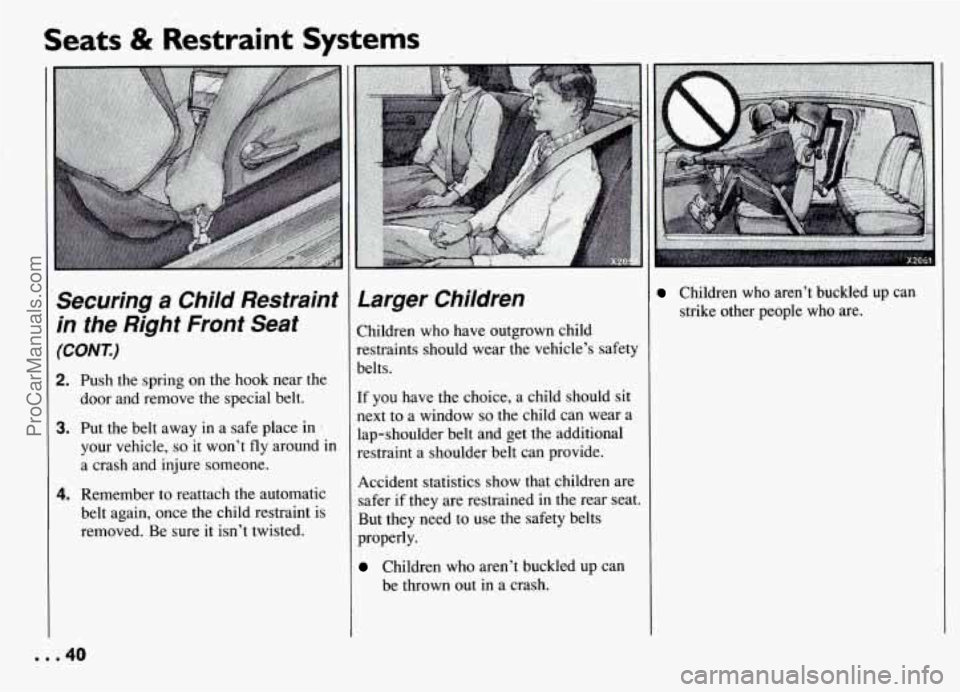
Larger Children
Children who have outgrown child
restraints should wear the vehicle’s safety
belts.
If you have the choice, a child should sit
next to a window
so the child can wear a
lap-shoulder belt and get the additional
restraint a shoulder belt can provide.
Accident statistics show that children are
safer if they are restrained in the rear seat.
But they need to use the safety belts
properly.
Children who aren’t buckled up can
be thrown out in a crash.
Children who aren’t buckled up can
strike other people who are.
. . .40
ProCarManuals.com
Page 46 of 274
...
dele you can learn about the many
tandard and optional features on our Pontiac. and information on
tarting. shifting and braking
. Also
!xplained are the instrument panel
nd the warning systems that tell you
’ everything is working properly ..
ind what to do if you have a problem .
Part 2
Features & Controls
Keys ..... ....................................................... 46
DoorLocks ........................................................ 47
Keyless Entry System
............................................... 50
GloveBox ........................................................ 54
Ignitionswitch
..................................................... 55
StartingYourEngine ................................................ 56
Engine Coolant Heater (Engine Block Heater) ............................ 58
Shifting the Automatic Transaxle ...................................... 59
Shifting the Five-Speed Manual Transaxle ............................... 64
Shifting Into Park (Automatic Transaxle) ................................ 67
Windows
......................................................... 72
Turn Signal/Multifunction Lever ....................................... 73
CruiseControl
..................................................... 74
Lightcontrols
..................................................... 77
Battery Rundown Protection
.......................................... 80
Windshield Wipers .................................................. 81
Windshield Washer ................................................. 82
Mirrors ........................................................... 82
SunVisors ........................................................ 84
Instrumentpanel ................................................... 88
Warning Lights, Gages and Indicators ................................... 93
ParkingBrake ...................................................... 66
45.0.
ProCarManuals.com
Page 53 of 274
Features & Controls
Battery Replacement
(CONK)
To Replace Batteries in the Remote
Keyless Entry:
1. Remove the screw from back cover.
2. Lift the front cover off, bottom half
first.
3. Remove and replace the two batteries
(2016).
4. Reassemble the transmitter.
5. Check the transmitter operation.
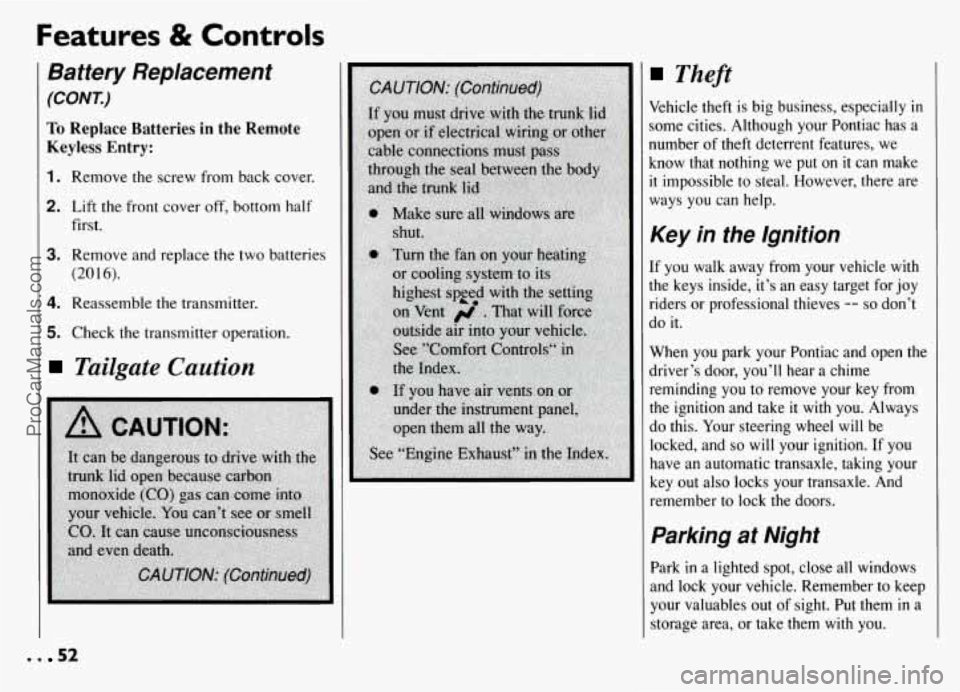
Tailgate Caution
. . 52
Theft
Vehicle theft is big business, especially in
some cities. Although your Pontiac has a
number of theft deterrent features, we
know that nothing we put on
it can make
it impossible to steal. However, there are
ways you can help.
Key in the Ignition
If you walk away from your vehicle with
the keys inside, it’s an easy target for joy
riders or professional thieves
-- so don’t
do
it.
When you park your Pontiac and open the
driver’s door, you’ll hear a chime
reminding you to remove your key from
the ignition and take
it with you. Always
do this. Your steering wheel will be
locked, and
so will your ignition. If you
have an automatic transaxle, taking your
key out also locks your transaxle. And
remember to lock the doors.
Parking at Night
Park in a lighted spot, close all windows
and lock your vehicle. Remember to keep
your valuables out of sight. Put them
in a
storage area, or take them with you.
ProCarManuals.com
Page 73 of 274
Features & Controls
Windows
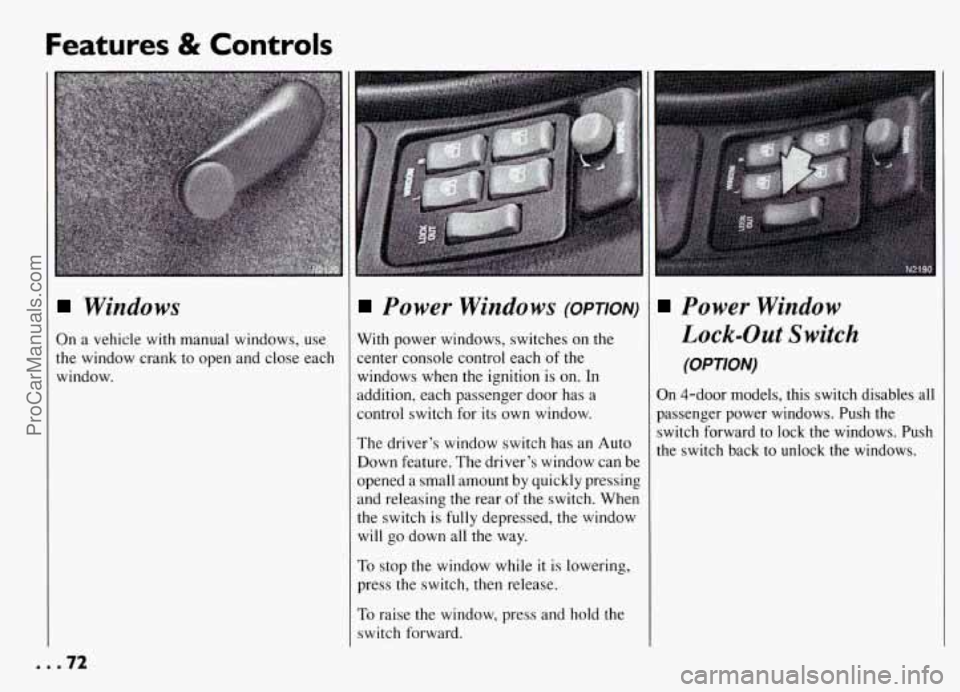
On a vehicle with manual windows, use
the window crank to open and close each
window.
Power Windows (OPTION)
With power windows, switches on the
center console control each of the
windows when the ignition is on. In
addition, each passenger door has a
control switch for its own window.
The driver’s window switch has an Auto
Down feature. The driver’s window can be
opened a small amount
by quickly pressing
and releasing the rear
of the switch. When
the switch is fully depressed, the window
will go down all the way.
To stop the window while it is lowering,
press the switch, then release.
To raise the window, press and hold the
switch forward.
Power Window
Lock-Out Switch
(OPTION)
On 4-door models, this switch disables all
passenger power windows.
Push the
switch forward to lock the windows. Push
the switch back to unlock the windows.
... 72
ProCarManuals.com
Page 90 of 274
The Instrument
Panel-Your Information System
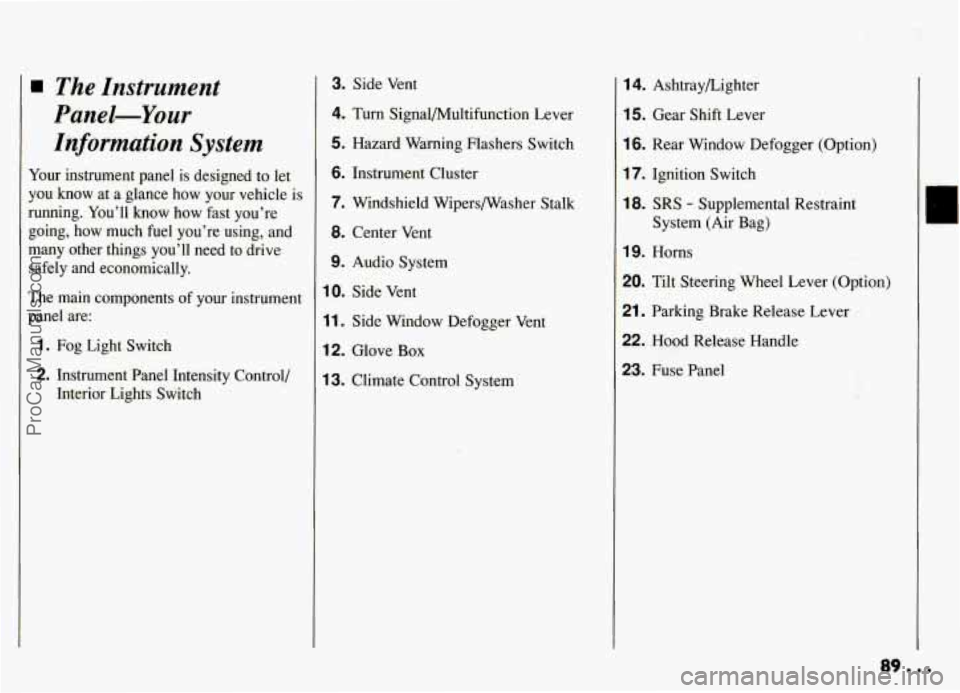
Your instrument panel is designed to let
you know at a glance how
your vehicle is
running. You’ll know how fast you’re
going, how much fuel you’re using, and
many other things you’ll need to drive
safely and economically.
The main components of your instrument
panel are:
1. Fog Light Switch
2. Instrument Panel Intensity Control,’
Interior Lights Switch
3. Side Vent
4. Turn Signal/Multifunction Lever
5. Hazard Warning Flashers Switch
6. Instrument Cluster
7. Windshield Wipersmasher Stalk
8. Center Vent
9. Audio System
10. Side Vent
11. Side Window Defogger Vent
12. Glove Box
13. Climate Control System
14. Ashtraybighter
15. Gear Shift Lever
16. Rear Window Defogger (Option)
17. Ignition Switch
18. SRS - Supplemental Restraint
System (Air Bag)
19. Horns
20. Tilt Steering Wheel Lever (Option)
21. Parking Brake Release Lever
22. Hood Release Handle
23. Fuse Panel
ProCarManuals.com
Page 103 of 274
I’
Comfort Controls & Audio Systems
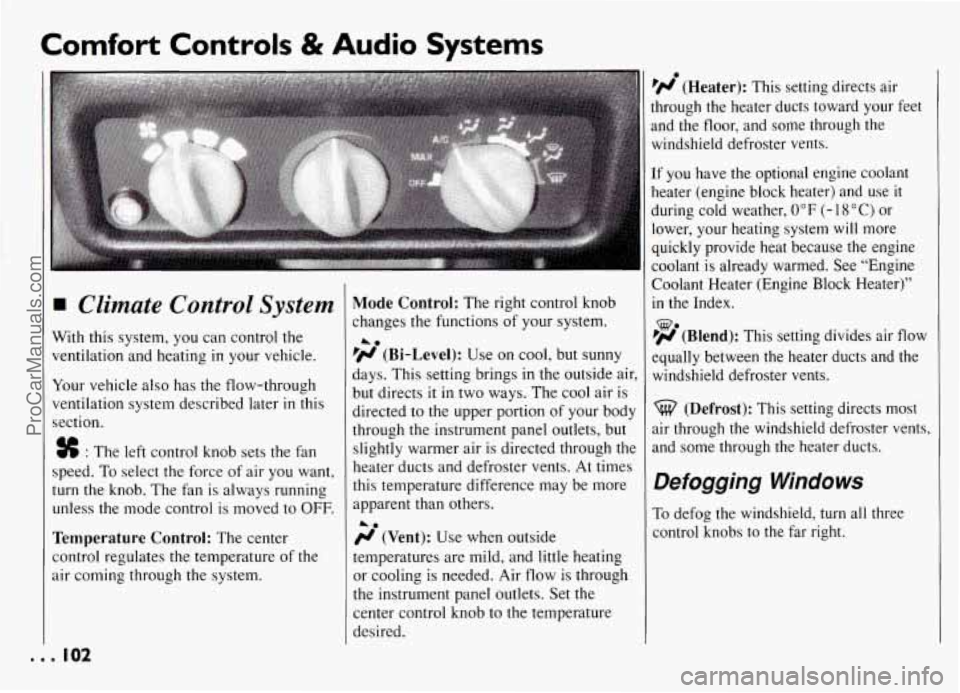
w Climate Control System
With this system, you can control the
ventilation and heating
in your vehicle.
Your vehicle also has the flow-through
ventilation system described later
in this
section.
. . . 102
# : The left control knob sets the fan
speed. To select the force of air you want,
turn the knob. The fan is always running
unless the mode control is moved to
OFF.
Temperature Control: The center
control regulates the temperature of the
air coming through the system.
Mode Control: The right control knob
:hanges the functions of your system.
’(rr (Bi-Level): Use on cool, but sunny
days. This setting brings
in the outside ai
but directs it
in two ways. The cool air is
directed to the upper portion
of your bod
through the instrument panel outlets, but
slightly warmer air is directed through th
heater ducts and defroster vents. At time:
this temperature difference may be more
apparent than others.
(rr (Vent): Use when outside
temperatures are mild, and little heating
or cooling
is needed. Air flow is through
the instrument panel outlets. Set the
center control knob to the temperature
desired.
A.
A.
p(rr (Heater): This setting directs air
ihrough the heater ducts toward your feet
and the floor, and some through the
windshield defroster vents.
[f you have the optional engine coolant
heater (engine block heater) and use it
during cold weather,
0°F (- 18 “C) or
lower, your heating system
will more
quickly provide heat because the engine
coolant is already warm.ed. See “Engine
Coolant Heater (Engine
Block Heater)’’
in the Index.
%?a FrJ (Blend): This setting divides air flow
equally between the heater ducts and the
windshield defroster vents.
(Defrost): This setting directs most
air through the windshield defroster vents,
and some through the heater ducts.
Defogging Windows
To defog the windshield, turn all three
control knobs to the far right.
ProCarManuals.com
Page 104 of 274
Air Conditioning
System (OPTION)
The air conditioner and heater work best
if you keep your windaws closed while
using them. Your vehicle also has the
flow-through ventilation system
described later
in this section.
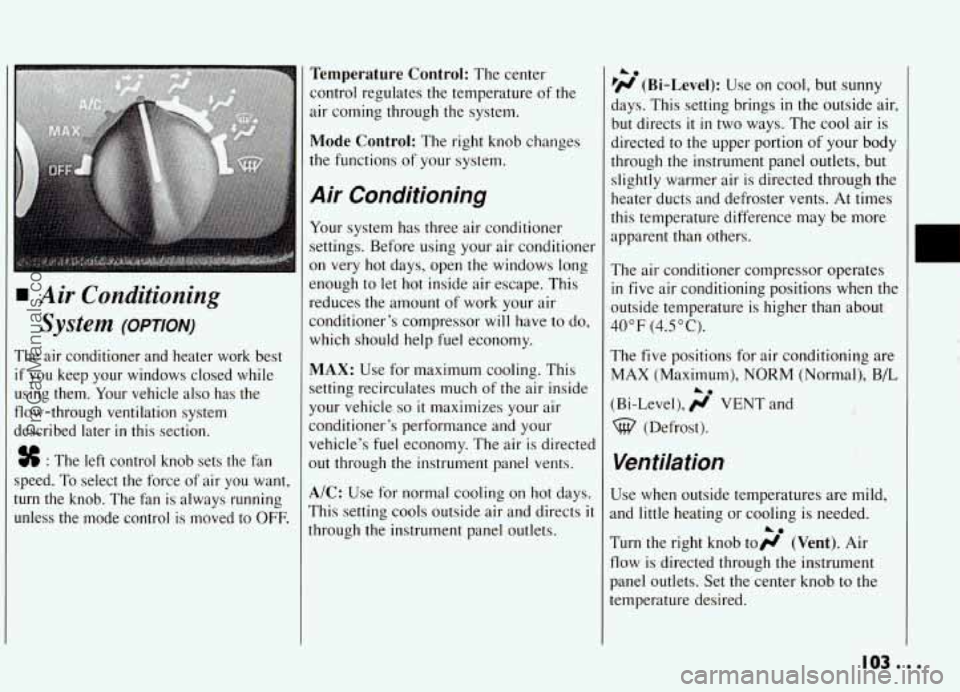
% : The left control knob sets the fan
speed. To select the force of air you want,
turn the knob. The fan is always running
unless the mode control is moved to
OFF.
Temperature Control: The center
control regulates the temperature of the
air coming through the system.
Mode Control: The right knob changes
the functions of your system.
A.ir Conditioning
Your system has three air conditioner
settings. Before using your air conditioner
on
very hot days, open the windows long
enough to let hot inside air escape. This
reduces the amount of work your air
conditioner’s compressor will have to do,
which should help fuel economy.
MAX: Use for maximum cooling. This
setting recirculates much of the air inside
your vehicle
SO it maximizes your air
conditioner’s performance and your
vehicle’s fuel economy. The air
is directed
out through the instrument panel vents.
A/C: Use for normal cooling on hot days.
This setting cools outside air and directs
it
through the instrument panel outlets.
he
lH (Bi-Level): Use on cool, but sunny
days. This setting brings
in the outside air,
but directs
it in two ways. The cool air is
directed to the upper portion of your body
through the instrument panel outlets, but
slightly warmer air is directed through the
heater ducts and defroster vents. At times
this temperature difference may be more
apparent than others.
The air conditioner compressor operates
in five air conditioning positions when the
outside temperature is higher than about
40°F (4.5”C).
The five positions for air conditioniqg are
MAX (Maximum), NORM (Normal.), B/L
(Bi-Level), ;j’ VENT and
%@ (Defrost). .. ._.
1. . ;>. w >%:
Ventilation
Use when outside temperatures are mild,
and little heating or cooling
is needed.
Turn the right knob toH (Vent). Air
flow is directed through the instrument
panel outlets. Set the center knob to the
temperature desired.
i.
IOS...
ProCarManuals.com