engine PONTIAC GRAND-AM 1995 User Guide
[x] Cancel search | Manufacturer: PONTIAC, Model Year: 1995, Model line: GRAND-AM, Model: PONTIAC GRAND-AM 1995Pages: 354, PDF Size: 17.81 MB
Page 75 of 354
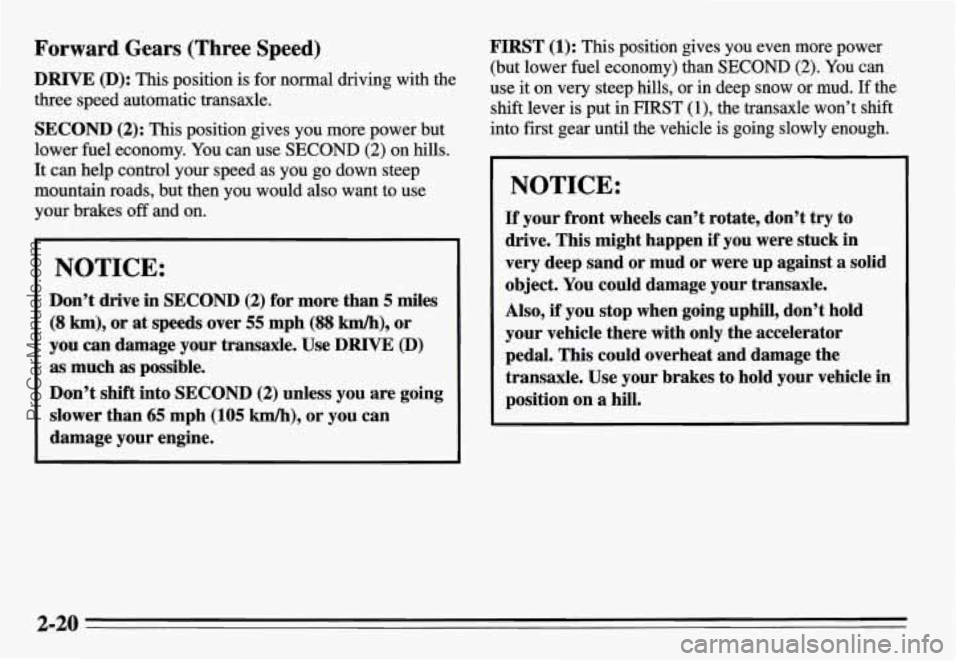
Forward Gears (Three Speed)
DRIVE (D): This position is for normal driving with the
three speed automatic transaxle.
SECOND (2): This position gives you more power but
lower
fuel economy. You can use SECOND (2) on hills.
It
can help control your speed as you go down steep
mountain roads, but then you would
also want to use
your brakes off and on.
NOTICE:
Don’t drive in SECOND (2) for more than 5 miles
(8 km), or at speeds over 55 mph (88 km/h), or
you can damage your transaxle. Use DRIVE
@)
as much as possible.
Don’t shift into
SECOND (2) unless you are going
slower than
65 mph (105 M), or you can
damage your engine.
FIRST (1): This position gives you even more power
(but lower fuel economy) than
SECOND (2). You can
use it on very steep hills, or in deep snow or mud.
If the
shift lever
is put in FIRST (l), the transaxle won’t shift
into first gear until the vehicle
is going slowly enough.
NOTICE:
If your front wheels can’t rotate, don’t try to
drive. This might happen
if you were stuck in
very deep sand
or mud or were up against a solid
object. You could damage your transaxle.
Also, if you stop when going uphill, don’t hold
your vehicle there with only the accelerator
pedal. This could overheat and damage the
transaxle. Use your brakes to hold your vehicle in
position on
a hill.
2-20
ProCarManuals.com
Page 76 of 354
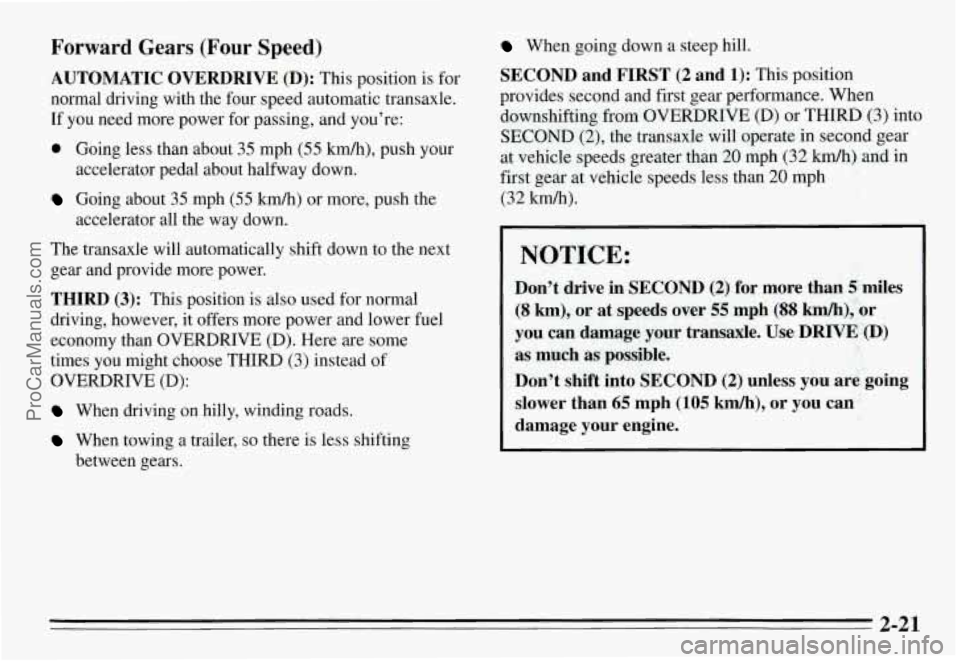
Forward Gears (Four Speed)
AUTOMATIC OVERDRIVE (D): This position is for
normal driving with the four speed automatic transaxle.
If you need more power for passing, and you’re:
0 Going less than about 35 mph (55 km/h), push your
accelerator pedal about halfway down.
Going about 35 mph (55 km/h) or more, push the
accelerator all the way down.
The transaxle will automatically shift down to the next
gear and provide more power.
THIRD (3): This position is also used for normal
driving, however, it offers more power and lower fuel
economy than OVERDRIVE (D). Here are some
times
you might choose THIRD (3) instead of
OVERDRIVE (D):
When driving on hilly, winding roads.
When towing a trailer, so there is less shifting
between gears.
When going down a steep hill.
SECOND and FIRST (2 and 1): This position
provides second and first gear performance. When
downshifting from OVERDRIVE
(D) or THIRD (3) into
SECOND
(2), the transaxle will operate in second gear
at vehicle speeds greater than
20 mph (32 km/h) and in
first gear at vehicle speeds less than
20 mph
(32 Wh).
NOTICE:
Don’t drive in SECOND (2) for more than 5 miles
(8 km), or at speeds over 55 mph (88 km/h), or
you can damage your transaxle.
Use DRIVE (D)
as much as possible.
Don’t shift into SECOND
(2) unless you are going
slower than
65 mph (105 kmh), or you can
damage your engine.
2-21
ProCarManuals.com
Page 78 of 354
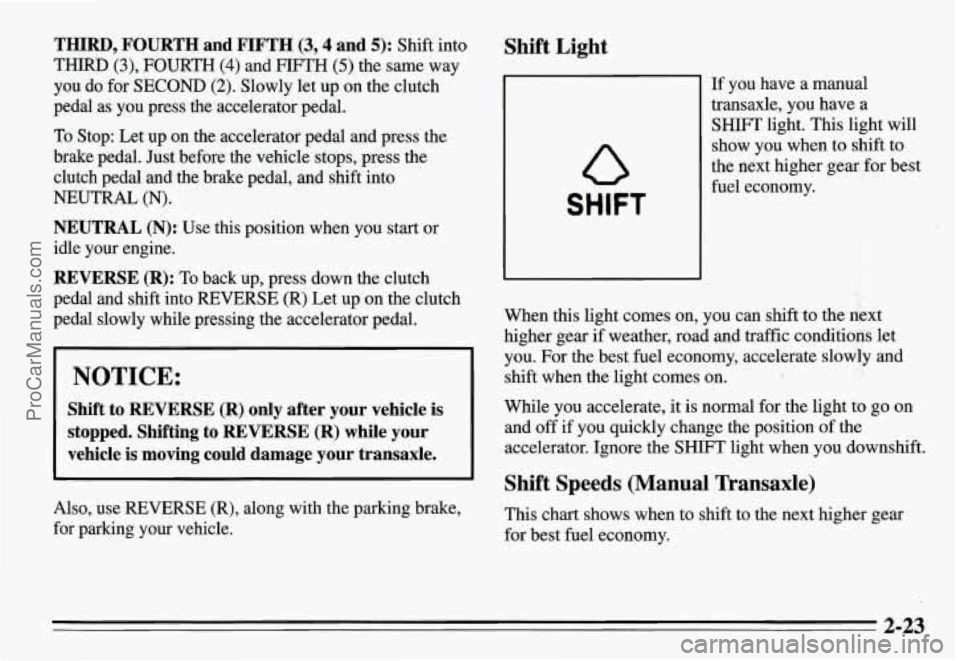
THIRD, FOURTH and FIFTH (3,4 and 5): Shift into
THIRD (3), FOURTH (4) and l?lFTH (5) the same way
you do for
SECOND (2). Slowly let up on the clutch
pedal as you press the accelerator pedal.
To Stop: Let up on the accelerator pedal and press the
brake pedal.
Just before the vehicle stops, press the
clutch pedal and the brake pedal, and shift into
NEUTRAL
(N).
NEUTRAL (N): Use this position when you start or
idle your engine.
REVERSE (R): To back up, press down the clutch
pedal and shift into REVERSE
(R) Let up on the clutch
pedal slowly while pressing the accelerator pedal.
I NOTICE:
Shift to REVERSE (R) only after your vehicle is
stopped. Shifting to REVERSE (R) while your
vehicle is moving could damage your transaxle.
Also, use REVERSE (R), along with the parking brake,
for parking your vehicle.
Shift Light
0
SHIFT
If you have a manual
transaxle, you have a
SHIFT light. This light will
show
you when to shift to
the next higher gear for best
fuel economy.
k' . :I
When this light comes on, you can shift to the next
higher gear if weather, road and traffic conditions let
you. For the best fuel economy, accelerate slowly
and
shift when the light comes on.
While you accelerate, it is normal for the light to go on
and
off if you quickly change the position of the
accelerator. Ignore the
SHIFT light when you downshift.
Shift Speeds (Manual Transaxle)
This chart shows when to shift to the next higher gear
for best fuel economy.
2-23
ProCarManuals.com
Page 79 of 354
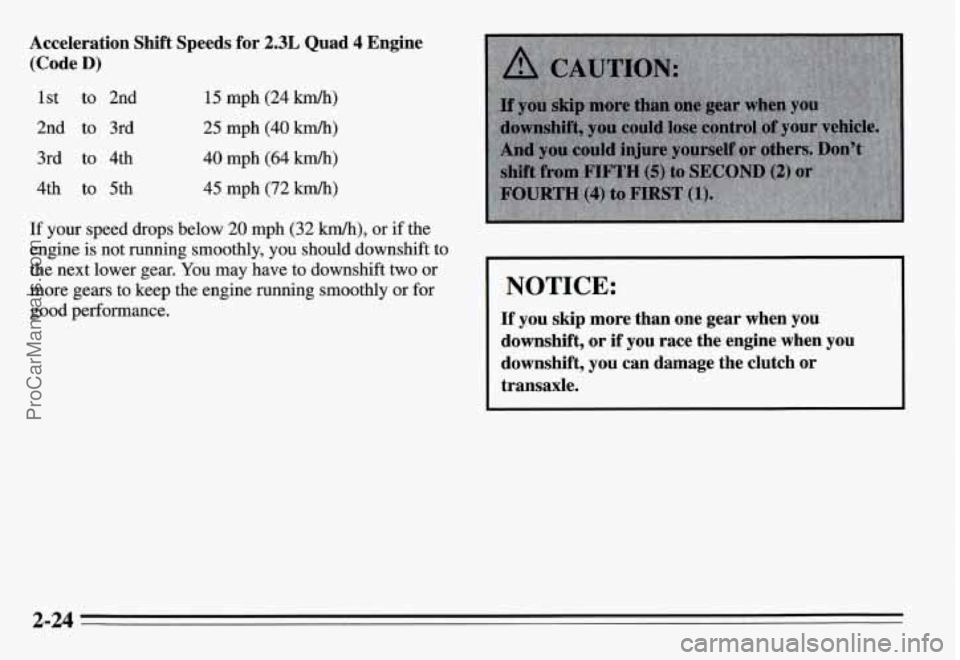
Acceleration Shift Speeds for 2.3L Quad 4 Engine
(Code
D)
1st to 2nd
2nd to 3rd
3rd to 4th
4th to 5th 15 mph (24 km/h)
25 mph (40 kmlh)
40 mph (64 km/h)
45 mph (72 km/h)
If your speed drops below 20 mph (32 krn/h), or if the
engine
is not running smoothly, you should downshift to
the next lower gear. You may have to downshift two
or
more gears to keep the engine running smoothly or for NOTICE:
good performance. If you skip more than one gear when you
downshift, or if you race the engine when you
downshift, you can damage the clutch or
transaxle.
2-24
ProCarManuals.com
Page 82 of 354
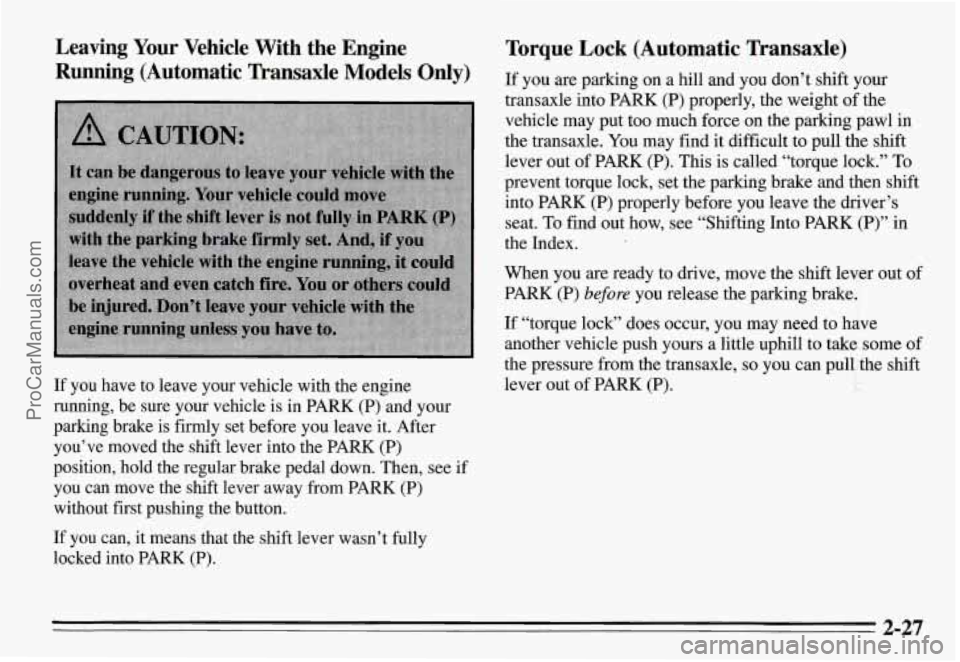
Leaving Your Vehicle With the Engine Running (Automatic Wansaxle Models Only)
If you have to leave your vehicle with the engine
running, be sure your vehicle is in PARK (P) and your
parking brake is firmly set before you leave it. After
you’ve moved the shift lever into the PARK (P)
position, hold the regular brake pedal down. Then, see if
you can move the shift lever away from PARK (P)
without first pushing the button.
If you can, it means that the shift lever wasn’t fully
locked into PARK (P).
Torque Lock (Automatic Transaxle)
If you are parking on a hill and you don’t shift your
transaxle into PARK (P) properly, the weight of the
vehicle may put too much force on the parking pawl in
the transaxle. You may find it difficult to pull the shift
lever out of PARK (P). This is called “torque lock.” To
prevent torque lock, set the parking brake and then shift
into PARK (P) properly before you leave the driver’s
seat. To find out how, see “Shifting Into PARK (P)” in
the Index.
When you are ready to drive, move the shift lever out of
PARK (P)
before you release the parking brake.
If “torque lock” does occur, you may need to have
another vehicle push yours a little uphill to take some of
the pressure from the transaxle,
so you can pull the shift
lever out of PARK (P).
2-27
ProCarManuals.com
Page 84 of 354
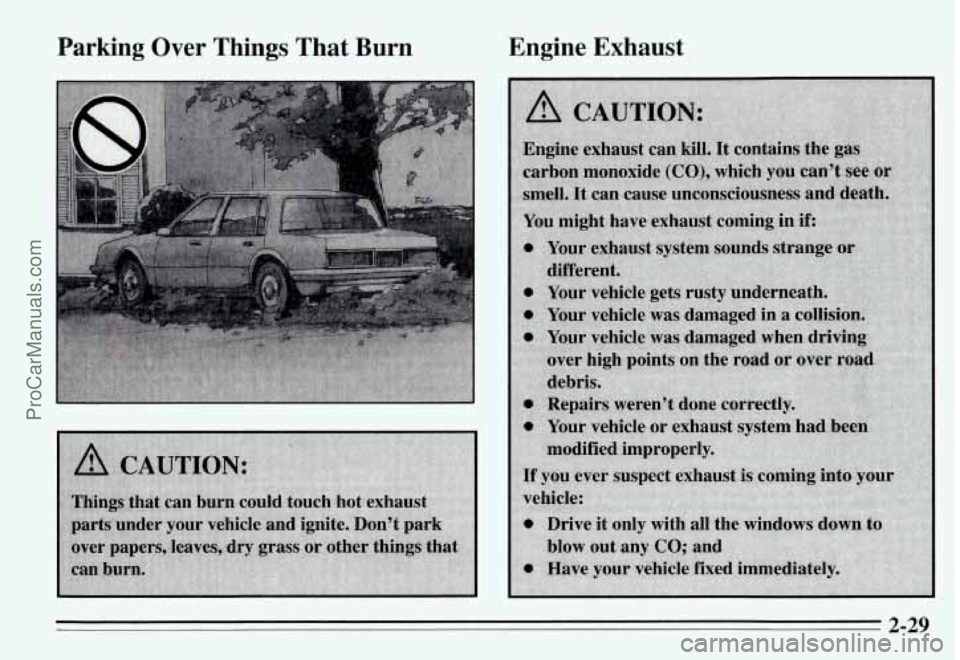
Parking Over Things That Burn Engine Exhaust
2-29
ProCarManuals.com
Page 85 of 354
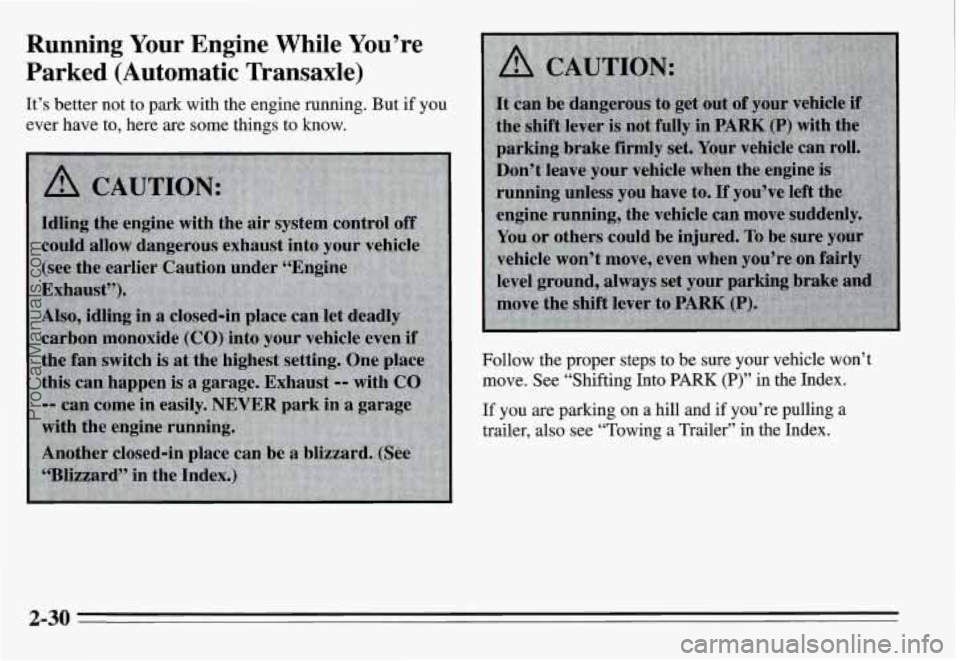
Running Your Engine While You’re
Parked (Automatic Transaxle)
It’s better not to park with the engine running. But if you
ever have to, here are some things to
know.
Follow the proper steps to be sure your vehicle won’t
move. See “Shifting Into
PARK (P)” in the Index.
If you are parking on a hill and if you’re pulling a
trailer, also see “Towing a Trailer” in the Index.
2-30
ProCarManuals.com
Page 112 of 354
Tachometer (Option)
e--
@ -*
5
4
RPM
XlOOO
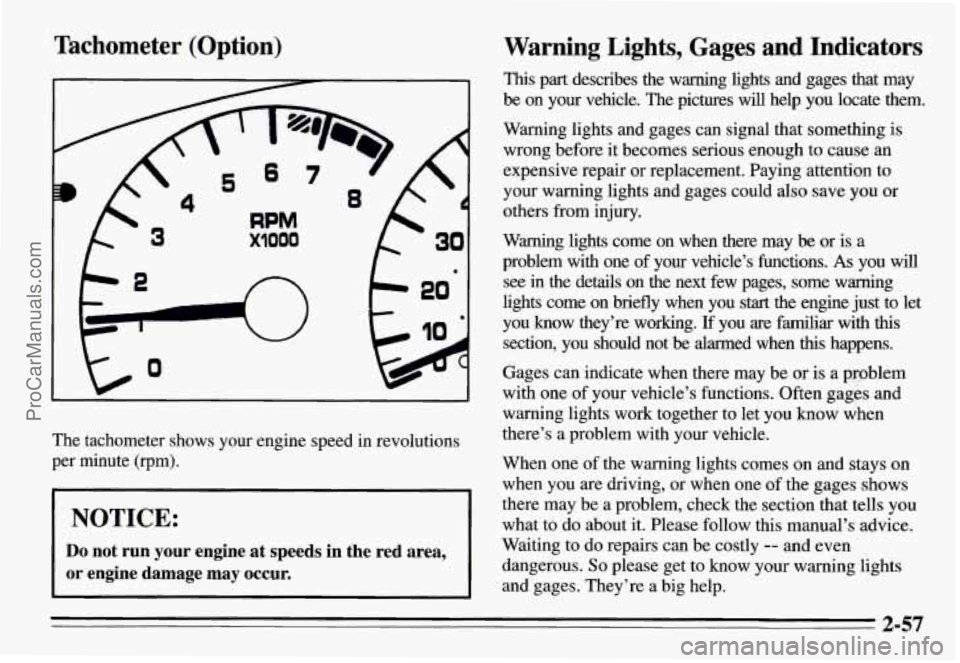
The tachometer shows your engine speed in revolutions
per minute (rpm).
NOTICE:
Do not run your engine at speeds in the red area,
or engine damage may occur.
Warning Lights, Gages and Indicators
This part describes the warning lights and gages that may
be on your vehicle. The pictures will help you locate them.
Warning lights and gages can signal that something is
wrong before it becomes serious enough to cause an
expensive repair or replacement. Paying attention to
your warning lights and gages could also save you or
others from injury.
Warning lights come on when there may be or is a
problem with one
of your vehicle’s functions. As you will
see in the details on the next few pages, some warning
lights come on briefly when you
start the engine just to let
you know they’re working. If you are familiar with this
section, you should not be alarmed when this happens.
Gages can indicate when there may be or is a problem
with one of your vehicle’s functions. Often gages and
warning lights work together to let
you know when
there’s a problem with your vehicle.
When one of the warning lights comes on and stays on
when you are driving, or when one of the gages shows
there may be a problem, check the section that tells you
what to do about it. Please follow this manual’s advice.
Waiting to do repairs can be costly
-- and even
dangerous.
So please get to know your warning lights
and gages. They’re a big help.
2-57
ProCarManuals.com
Page 114 of 354
Air Bag Readiness Light
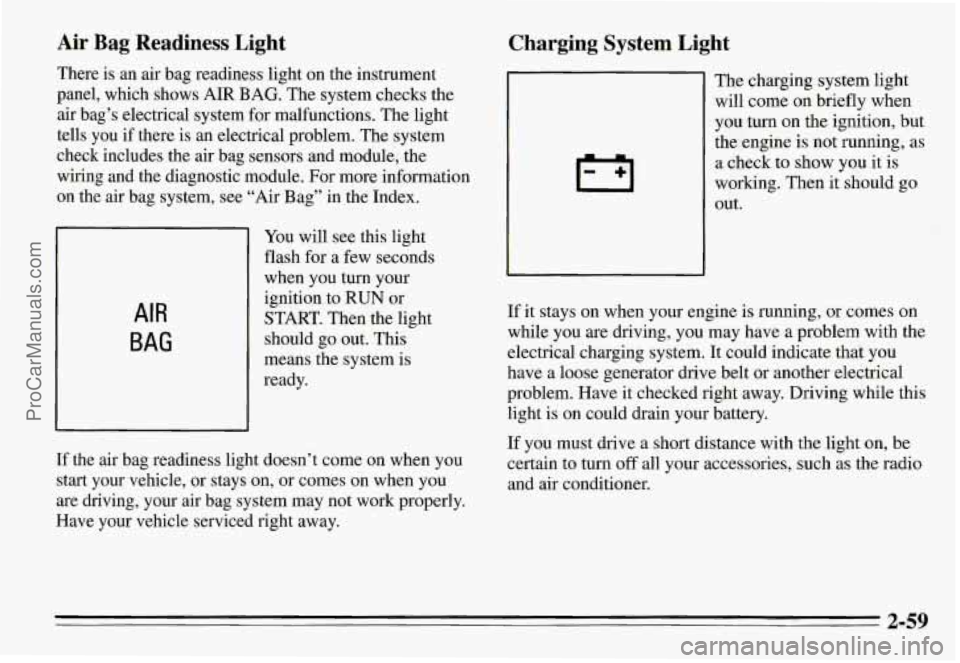
There is an air bag readiness light on the instrument
panel, which shows AIR BAG. The system checks the
air bag’s electrical system for malfunctions. The light
tells you if there is an electrical problem. The system
check includes the air bag sensors and module, the
wiring and the diagnostic module. For more information
on the air bag system, see “Air Bag” in the Index.
AIR
BAG
You will see this light
flash
for a few seconds
when you turn your
ignition to
RUN or
START. Then the light
should go out. This
means the system is
ready.
If the air bag readiness light doesn’t come on when you
start your vehicle, or stays on,
or comes on when you
are driving, your air bag system may not work properly.
Have your vehicle serviced right away.
Charging System Light
The charging system light
will come on briefly when
you turn on the ignition, but
the engine
is not running, as
a check to show you
it is
working. Then it should go
out.
If it stays on when your engine is running, or comes on
while you are driving, you may have
a problem with the
electrical charging system. It could indicate that you
have a loose generator drive belt or another electrical
problem. Have it checked right away. Driving while this
light is on could drain your battery.
If you must drive a short distance with the light on, be
certain to
turn off all your accessories, such as the radio
and air conditioner.
2-59
ProCarManuals.com
Page 115 of 354
Voltmeter (Option)
U
W
[-I
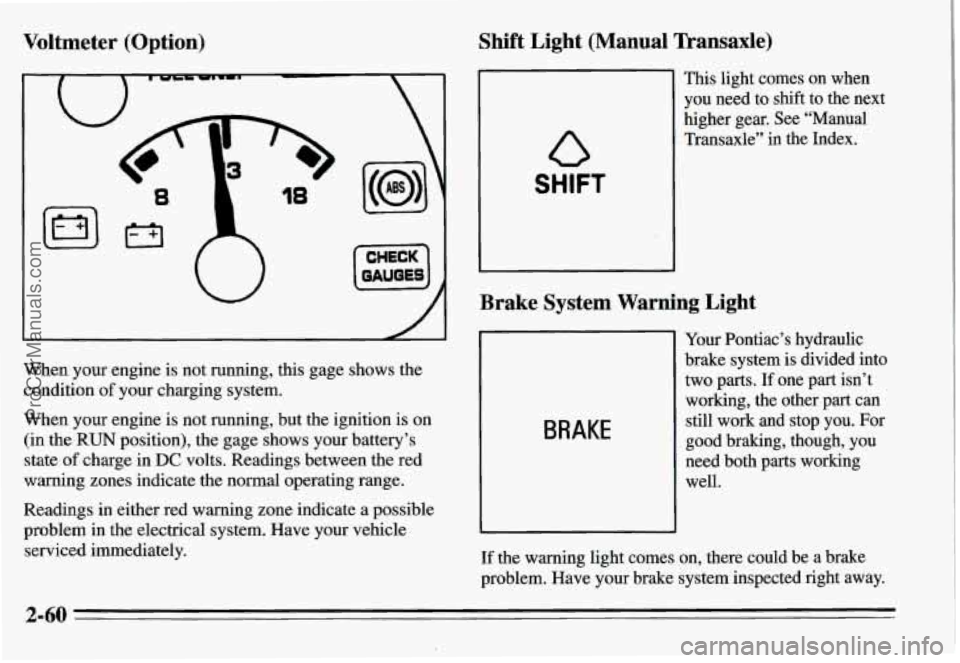
When your engine is not running, this gage shows the
condition
of your charging system.
When your engine is not running, but the ignition is on
(in the
RUN position), the gage shows your battery’s
state of charge in
DC volts. Readings between the red
warning zones indicate the normal operating range.
Readings in either red warning zone indicate a possible
problem in the electrical system. Have your vehicle
serviced immediately.
Shift Light (Manual Transaxle)
0
SHIFT
L
This light comes on when you need to shift to the next
higher gear. See “Manual
Transaxle” in the Index.
Brake System Warning Light
BRAKE
Your Pontiac .’s hyc h-au llic
brake system is divided into
two parts.
If one part isn’t
working, the other
part can
still work
and stop you. For
good braking, though, you
need both parts working
well.
If the warning light comes on, there could be a brake
problem. Have your brake system inspected right away.
2-60
ProCarManuals.com