engine coolant PONTIAC GRAND-AM 1995 User Guide
[x] Cancel search | Manufacturer: PONTIAC, Model Year: 1995, Model line: GRAND-AM, Model: PONTIAC GRAND-AM 1995Pages: 354, PDF Size: 17.81 MB
Page 195 of 354
If you no longer have the overheat warning, you can
drive. Just to be safe, drive slower for about ten minutes.
If the warning doesn’t come back on, you can drive
normally.
If the warning continues, pull over, stop, and park your
vehicle right away.
If there’s still no sign of steam, you can idle the engine
for two or three minutes while you’re parked, to see if
the warning stops. But then,
if you still have the
warning,
turn ofthe engine and get everyone out of the
vehicle
until it cools down.
You may decide not to lift the hood but to get service
help right away.
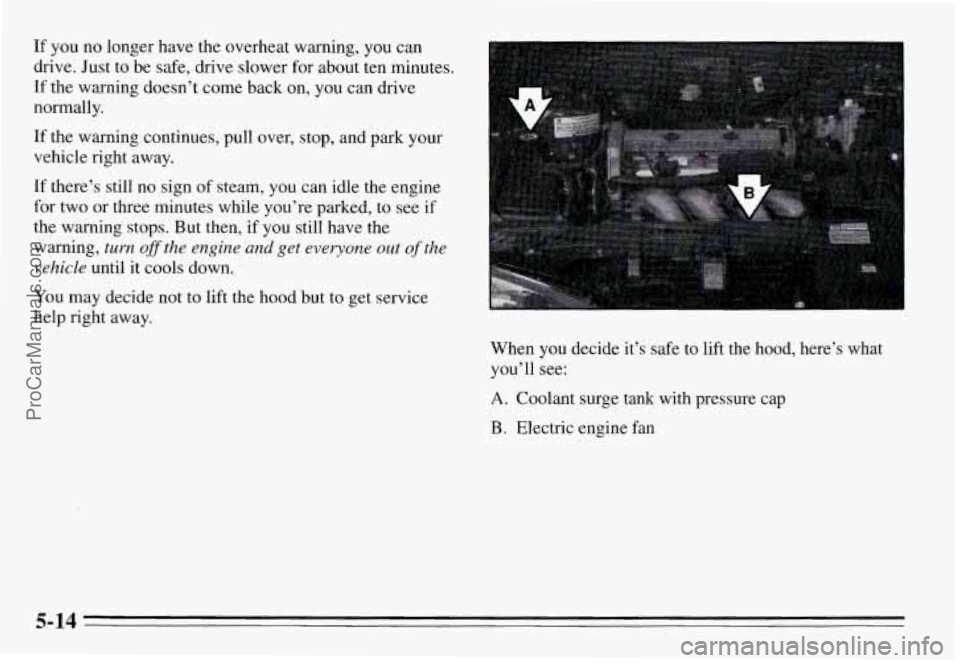
When you decide it’s safe to lift the hood, here’s what
you’ll see:
A. Coolant surge tank with pressure cap
B. Electric engine fan
5-14
ProCarManuals.com
Page 197 of 354
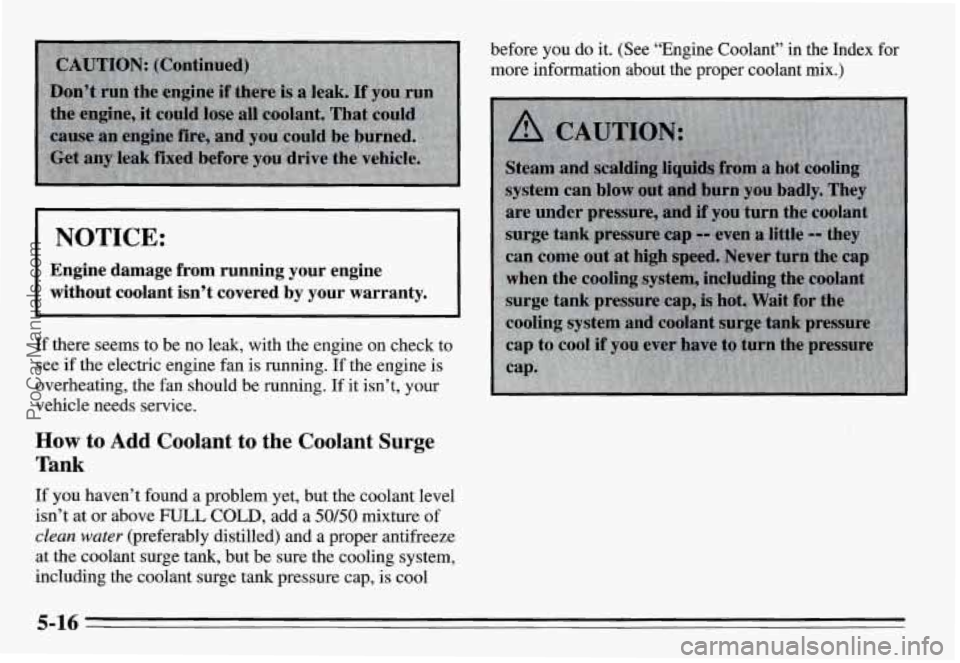
Engine damage from running your engine
without coolant isn’t covered
by your warranty.
If there seems to be no leak, with the engine on check to
see if the electric engine fan is running.
If the engine is
overheating, the fan should be running. If it isn’t, your
vehicle needs service.
How to Add Coolant to the Coolant Surge
Tank
If you haven’t found a problem yet, but the coolant level
isn’t at or above FULL COLD, add a 50/50 mixture of
clean water (preferably distilled) and a proper antifreeze
at the coolant surge
tank, but be sure the cooling system,
including the coolant surge tank pressure cap, is cool
before you do it. (See “Engine Coolant” in the Index for
more information about the proper coolant
mix.)
I NOTICE:
5-16
ProCarManuals.com
Page 199 of 354
NOTICE:
In cold weather, water can freeze and crack the
engine, radiator, heater core and other parts.
So
use the recommended coolant.
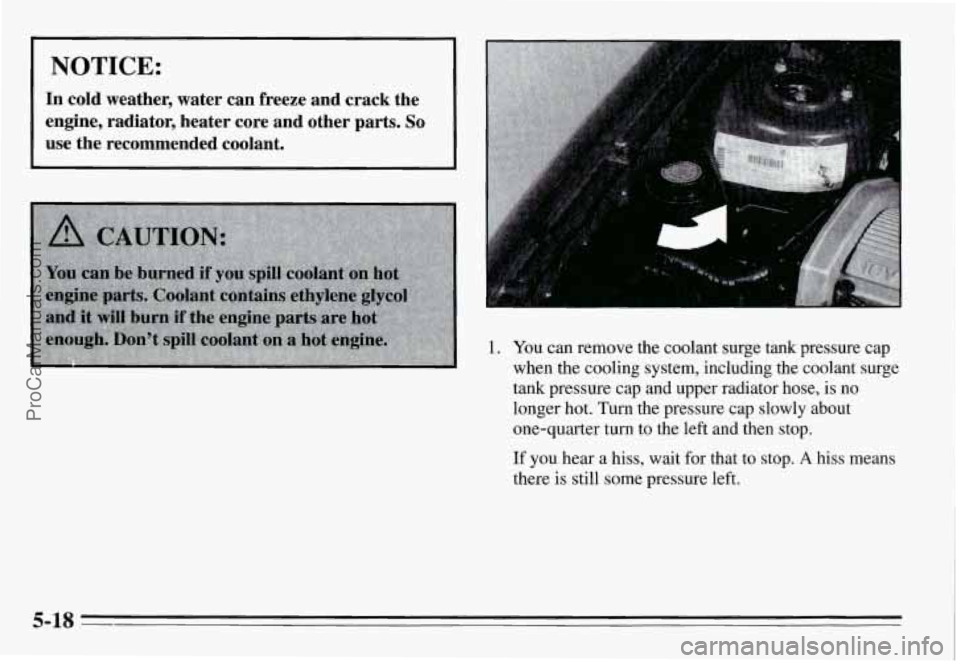
1. You can remove the coolant surge tank pressure cap
when the cooling system, including the coolant surge
tank pressure cap and upper radiator hose, is no
longer hot. Turn the pressure cap slowly about
one-quarter turn to the left and then stop.
If you hear a hiss, wait for that to stop. A hiss means
there is still some pressure left.
5-18 -
ProCarManuals.com
Page 201 of 354
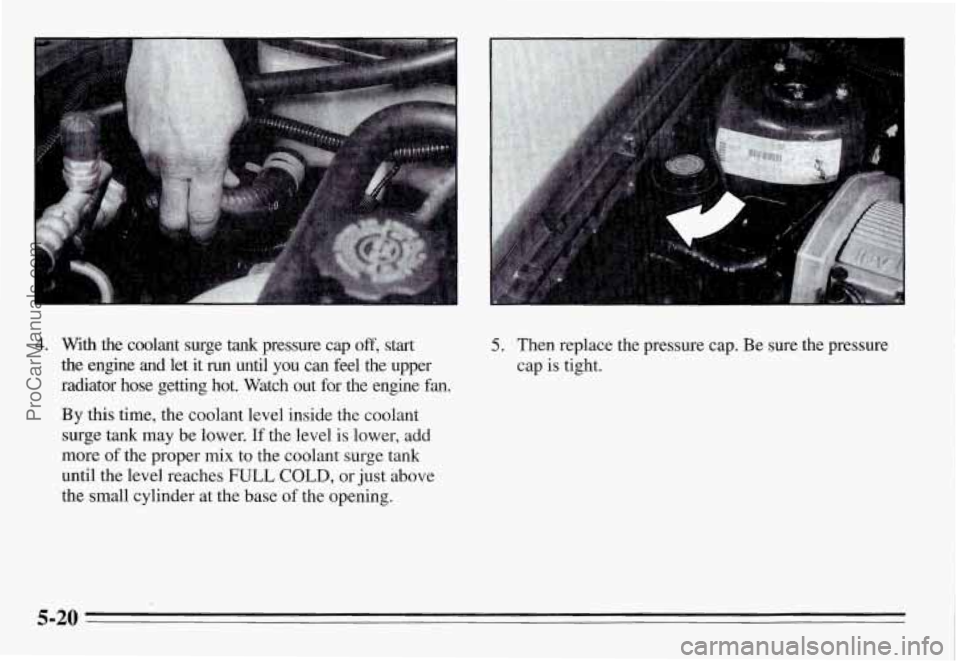
4. With the coolant surge tank pressure cap off, start
the engine and let it run until you can feel the upper
radiator hose getting hot. Watch out for the engine fan.
By this time, the coolant level inside the coolant
surge tank may be lower. If the level is lower, add
more of the proper mix to the coolant surge tank
until the level reaches
FULL COLD, or just above
the small cylinder at the base of the opening.
1
5. Then replace the pressure cap. Be sure the pressure
cap is tight.
5-20
ProCarManuals.com
Page 220 of 354
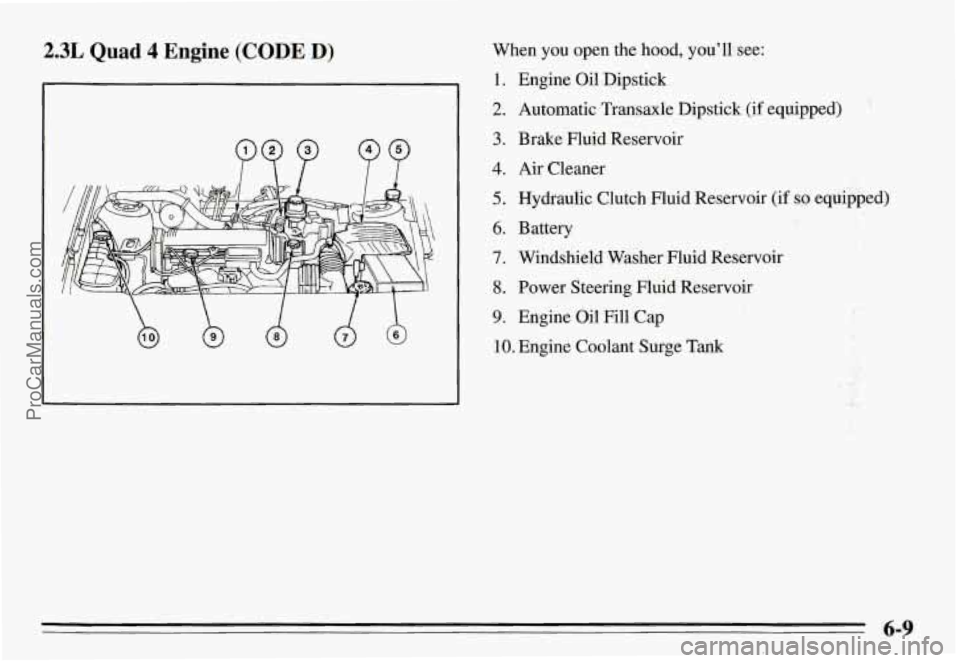
2.3L Quad 4 Engine (CODE D)
PO ??
When you open the hood, you'll see:
1.
2.
3.
4.
5.
6.
7.
8.
9.
Engine Oil Dipstick
Automatic Transaxle Dipstick (if equipped)
Brake Fluid Reservoir
Air Cleaner
,? I, 4
Hydraulic Clutch Fluid Reservoir (if so equipped)
Battery
Windshield Washer Huid Reservoir
Power Steering Fluid Reservoir
Engine Oil
Fill Cap
'il.
10. Engine Coolant Surge Tank
6-9
ProCarManuals.com
Page 221 of 354
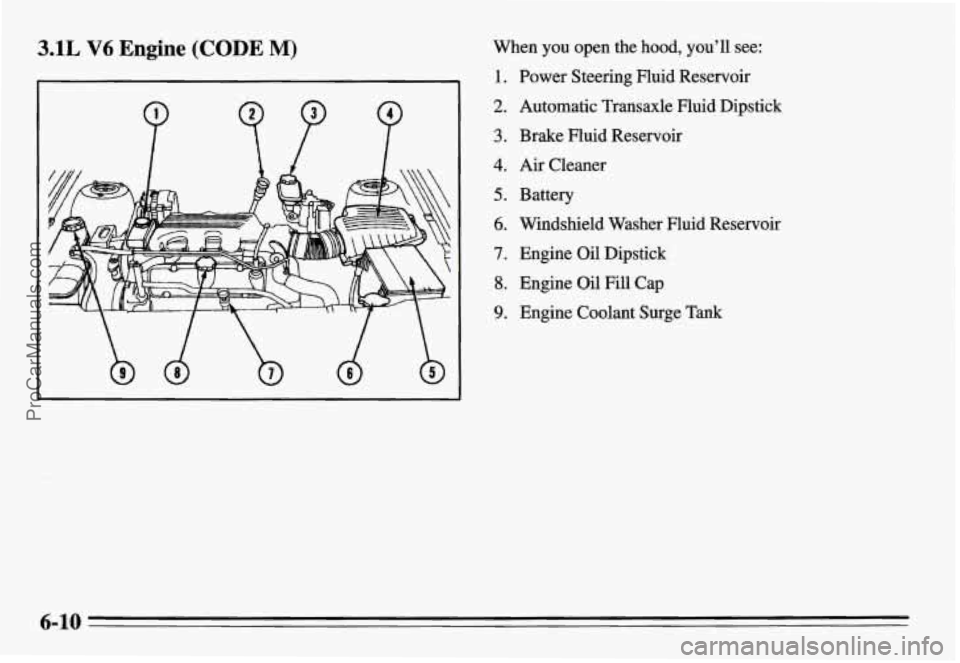
3.1L V6 Engine (CODE M)
P 9p P
When you open the hood, you’ll see:
1.
2.
3.
4.
5.
6.
7.
8.
9.
Power Steering Fluid Reservoir
Automatic Transaxle Fluid Dipstick
Brake Fluid Reservoir
Air Cleaner
Battery
Windshield Washer Fluid Reservoir
Engine Oil Dipstick
Engine Oil
Fill Cap
Engine Coolant Surge Tank
6-10
ProCarManuals.com
Page 227 of 354
When to Change Engine Oil
See if any one of these is true for you:
Most trips are less than 5 to 10 miles (8 to 16 km).
This is particularly important when outside
temperatures are below freezing.
Most trips include extensive idling (such as frequent
driving in stop and go traffic).
0 Most trips are through dusty areas.
0 You frequently tow a trailer or use a carrier on top of
your car.
If any one of these is true for your vehicle, then you
need to change your oil and filter every
3,000 miles
(5 000 km) or 3 months -- whichever comes first.
If none of them is true, change the oil and filter every
7,500 miles (12 500 km) or 12 months -- whichever
comes first.
Engine Coolant Heater
An engine coolant heater can be a big help if you have
to park outside in very cold weather,
0 OF (- 18 O C) or
colder.
If your vehicle has this option, see “Engine
Coolant Heater” in the Index.
What to Do with Used Oil
Did you know that used engine oil contains certain
elements that may be unhealthy for your skin and could
even cause cancer? Don’t let used oil stay on your skin
for
very long. Clean your skin and nails with soap and
water, or a good hand cleaner. Wash or properly throw
away clothing or rags containing used engine oil. (See
the manufacturer’s warnings about the use and disposal
of oil products.)
Used oil can be a real threat to the environment. If you
change your own oil, be sure to drain all free-flowing oil
from the filter before disposal. Don’t ever dispose of oil
by putting it in the trash, pouring it on the ground, into
sewers, or into streams or bodies of water. Instead,
recycle it by taking it
to a place that collects used oil. If
you have a problem properly disposing
of your used oil,
ask your dealer, a service station or a local recycling
center for help.
6-16
ProCarManuals.com
Page 233 of 354
Hydraulic Clutch Refer to the Maintenance Schedule to determine how often you should check the fluid level in your clutch
The hydraulic clutch linkage in your vehicle is master cylinder reservoir and for the proper fluid. See
self-adjusting. The clutch master cylinder reservoir is “Owner Checks and Services” and “Recommended
filled with hydraulic clutch fluid. Fluids and Lubricants” in the Index.
It isn’t a good idea to “top off’ your clutch fluid. Adding
fluid won’t correct a leak. How to Check
A fluid loss in this system could indicate a problem.
Have the system inspected and repaired.
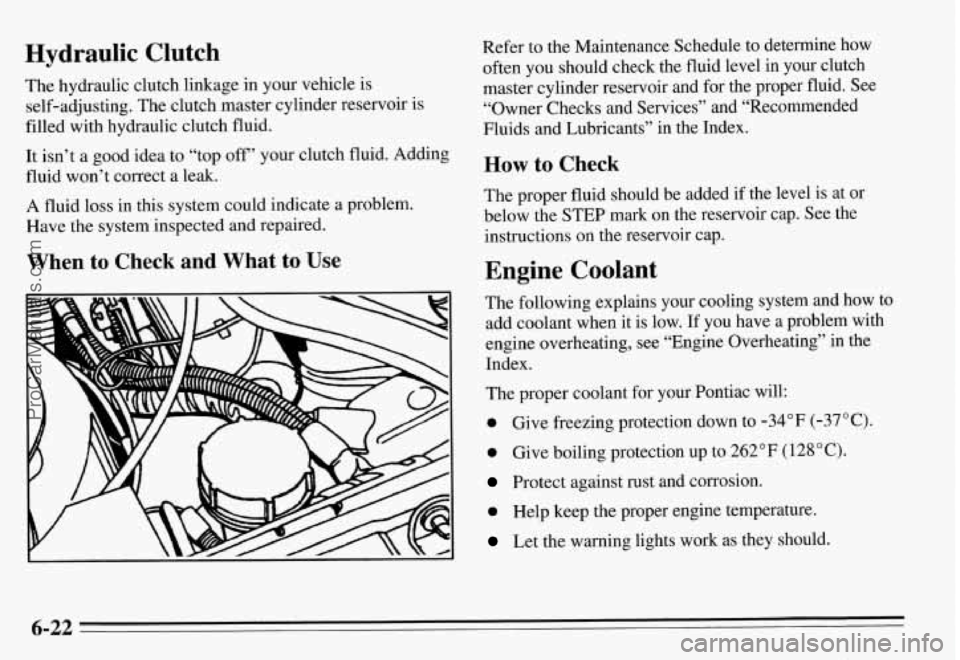
When to Check and What to Use
The proper fluid should be added if the level is at or
below the STEP mark on the reservoir cap. See the
instructions on the reservoir cap.
Engine Coolant
The following explains your cooling system and how to
add coolant when it is low. If you have a problem with
engine overheating, see “Engine Overheating” in the
Index.
The proper coolant for your Pontiac will:
0 Give freezing protection down to -34°F (-37°C).
0 Give boiling protection up to 262 OF ( 128 O C).
Protect against rust and corrosion.
0 Help keep the proper engine temperature.
Let the warning lights work as they should.
6-22
ProCarManuals.com
Page 234 of 354
What to Use
Use a mixture of one-half clean water (preferably
distilled) and one-half antifreeze that meets
“GM
Specification 1825M,” which won’t damage aluminum
parts.
You can also use a recycled coolant conforming to
GM Specification 1825M with a complete coolant flush
and refill. Use GM Engine Coolant Supplement (sealer)
with any complete coolant flush and refill. If you use
this mixture, you don’t need to add anything else.
NOTICE:
If you use an improper coolant mix, your engine
could overheat and be badly damaged. The
repair cost wouldn’t be covered by your
warranty.
Too much water in the mix can freeze
and crack the engine, radiator, heater core and
other parts.
6-23
ProCarManuals.com
Page 235 of 354
Adding Coolant To Check Coolant
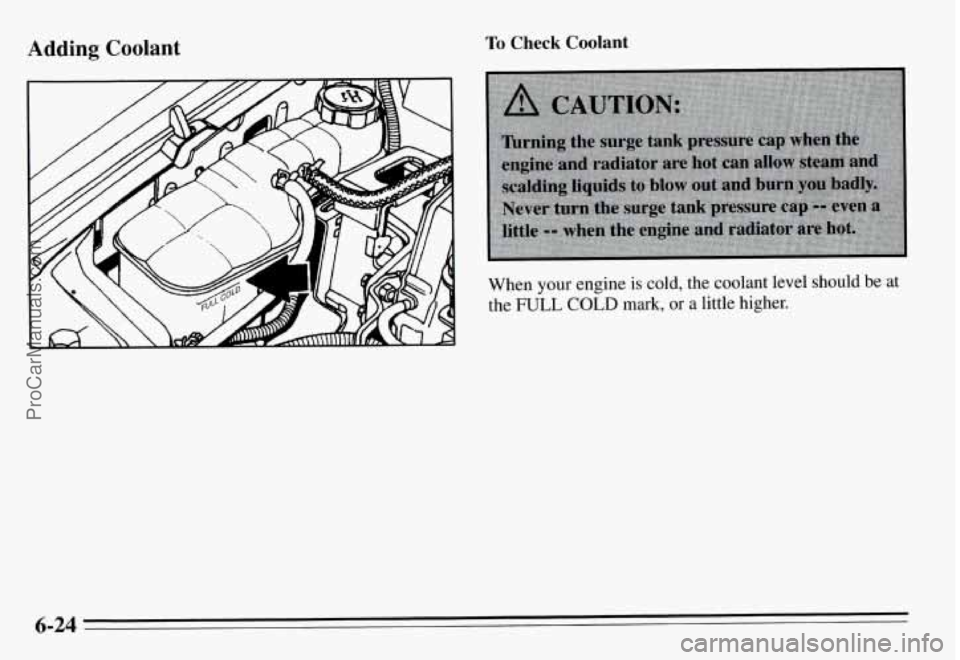
When your engine is cold, the coolant level should be at
the
FULL COLD mark, or a little higher.
6-24
ProCarManuals.com