warning light PONTIAC GRAND-AM 1995 User Guide
[x] Cancel search | Manufacturer: PONTIAC, Model Year: 1995, Model line: GRAND-AM, Model: PONTIAC GRAND-AM 1995Pages: 354, PDF Size: 17.81 MB
Page 116 of 354
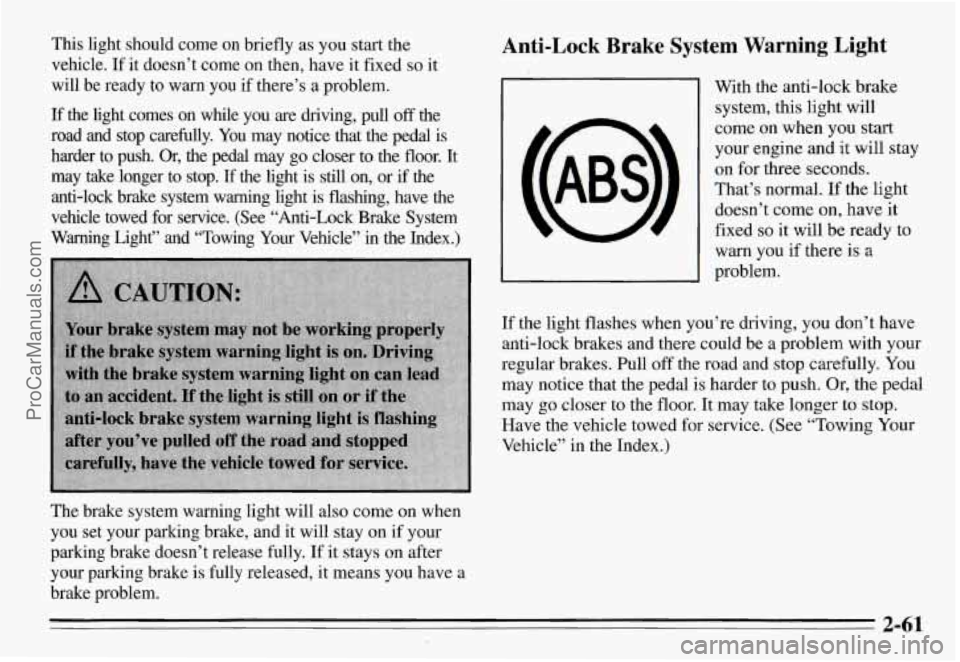
This light should come on briefly as you start the
vehicle. If it doesn’t come on then, have it fixed
so it
will be ready to warn you if there’s a problem.
If the light comes on while you are driving, pull off the
road
and stop carefully. You may notice that the pedal is
harder to push.
Or, the pedal may go closer to the floor. It
may take longer to stop. If the light is still on, or if the
anti-lock brake system warning light is flashing, have the
vehicle towed for service. (See “Anti-Lock Brake System
Warning Light” and “Towing Your Vehicle” in the Index.)
The brake system warning light will also come on when
you set your parking brake, and it will stay
on if your
parking brake doesn’t release fully. If it stays on after
your parking brake is fully released, it means you have a
brake problem.
Anti-Lock Brake System Warning Light
1
With the anti-lock brake
svstem. this lirrht will
8 u
come on when you start
your engine and it will stay
on for three seconds.
That’s normal. If the light
doesn’t come
on, have it
fixed
so it will be ready to
warn you if there is a
problem.
If the light flashes when you’re driving, you don’t have
anti-lock brakes and there could be a problem w-ith your
regular brakes. Pull off the road and stop carefully. You
may notice that the pedal is harder to push.
Or, the pedal
may go closer to the floor. It may take longer to stop.
Have the vehicle towed for service. (See “Towing Your
Vehicle” in the Index.)
2-61
ProCarManuals.com
Page 117 of 354
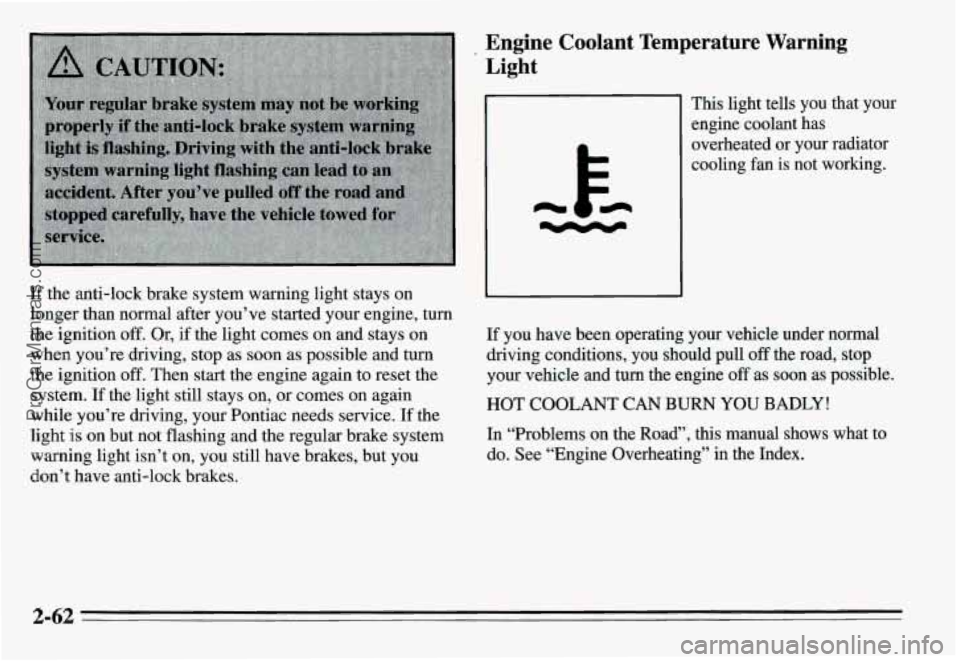
If the anti-lock brake system warning light stays on
longer than normal after you’ve started your engine, turn
the ignition off. Or, if the light comes on
and stays on
when you’re driving, stop as soon as possible and turn
the ignition
off. Then start the engine again to reset the
system. If the light still stays on, or comes on again
while you’re driving, your Pontiac needs service.
If the
light
is on but not flashing and the regular brake system
warning light isn’t on, you still have brakes, but you
don’t have anti-lock brakes.
. Engine Coolant Temperature Warning
Light
This light tells you that your
engine coolant has
overheated or your radiator
cooling fan is not working.
If you have been operating your vehicle under normal
driving conditions, you should pull off the road, stop
your vehicle and turn the engine
off as soon as possible.
HOT COOLANT CAN BURN YOU BADLY!
In “Problems on the Road”, this manual shows what to
do. See “Engine Overheating” in the Index.
2-62
ProCarManuals.com
Page 118 of 354
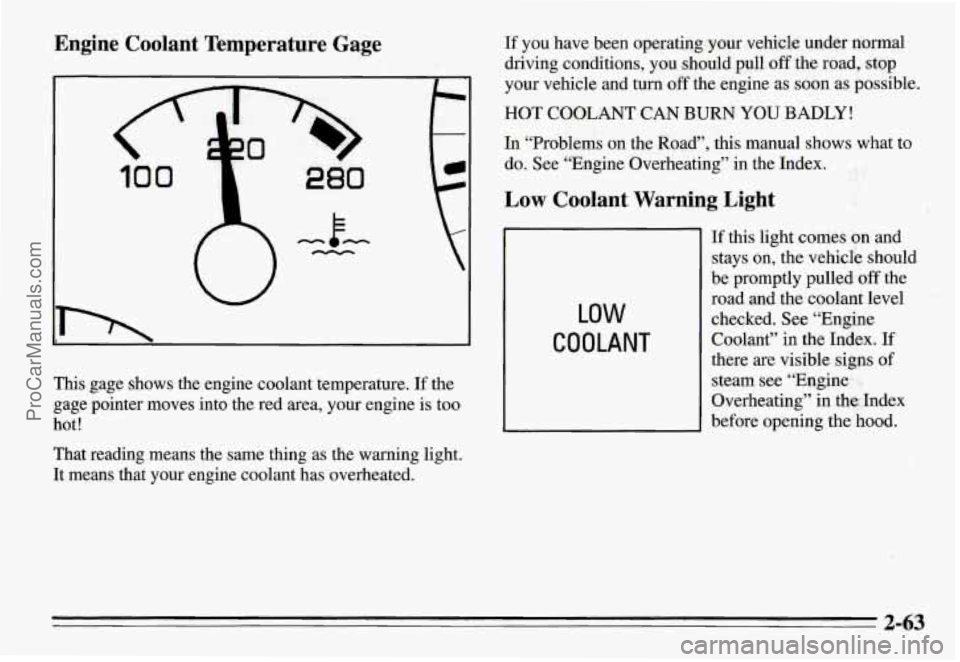
Engine Coolant Temperature Gage
loo b
280
-E- -
r-r .J
This gage shows the engine coolant temperature. If the
gage pointer moves into the red area, your engine
is too
hot!
That reading means the same thing as the warning light.
It means that your engine coolant has overheated.
If you have been operating your vehicle under normal
driving conditions, you should pull
off the road, stop
your vehicle and
turn off the engine as soon as possible.
HOT COOLANT CAN BURN YOU BADLY!
In “Problems on the Road”, this manual shows what to
do. See “Engine Overheating’, in the Index.
Low Coolant Warning Light
LOW
COOLANT
If this light comes on and
stays on, the vehicle should
be promptly pulled off the
road
and the coolant level
checked. See “Engine
Coolant” in the Index.
If
there are visible signs of
steam see “Engine
Overheating” in the:Index
before opening the hood.
2-63
ProCarManuals.com
Page 120 of 354
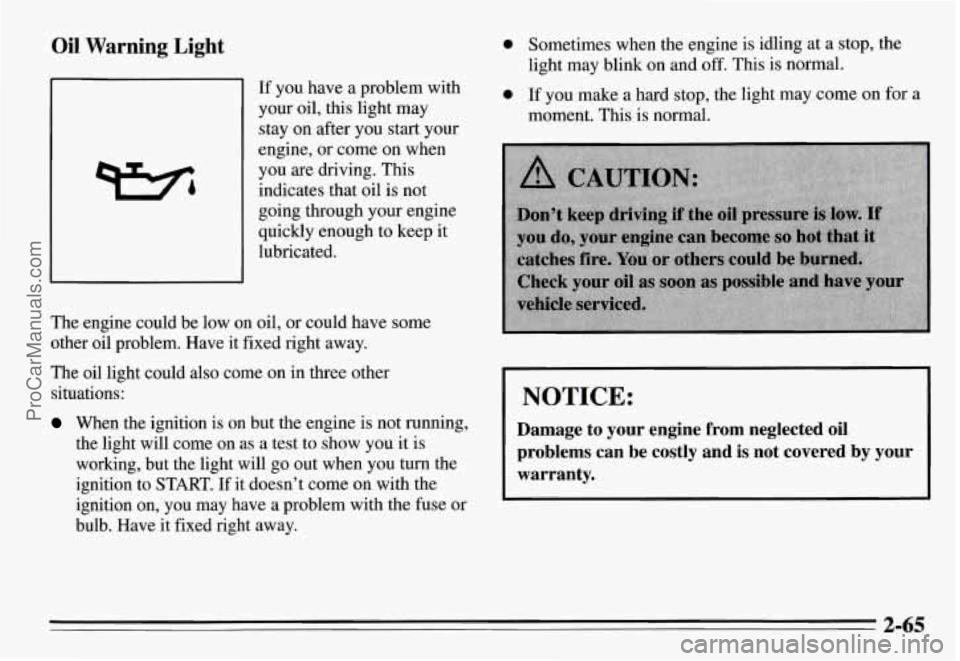
Oil Warning Light
If you have a problem with your oil, this light may
stay on after you start your
engine, or come on when
you
are driving. This
indicates that oil is not
going through your engine
quickly enough to keep it
lubricated.
The engine could be low on oil, or could have some
other oil problem. Have it fixed right away.
The oil light could
also come on in three other
situations:
When the ignition is on but the engine is not running,
the light will come on as a test to show you it is
working, but the light
will go out when you turn the
ignition
to START. If it doesn’t come on with the
ignition on, you may have a problem with the fuse or
bulb. Have it fixed right away.
0 Sometimes when the engine is idling at a stop, the
0 If you make a hard stop, the light may come on for a
light may blink on and off. This is normal.
moment. This is normal.
NOTICE:
Damage to your engine from neglected oil
problems can be costly and is not covered by your
warranty.
2-65
ProCarManuals.com
Page 123 of 354
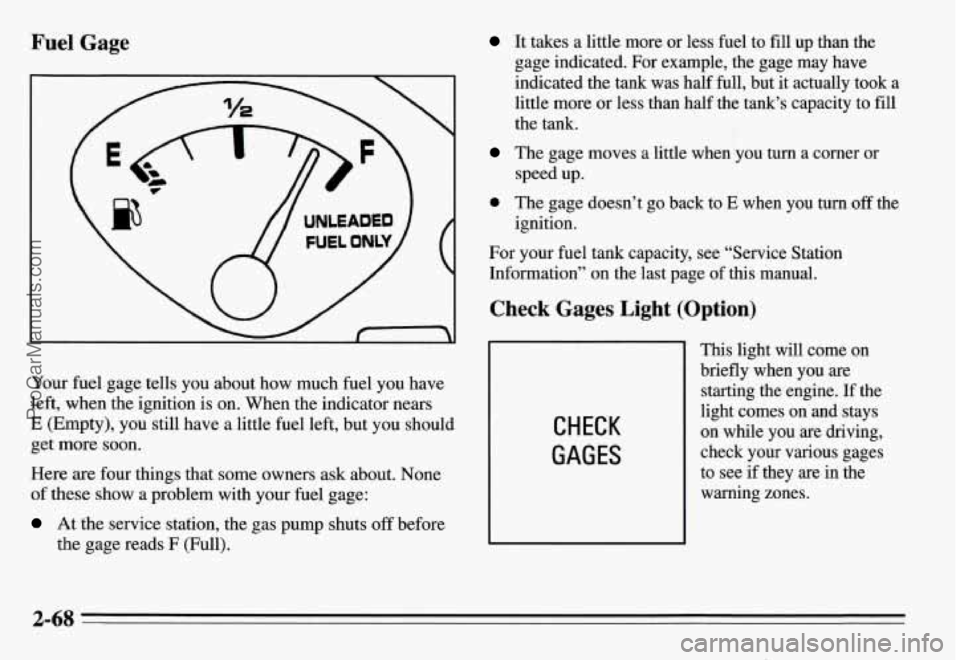
Fuel Gage
Your fuel gage tells you about how much fuel you have
left, when the ignition is on. When the indicator nears
E (Empty), you still have a little fuel left, but you should
get more soon.
Here are four things that some owners ask about. None
of these show a problem with your fuel gage:
At the service station, the gas pump shuts off before
the gage reads F (Full).
It takes a little more or less fuel to fill up than the
gage indicated. For example, the gage may have
indicated the tank was half full, but it actually took a
little more or less than half the tank’s capacity to fill
the tank.
The gage moves a little when you turn a corner or
0 The gage doesn’t go back to E when you turn off the
For your fuel tank capacity, see “Service Station
Information” on the last page of this manual.
Check Gages Light (Option)
speed up.
ignition.
CHECK
GAGES
This light will come on
briefly when you
are
starting the engine. If the
light comes on and stays
on while you are driving,
check your various gages
to see if they
are in the
warning zones.
2-68
ProCarManuals.com
Page 149 of 354
Avoid needless heavy braking. Some people drive
in spurts
-- heavy acceleration followed by heavy
braking
-- rather than keeping pace with traffic. This
is a mistake. Your brakes may not have time to cool
between hard btops. Your brakes will wear out much
faster if you do a lot
of heavy braking. If you keep pace
with the traffic and allow realistic following distances,
you will elimiaate a lot
of unnecessary braking. That
means better biaking and longer brake life.
If your engine ever stops while you’re driving, brake
normally but don’t pump your brakes.
If you do, the
pedal may get harder to push down. If your engine
stops, you will. still have some power brake assist. But
you will use it’when you brake. Once the power assist is
used
up, it may t&e longer to stop and the brake pedal
will
be harder to push.
Anti-Lock Brakes (ABS)
Your Pontiac has an advanced electronic braking system
that will help prevent a braking skid.
1
This light on the
instrument panel will come on briefly when
you start your vehicle.
When you start your vehicle, or when you begin to drive
away, you may hear a momentary motor or clicking
noise. And you may even notice that your brake pedal
moves a
little while this is going on. This is the ABS
system testing itself. If there’s a problem with the
anti-lock brake system, the anti-lock brake system
warning light will stay on or flash.
See “Anti-Lock Brake System Warning Light” in the
Index.
4-6
ProCarManuals.com
Page 160 of 354
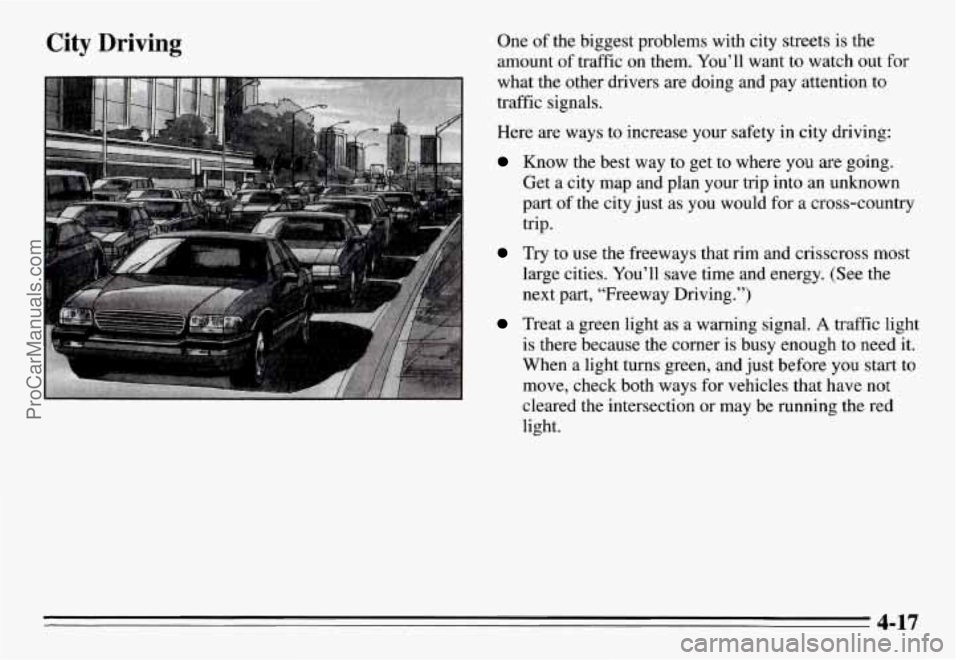
City Driving One of the biggest problems with city streets is the
amount of traffic on them. You’ll want to watch out for
what the other drivers
are doing and pay attention to
traffic signals.
Here are ways to increase your safety in city driving:
Know the best way to get to where you are going.
Get a city map and plan your trip into an unknown
part of the city just as you would for a cross-country
trip.
Try to use the freeways that rim and crisscross most
large cities. You’ll save time and energy.
(See the
next
part, “Freeway Driving.”)
Treat a green light as a warning signal. A traffic light
is there because the corner is busy enough to need it.
When a light turns green, and just before
you start to
move, check both ways for vehicles that have not
cleared the intersection or may be running the red
light.
4-17
ProCarManuals.com
Page 165 of 354
Winter Driving
Here are some tips for winter driving:
a Have your Pontiac in good shape for winter. Be sure
your engine coolant mix is correct.
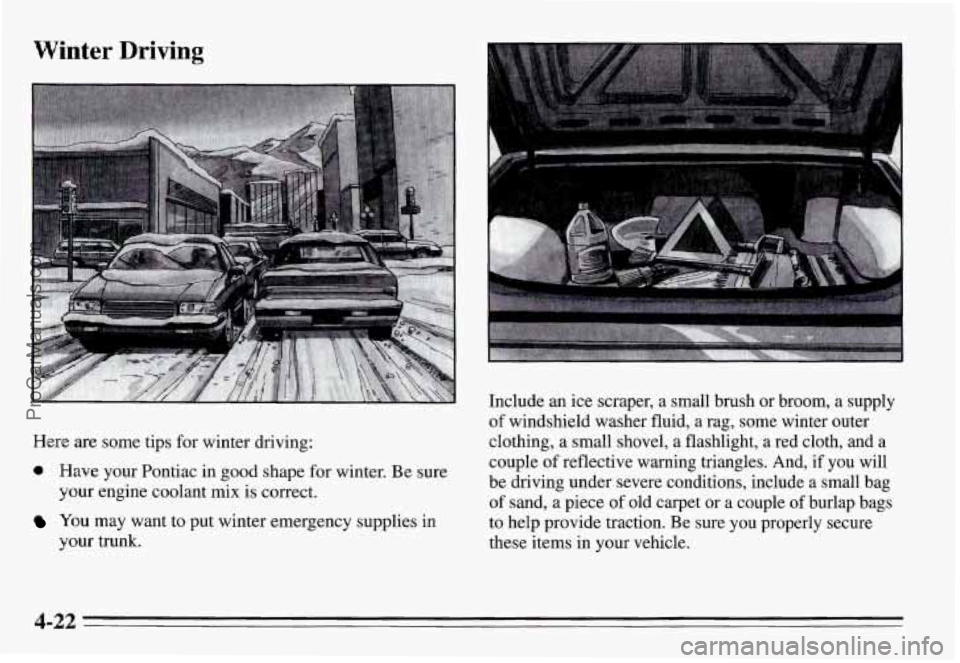
You may want to put winter emergency supplies in
your trunk.
Include an ice scraper, a small brush or broom, a supply
of windshield washer fluid, a rag, some winter outer
clothing, a small shovel, a flashlight, a red cloth, and a couple of reflective warning triangles. And, if you will
be driving under severe conditions, include a small bag
of sand, a piece
of old carpet or a couple of burlap bags
to help provide traction. Be sure you properly secure
these items in your vehicle.
4-22
ProCarManuals.com
Page 193 of 354
NOTICE:
Towing a vehicle over rough surfaces could
damage a vehicle. Damage can occur from vehicle
to ground or vehicle to wheel-lift equipment. To
help avoid damage, install a towing dolly and
raise the vehicle until adequate clearance is
obtained between the ground and/or wheel-lift
equipment.
Do not attach winch cables or J-hooks to
suspension components when using car carrier
equipment.
Always use T-hooks inserted in the
T-hook Slots.
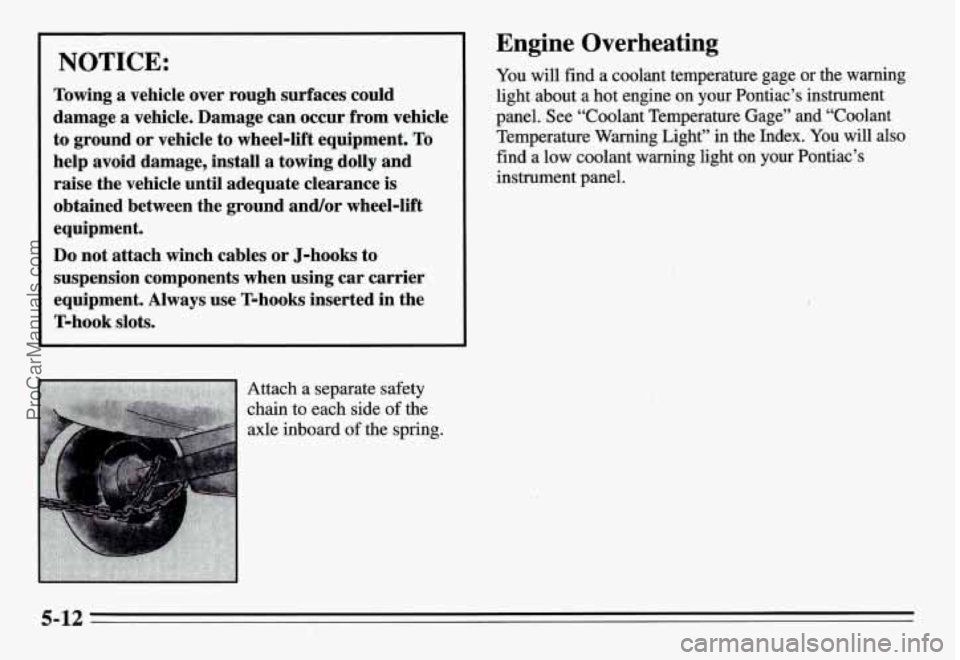
Attach a separate safety
chain to each side of the
axle inboard
of the spring.
Engine Overheating
You will find a coolant temperature gage or the warning
light about
a hot engine on your Pontiac’s instrument
panel. See “Coolant Temperature Gage” and “Coolant
Temperature Warning Light” in the Index. You will also
find a low coolant warning light on your Pontiac’s
instrument panel.
5-12
ProCarManuals.com
Page 233 of 354
Hydraulic Clutch Refer to the Maintenance Schedule to determine how often you should check the fluid level in your clutch
The hydraulic clutch linkage in your vehicle is master cylinder reservoir and for the proper fluid. See
self-adjusting. The clutch master cylinder reservoir is “Owner Checks and Services” and “Recommended
filled with hydraulic clutch fluid. Fluids and Lubricants” in the Index.
It isn’t a good idea to “top off’ your clutch fluid. Adding
fluid won’t correct a leak. How to Check
A fluid loss in this system could indicate a problem.
Have the system inspected and repaired.
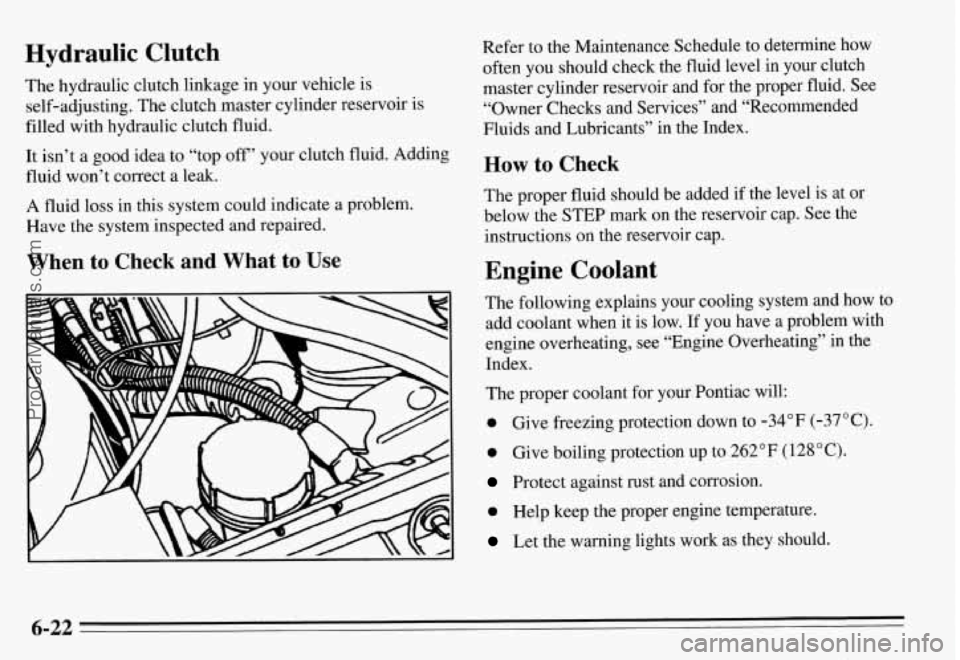
When to Check and What to Use
The proper fluid should be added if the level is at or
below the STEP mark on the reservoir cap. See the
instructions on the reservoir cap.
Engine Coolant
The following explains your cooling system and how to
add coolant when it is low. If you have a problem with
engine overheating, see “Engine Overheating” in the
Index.
The proper coolant for your Pontiac will:
0 Give freezing protection down to -34°F (-37°C).
0 Give boiling protection up to 262 OF ( 128 O C).
Protect against rust and corrosion.
0 Help keep the proper engine temperature.
Let the warning lights work as they should.
6-22
ProCarManuals.com