dead PONTIAC GRAND-AM 1996 Owners Manual
[x] Cancel search | Manufacturer: PONTIAC, Model Year: 1996, Model line: GRAND-AM, Model: PONTIAC GRAND-AM 1996Pages: 356, PDF Size: 17.17 MB
Page 85 of 356
Running Your Engine While You’re
Parked (Automatic Transaxle)
It’s better not to park with the engine running. But if you
ever have to, here are some things to know.
/$ CAUTION:
Idling the engine with the air system control off
could allow dangerous exhaust into your vehicle
(see the earlier Caution under “Engine
Exhaust”).
Also, idling in a closed-in place can let deadly
carbon monoxide
(CO) into your vehicle even if
the fan switch is at the highest setting. One place
this can happen
is a garage. Exhaust -- with
CO -- can come in easily. NEVER park in a
garage with the engine running.
Another closed-in place can be
a blizzard. (See
“Blizzard” in
the Index.)
1
It can be dangerous to get out of your vehicle if
the shift lever
is not fully in PARK (P) with the
parking brake firmly set. Your vehicle can roll.
Don’t leave your vehicle when the engine is
running unless you have to.
If you’ve left the
engine running, the vehicle can move suddenly.
You or others could be injured.
To be sure your
vehicle won’t move, even when you’re on fairly
level ground,
always set your parking brake and
move the shift lever to PARK (P).
Follow the proper steps to be sure your vehicle won’t
move. See “Shifting Into PARK (P)” in the Index.
If you are parking on a hill and if you’re pulling a
trailer? also see “Towing a Trailer” in the Index.
2-29
ProCarManuals.com
Page 176 of 356
Tie a red cloth to your vehicle to alert police that
you’ve been stopped by the snow.
Put on extra clothing or wrap a blanket around you.
If you have no blankets or extra clothing, make body
insulators
frob newspapers, burlap bags, rags, floor
mats -- anything you can wrap around yourself or
tuck under your clothing to keep warm. ..
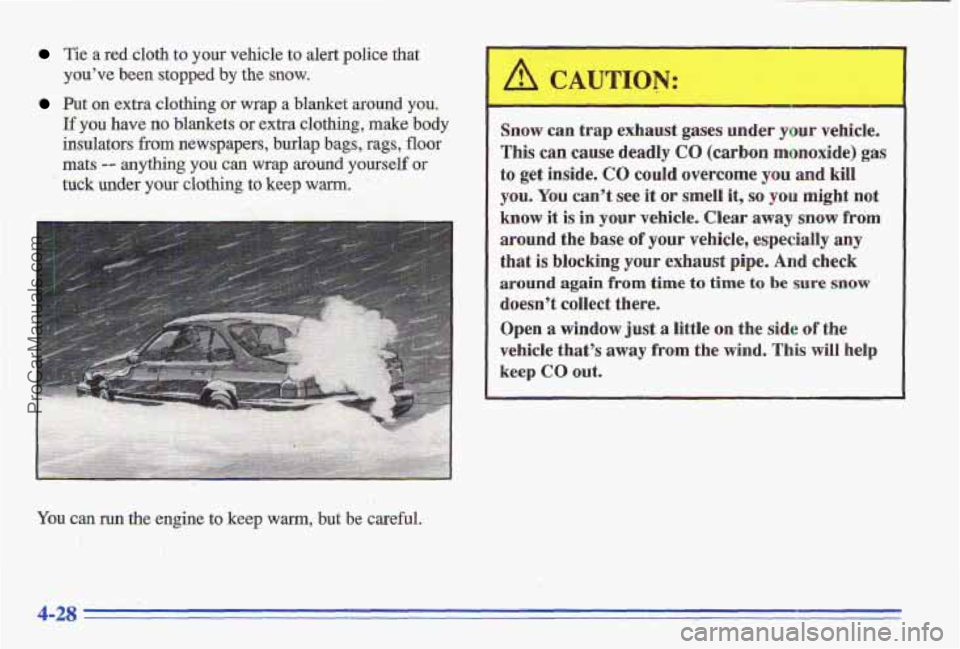
Snow can trap exhaust gases under your vehicle.
This
can cause deadly CO (carbon monoxide) gas
to get inside. CO could overcome you and kill
you. You can’t see it or smell it, so you might not
know it is in your vehicle. Clear away snow from
around the base of your vehicle, especially any
that
is blocking your exhaust pipe. And check
around again from time to time to be sure snow
doesn’t collect there.
Open
a window just a little on the side of the
vehicle that’s away from the wind. This will help
keep
CO out.
You can sun the engine to keen warm, but be careful.
1. ..
‘4 . ’% . , ! 1- . ,;
4-28
.. .
ProCarManuals.com
Page 184 of 356
Weight of the Trailer Tongue
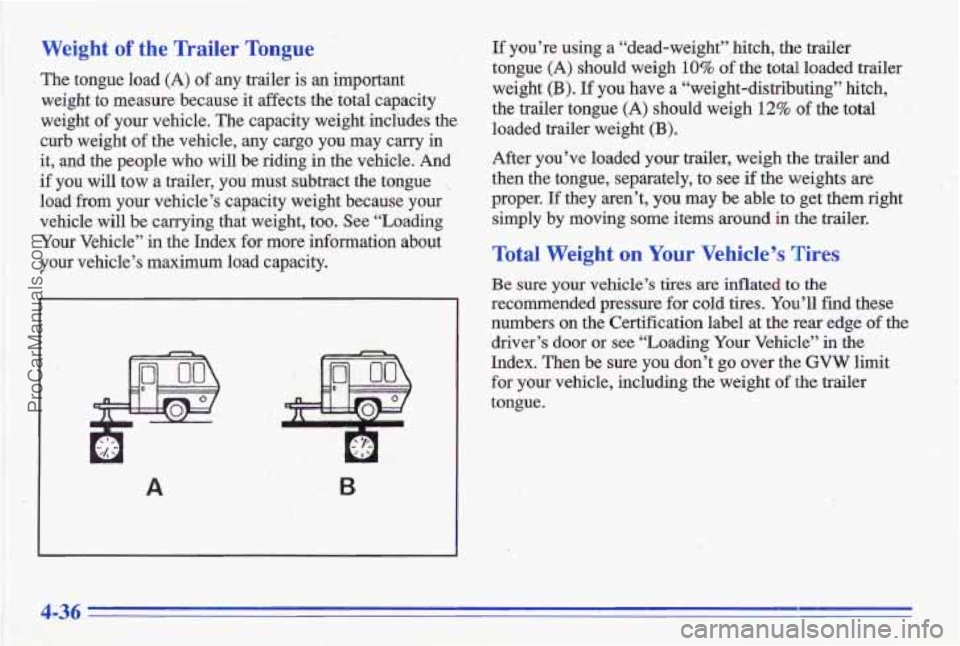
The tongue load (A) of any trailer is an important
weight to measure because it affects the total capacity
weight of your vehicle. The capacity weight includes the
curb weight of the vehicle, any cargo you may carry
in
it, and the people who will be riding in the vehicle. And
if you will tow a trailer, you must subtract the tongue _.
load from your vehicle’s capacity weight because your
vehicle will be carrying that weight,
too. See “Loading
Your Vehicle” in the Index for more information about
yow vehicle’s maximum load capacity.
B
If you’re using a “dead-weight” hitch, the trailer
tongue
(A) should weigh 10% of the total loaded trailer
weight
(€3). If you have a “weight-distributing” hitch,
the trailer tongue
(A) should weigh 12% of the total
loaded
trailer weight (B).
After you’ve loaded your trailer, weigh the trailer and
then the tongue, separately, to see if the weights me
proper. If they aren’t, you may be able to get them right
simply
by moving some items around in the trailer.
Total Weight on Your Vehicle’s Tires
Be sure your vehicle’s tires are inflated to the
recornended pressure for cold tires. You’ll find these
numbers on
the Certification label at the rear edge of the
driver’s door or see “Loading Your Vehicle” in the
Index. Then be sure you don’t
go over the GVW limit
for your vehicle, including the weight
of the trailer r
tongue.
.’ . :
4-36
ProCarManuals.com
Page 185 of 356
Hitches Safety Chains
It’s important to have the correct hitch equipment.
Crosswinds, large trucks going by
and rough roads are a
few reasons why you’ll need the right hitch. Here are
some rules to follow:
Will you have to make any holes in the body of your
vehicle when
you install a trailer hitch? If you do,
then be sure to seal the holes later when you remove
the hitch.
If you don’t seal them, deadly carbon
monoxide
(CO) from your exhaust can get into your
vehicle (see “Carbon Monoxide” in the Index). Dirt
’ and water can, too.
The bumpers on your vehicle are not intended for
hitches. Do not attach rental hitches or other
bumper-type hitches to them. Use only a
frame-mounted hitch that
does not attach to the
bumper.
i
You should always attach chains between your vehicle
and your trailer.
Cross the safety chains under the tongue
of the trailer so that the tongue will not drop to the road
if it becomes separated from the hitch. Instructions
about safety chains may be provided by the hitch
manufacturer or by the trailer manufacturer. Follow the
manufacturer’s recommendation for attaching safety chains and do not attach
them to the bumper. Always
leave just enough slack
so you can prn with your rig.
And, never allow safety chains to drag on the ground.
Trailer Brakes
Does your trailer have its own brakes?
Be sure
to read and follow the instructions for the trailer
brakes so you’ll be able to install, adjust and maintain
them properly.
And because you have anti-lock brakes,
do not try to tap into your vehicle’s brake system. If you
do, both brake systems won’t work well, or at all.
4-34
ProCarManuals.com
Page 195 of 356
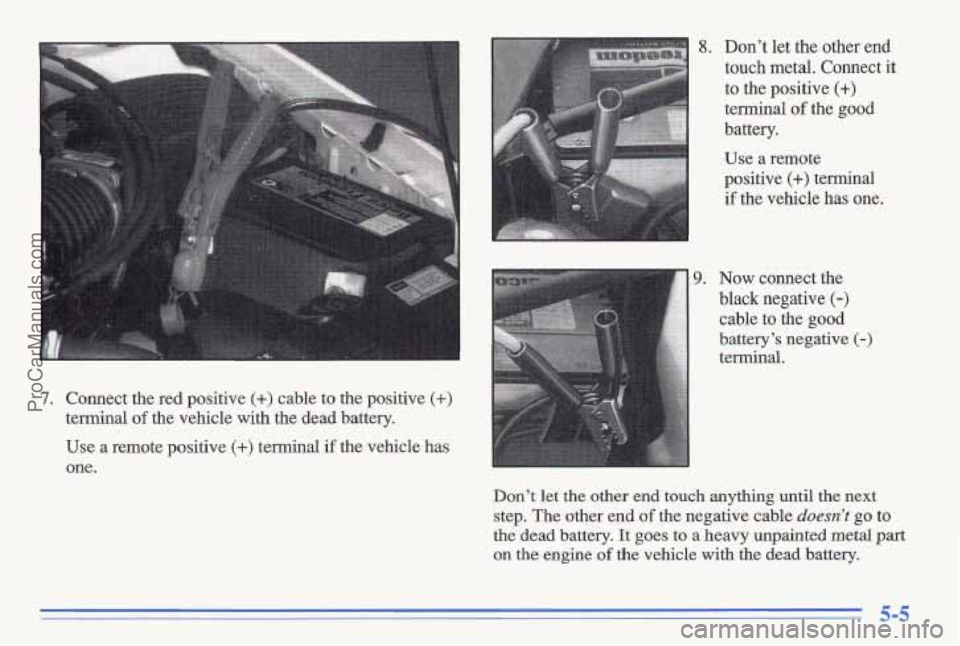
Use a remote positive (+) terminal if the vehicle has
one.
8. Don’t let the other end
touch metal. Connect it
to the positive
(+)
terminal of the good
battery.
Use a remote
positive
(+) terminal
if the vehicle has one.
7. Connect the red positive (+) cable to the positive (+)
terminal of the vehicle with the dead battery.
II
9. Now connect the
black negative
(-)
I cable to the good q;<2: &?:I battery’s negative (-)
terminal.
Don’t let the other end
touch anything until the next
step. The other end
of the negative cable doesn’t go to
the dead battery.
It goes to a heavy unpainted metal part
on the engine of the vehicle with the dead battery.
5-5
ProCarManuals.com
Page 196 of 356
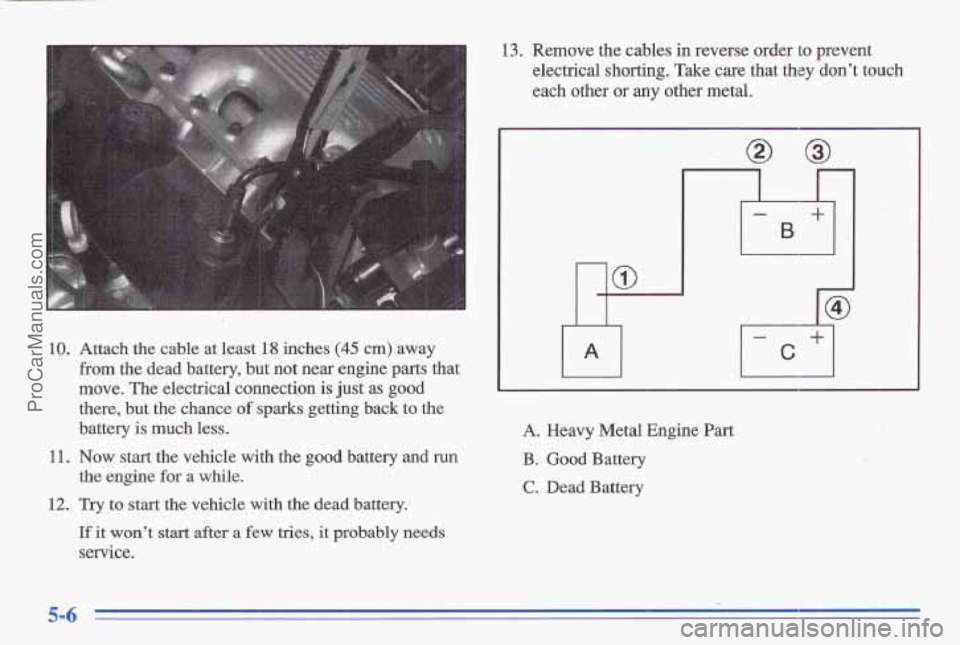
10. Attach the cable at least 18 inches (45 cm) away
from the dead battery, but not near engine pasts that
move. The electrical connection is just as good
there, but the chance of sparks getting back to the
battery
is much less.
the engine for a while.
11. Now start the vehicle with the good battery and run
12. Try to start the vehicle with the dead battery.
If it won’t start after a few tries, it probably needs
service.
13. Remove the cables in reverse order to prevent
electrical shorting.
Take care that they don’t touch
each other or
any other metal.
A. Heavy Metal Engine Part
B. Good Battery
C. Dead Battery
-
5-6
ProCarManuals.com
Page 345 of 356
Climate Control System ........................... 3-1 .
Climate Control System with Air Conditioning ......... 3-3
Clock. Setting the ................................ 3-8
Clutch. Hydraulic
............................... 6-21
Clutch Fluid. Hydraulic
.......................... 6-22
Comfort Controls
................................ 3 - 1
Compact Disc Adapter Kit ................... 3- 13, 3- 16
Compact Disc Care .............................. 3#-25 .
Compact Disc Player ............................ 3-17
Compact Disc Player Errors
.... ................... 3 - 18
Compact Spare Tire
............................. 5-31
Control
of a Vehicle ............................... 4-5
Convex Outside Mirror
.......................... 2-45
Coolant
....................................... 6-22
Heater. Engine
............................... 2- 16
Surge Tank ................................... 5-16
Surge Tank Pressure Cap
....................... 6-26
Courtesy Transportation ........................... 8-7
Cruise Control ................................. 2-35
Customer Assistance for Text Telephone Users ......... 8-4
Customer Satisfaction Procedure
.................... 8-2
Coinholder
.................................... 2-46
Cooling System ....................... .( ........ 5-14
Customer Assistance Information
.................... 8- 1
Damage. Finish ................................ 6-51 Defensive Driving
............................... 4- 1
Defogger. Rear Window .......................... 3-7
Defogging
..................................... 3-6
Defrosting
...................................... 3-6
Dimensions. Vehicle ............................. 6-61
Dolby@
B Noise Reduction ....................... 3-12
Driver Position
................................. 1-12 Door Locks .................. ,. .................. 2.-3
Defensive
.................................... 4-1
Drunken ..................................... 4-2
Freeway
.................................... 4-21
Night
. '\. .................................... 4-15
On Grades While Towing a Trailer ............... 4-39
On Hill and Mountain Roads
.................... 4-23
Through Water ................................ 4-19
Winter
....................................... 4-25
With a Trailer ................................ 4-38
-In a Blizzard .................................. 4-27
In Foreign Countries ............................ 6-3
IntheRain
................................... 4-17
OnCurves
.................................. 4-10
On Snow and Ice .............................. 4-26
WetRoads
.................................. 4-17
Drunken Driving
................................ 4-2
' .. 4 . 0 . . ;.&$ ... .:;::.I.... .... :?&% Damage. Sheet Metal ............................ 6-50 .. VI
Daytime Running Lamps ......................... 2-40 Easy Entry Seat ...................
Dead Battery ................................... 5-2 Electrical Equipment. Adding ...... 2-
Defects. Reporting Safety ......................... 8-9 Electrical System ...................
.............
14.2.15.3.24. 6254 1-6
............ 6-54
9-3
ProCarManuals.com