fuel PONTIAC GRAND-AM 1996 Owners Manual
[x] Cancel search | Manufacturer: PONTIAC, Model Year: 1996, Model line: GRAND-AM, Model: PONTIAC GRAND-AM 1996Pages: 356, PDF Size: 17.17 MB
Page 7 of 356
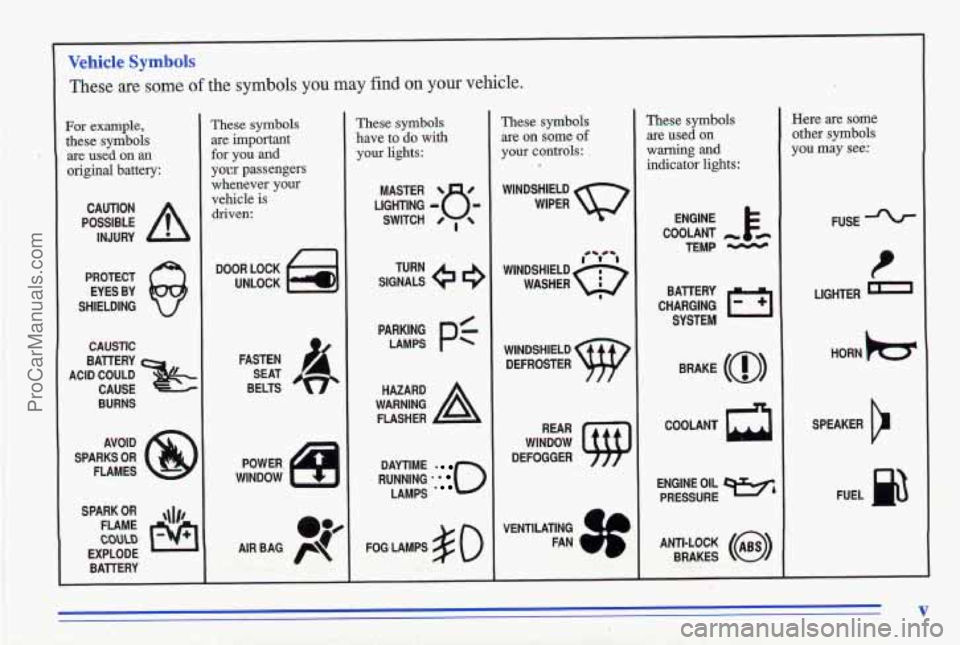
For example,
these symbols
me used on an
original battery:
POSSIBLE A
CAUTION
INJURY
PROTECT EYES BY
SHIELDING
CAUSTIC
ACID COULD BAllERY
CAUSE
BURNS
AVOID
SPARKS OR FLAMES
FLAME
EXPLODE BAllERY
These symbols
are important
for you and
yorr passengers
whenever your
vehicle is
driven:
DOOR LOCK
UNLOCK
FASTEN SEAT
BELTS
Vehicle Symbols
These are some of the symbols you may find on your vehicle.
Op
AIR BAG p
These symbols
have
to do with
your lights:
SIGNALS e
TURN
PARKING
pf
LAMPS
RUNNING
' ' 0
DAYTIME *
LAMPS *
FOG LAMPS $0
These symbols
are
on some of
your controls:
WINDSHIELD
DEFROSTER
WINDOW
DEFOGGER
VENTILATING FAN
These symbols are used on
warning and
indicator lights:
ENGINE k
COOLANT - rd
TEMP -
BRAKE (0)
ENGINE OIL
PRESSURE
ANTI-LOCK
(e)
BRAKES
Here are some
other symbols
you may
see:
FUSE
LIGHTER
m
HORN )tr
SPEAKER
b
il'
FUEL
V
ProCarManuals.com
Page 64 of 356
Trunk Trunk Lock
4 CAUTION: ..
It can be dangerous to drive with the trunk lid
open because carbon monoxide
(CO) gas can
come into your vehicle. You can’t see or smell
CO. It can cause unconsciousness and even death.
If you must drive with the trunk lid open or if
electrical wiring or other cable connections must
pass through the seal between the body and the
trunk’ lid:
Make sure all windows are shut.
0 lbrn the fan on your h’eating or cooling
system to its highest speed with the setting
on VENT. That will force outside air into
your vehicle.
See “Comfort Controls’’ in the
Index.
instrument panel,
open them all the way.
If you have ai: outlets on or under the
See “Engine Exhaust” in the Index.
To unlock the trunk from the outside, insert one of the
keys to the vehicle and turn the trunk
lock cylinder.
Remote Trunk Release
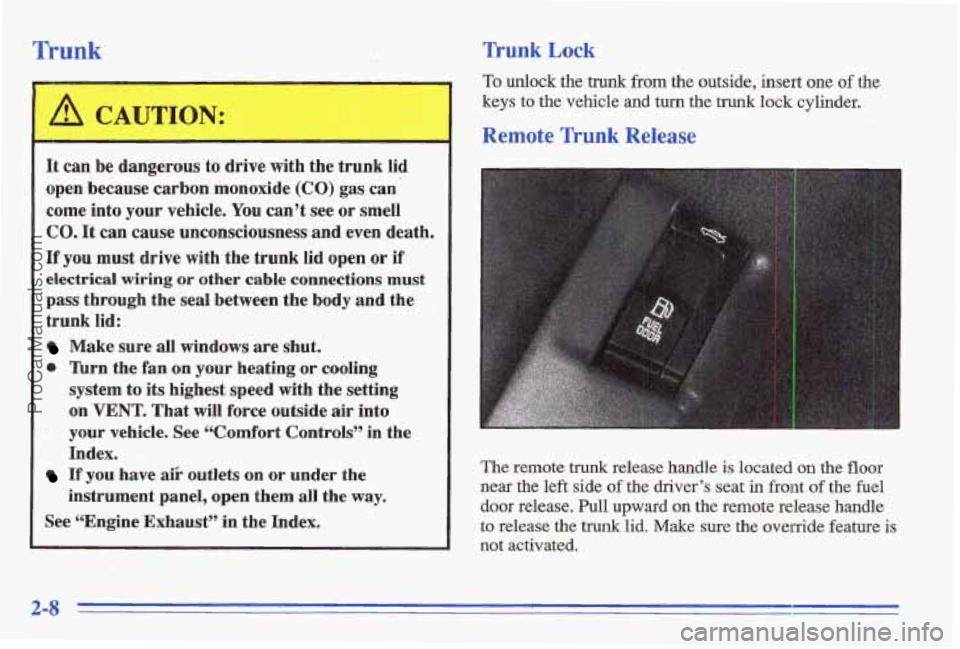
The remote trunk release handle is located on the floor
near the left side of the driver’s seat in front of the fuel
door release. Pull upward on the remote release handle
to release the
trunk lid. Make sure the override feature is
not activated.
2-8
ProCarManuals.com
Page 66 of 356
If you par^ in a lot where someone will be wawung
your vehicle, it’s best to lock it
up and take your keys.
But what if you have to leave
your ignition key? What if
you have to leave something valuable. in your vehicle?
Put your valuables in a storage area, lie your trunk
Lock the glove box,
Lock all the doors except the driver’s.
or
glove
box,
e Then take the door key with you.
Passlock TM
Your venicle 1s equipped with the Passlock
theft-deterrent system.
Passlock
is a passive theft-deterrent system. The system
,is armed once the key is‘removed from the ignition.
Passlock enables fuel if the ignition lock cylinder is
turned
with a valid key. If a correct key is not used, fuel
is disabled.
During
normal operation, the THEFT SYS light will go
off after the engine is started. In the unlikely event that
the engine stalls and the THEFT SYS light flashes, wait
until the light stops flashing b’efose
trying to restart the
engine. Remember to release the key
from the START
position as soon as the engine starts. If after several tries
the vehicle still does
not start, the vehicle may need
service. At this time, you may
also want to check the
fuses (see “Fuses and Circuit Breakers” in the Index).
See your Pontiac dealer for service.
If the THEFT SYS light comes on while the engine is
running, a problem
has been detected and the system
may need service. See your dealer for service.
In an emergency, call the Bontiac Roadsi4e Assistance
Program at 1-8OO-RBADSIDE or 1-800-762-3743.
ProCarManuals.com
Page 72 of 356
Engine Coolant Heater (Option)
2.4L Engine
c
c
I RI
3.1L Engine
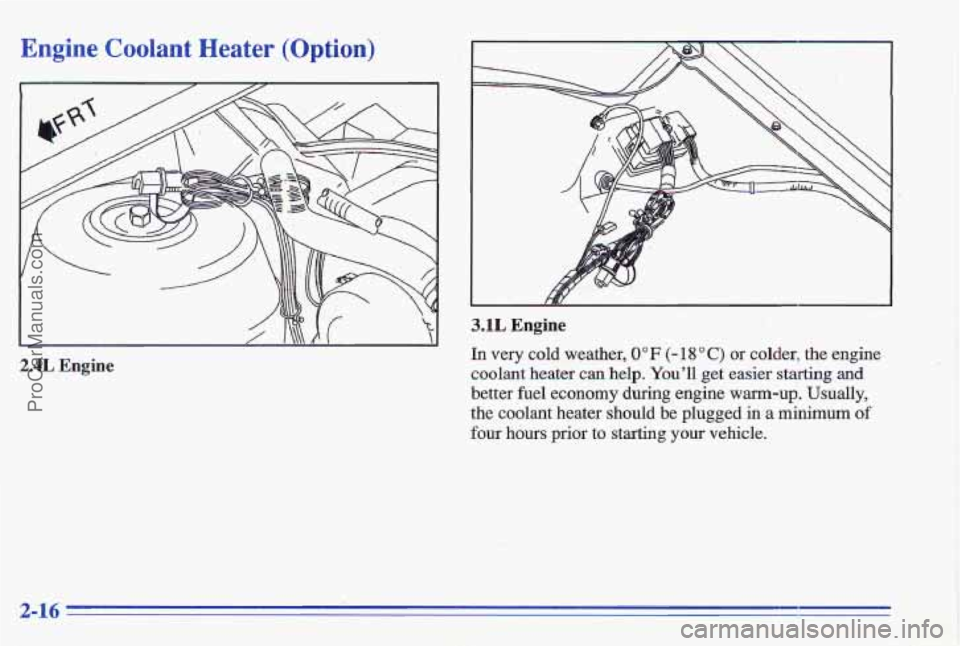
In very cold weather, 0°F (- 18°C) or colder, the engine
coolant heater can help. You’ll get easier starting and
better fuel economy during engine warm-up. Usually,
the coolant heater should be plugged
in a minimum of
four hours prior to starting your vehicle.
2-16
ProCarManuals.com
Page 76 of 356
AUTOMATIC OVERDRIVE (D): This position is for-
normal driving with the four-speed automatic transaxle.
If
you need more power for passing, and you’re:
0 Going less than about 35 mph (55 km/h), push your
Going about 35 mph (55 km/h) or more, push the
The transaxle will automatically shift down to the next gear
and provide more power.
THIRD (3): This position is also used for normal
driving, however, it offers more power and lower fuel
economy than AUTOMATIC OVERDRIVE (D). Here
are some times you might choose THIRD (3) instead of
AUTOMATIC OVERDRIVE (D):
When driving on hilly, winding roads.
0 When towing a trailer, so there is less shifting
0 When going down a steep hill,
accelerator
pedal about halfway down.
accelerator
all the way down.
between
gears.
SECOND (2) and FIRST (1): These positions provide
second and first gear performance. When downshifting
from AUTOMATIC OVERDRIVE (D) or THIRD (3)
into SECOND (2), the transaxle will operate in second
gear at vehicle speeds greater than 20 mph (32 km/h)
and in first gear at vehicle speeds less than 20 mph
(32 km/h).
_. .
NOTICE:
Don’t drive in SECOND (2) for more than 25 miles
(41 km), or at speeds over 55 mph (88 kdh), or
you
can damage your transaxle. Use THIRD (3)
or AUTOMATIC OVERDRIVE (D) as much as
possible,
Don% shift into SECOND
(2) unless you are going
slower than 65 rnph (109 kmh), or you can
damage your engine.
...
.’. ’ ir ’
2-20
ProCarManuals.com
Page 78 of 356
NEUTRAL '(N): Use this position when you start or
idle your engine.
REVERSE (R): To back up, press down the clutch
pedal and shift into REVERSE (R). Let up on the clutch
pedal slowly
while pressing the accelerator pedal.
'1 NOTICE:
Shift to REVERSE (R) only after your vehicle is
stopped. Shifting to REVERSE (It) while your
vehicle is moving could damage your transaxle.
..
1
Also, use WVERSE (R), along with the parking brake,
for parking your vehicle.
Shift Speeds
I A CAUTION:
If you skip more than one gear when you
downshift, you could lose control of your vehicle.
And you could injure yourself or others. DonY
shift from
FIFTH (5) to SECOND (2) or from
FOURTH (4) to FIRST (1).
This chart shows when to shift to the next higher gear
for best
fuel economy.
ProCarManuals.com
Page 79 of 356
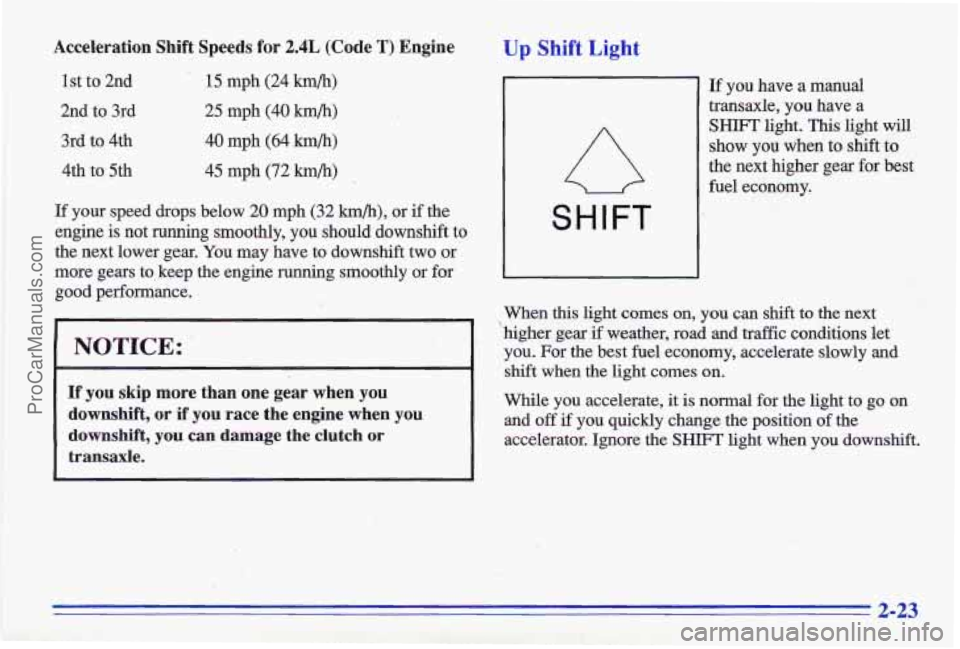
Acceleration Shift Speeds for 2.4L (Code T) Engine
1st to 2nd 15 mph (24 krn/h)
2nd to 3rd 25 mph (40 krn/h)
3rd to 4th 40 mph (64 h/h)
4th to 5th 45 mph (72 km/h)
If your speed drops below 20 mph (32 lun/h), or if the
engine is not running smoothly, you should downshift to
the next lower gear. You may have to downshift two or
more gears
to, keep the engine running smoothly or for
good performance.
NOTICE:
If you skip more than one gear when you
downshift, or if you race the engine when you
downshift, you can damage the clutch or
transaxle.
Up Shift Light
SHIFT
If you have a manual
transaxle, you have a
SHIFT light. This light will
show you when to
shift to
the next higher gear for best
fuel economy.
When this light comes on, you can shift
to the next
higher gear
if weather, road and traffic conditions let
you. For the best fuel economy, accelerate slowly and
shift when the light comes on.
\,
While you accelerate, it is normal for the light to go on
and off if you quickly change the position of the
accelerator. Ignore the
SHIFT light when you downshift.
2-23
ProCarManuals.com
Page 107 of 356
Your instlument panel is designed to let you know at a
glance how your vehicle is running. You’ll know how
fast you’re going,
how much fuel you’re using, and
many other things you’ll need to drive safely and
economically.
The main components of your instrument panel are:
A. Fuse Panel
B. Vent
C. Turn Signal/Multifunction ,Lever
D. SRS - Supplemental Restraint System (Air Bag)
E. Hazard Warning Flashers Switch
E Instrument Cluster
G. Windshield Wipersmasher Stalk
H. Audio System
I. Side Window Defogger Vent
J. Glove Box
K. Climate Control System
L. Gear Shift Lever
M. Ashtray
N. Enhanced Traction System (ETS) Switch (Option)
0. Lighter
P. Ignition Switch
Q. Tilt Steering Wheel Lever (Option)
R. Fog Lamp Switch
S. Instrument Panel Intensity Control/ Interior Lamps
Switch
T. Hood Release Handle
2-51
ProCarManuals.com
Page 116 of 356
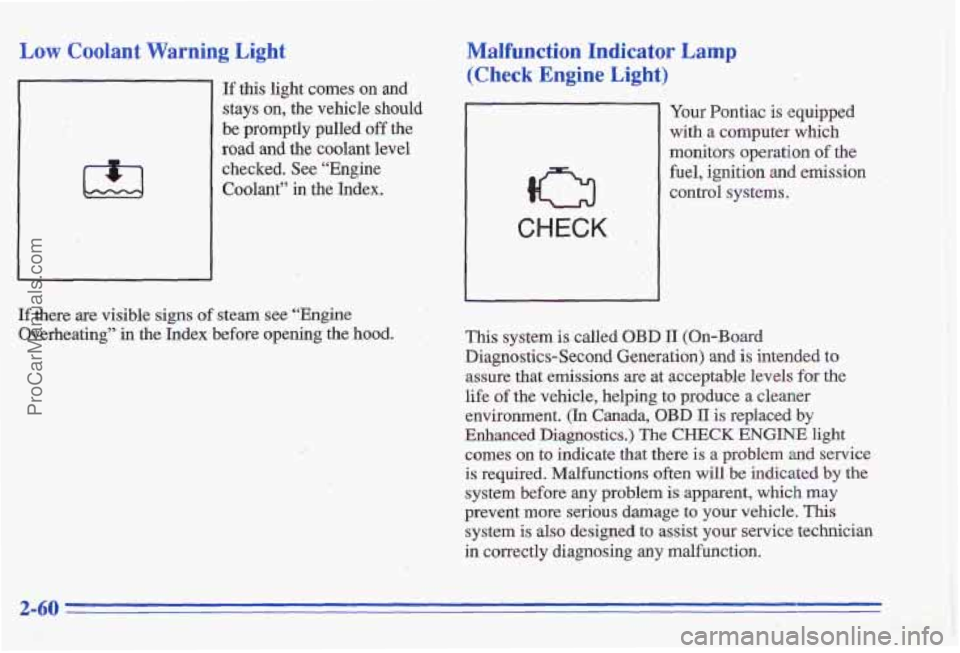
Low Coolant Warning Light
; I’ ,.
If this light comes on and
stays on, the vehicle should
be promptly pulled
off the
road and the coolant level
checked.
See “Engine
Coolant”
in the Index.
Malfunctilon Indicator Lamp
(Check Engine Light) ~ ..
0
CHECK
Your Pontiac is equipped
with a computer
which
monitors operation of the
fuel, ignition and emission
control systems.
If there are visible signs of steam see “Engine
Overheating” in the
Index before opening the hood. , . ’? --+ -- This system is called OBD I1 (On-Board .>. ’ I .;: . , Diagnostics-Second Generation) and is intended to
.-. . assure that emissions are at acceptable levels for the
life of the vehicle, helping to produce a cleaner
environment.
(In! Canada, OBD 11 is replaced by
Enhanced Diagnostics.) The CHECK ENGINE light
comes on to indicate that there is a problem and service
is required, Malfunctions often will
be indicated by the
system before
any problem is apparent, which may
prevent more serious damage to your vehicle. This
system is
also designed to assist your service technician
d . in correctly diagnosing any malfunction.
.. .? ’. .. .- . .. i - ,, , c < -. , ,. t :. . ‘7 -n. 9’ .! , . ‘i :- -:x: :, -’ ::;.- . b- .. ,- , . .. .. . : .. -. I. . :. ‘1 .’ ’ E -, . - . r_ :. .. . I. , I -.. . I .C . .. . . .. . .-..-‘ >: =: , , ‘. .. -; T‘.
’ ““2-60
ProCarManuals.com
Page 117 of 356
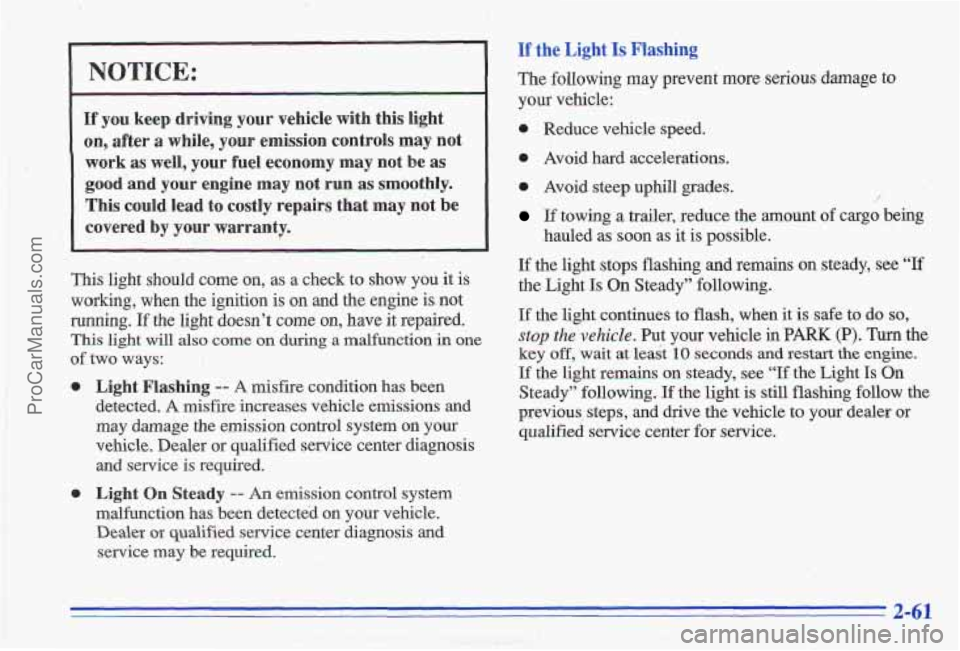
I NOTICE:
If you keep driving your vehicle with this light
on, after a while, your emission controls may nmot
work as well, your fuel economy may not be as
good and your engine may not run as smoothly.
This could lead to costly repairs that may not be
covered by your warranty.
This light should come on, as a check to show you it is
working, when the ignition
is on and the engine is not
running.
If the light doesn’t come on, have it repaired.
This
light will also come on during a malfunction’ in one
of two ways:
0 Light Flashing -- A misfire condition has been
detected.
A misfire increases vehicle emissions and
may damage the emission control system on your
vehicle. Dealer or qualified service center diagnosis
and service is required.
0 Light On Steady -- An emission control system
malfunction has been detected on your vehicle.
Dealer or qualified service center diagnosis and
service may be required.
If the Light Is Flashing
The following may prevent ml
your vehicle:
0 Reduce vehicle speed.
0 Avoid hard accelerations.
0 Avoid steep uphill grades.
e serious damage to
i
If towing a trailer, reduce the amount of cargo being
hauled as-soon as it is possible.
If the light stops flashing and remains on steady, see “If
the Light Is On Steady” following.
If the light continues to flash, when it is safe to do so,
stop the vehicle. Put your vehicle in PARK (P). Turn the
key off, wait at least 10 seconds and restart the engine.
If the light remains on steady, see “If the Light Is On
Steady” following.
If the light is still flashing follow the
previous, steps, and drive the vehicle to
your dealer or
qualified service center for service.
2-61
ProCarManuals.com