light PONTIAC GRAND AM 1997 User Guide
[x] Cancel search | Manufacturer: PONTIAC, Model Year: 1997, Model line: GRAND AM, Model: PONTIAC GRAND AM 1997Pages: 371, PDF Size: 18.14 MB
Page 91 of 371
Turn and Lane Change Signals
The turn signal has two upward (for right) and two
downward (for left) positions. These positions allow you
to signal a turn or a lane change.
To signal a turn, move the lever all the way up or down.
When the turn is finished, the lever will return
automatically.
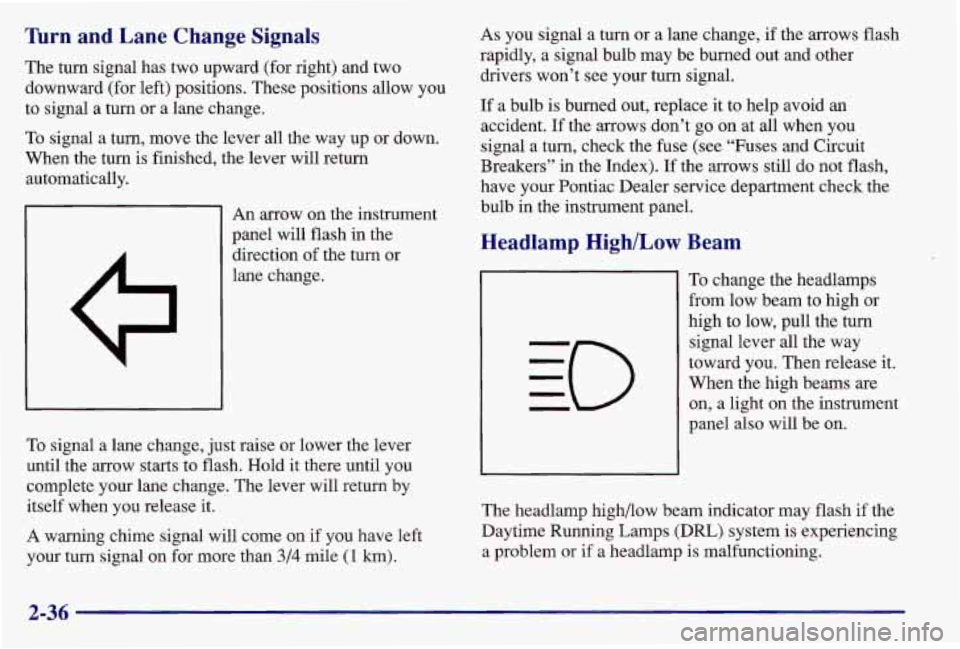
An arrow on the instrument
panel will flash in the
direction of the turn or
lane change.
To signal a lane change, just raise or lower the lever
until the arrow starts to flash. Hold it there until you
complete your lane change. The lever will return by
itself when you release it.
A warning chime signal will come on
if you have left
your turn signal on for more than
3/4 mile (1 km).
As you signal a turn or a lane change, if the arrows flash
rapidly, a signal bulb may be burned out and other
drivers won’t see your turn signal.
If a bulb is burned out, replace it to help avoid an
accident. If the arrows don’t go on at all when you
signal a turn, check the fuse (see “Fuses and Circuit
Breakers” in the Index). If the arrows still do not flash,
have your Pontiac Dealer service department check the
bulb in the instrument panel.
Headlamp High/Low Beam
To change the headlamps
from low beam to high or
high to low, pull the turn
signal lever all the way
toward you. Then release it.
When the high beams are
on, a light on the instrument
panel
also will be on.
The headlamp high/low beam indicator may flash
if the
Daytime Running Lamps (DRL) system is experiencing
a problem
or if a headlamp is malfunctioning.
2-36
Page 92 of 371
Windshield Wipers
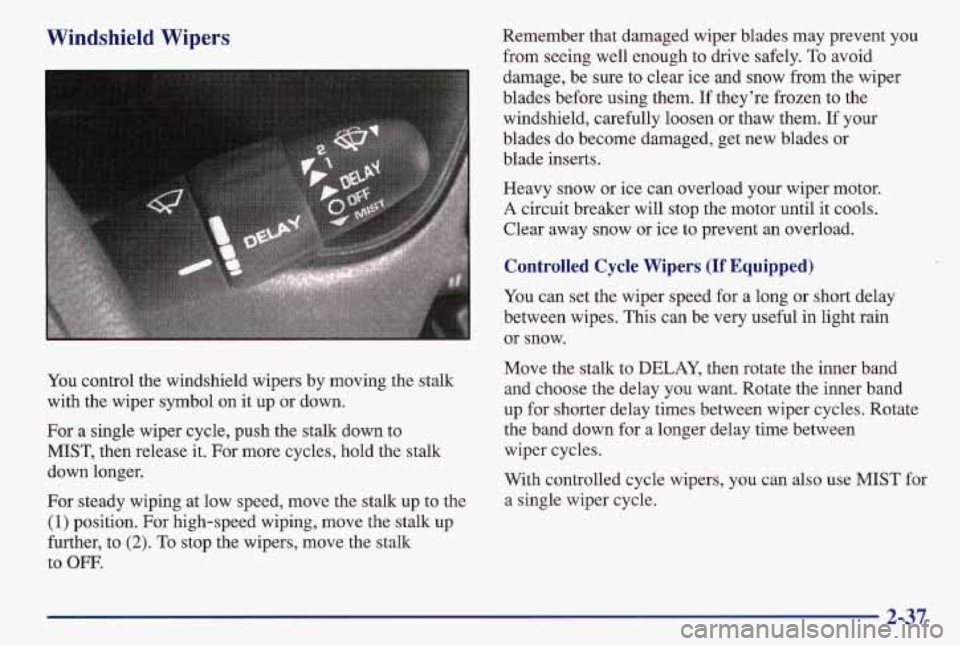
You control the windshield wipers by moving the stalk
with the wiper symbol on it up or down.
For a single wiper cycle, push the stalk down to
MIST, then release it. For more cycles, hold the stalk
down longer.
For steady wiping at low speed, move the stalk up to the
(1) position. For high-speed wiping, move the stalk up
further, to
(2). To stop the wipers, move the stalk
to OFF. Remember that damaged wiper blades may prevent you
from seeing well enough to drive safely.
To avoid
damage, be sure to clear
ice and snow from the wiper
blades before using them. If they’re frozen to the
windshield, carefully loosen or thaw them. If your
blades do become damaged, get new blades or
blade inserts.
Heavy snow
or ice can overload your wiper motor.
A circuit breaker will stop the motor until it cools.
Clear away snow or ice to prevent an overload.
Controlled Cycle Wipers (If Equipped)
You can set the wiper speed for a long or short delay
between wipes. This can be very useful in light rain
or snow.
Move the stalk to DELAY, then rotate the inner band
and choose the delay you want. Rotate the inner band
up for shorter delay times between wiper cycles. Rotate
the band down for a longer delay time between
wiper cycles.
With controlled cycle wipers, you can also use
MIST for
a single wiper cycle.
2-37
Page 97 of 371
Reducing Speed While Using Cruise Control
There are two ways to reduce your speed while using
cruise control:
Press in the button at the end of the lever until you
reach the lower speed you want, then release it.
To slow down in very small amounts, push the
button for less than half a second. Each time
you do
this, you’ll go
1 mph (1.6 km/h) slower.
Passing Another Vehicle While Using Cruise Control
Use the accelerator pedal to increase your speed. When
you take your foot off the pedal, your vehicle will slow
down to the cruise control speed you set earlier.
Using Cruise Control on Hills
How well your cruise control will work on hills depends
upon your speed, load, and the steepness
of the hills.
When going up steep hills, you may have to step on the accelerator pedal to maintain your speed. When going
downhill, you may have to brake or shift to a lower gear
to keep your speed down. Of course, applying the brake
takes you out
of cruise control. Many drivers find this to
be too much trouble and don’t use cruise control on
steep hills.
Ending Cruise Control
There are two ways to turn off the cruise control:
Step lightly on the brake pedal or push the clutch
pedal,
if you have a manual transaxle: OR
Move the cruise switch to OFF.
Erasing Cruise Speed Memory
When you turn off the cruise control or the ignition,
your cruise control set speed memory
is erased.
2-42
Page 98 of 371
Exterior Lamps
Headlamps
I-
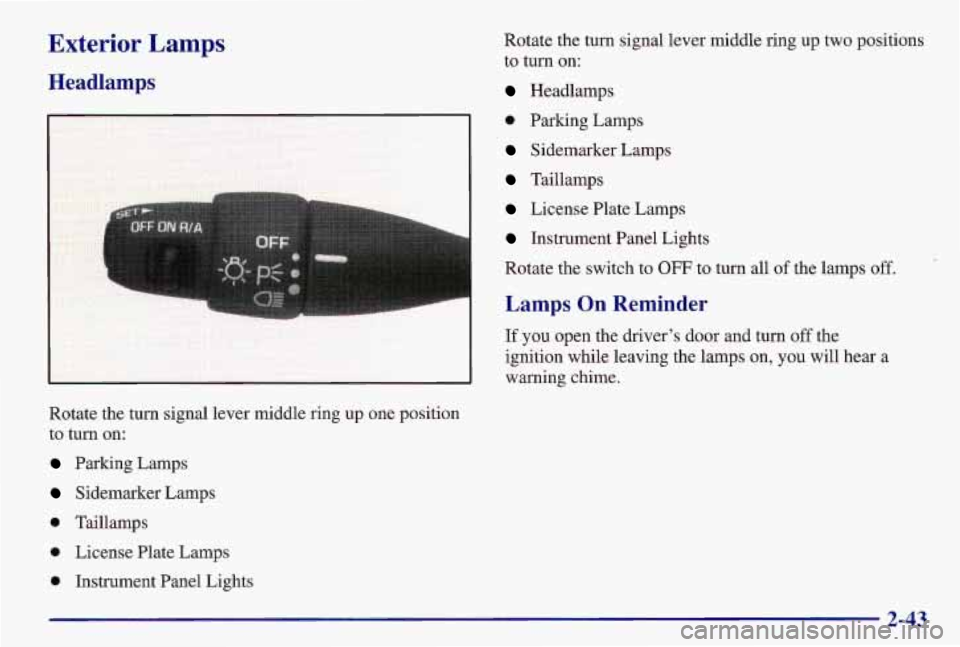
Rotate the turn signal lever middle ring up one position
to turn on:
Parking Lamps
Sidemarker Lamps
0 Taillamps
0 License Plate Lamps
0 Instrument Panel Lights Rotate the turn signal lever middle ring up two positions
to
turn on:
Headlamps
0 Parking Lamps
Sidemarker Lamps
Taillamps
License Plate Lamps
Instrument Panel Lights
Rotate the switch to
OFF to turn all of the lamps off.
Lamps On Reminder
If you open the driver’s door and turn off the
ignition while leaving the lamps
on, you will hear a
warning chime.
2-43
Page 99 of 371
Daytime Running Lamps
Daytime Running Lamps (DRL) can make it easier for
others to see the front
of your vehicle during the day.
DRL can be helpful in many different driving
conditions, but they can be especially helpful in the
short periods after dawn and before sunset.
The DRL system will make your high-beam headlamps
come on at a reduced brightness when:
The engine is running,
0 The headlamp switch is in the OFF position,
The light sensor detects daytime light,
0 The parking brake is released and
The shift lever is not in PARK (P) on an
automatic transaxle.
When the DRL system is on, the taillamps, sidemarker,
park lamps
and instrument panel lights will not be
illuminated.
The DRL and the ALC systems will remain off any time
your automatic transaxle vehicle is in PARK (P) and the
parking brake is engaged.
The DRL and the ALC systems will remain
off any time
your manual transaxle vehicle is in NEUTRAL (N) and
the parking brake is engaged.
Automatic Light Control (ALC)
Your vehicle is equipped with an automatic light sensor
on top of the instrument panel under the defroster grill,
so be sure it is not covered which will cause the
nighttime lights to be on continuously.
When it is dark enough outside, your ALC will turn
on
your low-beam headlamps at the normal brightness
along with other lamps such as the taillamps,
sidemarker, park lamps and instrument panel lights.
There is a 20-second delay in the transition between
daytime and nighttime operation
of the DRL and the
ALC systems.
If the light sensor senses a reduction in
lighting that lasts longer than
20 seconds, it will activate
the nighttime lamps. If you are driving through a
parking garage, heavy overcast weather, a tunnel or
fueling your vehicle in a low light area, the ALC will
turn on your low-beam headlamps at a normal
brightness along with the taillamps, sidemarker, park
lamps and the instrument panel lights. The radio lights
will be dimmer.
As with any vehicle, you should turn on the regular
headlamp system when you need
it.
Page 100 of 371
Fog Lamps
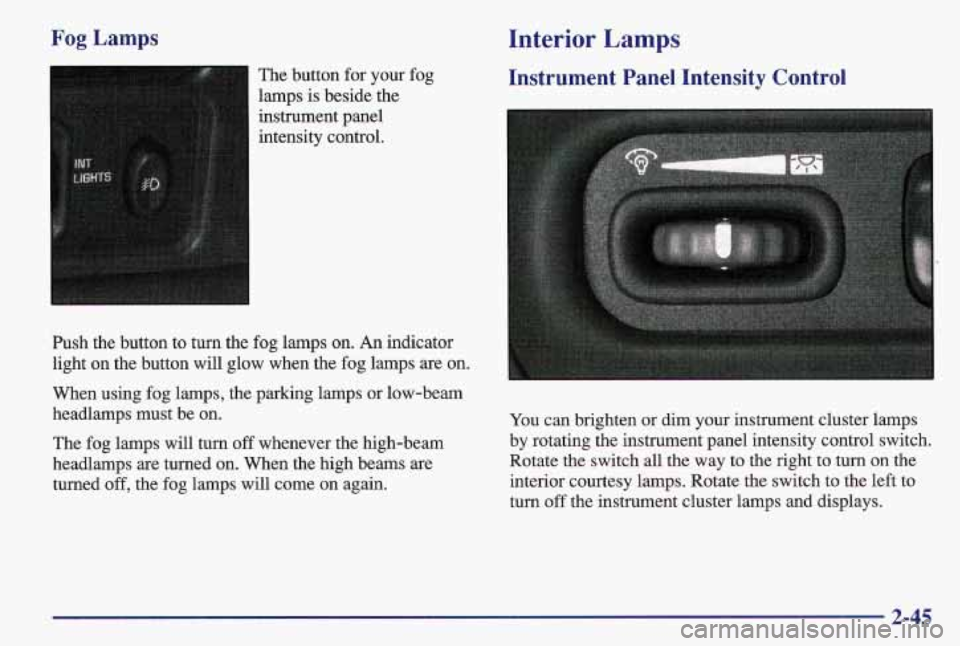
The button for your fog
lamps is beside the
instrument panel
intensity control.
Push the button to turn the fog lamps
on. An indicator
light on the button will glow when the fog lamps are on.
When using fog lamps, the parking lamps or low-beam
headlamps must be on.
The fog lamps will turn off whenever the high-beam
headlamps
are turned on. When the high beams are
turned off, the fog lamps will come on again.
Interior Lamps
Instrument Panel Intensity Control
You can brighten or dim your instrument cluster lamps
by rotating the instrument panel intensity control switch.
Rotate the switch all the way to the right to turn on the
interior courtesy lamps. Rotate the switch to the left to
turn
off the instrument cluster lamps and displays.
2-45
Page 103 of 371
Mirrors
Convex Outside Mirror
Your passenger's side mirror is convex. A convex
mirror's surface is curved
so you can see more from the
driver's seat.
I
'
A CAUTION:
Inside Day/Night Rearview Mirror
A convex mirror can make things (like other
vehicles) look farther away than they really are.
If you cut too sharply into the right lane, you
could hit a vehicle on your right. Check your
inside mirror or glance over your shoulder
before
changing lanes.
C
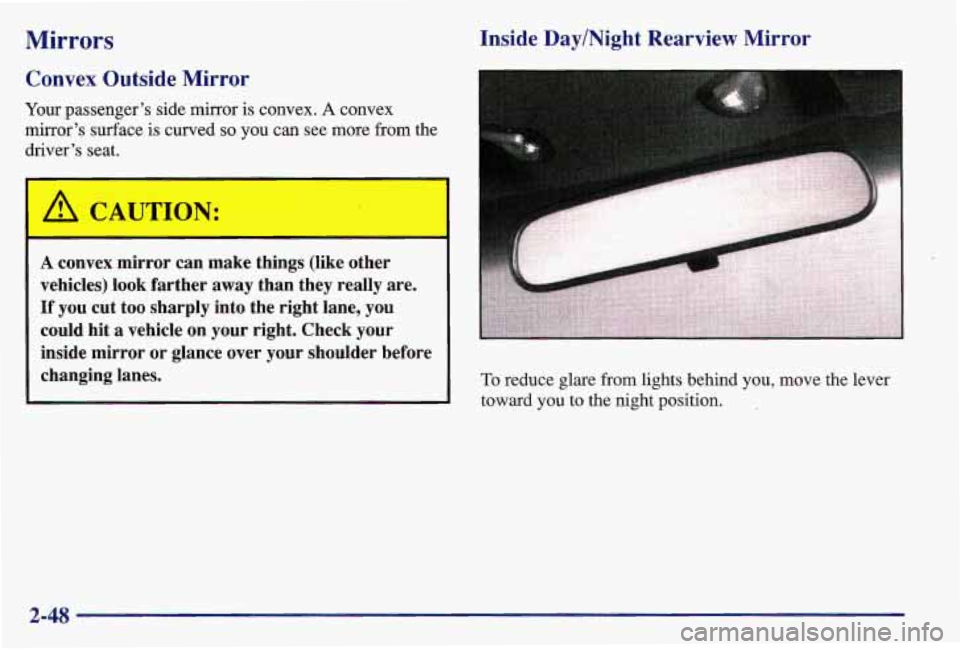
To reduce glare from lights behind you, move the lever
toward you
to the night position.
2-48
Page 106 of 371
Rear Seat Cupholder
There are cupholders on the underside of the front
storage armrest lid
for the rear passengers to use. Open
the lid completely to use the cupholders.
Convenience Net (If Equipped)
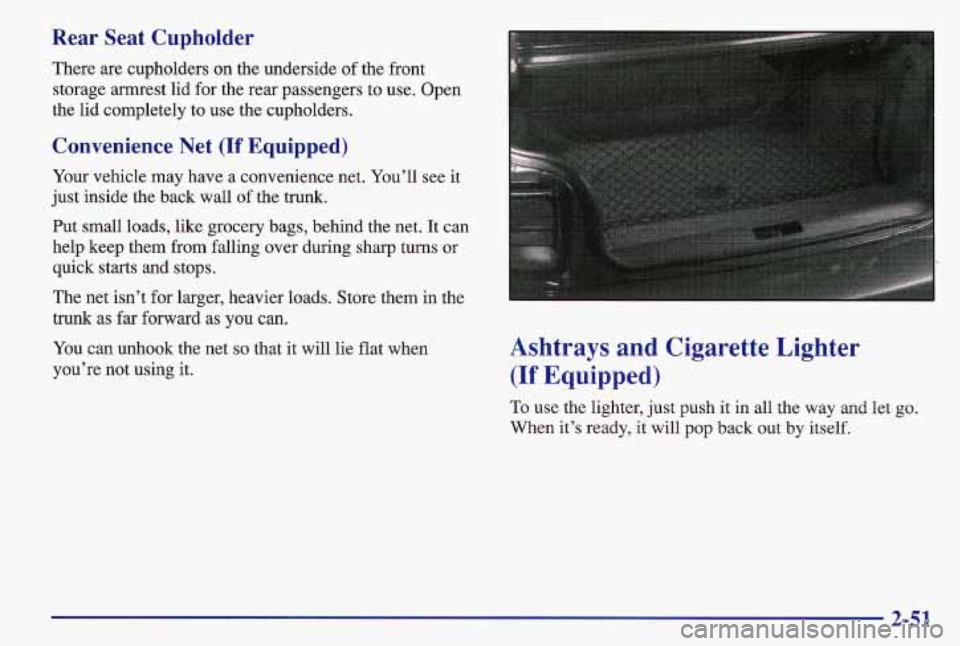
Your vehicle may have a convenience net. You’ll see it
just inside the back wall
of the trunk.
Put small loads, like grocery bags, behind the net. It can
help keep them from falling over during sharp turns
or
quick starts and stops.
The net isn’t for larger, heavier loads. Store them
in the
trunk as far forward as you can.
You can unhook the net
so that it will lie flat when
you’re not using it. Ashtrays and Cigarette Lighter
(If Equipped)
To use the lighter, just push it in all the way and let go.
When it’s ready, it will pop back
out by itself.
2-51
Page 107 of 371
NOTICE:
Don’t hold a cigarette lighter in with your hand
while it is heating, If you do, it won’t be able to
back away from the heating element when it’s ready. That can make it overheat, damaging the
lighter and the heating element.
To clean the center console ashtray, remove the ashtray
and empty it. The ashtray can be placed
in the rear
cupholder for the rear passengers to use. The ashtray can
also be placed inside the center console for storage.
When the ashtray
is removed, you can also use this tray
as a cupholder. The ashtray can be stored in the center
console storage area when not in use.
NOTICE:
Don’t put papers and other things that burn into
your ashtrays. If
you do, cigarettes or other
smoking materials could set them
on fire,
causing damage.
Sun Visors
To block out glare, you can swing down the visors. You
can also swing them to the side.
Your vehicle may also have a plastic extension which
pulls out of the main visor to increase protection
from glare.
Visor Vanity Mirror
Open the cover to expose the vanity mirror.
Accessory Power Outlet
If you have an accessory power outlet, you can plug in
an additional electrical accessory. The outlet is located
on the instrument panel to the right of the steering
wheel. Be sure to follow the proper installation
instructions that are included with any electrical
equipment you install. The accessory power outlet is
protected by a fuse and has a maximum current level.
Litter Bag Hook
There is a litter bag hook located on the front passenger
side
of the center console storage area.
2-52
Page 113 of 371
Tachometer
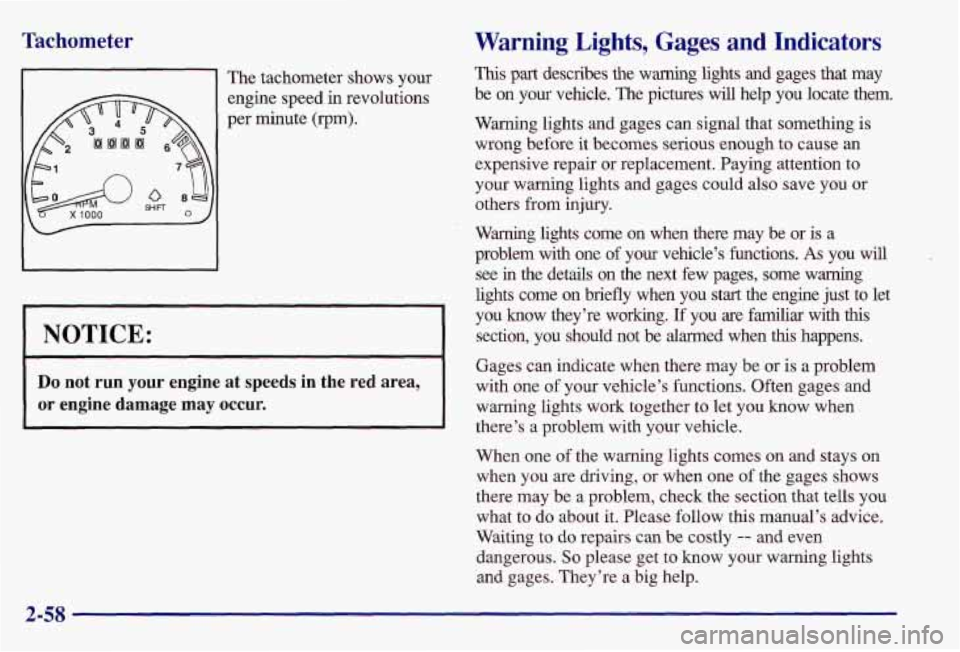
The tachometer shows your
engine speed in revolutions
per minute (rpm).
Warning Lights, Gages and Indicators
This part describes the warning lights and gages that may
be on your vehicle. The pictures will help you locate them.
Warning lights and gages can signal that something is
wrong before it becomes serious enough to cause an
expensive repair or replacement. Paying attention to
your warning lights and gages could also save you or others from injury.
Warning lights come on when there may be or is a
problem with one of your vehicle’s functions.
As you will
see
in the details on the next few pages, some warning
lights come on briefly when you start the engine just to let \
you know they’re working. If you are familiar with this
NOTICE: section, you should not be alarmed when this happens.
Gages can indicate when there may be
or is a problem
Do not run your engine at speeds in the red area,
warning lights work together to let you know when or engine damage may occur.
with one of your vehicle’s functions. Often gages and
there’s a problem with your vehicle. When one
of the warning lights comes on and stays on
when
you are driving, or when one of the gages shows
there may be a problem, check the section that tells you what to
do about it. Please follow this manual’s advice.
Waiting to do repairs can be costly
-- and even
dangerous.
So please get to know your warning lights
and gages. They’re a big help.