warning PONTIAC GRAND AM 1997 User Guide
[x] Cancel search | Manufacturer: PONTIAC, Model Year: 1997, Model line: GRAND AM, Model: PONTIAC GRAND AM 1997Pages: 371, PDF Size: 18.14 MB
Page 115 of 371
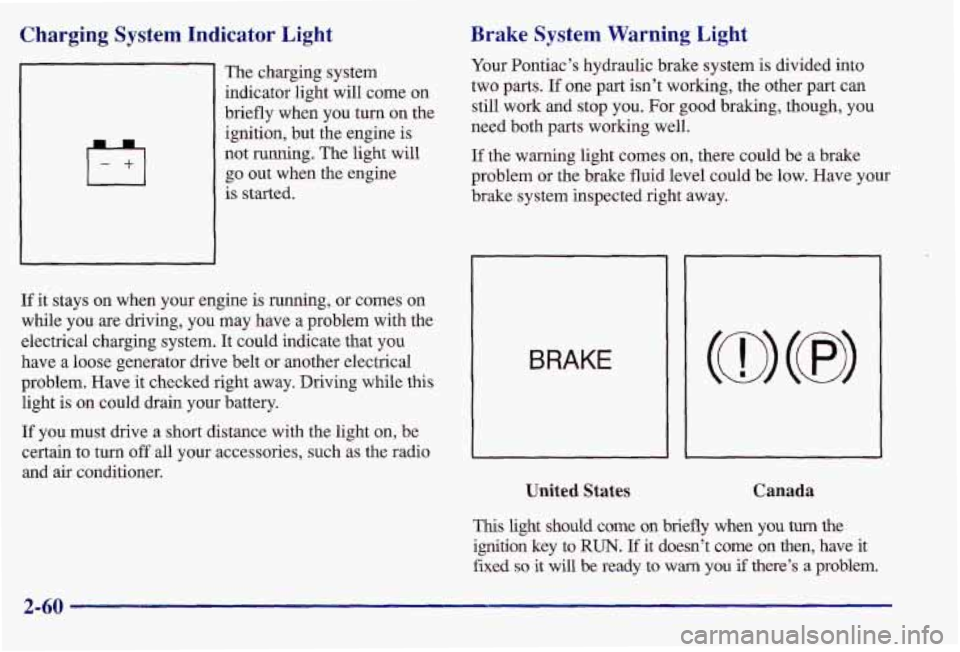
Charging System Indicator Light
The charging system
indicator light will come on
briefly when you turn on the ignition, but the engine is
not running. The light will
go out when the engine
is stated.
If it stays on when your engine is running, or comes on
while you are driving, you may have a problem with the
electrical charging system.
It could indicate that you
have a loose generator drive belt or another electrical
problem. Have it checked right away. Driving while this
light is
on could drain your battery.
If you must drive a short distance with the light on, be
certain to turn
off all your accessories, such as the radio
and air conditioner.
Brake System Warning Light
Your Pontiac’s hydraulic brake system is divided into
two parts.
If one part isn’t working, the other part can
still work and stop you. For good braking, though, you
need both parts working well.
If the warning light comes on, there could be a brake
problem or the brake fluid level could be low. Have your
brake system inspected right away.
BRAKE
United States Canada
This light should come on briefly when you turn the
ignition key to RUN. If it doesn’t come on then, have it
fixed
so it will be ready to warn you if there’s a problem.
2-60
Page 116 of 371
If the light comes on while you are driving, pull off the
road and stop carefully. You may notice that the pedal is
harder to push. Or, the pedal may go closer to the floor.
It may take longer to stop.
If the light is still on, have the
vehicle towed for service. (See “Towing Your Vehicle”
in the Index.)
A CAUTION:
Your brake system may not be working properly
if the brake system warning light is
on. Driving
with the brake system warning light on can lead
to an accident. If the light is still on after you’ve
pulled off the road and stopped carefully, have
the vehicle towed for service.
When the ignition is on, the brake system warning light
will also come on when you set your parking brake. The
light will stay on
if your parking brake doesn’t release
fully. If it stays on after your parking brake is fully
released, it means you have a brake problem.
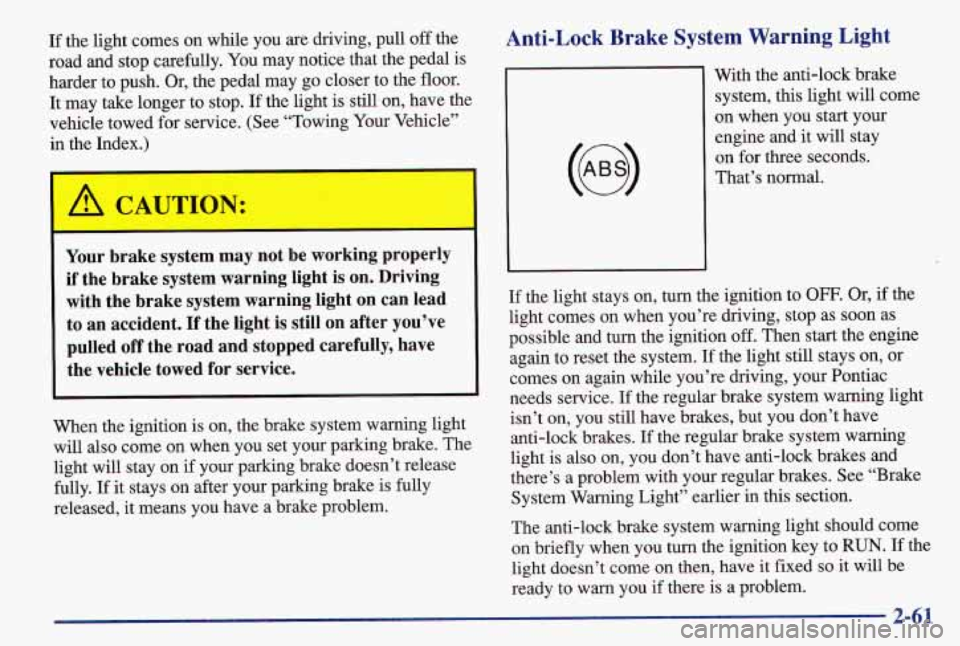
Anti-Lock Brake System Warning Light
With the anti-lock brake
system, this light will come
on when you start your
engine and it will stay
on for three seconds.
That’s normal.
If the light stays on, turn the ignition to OFF. Or, if the
light comes on when you’re driving, stop as soon as
possible and turn the ignition off. Then start the engine
again to reset the system. If the light still stays on, or
comes on again while you’re driving, your Pontiac
needs service.
If the regular brake system warning light
isn’t on, you still have brakes, but you don’t have
anti-lock brakes.
If the regular brake system warning
light is also on, you don’t have anti-lock brakes and
there’s a problem with your regular brakes. See “Brake
System Warning Light” earlier in this section.
The anti-lock brake system warning light should come on briefly when you turn the ignition key to
RUN. If the
light doesn’t come on then, have
it fixed so it will be
ready to warn you
if there is a problem.
2-61
Page 117 of 371
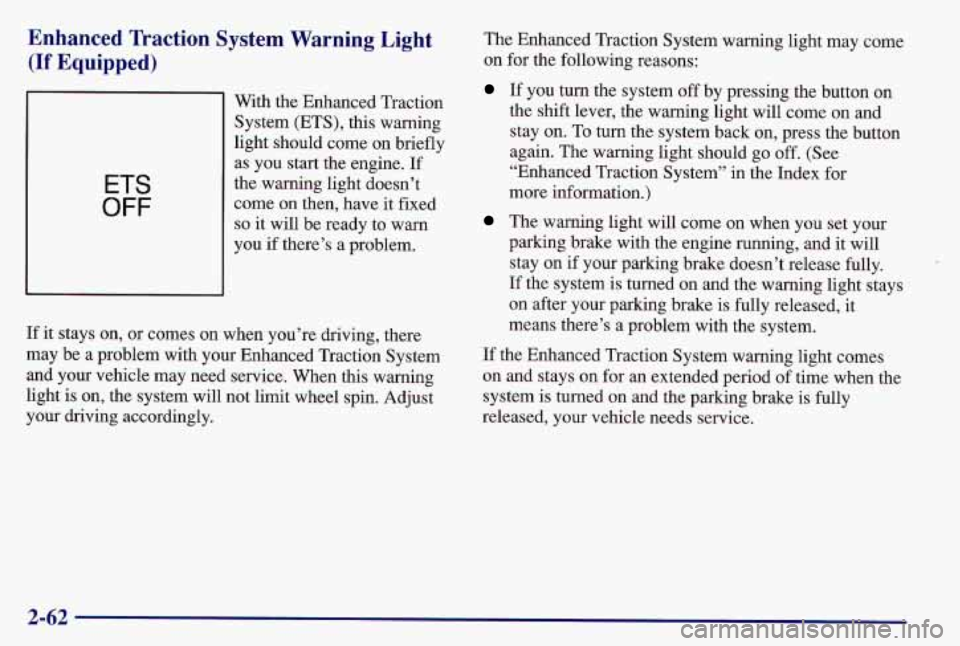
Enhanced Traction System Warning Light
(If Equipped)
ETS
OFF
With the Enhanced Traction
System (ETS), this warning
light should come on briefly as you start the engine. If
the warning light doesn’t come on then, have
it fixed
so it will be ready to warn
you if there’s a problem.
If it stays on, or comes on when you’re driving, there
may be a problem with your Enhanced Traction System
and your vehicle may need service. When this warning
light is on, the system will not limit wheel spin. Adjust
your driving accordingly. The Enhanced
Traction System warning light may come
on for the following reasons:
If you turn the system off by pressing the button on
the shift lever, the warning light will come on and
stay on.
To turn the system back on, press the button
again. The warning light should go
off. (See
“Enhanced Traction System” in the Index for
more information.)
The warning light will come on when you set your
parking brake with the engine running, and
it will
stay on if your parking brake doesn’t release fully.
If the system is turned on and the warning light stays
on after your parking brake is fully released,
it
means there’s a problem with the system.
If the Enhanced Traction System warning light comes
on and stays on for an extended period of time when the
system is turned on and the parking brake is fully
released, your vehicle needs service.
2-62
Page 119 of 371
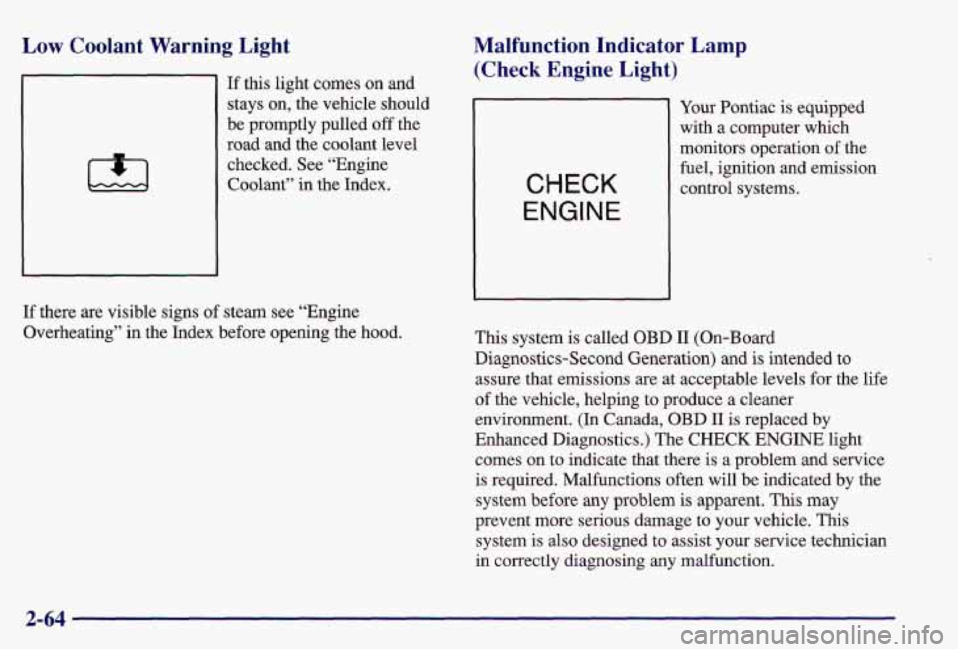
Low Coolant Warning Light
If this light comes on and
stays on, the vehicle should
be promptly pulled off the
road and the coolant level
checked. See “Engine
Coolant” in the Index.
If there are visible signs of steam see “Engine
Overheating” in the Index before opening the hood.
Malfunction Indicator Lamp
(Check Engine Light)
Your Pontiac is equipped
with a computer which
monitors operation
of the
fuel, ignition and emission
CHECK
ENGINE
This system is called OBD I1 (On-Board
Diagnostics-Second Generation) and is intended to
assure that emissions are at acceptable levels for the life
of the vehicle, helping to produce a cleaner
environment. (In Canada, OBD
I1 is replaced by
Enhanced Diagnostics.) The CHECK
ENGINE light
comes on
to indicate that there is a problem and service
is required. Malfunctions often will be indicated by the
system before any problem is apparent. This may
prevent more serious damage to your vehicle.
This
system is also designed to assist your service technician
in correctly diagnosing
any malfunction.
2-64
Page 122 of 371
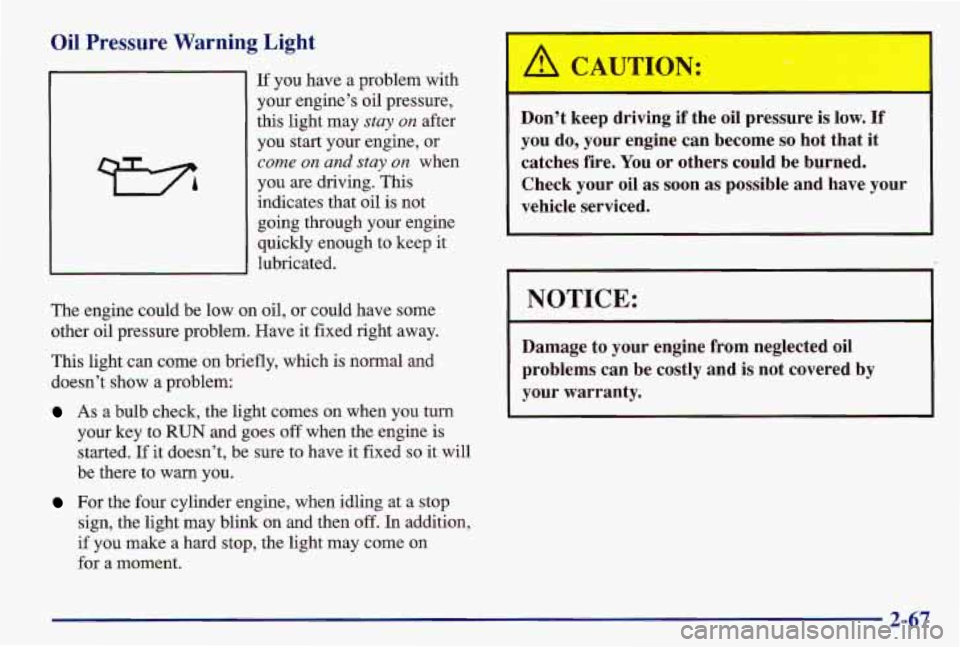
Oil Pressure Warning Light
If you have a problem with
your engine’s oil pressure,
this light may
stay on after
you start your engine, or
come on and stay on when
you are driving. This
indicates that oil is not
going through your engine
quickly enough to keep it
lubricated.
The engine could be low on oil, or could have some
other oil pressure problem. Have it fixed right away.
This light can come on briefly, which is normal and
doesn’t show a problem:
As a bulb check, the light comes on when you turn
your key to
RUN and goes off when the engine is
started.
If it doesn’t, be sure to have it fixed so it will
be there to warn you.
For the four cylinder engine, when idling at a stop
sign, the light may blink on and then off. In addition,
if you make a hard stop, the light may come on
for
a moment. Don’t
keep driving
if the oil pressure is low. If
you do, your engine can become so hot that it
catches fire. You or others could be burned.
Check your
oil as soon as possible and have your
vehicle serviced.
I I
NOTICE:
Damage to your engine from neglected oil
problems can be costly and is not covered by
your warranty.
2-67
Page 123 of 371
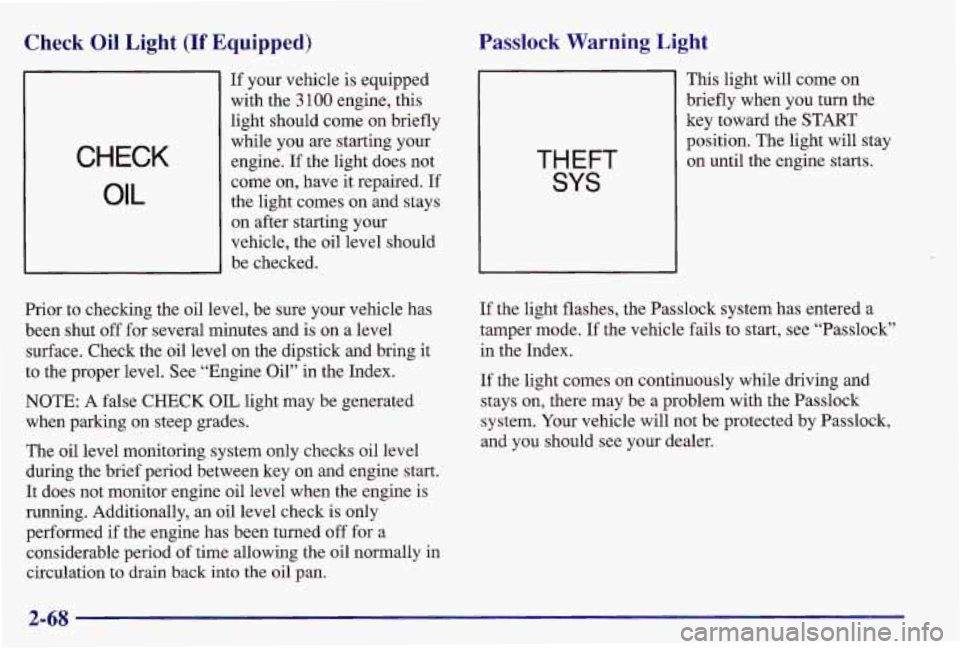
Check Oil Light (If Equipped)
CHECK
OIL
If your vehicle is equipped
with the
3 100 engine, this
light should come on briefly
while you are starting your engine.
If the light does not
come on, have it repaired. If
the light comes on and stays on after starting your
vehicle, the oil level should
be checked.
Prior to checking the oil level, be sure your vehicle has been shut off for several minutes and is on a level
surface. Check the oil level on the dipstick and bring it
to the proper level. See “Engine Oil” in the Index.
NOTE: A false
CHECK OIL light may be generated
when parking on steep grades.
The oil level monitoring system only checks oil level
during the brief period between key on and engine start.
It does not monitor engine oil level when the engine is
running. Additionally,
an oil level check is only
performed if the engine has been turned
off for a
considerable period
of time allowing the oil normally in
circulation
to drain back into the oil pan.
Passlock Warning Light
THEFT
SYS
This light will come on
briefly when you turn the
key toward the START
position. The light will stay
on until the engine starts.
If the light flashes, the Passlock system has entered a
tamper mode. If the vehicle fails to start, see “Passlock”
in the Index.
If the light comes on continuously while driving and
stays
on, there may be a problem with the Passlock
system. Your vehicle will not be protected by Passlock,
and
you should see your dealer.
2-68
Page 158 of 371
Avoid needless heavy braking. Some people drive in
spurts
-- heavy acceleration followed by heavy
braking
-- rather than keeping pace with traffic. This is a
mistake. Your brakes may
not have time to cool between
hard stops. Your brakes will wear out much faster if you
do a lot of heavy braking. If you keep pace with the
traffic and allow realistic following distances, you will
eliminate a lot
of unnecessary braking. That means
better braking and longer brake life.
If your engine ever stops while you’re driving, brake
normally but don’t pump your brakes. If you do, the
pedal may get harder to push down.
If your engine
stops, you will still have some power brake assist. But
you will use it when you brake. Once the power assist is
used up, it may take longer
to stop and the brake pedal
will be harder to push.
Anti-Lock Brakes (ABS)
Your vehicle has anti-lock brakes (ABS). ABS is an
advanced electronic braking system that will help
prevent a braking skid.
When you start your engine, or when you begin to drive
away, your anti-lock brake system will check itself. You
may hear a momentary motor or clicking noise while
this test is going on, and you may even notice that your
brake pedal moves a little. This is normal.
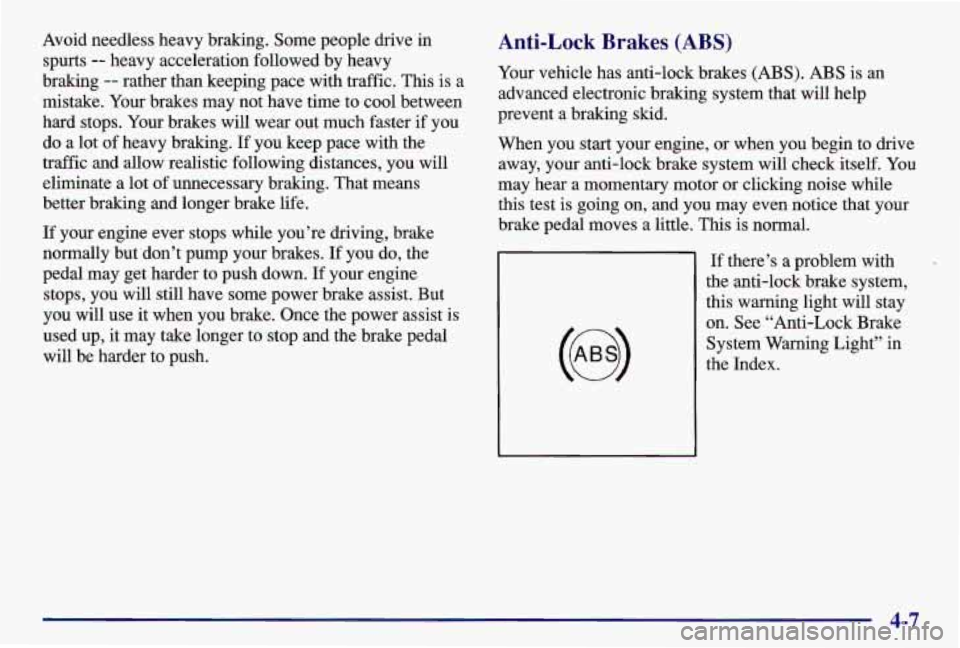
If there’s a problem with
the anti-lock brake system,
this warning light will stay
on. See “Anti-Lock Brake
System Warning Light” in
the Index.
4-7
Page 161 of 371
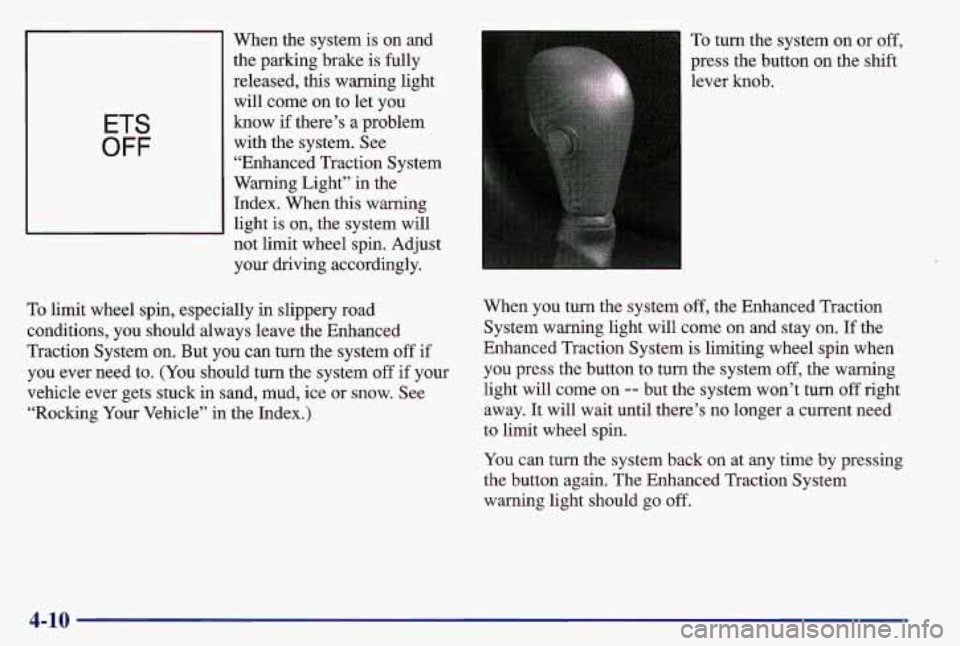
ETS
OFF
When the system is on and
the parking brake is fully
released, this warning light will come on to let you
know if there’s a problem
with the system. See
“Enhanced Traction System
Warning Light” in the
Index. When this warning
light
is on, the system will
not limit wheel spin. Adjust
your driving accordingly.
To limit wheel spin, especially in slippery road
conditions, you should always leave the Enhanced
Traction System on. But you can turn the system off if
you ever need
to. (You should turn the system off if your
vehicle ever gets stuck in sand, mud, ice or snow. See
“Rocking Your Vehicle” in the Index.) To
turn the system on or off,
press the button on the shift
lever knob.
When you turn the system off, the Enhanced Traction
System warning light will come
on and stay on. If the
Enhanced Traction System is limiting wheel spin when
you press the button to turn the system off, the warning
light will come on
-- but the system won’t turn off right
away. It will wait until there’s no longer a current need
to limit wheel spin.
You can turn the system back on at any time by pressing
the button again. The Enhanced Traction System
warning light should go
off.
4-10
Page 166 of 371
Loss of Control
Let’s review what driving experts say about what
happens when the three control systems (brakes, steering
and acceleration) don’t have enough friction where the
tires meet the road to do what the driver has asked.
In any emergency, don’t give up. Keep trying to steer and
constantly seek an escape route or area of less danger.
Skidding
In a skid, a driver can lose control of the vehicle.
Defensive drivers avoid most skids by taking reasonable
care suited to existing conditions, and by not
“overdriving” those conditions. But skids are
always possible.
The three types of skids correspond to your Pontiac’s
three control systems.
In the braking skid, your wheels
aren’t rolling. In the steering or cornering skid, too
much speed or steering in a curve causes tires to slip and
lose cornering force. And in the acceleration skid, too
much throttle causes the driving wheels to spin.
A cornering skid is best handled by easing your foot off
the accelerator pedal.
If you have the Enhanced Traction System, remember: It
helps avoid only the acceleration skid.
If you do not have the Enhanced Traction System, or if
the system is off, then an acceleration skid is also best
handled by easing your
foot off the accelerator pedal.
If your vehicle starts to slide, ease your foot off the
accelerator pedal and quickly steer the way you want the
vehicle to go.
If you start steering quickly enough, your
vehicle may straighten out. Always be ready for a
second skid
if it occurs.
Of course, traction is reduced when water, snow, ice,
gravel or other material is on the road, For safety, you’ll
want to slow down and adjust your driving to these
conditions. It is important to slow down on slippery
surfaces because stopping distance will be longer and
vehicle control more limited.
While driving on a surface with reduced traction, try
your best to avoid sudden steering, acceleration or
braking (including engine braking by shifting to a lower
gear). Any sudden changes could cause the tires to slide.
You may not realize the surface is slippery until your
vehicle is skidding. Learn to recognize warning
clues
-- such as enough water, ice or packed snow on
the road to make a “mirrored surface’’
-- and slow down
when you have any doubt.
Remember: Any anti-lock brake system (ABS) helps
avoid only
the braking skid.
4-15
Page 172 of 371
City Driving
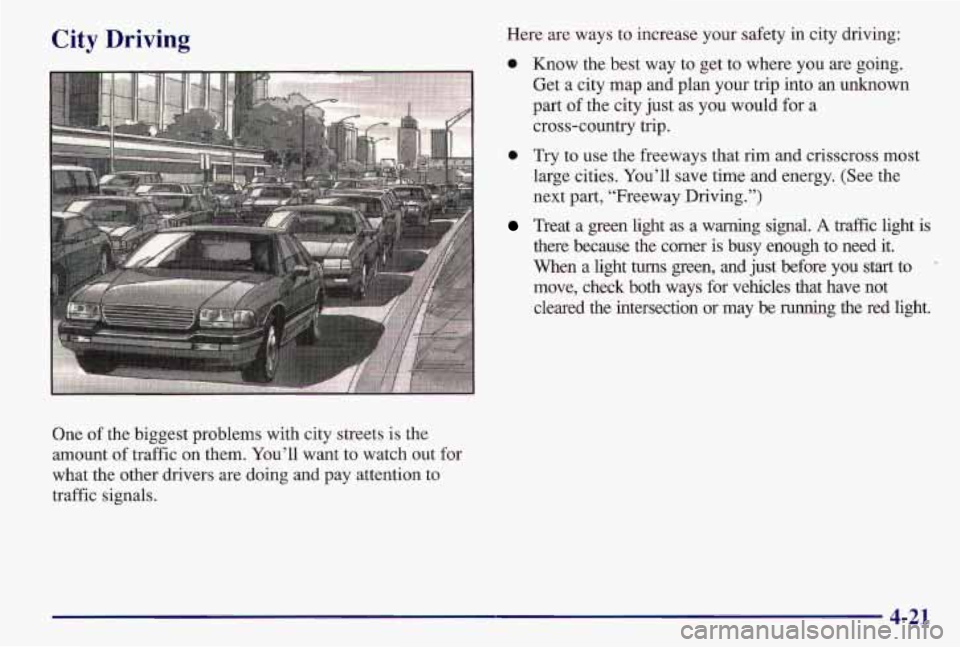
One of the biggest problems with city streets is the
amount of traffic on them. You’ll want to watch out for
what the other drivers are doing and pay attention to
traffic signals. Here are ways to increase your safety
in city driving:
0 Know the best way to get to where you are going.
Get a city map and plan your trip into an unknown
part of the city just as you would for a
cross-country trip.
0 Try to use the freeways that rim and crisscross most
large cities. You’ll save time and energy. (See the
next part, “Freeway Driving.”)
Treat a green light as a warning signal. A traffic light is
there because the corner is busy enough to need it.
When a light
turns green, and just before you start to e
move, check both ways for vehicles that have not
cleared the intersection or may be running the red light.
4-21