lock PONTIAC GRAND AM 1997 Owners Manual
[x] Cancel search | Manufacturer: PONTIAC, Model Year: 1997, Model line: GRAND AM, Model: PONTIAC GRAND AM 1997Pages: 371, PDF Size: 18.14 MB
Page 6 of 371
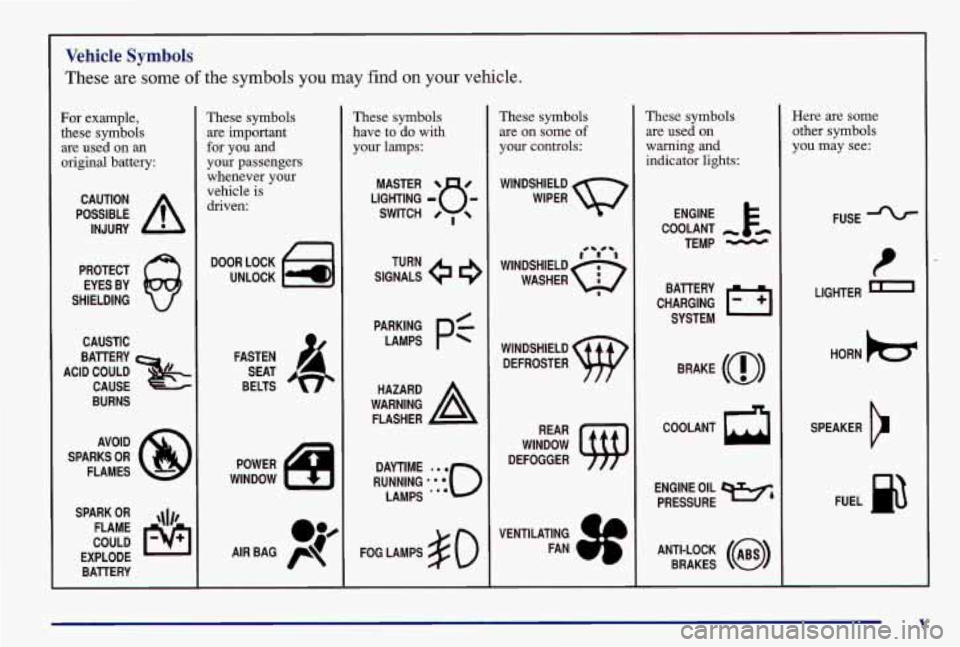
Vehicle Symbols
These are some of the symbols you may find on your vehicle.
For example,
these symbols are used on
an
original battery:
POSSIBLE A
CAUTION
INJURY
PROTECT EYES BY
SHIELDING
CAUSTIC
ACID COULD BATTERY
CAUSE
BURNS
SPARK
OR ,\I/,
COULD FLAME
EXPLODE BA'ITERY
These symbols
are important
for you and
your passengers whenever your
vehicle is
driven:
DOOR LOCK
UNLOCK
FASTEN SEAT
BELTS
These symbols
have to do with
your lamps:
SIGNALS e
TURN
FOG LAMPS
$0
These symbols
are on some
of
your controls:
WINDSHIELD
WIPER
WINDSHIELD DEFROSTER
These symbols
are used
on
warning and
indicator lights:
COOLANT -
TEMP -
CHARGING I-1
BA'ITERY
SYSTEM
BRAKE
(a)
COOLANT a
ENGINE OIL w,
PRESSURE
ANTI-LOCK
(@)
BRAKES
Here are some
other symbols
you may see:
FUSE -%-
t
LIGHTER n
HORN )tr
SPEAKER
b
FUEL m
V
Page 9 of 371
Seats and Seat Controls
This section tells you about the seats -- how to
adjust them
-- and also about reclining seatbacks and
head restraints.
Manual Seats
You can lose control of the vehicle if you try to
adjust
a manual driver’s seat while the vehicle is
moving. The sudden movement could startle and
confuse you, or make you push
a pedal when you
don’t want to. Adjust the driver’s seat only when
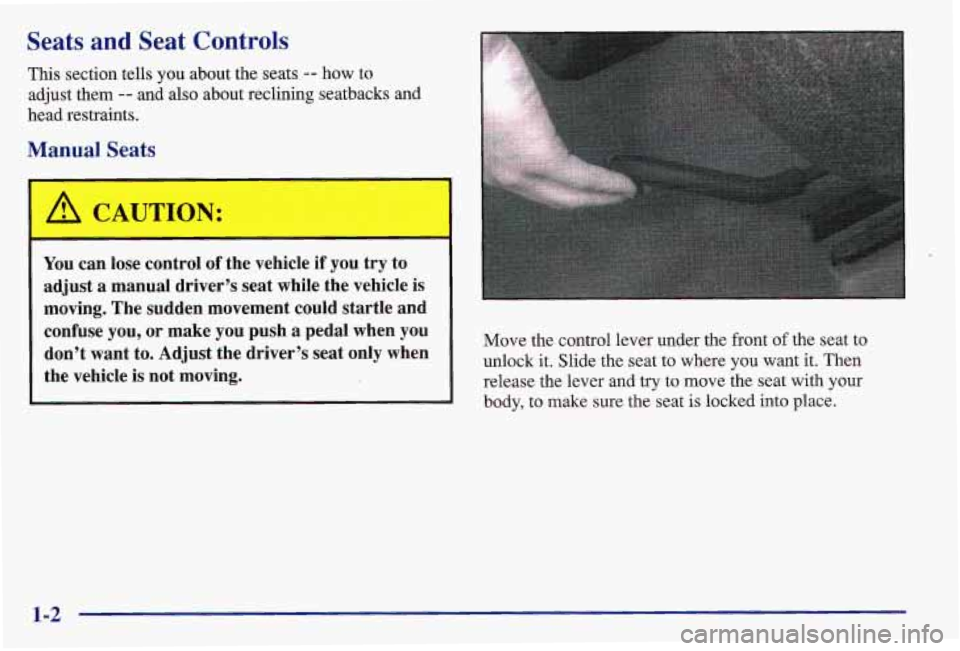
the vehicle is not moving. Move the control lever under the front
of the seat to
unlock
it. Slide the seat to where you want it. Then
release the lever and
try to move the seat with your
I body, to make sure the-seat is locked into place.
1-2
Page 10 of 371
Manual Lumbar Support (If Equipped) Power
Seat Controls (If Equipped)
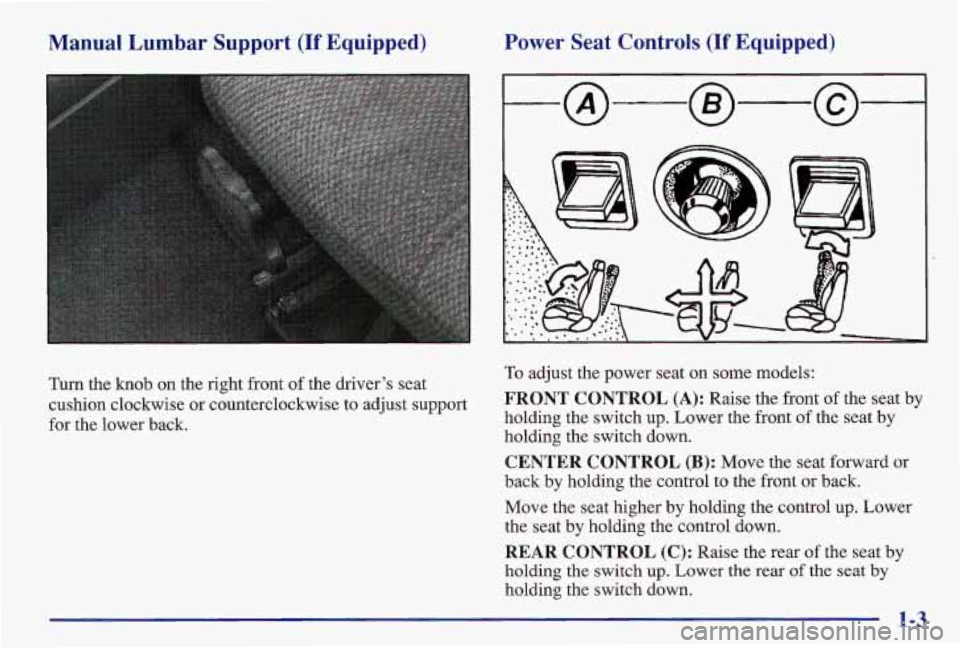
Turn the knob on the right front of the driver’s seat
cushion clockwise or counterclockwise to adjust support
for the lower back. To adjust the power seat on some models:
FRONT CONTROL (A): Raise the front of the seat by
holding the switch up. Lower the front
of the seat by
holding the switch down.
CENTER CONTROL (B): Move the seat forward or
back
by holding the control to the front or back.
Move the seat higher by holding the control up. Lower
the seat by holding the control down.
REAR CONTROL (C): Raise the rear of the seat by
holding the switch up. Lower the rear of the seat by
holding the switch down.
1-3
Page 11 of 371
Reclining Front Seatbacks
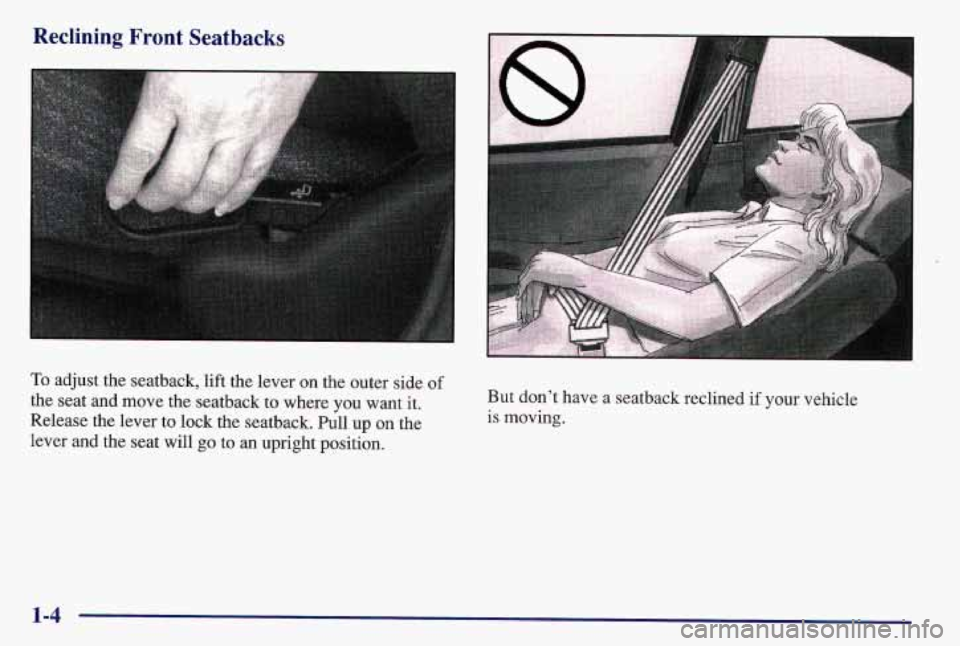
To adjust the seatback, lift the lever on the outer side of
the seat and move the seatback to where you want it.
Release the lever to lock the seatback. Pull up
on the
lever and the seat will go to an upright position. But don’t have
a seatback reclined
if your vehicle
is moving.
1-4
Page 13 of 371
To fold a front seatback forward, lift the seatback latch.
When you return the seatback to its original position, the
seatback will lock.
If the seatback isn’t locked, it could move
forward in
a sudden stop or crash. That could
cause injury to the person sitting there. Always
press rearward on the seatback
to be sure it
is locked.
Easy Entry Seat (2-Door Models)
The right front seat of your vehicle makes it easy to get
in
and out of the rear seat.
Tilt the right front seatback completely forward and
Move the right front seatback to its original position
the whole seat will
slide forward.
after someone gets into the rear seat area. Then move
the seat rearward until
it locks.
Tilt the seatback completely forward again to
get out.
I 6h CAUTION: I
If an easy entry right front seat isn’t locked, it
can move.
In a sudden stop or crash, the person
sitting there could be injured. After you’ve used
it, be sure to push rearward on an easy entry seat
to be sure it
is locked.
1-6
Page 20 of 371
How to Wear Safety Belts Properly
Adults
This part is only for people of adult size.
Be aware that there are special things to know about safety belts and children. And there are different rules for
smaller children and babies.
If a child will be riding in
your Pontiac, see the part of this manual called
“Children.” Follow those rules for everyone’s protection.\
First, you’ll want to know which restraint systems your
vehicle has.
We’ll start with the driver position.
Driver Position
This part describes the driver’s restraint system.
Lap-Shoulder Belt
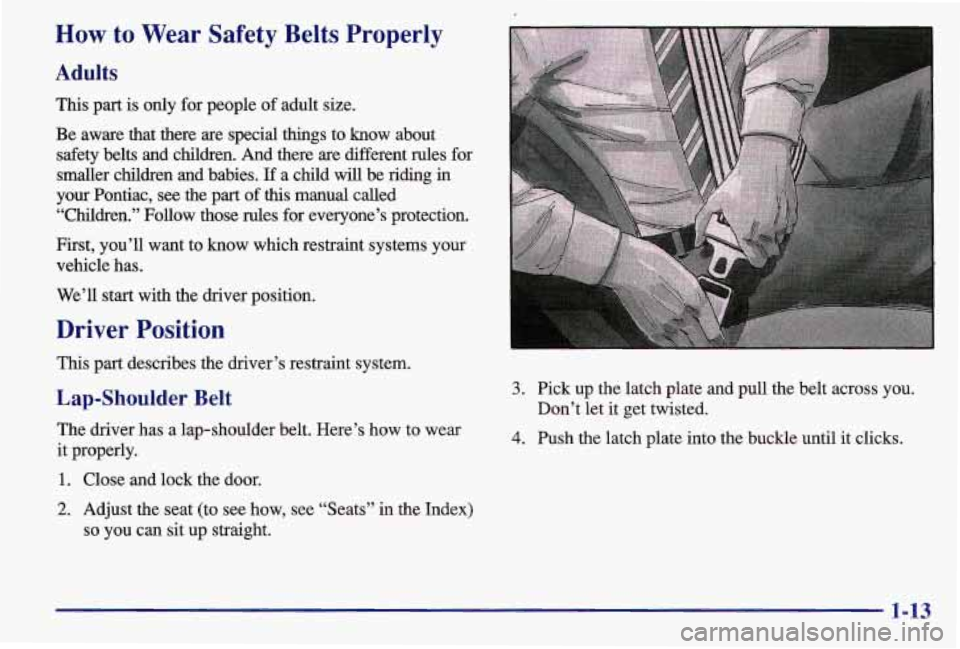
The driver has a lap-shoulder belt. Here’s how to wear
it properly.
1. Close and lock the door.
2. Adjust the seat (to see how, see “Seats” in the Index)
so you can sit up straight.
3. Pick up the latch plate and pull the belt across you.
4. Push the latch plate into the buckle until it clicks.
Don’t
let it get twisted.
1-13
Page 22 of 371
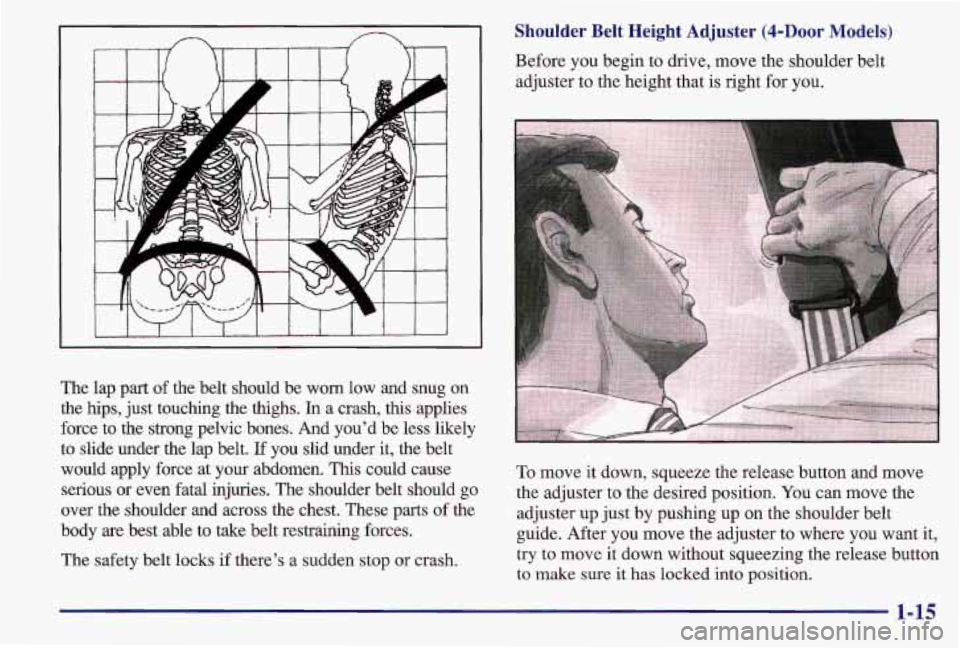
The lap part of the belt should be worn low and snug on
the hips, just touching the thighs.
In a crash, this applies
force to the strong pelvic bones. And you'd be less likely
to slide under the lap belt. If you slid under it, the belt
would apply force at your abdomen. This could cause serious or even fatal injuries. The shoulder belt should go
over the shoulder and across the chest. These
parts of the
body are best able to take belt restraining forces.
The safety belt locks if there's a sudden stop or crash.
Shoulder Belt Height Adjuster (4-Door Models)
Before you begin to drive, move the shoulder belt
adjuster to the height that
is right for you.
To move it down, squeeze the release button and move
the adjuster to the desired position. You can move the
adjuster up just by pushing up on the shoulder belt
guide. After you move the adjuster to where you want
it,
try to move it down without squeezing the release button
to make sure it has locked into position.
1-15
Page 37 of 371
The safety belt locks if there’s a sudden stop or a crash.
-
!& CAUTION:
-1
You can be seriously hurt if your shoulder belt is
too loose. In a crash, you would move forward
too much, which could increase injury. The
shoulder belt should fit against your body.
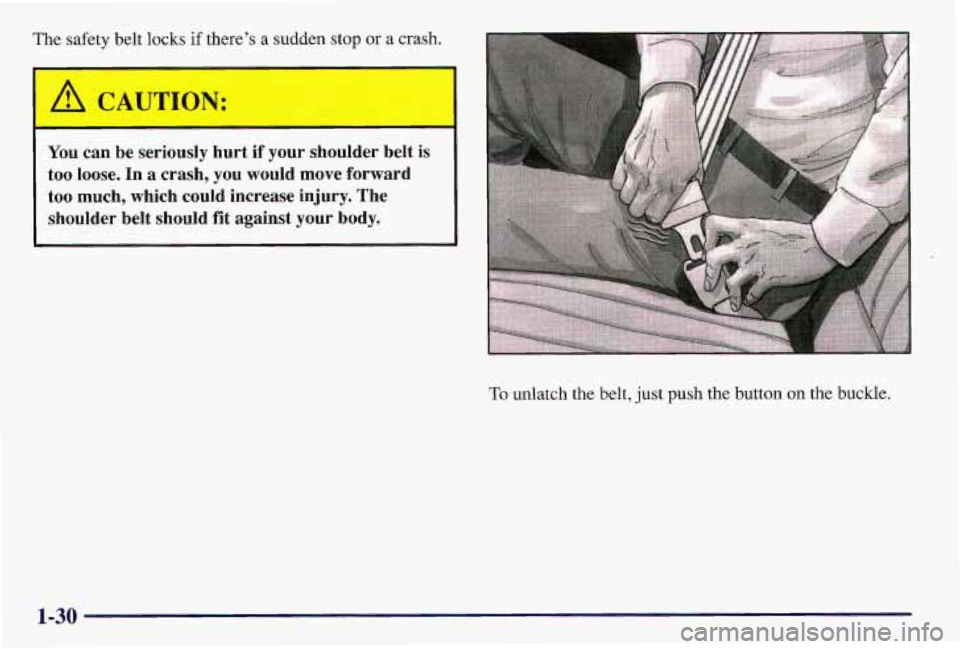
To unlatch the belt, just push the button on the buckle.
1-30
Page 56 of 371

Section 2 Features and Controls
Here you can learn about the many standard and optional features on your Pontiac, and information on starting,
shifting and braking. Also explained are the instrument panel and the warning systems that tell you if everything is
working properly
-- and what to do if you have a problem.
2-2 2-4
2-7
2-
10
2-12 2-13 2-13
2-
14
2- 16
2-19
2-2
1
2-25
2-28
2-29
2-3
1
Keys
Door Locks
Keyless Entry System (If Equipped)
Trunk
Theft
Passlock
TM
New Vehicle “Break-In”
Ignition Positions Starting Your Engine
Engine Coolant Heater (If Equipped)
Automatic Transaxle Operation
Manual Transaxle Operation
Parking Brake Shifting Into PARK (P) (Automatic Transaxle
Models Only) Shifting Out of PARK (P) (Automatic
Transaxle Models Only) 2-3
1
2-32
2-32
2-33
2-34
2-35
2-35 2-43
2-48
2-50
2-52
2-53
2-53
2-54
2-58
Parking Your Vehicle
(Manual Transaxle Only)
Parking Over Things That Burn
Engine Exhaust Running Your Engine While You’re Parked
(Automatic Transaxle)
Windows
Tilt Wheel (If Equipped)
Turn SignaUMultifunction Lever
Exterior Lamps
Mirrors Storage Compartments
Accessory Power Outlet
Garment Hook
Sunroof (If Equipped)
The Instrument Panel
--
Your Information System
Warning Lights, Gages and Indicators
2-1
Page 58 of 371

One key is used for the
ignition, the doors and all
other locks. If you need
a new key, go to your Pontiac dealer for the
correct key code. Remember to carry the pre-cut
emergency key which Pontiac sends after delivery. In an
emergency, call the Pontiac Roadside Assistance
Program at
1 -800-ROADSIE or 1-800-762-3743
(in Canada, call 1-800-268-6800).
When a new Pontiac is delivered, the dealer removes the
tags from the keys, and gives them to the first owner.
Each tag has a
code on it that tells your dealer or a
qualified locksmith how to make extra keys. Keep the
tags in a safe place.
If you lose your keys, you’ll be able
to have new ones made easily using these tags.
I NOTICE:
Your Pontiac has a number of new features that
can help prevent theft, therefore, you can have a
lot of trouble getting into your vehicle if you ever
lock your keys inside. You may even have to
damage your vehicle
to get in. So be sure you
have extra keys.
2-3