light PONTIAC GRAND AM 1998 Repair Manual
[x] Cancel search | Manufacturer: PONTIAC, Model Year: 1998, Model line: GRAND AM, Model: PONTIAC GRAND AM 1998Pages: 370, PDF Size: 16.11 MB
Page 258 of 370
When to Check and What to Use
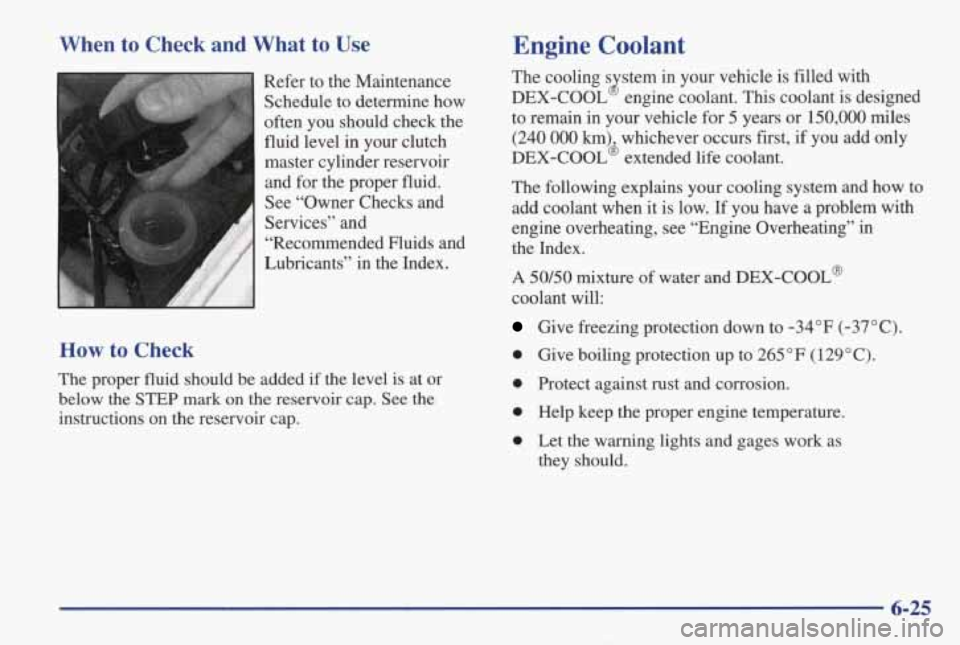
Refer to the Maintenance Schedule to determine how
often you should check the
fluid level in your clutch
master cylinder reservoir
and for the proper fluid.
See “Owner Checks and
Services” and
“Recommended Fluids and
Lubricants” in the Index.
How to Check
The proper fluid should be added if the level is at or
below the
STEP mark on the reservoir cap. See the
instructions on the reservoir cap.
Engine Coolant
The cooling s stem in your vehicle is filled with
DEX-COOL engine coolant. This coolant is designed
to remain in your vehicle for
5 years or 150,000 miles
(240 000 km) whichever occurs first, if you add only
DEX-COOL’ extended life coolant.
The following explains your cooling system and how to
add coolant when it is low. If you have
a problem with
engine overheating, see “Engine Overheating” in
the Index.
J
A 50/50 mixture of water and DEX-COOL@
coolant will:
Give freezing protection down to -34°F (-37°C).
0 Give boiling protection up to 265 OF (1 29 O C).
0 Protect against rust and corrosion.
0 Help keep the proper engine temperature.
0 Let the warning lights and gages work as
they should.
6-25
Page 261 of 370
Adding Coolant
Wrning the surge
tank pressure cap when the
engine and radiator are hot
can allow steam and
scalding
liquids to blow out and burn you badly.
Never turn the surge
tank pressure cap -- even a
little
-- when the engine and radiator are hot.
When your engine is cold, the coolant level should be at
the FULL COLD mark, or a little higher.
If the light comes on, it
means you’re low on
engine coolant.
See “Low Coolant Warning Light” in the Index.
If you need more coolant, add the proper DEX-COOL@
coolant mixture at the surge tank, but only when the
engine is cool.
A CAUTION:
L
I
You can be burned if you spill coolant on hot
engine
parts. Coolant contains ethylene glycol,
and it
will burn if the engine parts are hot
enough. Don’t spill coolant 0n.a hot engine.
When replacing the pressure cap, make sure it is tight.
6-28
Page 265 of 370
‘system fixed, since a leak means that sooner or later your
brakes won’t work well, or won’t work at
all.
So, it isn’t a good idea to “top off’ your brake fluid.
Adding brake fluid won’t correct a leak.
If you add fluid
when your linings are worn, then you’ll have too much
fluid when
you get new brake linings. You should add
(or remove) brake fluid, as necessary, only when work is
done
on the brake hydraulic system.
‘ /d CAUTION:
If you have too much brake fluid, it can spill on
the engine. The fluid
will burn if the engine is
hot enough. You or others could be burned,
and your vehicle could be damaged. Add brake
fluid
only when work is done on the brake
hydraulic system.
BRAKE
United States Canada
When your brake fluid falls to a low level, your brake
warning light will
come on. See “Brake System Warning
Light” in the Index.
6-32
Page 267 of 370
Brake Wear
Your vehicle has front disc brakes and rear drum brakes.
Disc brake
pads have built-in wear indicators that make a
high-pitched warning sound when the brake pads are worn
and new pads are needed. The sound may come and go or
be heard all the time your vehicle is moving (except when
you
are pushing on the brake pedal firmly).
A
a CAUTION:
The brake wear warning sound means that soon
your brakes won’t work well. That could lead to
an accident. When you hear the brake
wear
warning sound, have your vehicle serviced.
NOTICE:
Continuing to drive with worn-out brake pads
could result
in costly brake repair.
Some driving conditions or climates may cause a brake
squeal when the brakes are first applied or lightly
applied.
This does not mean something is wrong with
your brakes.
See “CaliperKnuckle Maintenance Inspection’’
in
Section 7 of this manual under Part C “Periodic
Maintenance Inspections.”
Properly torqued wheel nuts are necessary
to help
prevent brake pulsation. When tires are rotated, inspect
brake pads for
wear and evenly torque wheel nuts in the
proper sequence to
GM specifications.
Your rear drum brakes don’t have wear indicators, but if
you ever hear a rear brake rubbing noise, have the rear
brake linings inspected immediately.
Also, the rear
brake drums should
be removed and inspected each time
the tires are removed for rotation or changing.
When
you have the front brake pads replaced, have the rear
brakes inspected, too.
Brake linings should always be replaced
as complete
axle sets.
See “Brake System Inspection” in Section 7 of this manual
under Part C “Periodic Maintenance Inspections.”
6-34
Page 279 of 370
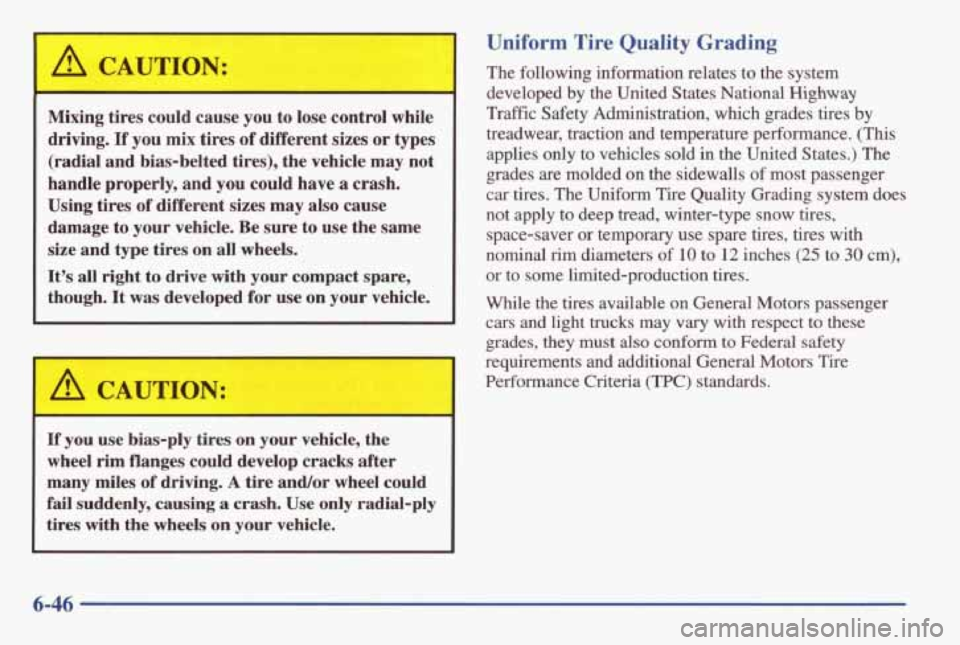
A CAUTION:
Mixing tires could cause you to lose control while
driving.
If you mix tires of different sizes or types
(radial and bias-belted tires), the vehicle may not
handle properly, and you could have a crash.
Using tires
of different sizes may also cause
damage to
your vehicle. Be sure to use the same
size and type tires
on all wheels.
It’s all right to drive with your compact spare,
though. It was developed for use
on your vehicle.
I
1
A CAUTION:
If you use bias-ply tires on your vehicle, the
wheel rim flanges could develop cracks after
many miles
of driving. A tire and/or wheel could
fail suddenly, causing
a crash. Use only radial-ply
tires
with the wheels on your vehicle.
Uniform Tire Quality Grading
The following information relates to the system
developed by the United States National Highway
Traffic Safety Administration, which grades tires by
treadwear, traction and temperature performance.
(This
applies only to vehicles sold in the United States.) The
grades are molded on the sidewalls
of most passenger
car tires. The Uniform
Tire Quality Grading system does
not apply to deep tread, winter-type snow tires,
space-saver or temporary use spare
tires, tires with
nominal rim diameters
of 10 to 12 inches (25 to 30 cm),
or to some limited-production tires.
While the tires available on General Motors passenger cars and light
trucks may vary with respect to these
grades, they must also conform to Federal safety
requirements and additional General Motors Tire
Performance Criteria (TPC) standards.
6-46
Page 290 of 370
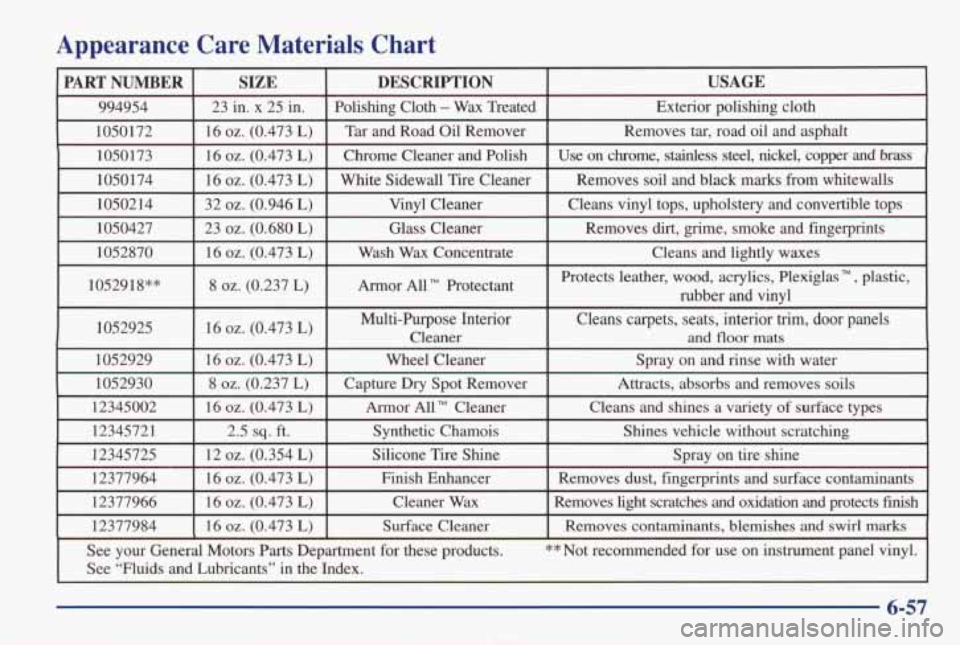
Appearance Care Materials Chart
PART NUMBER SIZE
994954 23 in. x 25 in.
1050172 16
oz. (0.473 L) 1050173 16
oz. (0.473 L)
DESCRIPTION
Exterior polishing cloth
Polishing Cloth - Wax Treated
USAGE
- - -
Tar and Road
Oil Remover
Use on chrome, stainless steel, nickel, copper
and brass Chrome Cleaner and Polish Removes
tar, road oil and asphalt
I 1050174 I 16 oz. (0.473 L) I White Sidewall Tire Cleaner I Removes soil and black marks from whitewalls
I 1050214 I 32 oz. (0.946 L) I Vinyl Cleaner I Cleans vinyl tops, upholstery and convertible tops
1050427
1052925 8
oz. (0.237 L) 1052918**
16
oz. (0.473 L) 1052870
23
oz. (0.680 L)
16
oz. (0.473 L)
1052929 16 oz. (0.473 L)
1052930 8 oz. (0.237 L)
12345002 16 oz. (0.473 L)
Glass Cleaner Removes dirt, grime, smoke and fingerprints
Wash Wax Concentrate Cleans and lightly waxes
Armor
All” Protectant Protects leather, wood, acrylics, Plexiglas ” , plastic,
rubber and vinyl
w
Multi-Purpose Interior Cleans carpets, seats, interior trim, door panels
Cleaner and floor mats
Wheel Cleaner Spray on and rinse with water
Capture
Dry Spot Remover Attracts, absorbs and removes soils
Armor All”” Cleaner Cleans and shines a variety
of surface types
12345721
Removes contaminants, blemishes
and swir1 marks Surface Cleaner 16 oz. (0.473 L) 12377984 Removes light scratches and oxidation and protects finish Cleane\
r Wax 16
oz. (0.473 L) 12377966 Removes dust, fingerprints and surface contaminants
Finish Enhancer
16
oz. (0.473 L) 12377964 Spray on tire shine
Silicone Tire Shine
12
oz. (0.354 L) 12345725 Shines vehicle without scratching
Synthetic Chamois
2.5
sq. ft.
See your General Motors Parts Department for these products. **\
Not recommended for use on instrument panel vinyl.
See “Fluids and Lubricants”
in the Index.
6-57
Page 293 of 370
Fuses and Circuit Breakers
The wiring circuits in your vehicle are protected from
short circuits by a combination of fuses, circuit breakers
and fusible links. This greatly reduces the chance
of
damage caused by electrical problems.
Look at the silver-colored band inside the fuse. If the
band is broken or melted, replace the fuse.
Be sure to
replace a bad fuse
with a new one of the identical size
and rating.
If
you ever have a problem on the road and don’t have a
spare fuse,
you can “borrow” one that has the same
amperage. Just pick
a feature of your vehicle that you
can get along without
-- like the radio or cigarette
lighter
-- and use its fuse, if it is the correct amperage.
Replace it as
soon as you can.
There
are two fuse blocks in your vehicle: the
instrument panel fuse block and the engine compartment
fuse block.
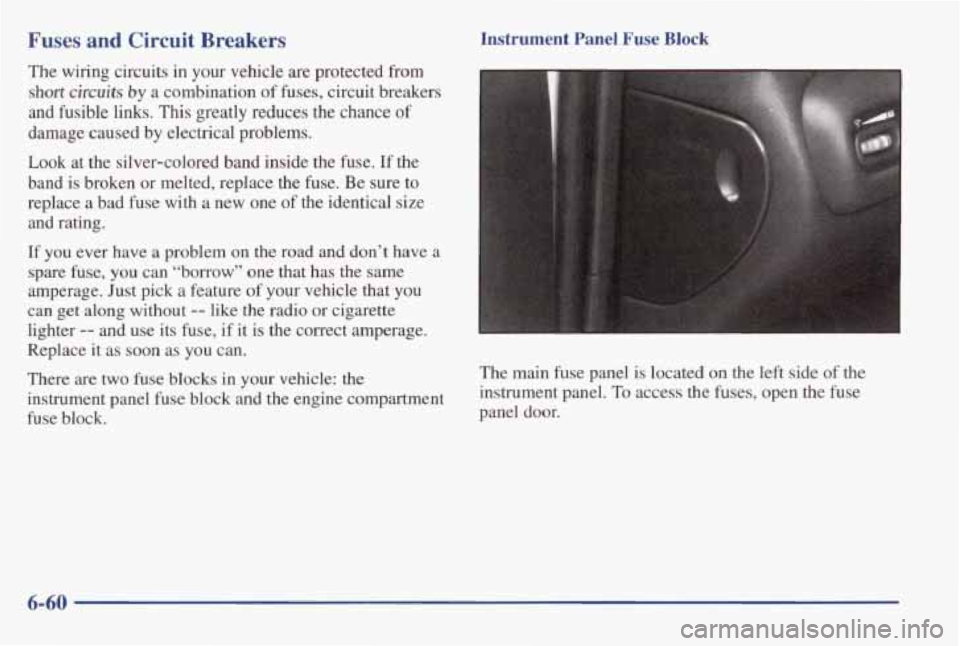
Instrument Panel Fuse Block
The main fuse panel is located on the left side of the
instrument panel.
To access the fuses, open the fuse
panel door.
6-60
Page 294 of 370
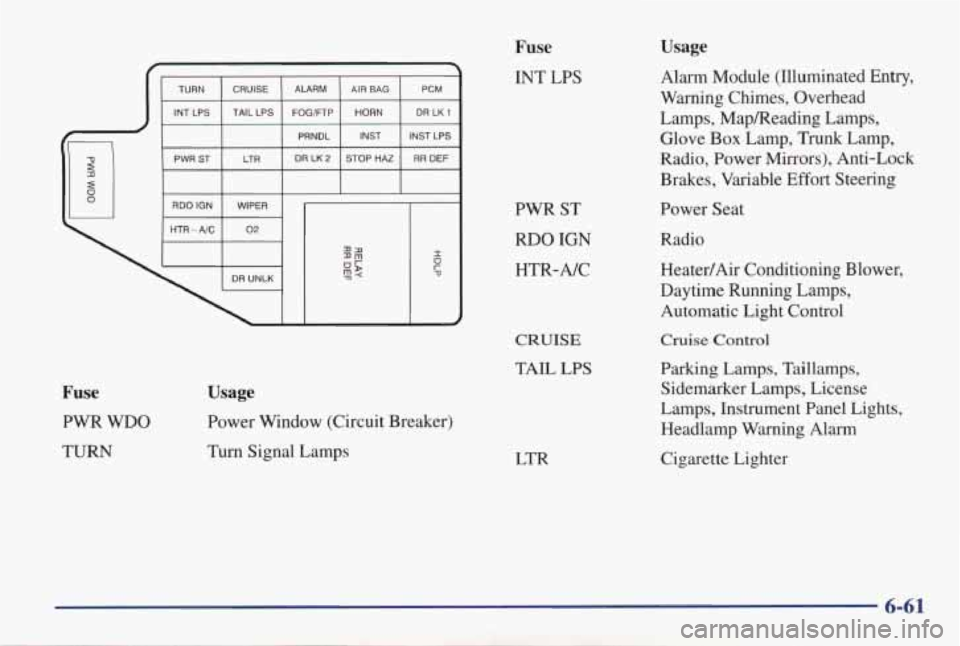
Fuse
PWR WDO
TURN
Usage
Power Window (Circuit Breaker)
Turn Signal Lamps
Fuse
INT LPS
PWR ST
RDO IGN
HTR-A/C
CRUISE
TAIL LPS
LTR
Usage
Alarm Module (Illuminated Entry,
Warning Chimes, Overhead
Lamps, MapReading Lamps,
Glove Box Lamp, Trunk Lamp,
Radio, Power Mirrors), Anti-Lock
Brakes, Variable Effort Steering
Power Seat
Radio
Heater/Air Conditioning Blower,
Daytime Running Lamps, Automatic Light Control
Cruise Control
Parking Lamps, Taillamps, Sidemarker Lamps, License
Lamps, Instrument Panel Lights,
Headlamp Warning Alarm
Cigarette Lighter
6-61
Page 295 of 370
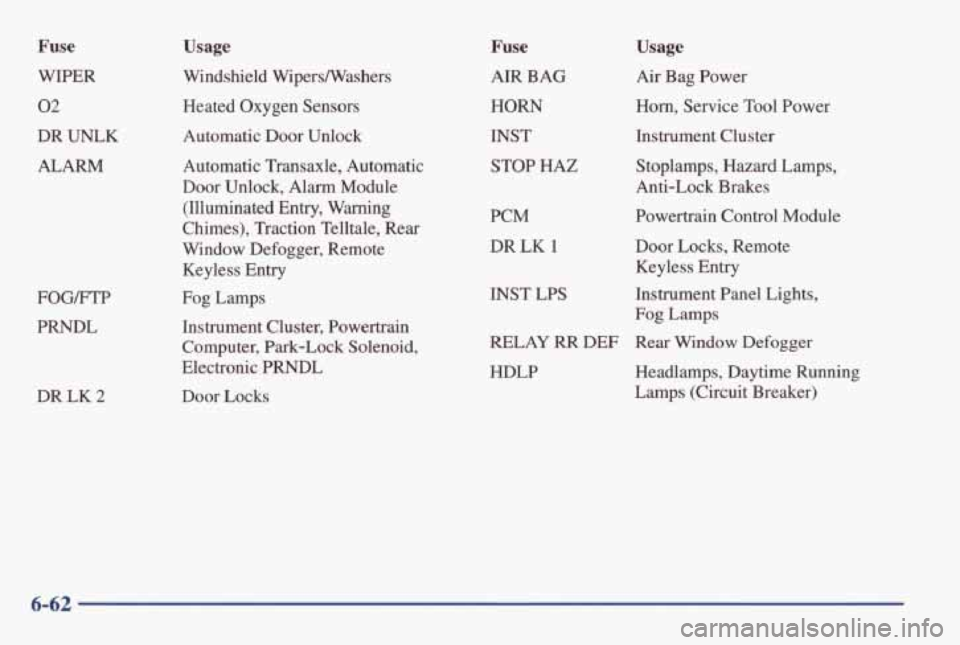
Fuse
WIPER
02
DR UNLK
ALARM
FOG/FTP
PRNDL
DR LK
2
Usage
Windshield Wipersmashers
Heated Oxygen Sensors
Automatic Door Unlock
Automatic Transaxle, Automatic
Door Unlock, Alarm Module (Illuminated Entry, Warning
Chimes), Traction Telltale, Rear
Window Defogger, Remote
Keyless Entry
Fog Lamps
Instrument Cluster, Powertrain
Computer,
Park-Lock Solenoid,
Electronic PRNDL
Door Locks
Fuse
AIR BAG
HORN
INST
STOP HAZ
PCM
DR LK
1
Usage
Air Bag Power
Horn, Service Tool Power
Instrument Cluster
Stoplamps, Hazard Lamps,
Anti-Lock Brakes
Powertrain Control Module
Door Locks, Remote
Keyless Entry
Fog Lamps
INST LPS Instrument Panel Lights,
RELAY RR DEF Rear Window Defogger
HDLP Headlamps, Daytime Running Lamps (Circuit Breaker)
6-62
Page 297 of 370
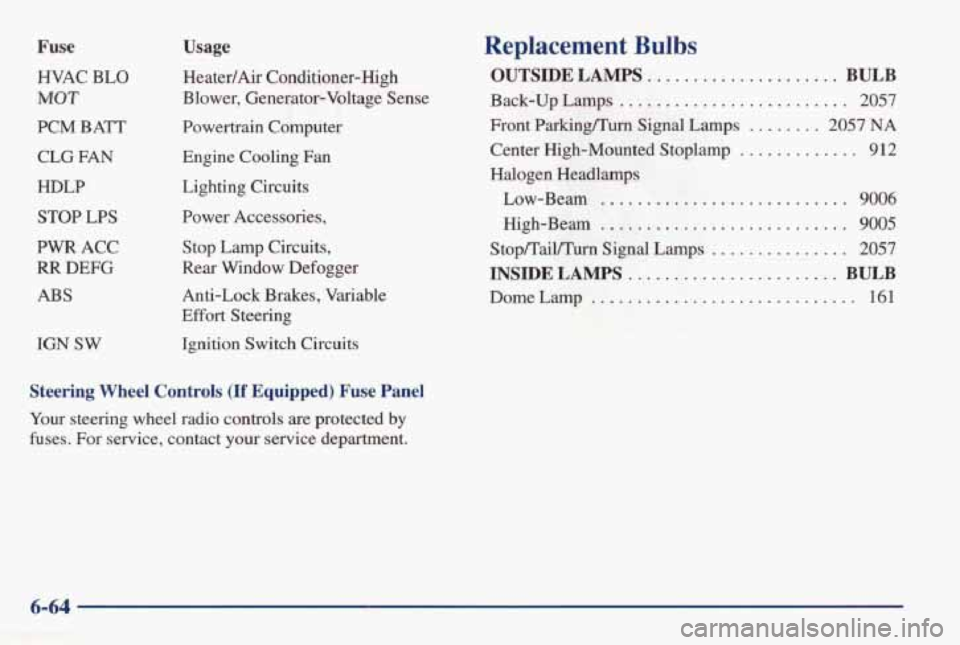
Fuse
HVAC BLO
MOT
PCM BATT
CLG FAN
HDLP
STOP LPS
PWR ACC
RR DEFG
ABS
IGN SW
Usage
Heater/Air Conditioner-High
Blower, Generator-Voltage Sense
Powertrain Computer
Engine Cooling
Fan
Lighting Circuits
Power Accessories,
Stop Lamp Circuits,
Rear Window Defogger
Anti-Lock Brakes, Variable
Effort Steering
Ignition Switch Circuits
Steering Wheel Controls (If Equipped) Fuse Panel
Your steering wheel radio controls are protected by
fuses.
For service, contact your service department.
Replacement Bulbs
OUTSIDE LAMPS ..................... BULB
Back-up Lamps ......................... 2057
Front Parking/Turn Signal Lamps ........ 2057 NA
Halogen Headlamps Center High-Mounted Stoplamp
............. 9 12
Low-Beam ................... - _. . 9006
High-Beam ........................... 9005
Stop/Tail/Turn Signal Lamps ............... 2057
INSIDE LAMPS ....................... BULB
Dome Lamp ............................. 16 1
6-64