seats PONTIAC GRAND AM 2000 Owners Manual
[x] Cancel search | Manufacturer: PONTIAC, Model Year: 2000, Model line: GRAND AM, Model: PONTIAC GRAND AM 2000Pages: 318, PDF Size: 2.42 MB
Page 4 of 318
ii
Table of Contents
Keys and Door Locks
Remote Keyless Entry System
Trunk Release
Automatic Transmission (If Equipped)
Manual Transmission
Parking Brake
Windows
Tilt Wheel
Turn Signal/Multifunction LeverWindshield Wipers
Cruise Control
Interior and Exterior Lamps
Mirrors
Storage Compartments
Convenience Net (If Equipped)
Sunroof (If Equipped)
Instrument Panel, Warning Lights and Gages Seats and Seat Controls
Safety BeltsAir Bag Systems
Child Restraints
Section
1
Section
2
Seats and Restraint Systems
Features and Controls
Page 13 of 318
1-
1-1
Section 1 Seats and Restraint Systems
Here you'll find information about the seats in your vehicle and how to use your safety belts properly. You can also
learn about some things you should not do with air bags and safety belt.
1
- 2 Seats and Seat Controls
1
- 9 Safety Belts: They're for Everyone
1
- 13 Here Are Questions Many People Ask About
Safety Belts
-- and the Answers
1
- 14 How to Wear Safety Belts Properly
1
- 14 Driver Position
1
- 22 Safety Belt Use During Pregnancy
1
- 23 Right Front Passenger Position
1
- 23 Supplemental Restraint System (SRS)
1
- 30 Rear Seat Passengers1
- 33 Rear Safety Belt Comfort Guides for
Children and Small Adults
1
- 35 Center Passenger Position
1
- 37 Children
1
- 39 Child Restraints
1
- 50 Larger Children
1
- 53 Safety Belt Extender
1
- 53 Checking Your Restraint Systems
1
- 53 Replacing Restraint System Parts After
a Crash
Page 14 of 318
1-2
Seats and Seat Controls
This section tells you about the seats -- how to
adjust them
-- and also about reclining seatbacks
and head restraints.
Manual Seats
CAUTION:
You can lose control of the vehicle if you try to
adjust a manual driver's seat while the vehicle is
moving. The sudden movement could startle and
confuse you, or make you push a pedal when you
don't want to. Adjust the driver's seat only when
the vehicle is not moving.
2-Way Manual Seat Controls
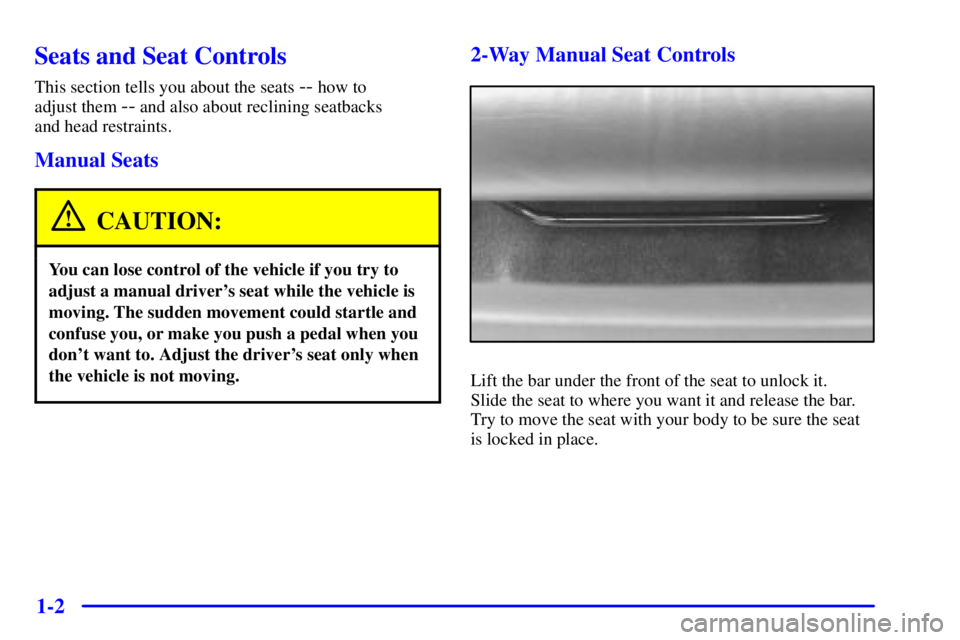
Lift the bar under the front of the seat to unlock it.
Slide the seat to where you want it and release the bar.
Try to move the seat with your body to be sure the seat
is locked in place.
Page 20 of 318
1-8 Easy Entry Seat (2-Door Models)
CAUTION:
If an easy entry right front seat isn't locked, it
can move. In a sudden stop or crash, the person
sitting there could be injured. After you've used
it, be sure to push rearward on an easy entry seat
to be sure it is locked.
The right front seat of your vehicle makes it easy to get
in and out of the rear seat.
1. Fold the right front seatback forward by lifting the
seatback latch fully.
2. The seat will slide forward to allow someone to get
into the rear seat area.
3. Push the seatback upright to lock and slide the seat
fully rearward to lock.
4. The front passenger should try to move the seat to
make sure the seat is locked into place.
Rear Seats
Folding the Rear Seat
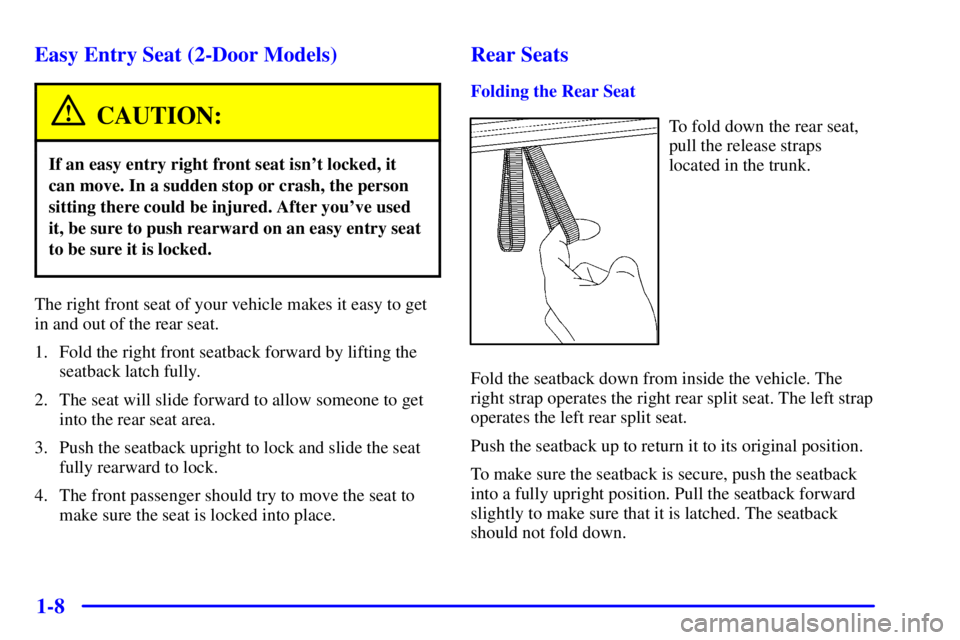
To fold down the rear seat,
pull the release straps
located in the trunk.
Fold the seatback down from inside the vehicle. The
right strap operates the right rear split seat. The left strap
operates the left rear split seat.
Push the seatback up to return it to its original position.
To make sure the seatback is secure, push the seatback
into a fully upright position. Pull the seatback forward
slightly to make sure that it is latched. The seatback
should not fold down.
Page 21 of 318
1-9
Safety Belts: They're for Everyone
This part of the manual tells you how to use safety belts
properly. It also tells you some things you should not do
with safety belts.
And it explains the Supplemental Restraint System (SRS),
or air bag system.
CAUTION:
Don't let anyone ride where he or she can't wear
a safety belt properly. If you are in a crash and
you're not wearing a safety belt, your injuries
can be much worse. You can hit things inside the
vehicle or be ejected from it. You can be seriously
injured or killed. In the same crash, you might
not be if you are buckled up. Always fasten your
safety belt, and check that your passengers' belts
are fastened properly too.
CAUTION:
It is extremely dangerous to ride in a cargo area,
inside or outside of a vehicle. In a collision,
people riding in these areas are more likely to be
seriously injured or killed. Do not allow people
to ride in any area of your vehicle that is not
equipped with seats and safety belts. Be sure
everyone in your vehicle is in a seat and using a
safety belt properly.
Your vehicle has a light that
comes on as a reminder to
buckle up. (See ªSafety
Belt Reminder Lightº in
the Index.)
Page 26 of 318
1-14
Q:If I'm a good driver, and I never drive far from
home, why should I wear safety belts?
A:You may be an excellent driver, but if you're in an
accident
-- even one that isn't your fault -- you
and your passengers can be hurt. Being a good
driver doesn't protect you from things beyond
your control, such as bad drivers.
Most accidents occur within 25 miles (40 km)
of home. And the greatest number of serious
injuries and deaths occur at speeds of less than
40 mph (65 km/h).
Safety belts are for everyone.
How to Wear Safety Belts Properly
Adults
This part is only for people of adult size.
Be aware that there are special things to know about
safety belts and children. And there are different rules
for smaller children and babies. If a child will be
riding in your vehicle, see the part of this manual
called ªChildren.º Follow those rules for
everyone's protection.
First, you'll want to know which restraint systems
your vehicle has.
We'll start with the driver position.
Driver Position
This part describes the driver's restraint system.
Lap-Shoulder Belt
The driver has a lap-shoulder belt. Here's how to wear
it properly.
1. Close and lock the door.
2. Adjust the seat (to see how, see ªSeatsº in the Index)
so you can sit up straight.
Page 52 of 318
1-40
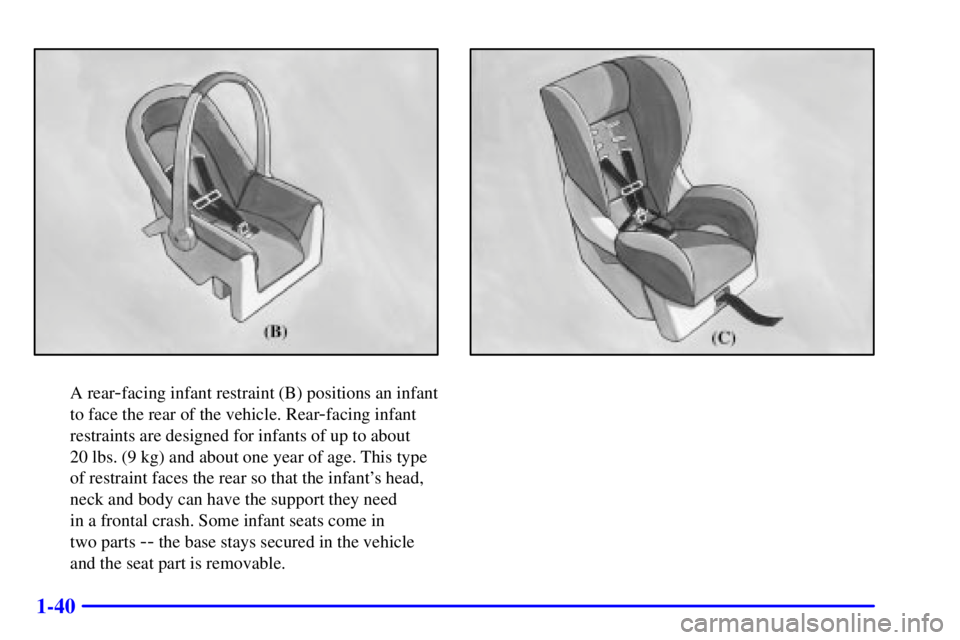
A rear-facing infant restraint (B) positions an infant
to face the rear of the vehicle. Rear
-facing infant
restraints are designed for infants of up to about
20 lbs. (9 kg) and about one year of age. This type
of restraint faces the rear so that the infant's head,
neck and body can have the support they need
in a frontal crash. Some infant seats come in
two parts
-- the base stays secured in the vehicle
and the seat part is removable.
Page 54 of 318
1-42
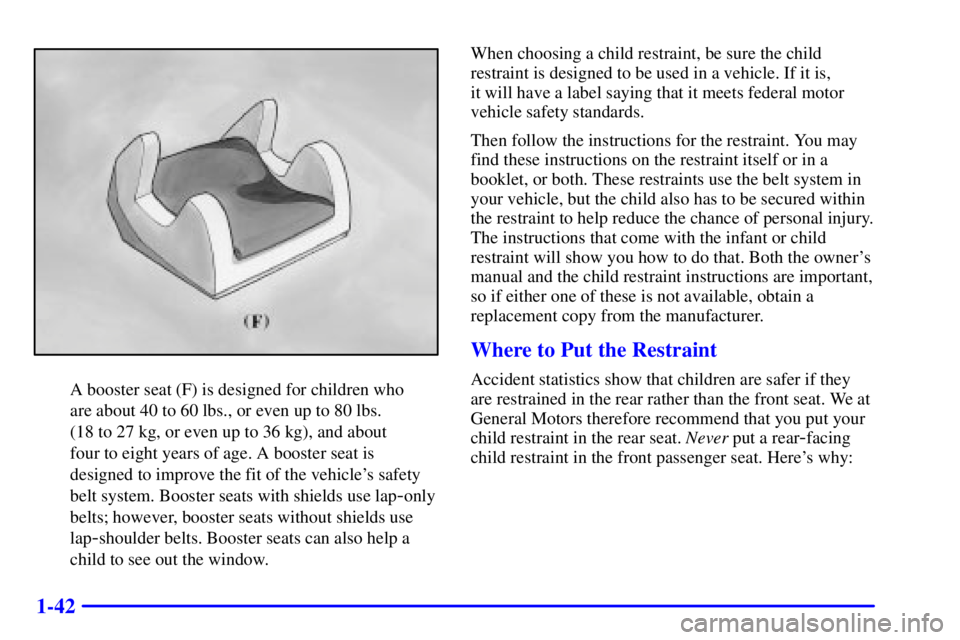
A booster seat (F) is designed for children who
are about 40 to 60 lbs., or even up to 80 lbs.
(18 to 27 kg, or even up to 36 kg), and about
four to eight years of age. A booster seat is
designed to improve the fit of the vehicle's safety
belt system. Booster seats with shields use lap
-only
belts; however, booster seats without shields use
lap
-shoulder belts. Booster seats can also help a
child to see out the window.When choosing a child restraint, be sure the child
restraint is designed to be used in a vehicle. If it is,
it will have a label saying that it meets federal motor
vehicle safety standards.
Then follow the instructions for the restraint. You may
find these instructions on the restraint itself or in a
booklet, or both. These restraints use the belt system in
your vehicle, but the child also has to be secured within
the restraint to help reduce the chance of personal injury.
The instructions that come with the infant or child
restraint will show you how to do that. Both the owner's
manual and the child restraint instructions are important,
so if either one of these is not available, obtain a
replacement copy from the manufacturer.
Where to Put the Restraint
Accident statistics show that children are safer if they
are restrained in the rear rather than the front seat. We at
General Motors therefore recommend that you put your
child restraint in the rear seat. Never put a rear
-facing
child restraint in the front passenger seat. Here's why:
Page 60 of 318

1-48
To remove the child restraint, just unbuckle the vehicle's
safety belt. It will be ready to work for an adult or larger
child passenger.
Securing a Child Restraint in the
Right Front Seat Position
Your vehicle has a right front passenger air bag. Never
put a rear
-facing child restraint in this seat. Here's why:
CAUTION:
A child in a rear-facing child restraint can be
seriously injured or killed if the right front
passenger's air bag inflates. This is because the
back of the rear
-facing child restraint would be
very close to the inflating air bag. Always secure
a rear
-facing child restraint in the rear seat.
Although a rear seat is a safer place, you can secure a
forward
-facing child restraint in the right front seat.
You'll be using the lap
-shoulder belt. See the earlier
part about the top strap if the child restraint has one.
Be sure to follow the instructions that came with the
child restraint. Secure the child in the child restraint
when and as the instructions say.
1. Because your vehicle has a right front passenger air
bag, always move the seat as far back as it will go
before securing a forward
-facing child restraint.
(See ªSeatsº in the Index.)
2. Put the restraint on the seat.
3. Pick up the latch plate, and run the lap and shoulder
portions of the vehicle's safety belt through or
around the restraint. The child restraint instructions
will show you how.
If the shoulder belt goes in front of the child's face
or neck, put it behind the child restraint.
Page 87 of 318
2-22
Automatic Transaxle Operation
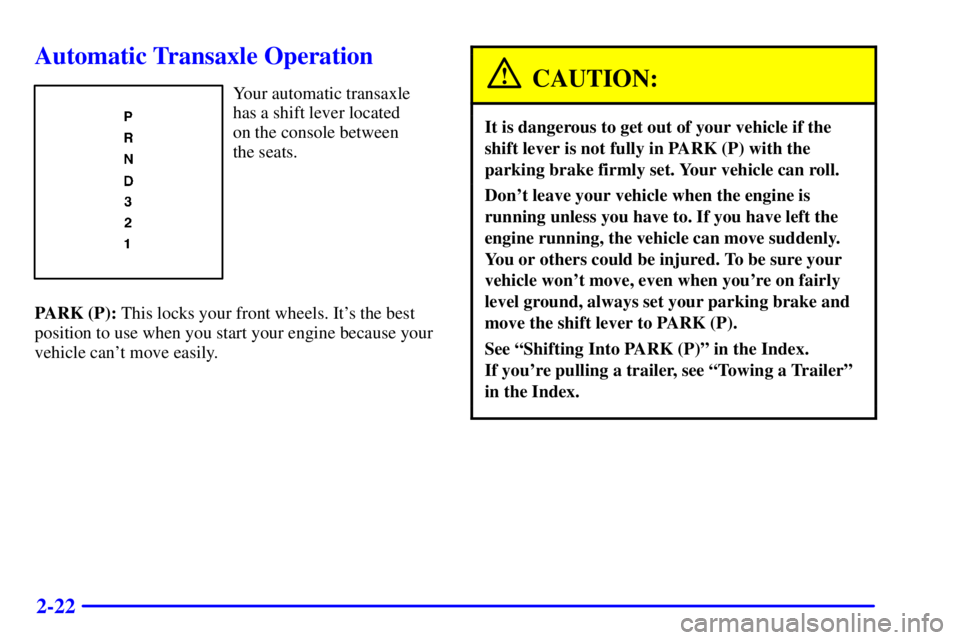
Your automatic transaxle
has a shift lever located
on the console between
the seats.
PARK (P): This locks your front wheels. It's the best
position to use when you start your engine because your
vehicle can't move easily.CAUTION:
It is dangerous to get out of your vehicle if the
shift lever is not fully in PARK (P) with the
parking brake firmly set. Your vehicle can roll.
Don't leave your vehicle when the engine is
running unless you have to. If you have left the
engine running, the vehicle can move suddenly.
You or others could be injured. To be sure your
vehicle won't move, even when you're on fairly
level ground, always set your parking brake and
move the shift lever to PARK (P).
See ªShifting Into PARK (P)º in the Index.
If you're pulling a trailer, see ªTowing a Trailerº
in the Index.