seats PONTIAC GRAND AM 2002 Owners Manual
[x] Cancel search | Manufacturer: PONTIAC, Model Year: 2002, Model line: GRAND AM, Model: PONTIAC GRAND AM 2002Pages: 335, PDF Size: 2.46 MB
Page 7 of 335
1-
1-1
Section 1 Seats and Restraint Systems
Here you'll find information about the seats in your vehicle and how to use your safety belts properly. You can also
learn about some things you should not do with air bags and safety belts.
1
-2 Seats and Seat Controls
1
-8 Safety Belts: They're for Everyone
1
-12 Here Are Questions Many People Ask About
Safety Belts
-- and the Answers
1
-13 How to Wear Safety Belts Properly
1
-14 Driver Position
1
-21 Safety Belt Use During Pregnancy
1
-22 Right Front Passenger Position
1
-22 Supplemental Restraint System (SRS)
1
-28 Rear Seat Passengers1
-31 Rear Safety Belt Comfort Guides for Children
and Small Adults
1
-34 Center Passenger Position
1
-35 Children
1
-39 Restraint Systems for Children
1
-54 Older Children
1
-57 Safety Belt Extender
1
-57 Checking Your Restraint Systems
1
-57 Replacing Restraint System Parts
After a Crash
Page 8 of 335
1-2
Seats and Seat Controls
This section tells you about the seats -- how to
adjust them
-- and also about reclining seatbacks and
head restraints.
Manual Seats
CAUTION:
You can lose control of the vehicle if you try to
adjust a manual driver's seat while the vehicle is
moving. The sudden movement could startle and
confuse you, or make you push a pedal when you
don't want to. Adjust the driver's seat only when
the vehicle is not moving.
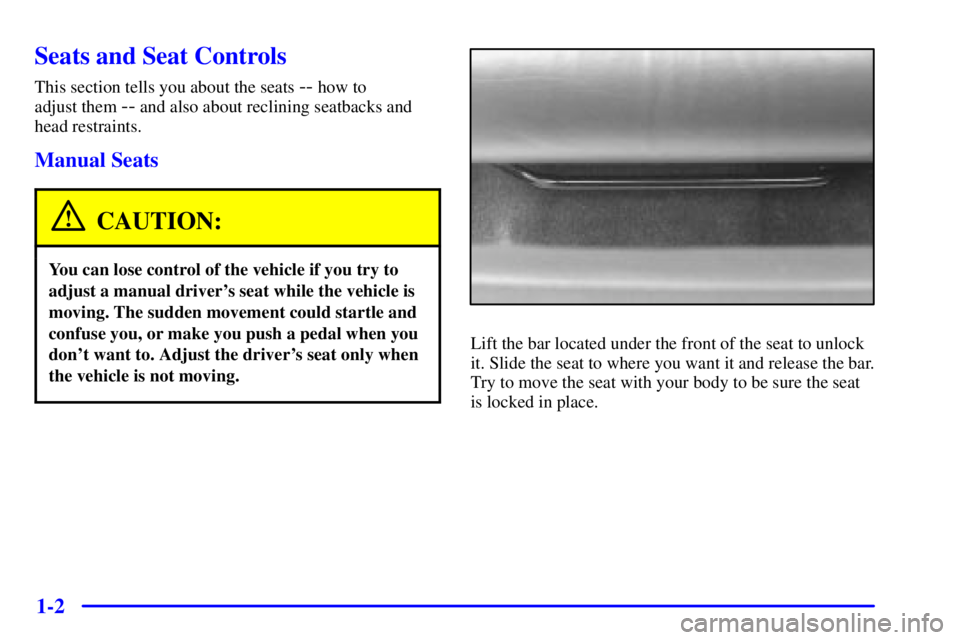
Lift the bar located under the front of the seat to unlock
it. Slide the seat to where you want it and release the bar.
Try to move the seat with your body to be sure the seat
is locked in place.
Page 13 of 335
1-7 Easy Entry Seat (Two-Door Models)
The right front seat of your vehicle makes it easy for
people to get in and out of the rear seat.
1. Fold the right front seatback forward after lifting the
seatback latch fully.
2. The seat will slide forward to allow someone to get
into the rear seat area.
3. Push the seatback upright to lock and slide the seat
fully rearward to lock. The front passenger should
try to move the seat to make sure the seat is locked
into place.
CAUTION:
If an easy entry right front seat isn't locked, it
can move. In a sudden stop or crash, the person
sitting there could be injured. After you've used
it, be sure to push rearward on an easy entry seat
to be sure it is locked.
Rear Seats
Folding the Rear Seatback (Option)
To fold down the rear seatback, do the following:
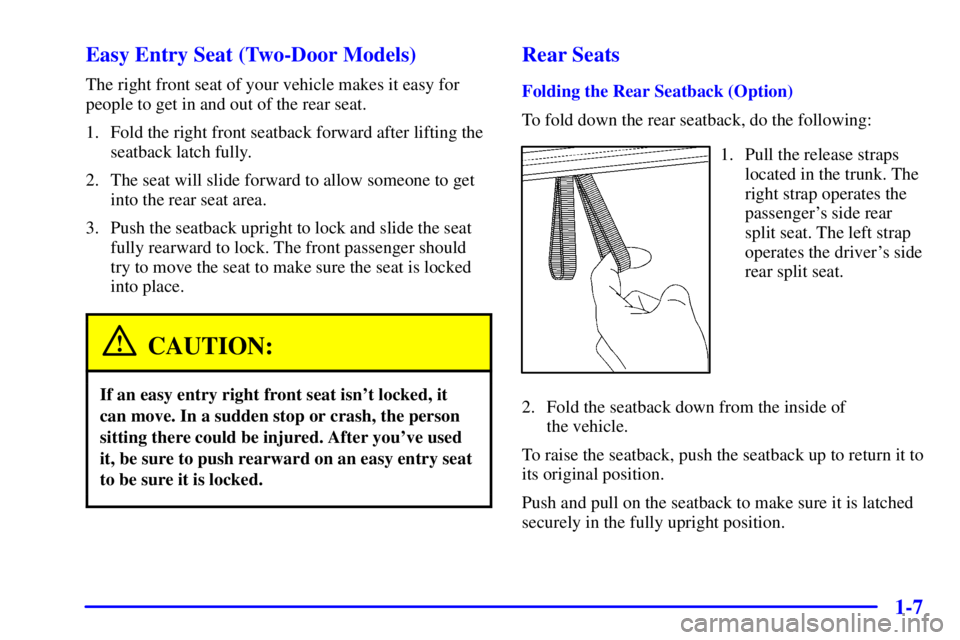
1. Pull the release straps
located in the trunk. The
right strap operates the
passenger's side rear
split seat. The left strap
operates the driver's side
rear split seat.
2. Fold the seatback down from the inside of
the vehicle.
To raise the seatback, push the seatback up to return it to
its original position.
Push and pull on the seatback to make sure it is latched
securely in the fully upright position.
Page 14 of 335
1-8
Safety Belts: They're for Everyone
This part of the manual tells you how to use safety belts
properly. It also tells you some things you should not do
with safety belts.
And it explains the Supplemental Restraint System
(SRS), or air bag system.
CAUTION:
Don't let anyone ride where he or she can't wear
a safety belt properly. If you are in a crash and
you're not wearing a safety belt, your injuries
can be much worse. You can hit things inside the
vehicle or be ejected from it. You can be seriously
injured or killed. In the same crash, you might
not be if you are buckled up. Always fasten your
safety belt, and check that your passengers' belts
are fastened properly too.
CAUTION:
It is extremely dangerous to ride in a cargo
area, inside or outside of a vehicle. In a collision,
people riding in these areas are more likely to be
seriously injured or killed. Do not allow people
to ride in any area of your vehicle that is not
equipped with seats and safety belts. Be sure
everyone in your vehicle is in a seat and using
a safety belt properly.
Your vehicle has a light
that comes on as a reminder
to buckle up. See ªSafety
Belt Reminder Lightº in
the Index.
In most states and Canadian provinces, the law says to
wear safety belts. Here's why: They work.
Page 20 of 335
1-14
Driver Position
This part describes the driver's restraint system.
Lap-Shoulder Belt
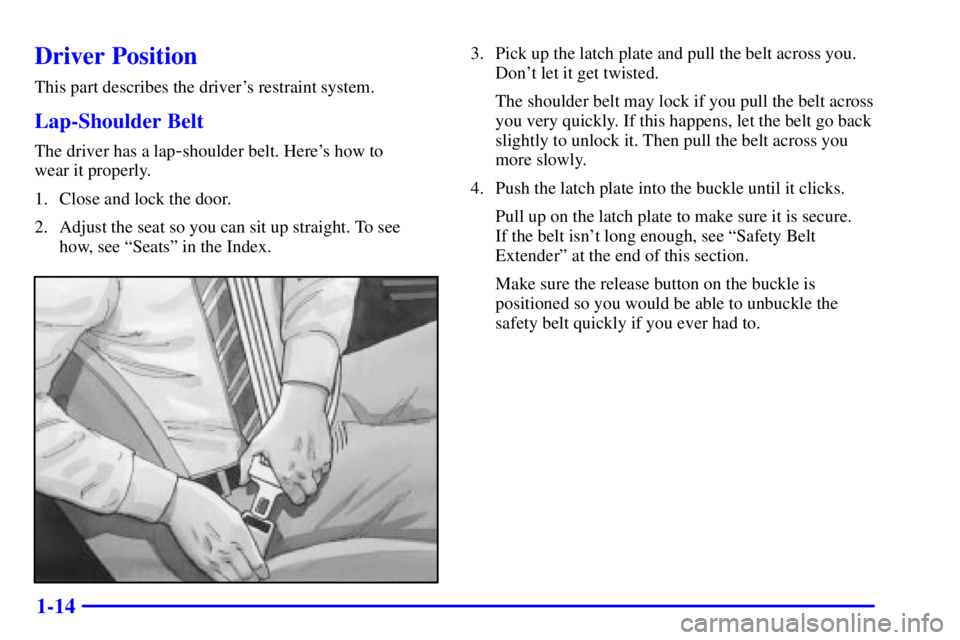
The driver has a lap-shoulder belt. Here's how to
wear it properly.
1. Close and lock the door.
2. Adjust the seat so you can sit up straight. To see
how, see ªSeatsº in the Index.
3. Pick up the latch plate and pull the belt across you.
Don't let it get twisted.
The shoulder belt may lock if you pull the belt across
you very quickly. If this happens, let the belt go back
slightly to unlock it. Then pull the belt across you
more slowly.
4. Push the latch plate into the buckle until it clicks.
Pull up on the latch plate to make sure it is secure.
If the belt isn't long enough, see ªSafety Belt
Extenderº at the end of this section.
Make sure the release button on the buckle is
positioned so you would be able to unbuckle the
safety belt quickly if you ever had to.
Page 37 of 335
1-31
CAUTION:
You can be seriously hurt if your shoulder belt is
too loose. In a crash, you would move forward
too much, which could increase injury. The
shoulder belt should fit against your body.
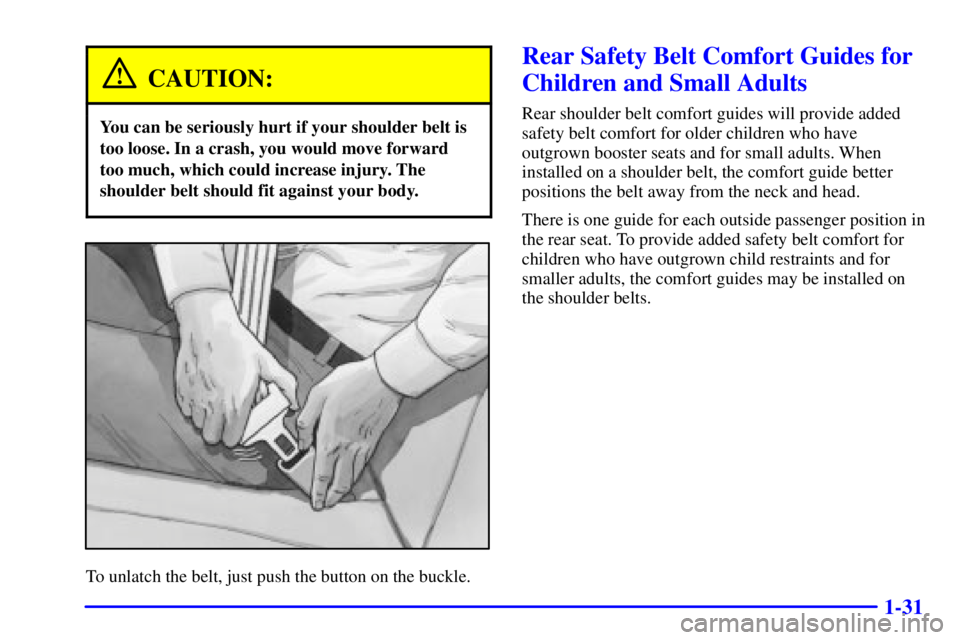
To unlatch the belt, just push the button on the buckle.
Rear Safety Belt Comfort Guides for
Children and Small Adults
Rear shoulder belt comfort guides will provide added
safety belt comfort for older children who have
outgrown booster seats and for small adults. When
installed on a shoulder belt, the comfort guide better
positions the belt away from the neck and head.
There is one guide for each outside passenger position in
the rear seat. To provide added safety belt comfort for
children who have outgrown child restraints and for
smaller adults, the comfort guides may be installed on
the shoulder belts.
Page 46 of 335
1-40
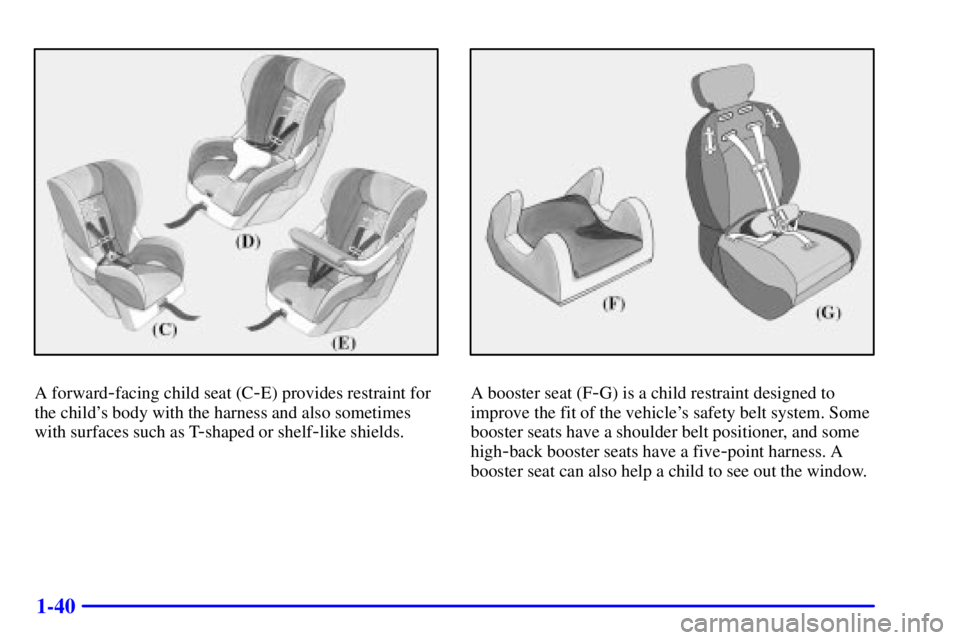
A forward-facing child seat (C-E) provides restraint for
the child's body with the harness and also sometimes
with surfaces such as T
-shaped or shelf-like shields.
A booster seat (F-G) is a child restraint designed to
improve the fit of the vehicle's safety belt system. Some
booster seats have a shoulder belt positioner, and some
high
-back booster seats have a five-point harness. A
booster seat can also help a child to see out the window.
Page 57 of 335
1-51 Securing a Child Restraint in the Right
Front Seat Position
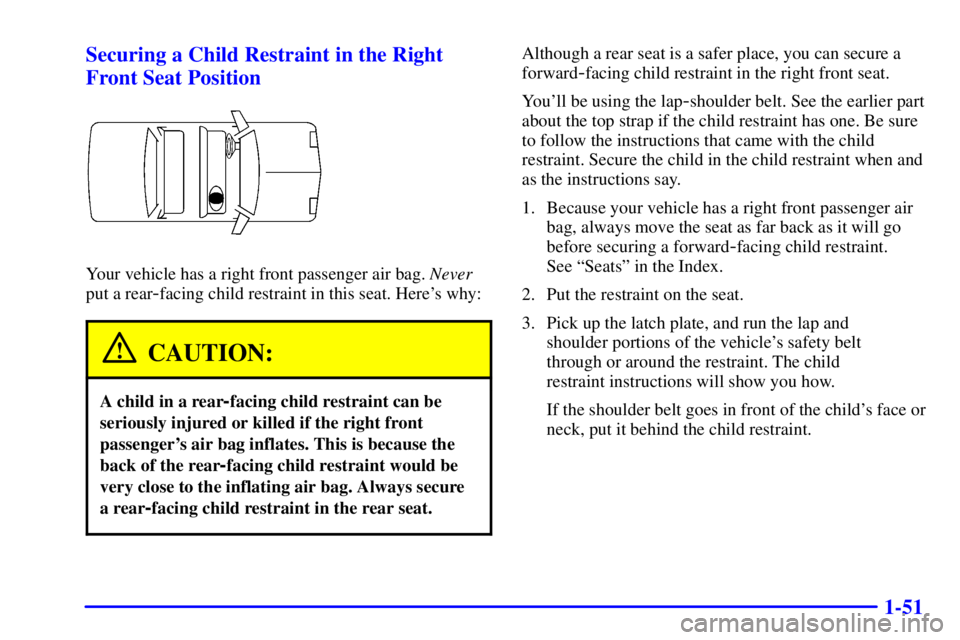
Your vehicle has a right front passenger air bag. Never
put a rear
-facing child restraint in this seat. Here's why:
CAUTION:
A child in a rear-facing child restraint can be
seriously injured or killed if the right front
passenger's air bag inflates. This is because the
back of the rear
-facing child restraint would be
very close to the inflating air bag. Always secure
a rear
-facing child restraint in the rear seat.
Although a rear seat is a safer place, you can secure a
forward
-facing child restraint in the right front seat.
You'll be using the lap
-shoulder belt. See the earlier part
about the top strap if the child restraint has one. Be sure
to follow the instructions that came with the child
restraint. Secure the child in the child restraint when and
as the instructions say.
1. Because your vehicle has a right front passenger air
bag, always move the seat as far back as it will go
before securing a forward
-facing child restraint.
See ªSeatsº in the Index.
2. Put the restraint on the seat.
3. Pick up the latch plate, and run the lap and
shoulder portions of the vehicle's safety belt
through or around the restraint. The child
restraint instructions will show you how.
If the shoulder belt goes in front of the child's face or
neck, put it behind the child restraint.
Page 60 of 335
1-54
Older Children
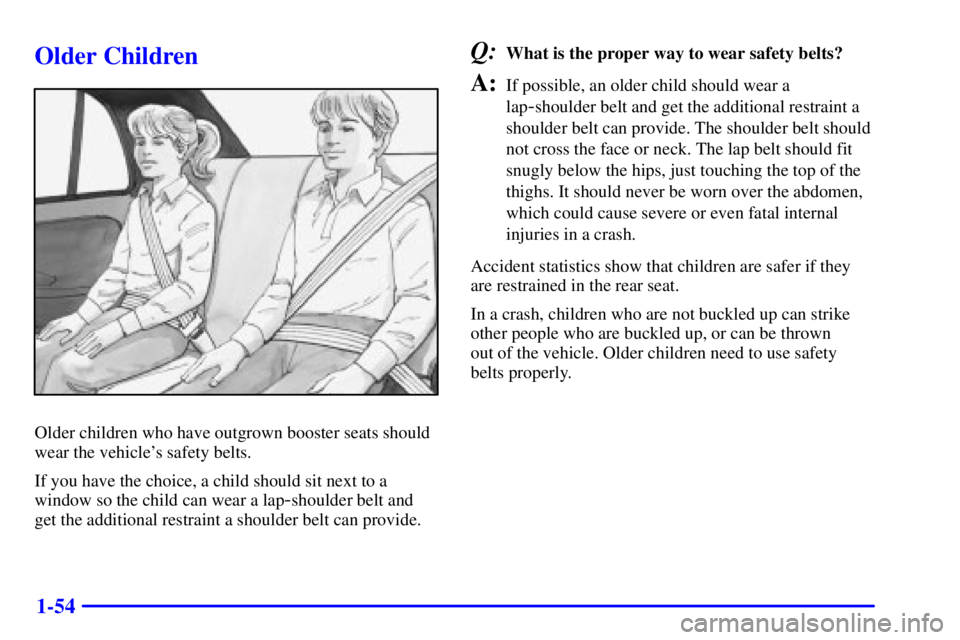
Older children who have outgrown booster seats should
wear the vehicle's safety belts.
If you have the choice, a child should sit next to a
window so the child can wear a lap
-shoulder belt and
get the additional restraint a shoulder belt can provide.
Q:What is the proper way to wear safety belts?
A:If possible, an older child should wear a
lap
-shoulder belt and get the additional restraint a
shoulder belt can provide. The shoulder belt should
not cross the face or neck. The lap belt should fit
snugly below the hips, just touching the top of the
thighs. It should never be worn over the abdomen,
which could cause severe or even fatal internal
injuries in a crash.
Accident statistics show that children are safer if they
are restrained in the rear seat.
In a crash, children who are not buckled up can strike
other people who are buckled up, or can be thrown
out of the vehicle. Older children need to use safety
belts properly.
Page 87 of 335
2-24 To Use the Engine Coolant Heater
1. Turn off the engine.
2. Open the hood and unwrap the electrical cord.
On the 2.2L L4 ECOTEC engine the engine
coolant heater cord is located in front of the engine
coolant surge tank on the passenger's side of the
engine compartment. On the 3400 V6 engine the
engine coolant heater cord is located near the engine
air cleaner/filter.
3. Plug it into a normal, grounded 110
-volt AC outlet.
CAUTION:
Plugging the cord into an ungrounded outlet
could cause an electrical shock. Also, the wrong
kind of extension cord could overheat and cause
a fire. You could be seriously injured. Plug the
cord into a properly grounded three
-prong
11 0
-volt AC outlet. If the cord won't reach, use
a heavy
-duty three-prong extension cord rated
for at least 15 amps.
4. Before starting the engine, be sure to unplug
and store the cord as it was before to keep it away
from moving engine parts. If you don't, it could
be damaged.
How long should you keep the coolant heater plugged
in? The answer depends on the outside temperature, the
kind of oil you have, and some other things. Instead of
trying to list everything here, we ask that you contact
your dealer in the area where you'll be parking your
vehicle. The dealer can give you the best advice for that
particular area.
Automatic Transaxle Operation
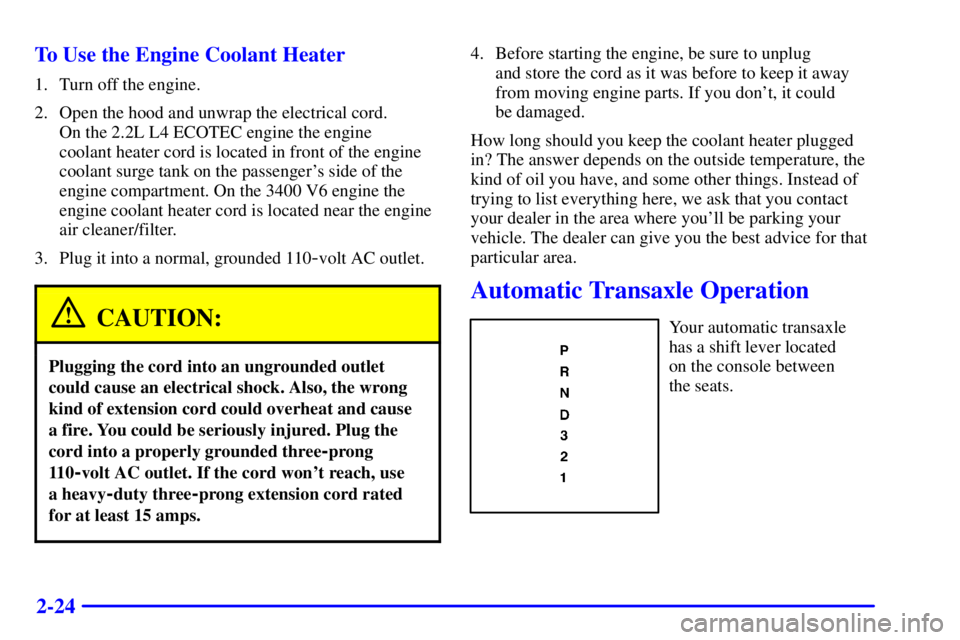
Your automatic transaxle
has a shift lever located
on the console between
the seats.