axle PONTIAC GRAND AM 2003 Owner's Manual
[x] Cancel search | Manufacturer: PONTIAC, Model Year: 2003, Model line: GRAND AM, Model: PONTIAC GRAND AM 2003Pages: 354, PDF Size: 16.3 MB
Page 138 of 354
Malfunction Indicator Lamp
Service Engine Soon Light
SERVICE
ENGINE
SOON
Your vehicle is equipped
with a computer which
monitors operation of the
fuel, ignition and emission control systems.
This system is called OBD
II (On-Board
Diagnostics-Second Generation) and is intended to
assure that emissions are at acceptable levels for the
life of the vehicle, helping
to produce a cleaner
environment. The
SERVICE ENGINE SOON light
comes on to indicate that there is a problem and
service is required. Malfunctions often will be indicated
by the system before any problem
is apparent. This
may prevent more serious damage
to your vehicle. This
system is also designed to assist your service
technician in correctly diagnosing any malfunction.
Notice: If you keep driving your vehicle with this
light on, after a while, your emission controls
may not work as well, your fuel economy may not
smoothly. This could lead to costly repairs that may not be covered by your warramty.
be 85 gcod and yaur engine may not run as
Notice: Modifications made to the engine,
transaxle, exhaust, intake or fuel system of your
vehicle or the replacement of
the original tires with
other than those
of the same Tire Performance
Criteria
(TPC) can affect your vehicle’s emission
controls and may cause
this light to come on.
Modifications to these systems could lead to costly
repairs not covered &y your warranty. This may
also result in a failure to pass a required Emission
Inspection/Maintenance test.
This light should come on, as a check to show you
it is
working, when the ignition is on and the engine
is
not running. If the light doesn’t come on, have it
repaired. This light will also come on during
a
malfunction in one of two ways:
e
e
Light Flashing - A misfire condition has been
detected.
A misfire increases vehicle emissions
and may damage the emission control system
on
your vehicle. Dealer or qualified service center
diagnosis and service may be required.
Light On Steady
- An emission control system
malfunction has been detected on your vehicle.
Dealer or qualified service center diagnosis
and service may be required.
3-31
Page 189 of 354
LOW
TRAC
This light will come on
when your Enhanced
Traction System is limiting
wheel spin. See
Enhanced Traction System
Active Light on page 3-29.
You may feel or hear the system working, but this is
normal. This light will also come on when the anti-lock
brake system is working.
If your vehicle is in cruise control when the enhanced
traction system begins
to limit wheel spin, the cruise
control will automatically disengage. When road
conditions allow you to safely use it again, you may
re-engage the cruise control. See “Cruise Control” under
Turn Signal/Multifunction Lever on page 3-6.
The Enhanced Traction System operates in all transaxle
shift lever positions. But the system can upshift the
transaxle only as high
as the shift lever position you’ve
chosen,
so you should use the lower gears only
when necessary. See
Automatic Transaxle Operation on
page
2-24.
TRAC
OFF
When the system is on and the parking brake is
fully released, this warning
light will come on to let
you know
if there’s a
problem.
See
Enhanced Traction System Warning Light on
page 3-28.
When this warning light is on, the system will
not limit wheel spin. Adjust your driving accordingly.
4-1 0
Page 204 of 354
Hill and Mountain Roads
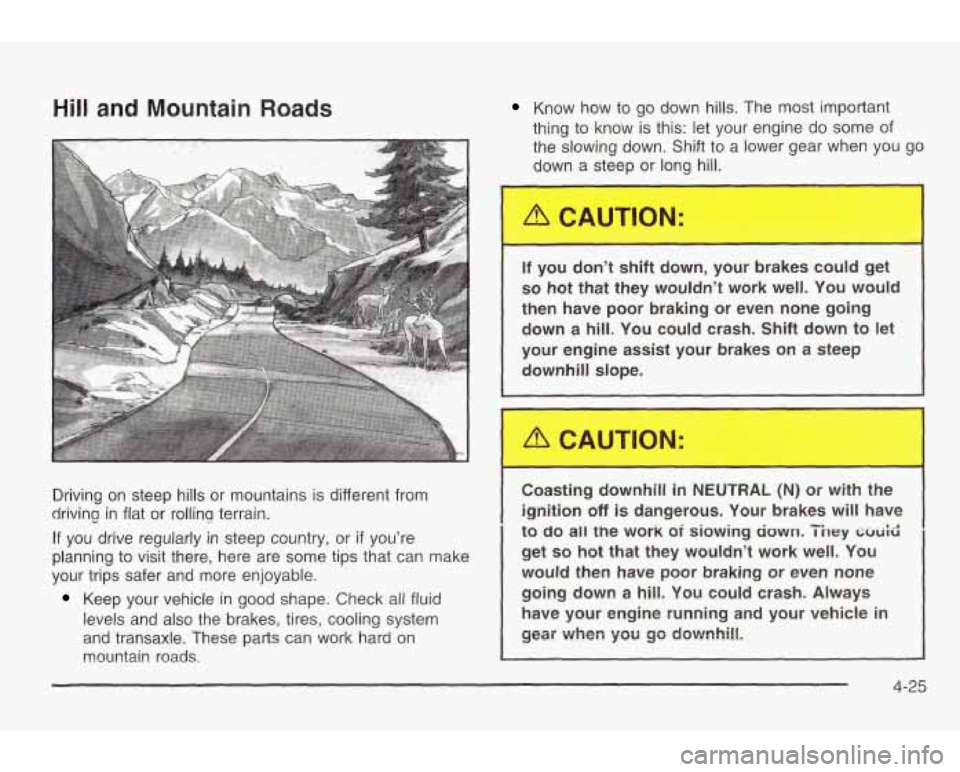
Driving on steep hills or mountains is different from
drivina
w in flat or rollinq terrain.
If you drive regularly in steep country, or if you’re
planning to visit there, here are some tips that can make
your trips safer and more enjoyable.
Keep your vehicle in good shape. Check all fluid
levels and
also the brakes, tires, cooling system
and transaxle. These parts can work hard on
mountain roads.
Know how to go down hills. The most important
thing
to know is this: let your engine do some of
the
slowing down. Shift to a lower gear when you go
down a steep or lom hill.
If you don’t shift down, your brakes could get
so hot that they wouldn’t work well. You would
then have poor braking or even none going
down a
hill. You could crash. Shift down to let
your engine assist your brakes
on a steep
downhill
slope.
i
Coasting downhill in NEUTRAL (N) or with the
ignition
off is dangerous. Your brakes will have
to
do all the work ai siowing down. I ney cwdd
get so hot that they wouldn’t work well. You
would then have poor braking or even none going down a hill. You could crash. Always have your engine running and your vehicle in
I.
4-25
Page 210 of 354
If You Are Stuck: In Sand, Mud, Ice
or Snow
In order to free your vehicle when it is stuck, you will
need to spin the wheels, but you don’t want to spin your
wheels too fast. The method known as “rocking” can
help you get out when you’re stuck, but you must
use caution.
If you
let your tires spin at high speed, they
can explode, and you or others could be
injured. And, the transaxle or other parts of the
vehicle can overheat. That could cause an
engine compartment fire
or other damage.
When you’re stuck, spin the wheels as little as
possible. Don’t spin the wheels above
35 mph
(55 km/h) as shown on the speedometer.
Notice: Spinning your wheels can destroy parts of
your vehicle as well as the tires. If you spin the
wheels too fast while shifting your transaxle back
and forth, you can destroy your transaxle. See
“Rocking Your Vehicle
To Get It Out.”
For information about using tire chains on your vehicle,
see
Tire Chains on page 5-60.
Rocking Your Vehicle To Get It Out
First, turn your steering wheel left and right. That will
clear the area around your front wheels. Then shift back
and forth between REVERSE (R) and a forward gear
(or with a manual transaxle, between FIRST
(1) or
SECOND
(2) and REVERSE (R)), spinning the wheels
as little as possible. Release the accelerator pedal
while you shift, and press lightly on the accelerator pedal
when the transaxle is in gear. By slowly spinning your
wheels in the forward and reverse directions, you
will cause a rocking motion that may free your vehicle.
If
that doesn’t get you out after a few tries, you may
need to be towed out. If you do need to be towed out,
see “Towing Your Vehicle” following.
4-31
Page 212 of 354
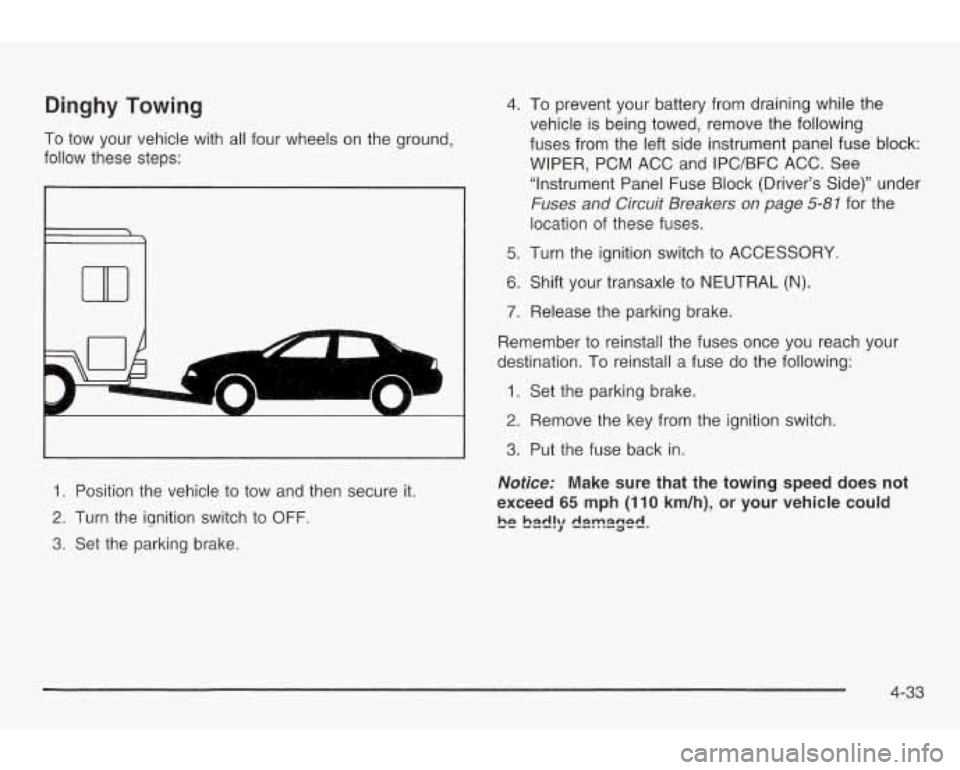
Dinghy Towing
To low your vehicle with all four wheels on the ground,
follow these steps:
ti
11701
1. Position the vehicle to tow and then secure it.
2. Turn the ignition switch to OFF.
3. Set the parking brake. 4.
To prevent your battery from draining while the
vehicle is being towed, remove the following
fuses from the left side instrument panel fuse block:
WIPER, PCM ACC and IPC/BFC ACC. See
“Instrument Panel Fuse Block (Driver’s Side)” under
Fuses and Circuit Breakers on page 5-81 for the
location of these fuses.
5. Turn the ignition switch to ACCESSORY.
6. Shift your transaxle to NEUTRAL (N).
7. Release the parking brake.
Remember to reinstall the fuses once you reach your
destination. To reinstall
a fuse do the following:
1. Set the parking brake.
2. Remove the key from the ignition switch.
3. Put the fuse back in.
Notice: Make sure that the towing speed does not
exceed
65 mph (1 10 km/h), or your vehicle could
be b2d!y dm2ge.r.
4-33
Page 213 of 354
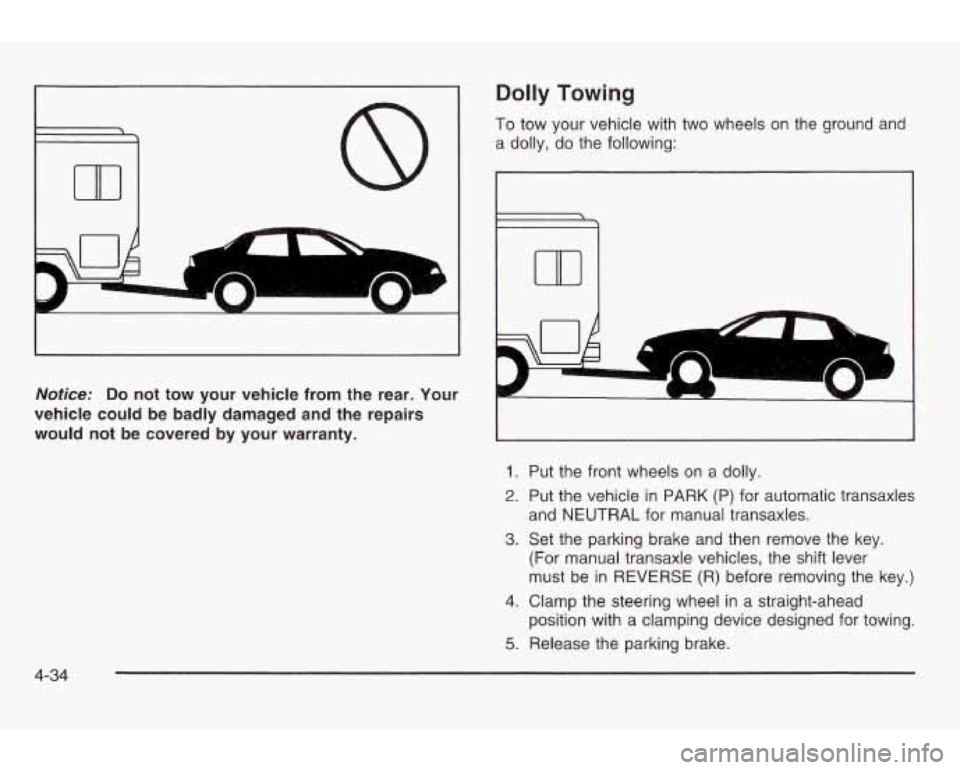
Dolly Towing
To tow your vehicle with two wheels on the ground and
a dolly, do the following:
Noficer Do not tow your vehicle from the rear. Your
vehicle could be badly damaged and the repairs
would not
be covered by your warranty. ~~~~~~~~~~~~~~~~~ ~~~~~~~~~~~~~ ~~~ ~
1. Put the front wheels on a dolly.
2. Put the vehicle in PARK (P) for automatic transaxles
and
NEUTRAL for manual transaxles.
3. Set the parking brake and then remove the key.
(For manual transaxle vehicles, the shift lever
must be in
REVERSE (R) before removing the key.)
4. Clamp the steering wheel in a straight-ahead
position with a clamping device designed for towing.
5. Release the parking brake.
4-34
Page 214 of 354
Loading Your Vehicle
'
OCCUPANTS VEHICLE CAP. WT.
TIRE-LOADING
INFORMATION
FRT. CTR.
RR. TOTAL LBS. KG
MAX. LOADING & GVWR SAME AS VEHICLE
CAPACITY WEIGHT
XXX COLD TIRE
TIRE
SIZE SPEED PRESSURE
RTG PSI/KPa
FRT.
RR.
SPA.
IF TIRES ARE HOT, ADD 4PS1128KPa
SEE OWNER'S MANUAL FOR ADDITIONAL
, INFORMATION
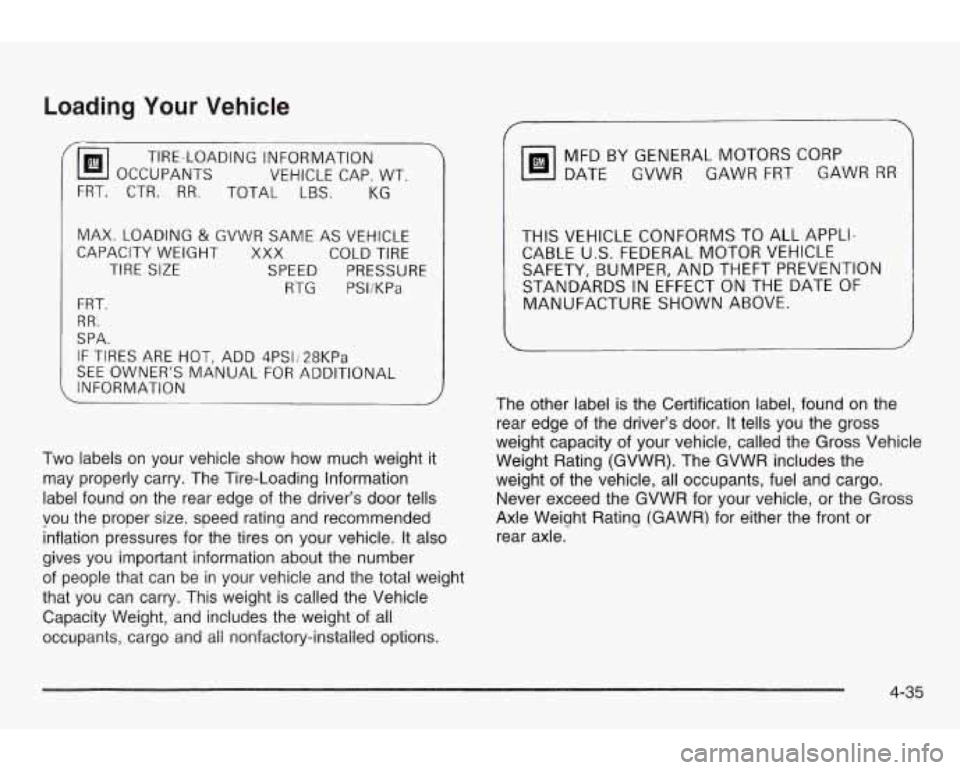
Two labels on your vehicle show how much weight it
may properly carry. The Tire-Loading Information
label found on the rear edge of the driver's door tells
you the proper size. speed ratinu and recommended
inflation pressures for the tires on your vehicle. It also
gives you important information about the number
of people that can be in your vehicle and the total weight
that you can carry. This weight is called the Vehicle
Capacity Weight, and includes the weight of all
occUpanfs, cargo and nonfac~ory~~ns~a~~e~ options.
7
MFD BY GENERAL MOTORS CORP
DATE GVWR GAWR FRT GAWR
RR
THIS VEHICLE CONFORMS TO ALL APPLI-
CABLE U.S. FEDERAL MOTOR VEHICLE
SAFETY, BUMPER, AND THEFT PREVENTION
STANDARDS
IN EFFECT ON THE DATE OF
MANUFACTURE SHOWN ABOVE.
The other label is the Certification label, found
on the
rear edge of the driver's door. It tells you the gross
weight capacity of your vehicle, called the Gross Vehicle
Weight Rating (GVWR). The GVWR includes the
weight of the vehicle, all occupants, fuel and cargo.
Never exceed the GVWR for your vehicle, or the Gross
Axle Weiqht Ratinq (GAWR) for either the front or
rear axle.
4-35
Page 216 of 354
Towing a Trailer
Y
If you don’t use the correct equipment and
drive properly, you can lose control when you
pull a trailer. For example, if the trailer is too
heavy, the brakes may not work well
-- or even
I at all. You and your passengers could be
~ seriously injured. You may also damage your
vehicle; the resulting repairs would not be
covered by your warranty. Pull a trailer only
if
you have followed all the steps in this section.
Ask your dealer for advice and information
about towing a trailer with your vehicle.
Your vehicle can tow a trailer
if it is equipped with the
proper trailer towing equipment. To identify what
the vehicle trailerinq capacity is for Vour vehicle, vou
should read the information in “Weight of the Trailer” that
appears later in this section. But trailering is different
than just driving your vehicle by itself. Trailering means
changes in handling, durability and fuel economy.
Successful, safe trailering takes correct equipment, and
It has to he L!sed proper!)/.
That’s the reason for this part. In it are many time-tested,
important trailering tips and safety rules. Many of
these are important for your safety and that of your
passengers.
So please read this section carefully before
you pull a trailer.
Load-pulling components such as the engine, transaxle,
wheel assemblies and tires are forced to work harder
against the drag
of the added weight. The engine
is required to operate at relatively higher speeds and
under greater loads, generating extra heat. What’s more,
the trailer adds considerably to wind resistance,
increasing the pulling requirements.
If You Do Decide To Pull A Trailer
If you do, here are some important points:
There are many different laws, including speed limit
restrictions, having to do with trailering. Make sure
your rig will be legal, not only where you live
but also where you’ll be driving.
A good source for
this information can be state or provincial police.
Consider using a sway control. You can ask a hitch
dealer about sway controls.
4-37
Page 217 of 354
0
0
0
Don’t tow a trailer at all during the first 1,000 miles
(1
600 km) your new vehicle is driven. Your
engine, axle or other parts could be damaged.
Then, during the first 500 miles (800 km) that you
tow a trailer, don’t drive over 50 mph (80 km/h)
and don’t make starts at full throttle. This helps your
engine and other parts of your vehicle wear in at
the heavier loads.
Obey speed limit restrictions when towing a trailer. Don’t drive faster than the maximum posted speed
for trailers, or no more than 55 mph (90 km/h),
to save wear on your vehicle’s parts.
Three important considerations have
to do with weight:
0 the weight of the trailer,
0 the weight of the trailer tongue
0 and the total weight on your vehicle’s tires.
Weight of the Trailer
How heavy can a trailer safely be?
It should never weigh more than 1,000 Ibs. (454 kg). But
even that can be
too heavy.
It depends on how you plan
to use your rig. For
example, speed, altitude, road grades, outside
temperature and how much your vehicle is used
to pull
a trailer are all important. And, it can also depend
on any special equipment that you have on your vehicle. You can
ask your dealer for our trailering information or
advice, or you can write us at:
Pontiac-GMC Customer Assistance
P.O. Box 33172
Detroit, MI 48232-51 72
In Canada, write to:
General Motors of Canada Limited
Customer Communication Centre, 163-005
1908 Colonel Sam Drive
Oshawa, Ontario L1H 8P7
Weight of the Trailer Tongue
The tongue load (A) of any trailer is an important weight
to measure because it affects the total or gross weight
of your vehicle. The Gross Vehicle Weight (GVW)
includes the curb weight of the vehicle, any cargo you
may carry in it, and the people who will be riding in
the vehicle. And
if you tow a trailer, you must add the
tongue load to the GVW because your vehicle will
be carrying that weight,
too. See Loading Your Vehicle
on page 4-35 for more information about your
vehicle’s maximum load capacity.
4-38
Page 221 of 354
Driving On Grades
Reduce speed and shift to a lower gear before you start
down a long or steep downgrade.
If you don’t shift
down, you might have to use your brakes
so much that
they would get hot and no longer work well.
On a long uphill grade, shift down and reduce your
speed
to around 45 mph (70 km/h) to reduce the
possibility
of engine and transaxle overheating.
Parking on Hills
You really should not park your vehicle, with a
trailer attached, on a hill.
If something goes
wrong, your rig could start to move. People
can be injured, and both your vehicle and the
trailer can be damaged. But
if you ever have
to park your rig on a hill, here’s
how to do it:
1. Apply your regular brakes, but don’t shift into
PARK (P) for an automatic transaxle or into gear for
a manual transaxle, yet. When parking uphill, turn
your wheels away from the curb. When parking
downhill, turn your wheels into the curb.
wheels. brakes until the chocks absorb the load.
2. Have someone place chocks
under the trailer
3. When the chocks are in place, release the regular
4. Reapply the regular brakes. Then apply your
parking brake and shift into PARK
(P) for an
automatic transaxle or REVERSE (R) for a manual
transaxle.
5. Release the regular brakes.
4-42