brake fluid PONTIAC GRAND AM 2003 Owners Manual
[x] Cancel search | Manufacturer: PONTIAC, Model Year: 2003, Model line: GRAND AM, Model: PONTIAC GRAND AM 2003Pages: 354, PDF Size: 16.3 MB
Page 108 of 354
Section 3 Instrument Panel
Instrument Panel Overview ............................... 3.2
Hazard Warnin Flashers
................................ 3.4
Other Warning !bevices
................................... 3.5
Horn
............................................................. 3.5
Tilt Wheel
..................................................... 3.5
Turn Signal/Multifunction Lever
......................... 3.6
Exterior Lamps
............................................. 3.13
Interior Lamps
.............................................. 3.16
Ashtrays and Cigarette Lighter
........................ 3.17
Climate Controls
............................................ 3.18
Climate Control System
................................. 3.18
Outlet Adjustment
......................................... 3.21
Warning Lights, Gages and Indicators
............. 3-22
Instrument Panel Cluster
................................ 3.23
Speedometer and Odometer
........................... 3.24
Tachometer
................................................. 3.24
Safety Belt Reminder Light
............................. 3.25
Air Bag Readiness Light ................................ 3.25
Charging System Light
.................................. 3.26
Up-Shift Light
............................................... 3.26
Erake QlQtT! -J -.-. !n!=lrning Light ........................ ~ 3-76 .
Warnin Light ........................................... 3-28
Warning Light
........................................... 3.28
Active Light
.............................................. 3.29
Low Coolant Warning Light
............................ 3.30
Anti-Lock
Brake System
Enhance
c? Traction System
Enhanced Traction System
Engine Coolant Temperature Gage
3.3~ rl on ..................
Malfunction Indicator Lamp ............................. 3.31
Oil Pressure Light
......................................... 3.34
Low Oil Level Li ht
....................................... 3.35
Securit Light:
............................................... 3-36
Service Vehicle Soon Light
............................ 3-36
Fuel Gage
................................................... 3-37
Audio System(s)
............................................. 3-38
Data Systems RDS)
.................................. 3-38
Change Engine
ail Light ................................ 3-35
Low dsher Fluid Warning Light
..................... 3-36
Setting the Time for Radios without Radio
Setting the Time
1 or Radios with Radio 3-39
........................... 3-39
.............................. 3-43
Radio with Cassette and CD
.......................... 3-55
Theft-Deterrent Feature
Theft-Deterrent Feature (Non-RDS Radios)
..................................... 3-68
(RDS Radios)
........................................... 3-68
MUUIW ULCCI II ly VVI IGGI VU1 ILI WIG v vv A . .A .- C'&-A~;~~ \Alhnnl Pnmtrnlrr Qxa .......................
Understanding Radio Reception ...................... 3-70
Care of Your Cassette Tape Player
................. 3-70
Care of Your CDs ......................................... 3-71
Care of Your CD Player
................................ 3-72
Fixed Mast Antenna ...................................... 3-72
XM Satellite Radio Antenna System
................ 3-72
DAB Radio Antenna System 3-11 Chime Level Adjustment ................................ 3-72
n Tn ...........................
3- 1
Page 204 of 354
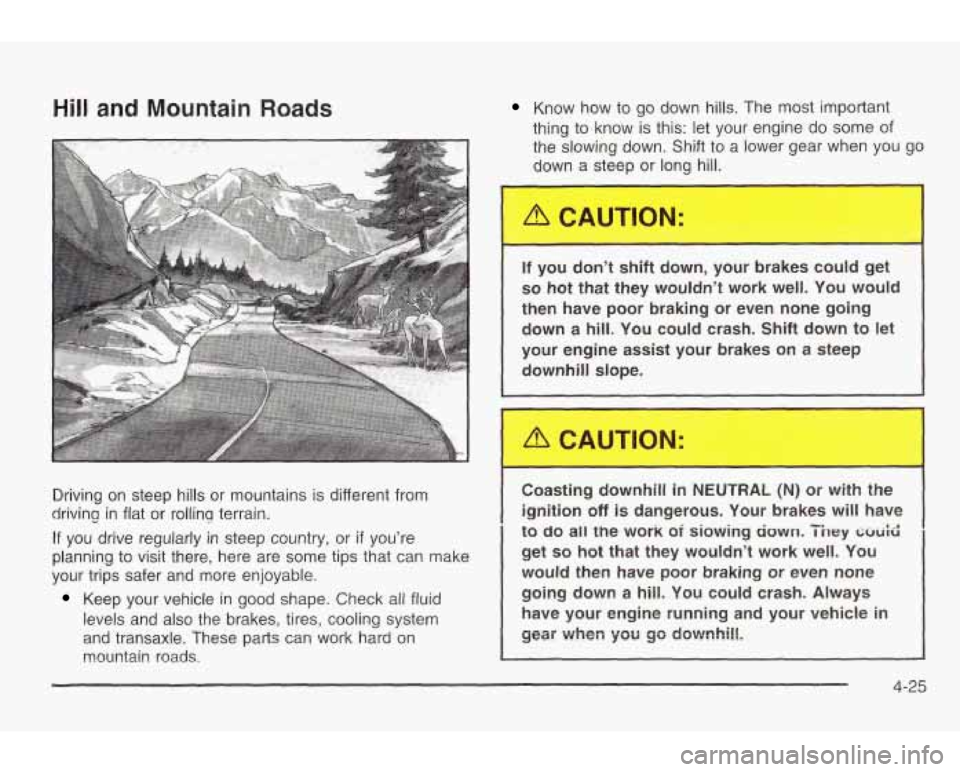
Hill and Mountain Roads
Driving on steep hills or mountains is different from
drivina
w in flat or rollinq terrain.
If you drive regularly in steep country, or if you’re
planning to visit there, here are some tips that can make
your trips safer and more enjoyable.
Keep your vehicle in good shape. Check all fluid
levels and
also the brakes, tires, cooling system
and transaxle. These parts can work hard on
mountain roads.
Know how to go down hills. The most important
thing
to know is this: let your engine do some of
the
slowing down. Shift to a lower gear when you go
down a steep or lom hill.
If you don’t shift down, your brakes could get
so hot that they wouldn’t work well. You would
then have poor braking or even none going
down a
hill. You could crash. Shift down to let
your engine assist your brakes
on a steep
downhill
slope.
i
Coasting downhill in NEUTRAL (N) or with the
ignition
off is dangerous. Your brakes will have
to
do all the work ai siowing down. I ney cwdd
get so hot that they wouldn’t work well. You
would then have poor braking or even none going down a hill. You could crash. Always have your engine running and your vehicle in
I.
4-25
Page 222 of 354
When You Are Ready to Leave After
Parking on
a Hill
1. Apply your regular brakes and hold the pedal down
while you:
0 start your engine,
0 shift into a gear, and
0 release the parking brake.
2. Let up on the brake pedal.
3. Drive slowly until the trailer is clear of the chocks.
4. Stop and have someone pick up and store the
chocks.
Maintenance When Trailer Towing
Your vehicle will need service more often when you’re
pulling a trailer. See the Maintenance Schedule for more
on this. Things that are especially important in trailer
operation are automatic transaxle fluid (don’t overfill), engine
oil, drive belt, cooling system and brake system.
Each of these
is covered in this manual, and the
Index will help you find them quickly.
If you’re trailering,
it’s a good idea
to review this information before you
start your trip.
Check periodically to see that all hitch nuts and bolts
are tight.
Engine Cooling When Trailer Towing
Your cooling system may temporarily overheat during
severe operating conditions. See
Engine Overheating on
page 5-26.
4-43
Page 224 of 354
Section 5 Service and Appearance Care
Service ............................................................ 5.3
Doing Your Own Service Work
......................... 5.3
Adding Equipment to the Outside of Your
Vehicle
...................................................... 5.4
Fuel ................................................................ 5.5
Gasoline Octane
............................................ 5.5
Gasoline Specifications
.................................... 5.5
California Fuel
............................................... 5-6
Additives
....................................................... 5-6
Fuels in Foreign Countries
............................... 5-7
Filling
a Portable Fuel Container ..................... -5-9
Filling Your Tank
............................................ 5-7
Checking Things Under the Hood
.................................................... 5-10
Hood Release
.............................................. 5-10
Engine Compartment Overview
....................... 5-12
Engine Oil
................................................... 5.15
Engine Air CleanedFilter
................................ 5-21
Manual Transaxle Fluid
.................................. 5-22
Hydraulic Clutch
........................................... 5-23
Engine Coolant
............................................. 5-23
Engine Overheating
....................................... 5-26
Cooling System
............................................ 5-29
Power Steering Fiuia
~1-36
I~~ULWIII~LIW I 1ulIaUAlG I lulu J-LL An ntnmntie Trnnr.r-.vln Cln #;PI r on ..............................
- -- ....................................
Windshield Washer Fluid ................................ 5-37
Brakes
........................................................ 5.39
Battery
........................................................ 5.42
Jump Starting
............................................... 5-43
Bulb Replacement .......................................... 5.49
Halogen Bulbs
.............................................. 5.49
Headlamps
.................................................. 5.49
Front Turn Signal and Parking Lamps
.............. 5-50
Center High-Mounted Stoplamp (CHMSL)
......... 5.50
Taillamps, Turn Signal, and Stoplamps
............ 5.51
Replacement Bulbs
....................................... 5.51
Windshield Wiper Blade Replacement
.............. 5.52
Tires
.............................................................. 5.53
Inflation
.. Tire Pressure ................................ 5-54
Tire Inspection and Rotation
........................... 5-55
When It
Is Time for New Tires ....................... 5-56
Buying New Tires
......................................... 5-56
Uniform Tire Quality Grading
......................... 5-57
Wheel Alignment and Tire Balance
.................. 5-59
Wheel Replacement
...................................... 5-59
Tire Chains
.................................................. 5-60
If a Tire Goes Flat ........................................ 5-61
Changing
a Flat Tire ..................................... 5-62
Compact Spare Tire
...................................... 5-71
5-
1
Page 233 of 354

Checking Things Under
the Hood
Hood Release
To open the hood, do the following:
1. Pull the handle located
under the instrument
panel on the drivier's side
of the vehicle.
L% CAUTION:
An electric fan under the hood can start up
and injure you even when the engine is not running. Keep hands, clothing and tools away
from any underhood electric fan.
Things that burn can get on hot engine parts
and start
a fire. These include liquids like fuel,
oil, coolant, brake fluid, windshield washer and
other fluids, and plastic or rubber. You or
others could be burned. Be careful not to drop
or spill things that will burn onto a hot engine.
I
5-1 0
Page 236 of 354
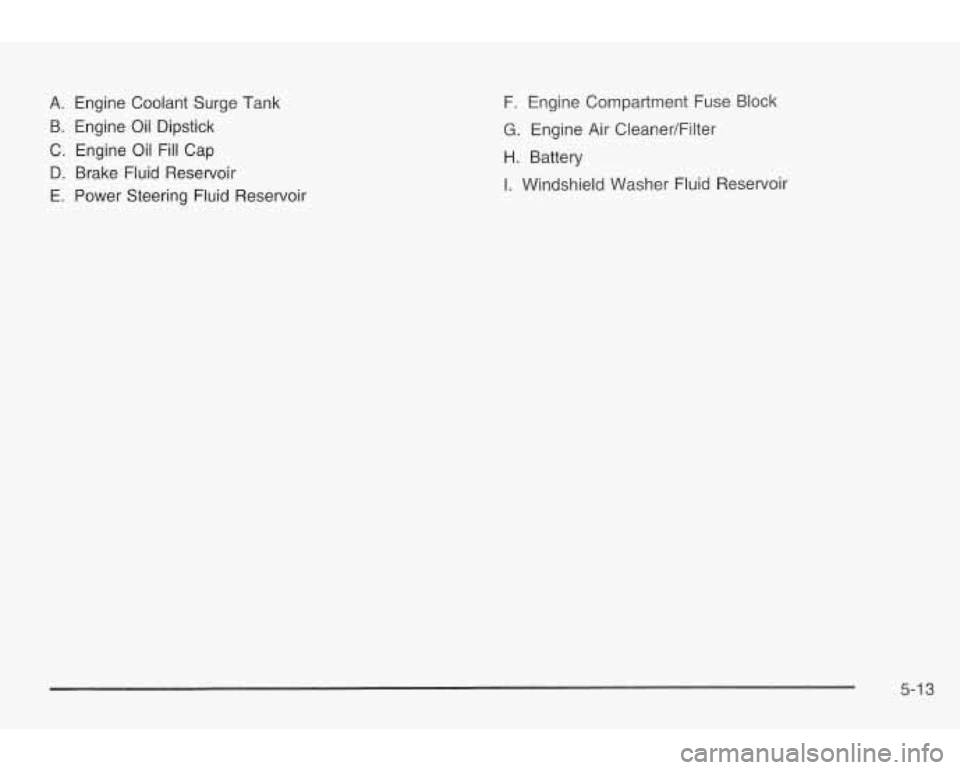
A. Engine Coolant Surge Tank
B. Engine Oil Dipstick
C. Engine
Oil Fill Cap
D. Brake Fluid Reservoir
E. Power Steering Fluid Reservoir F. Engine Compartment Fuse
Block
G. Engine Air Cleaner/Filter
H. Battery
I. Windshield Washer Fluid Reservoir
5-1 3
Page 237 of 354
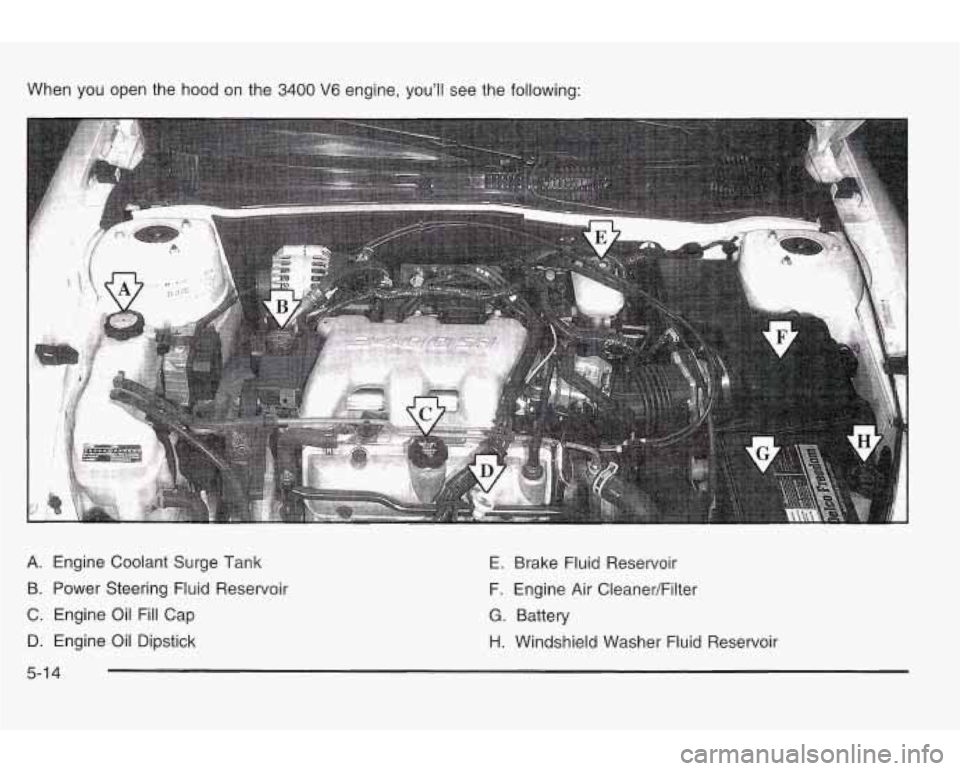
When you open the hood on the 3400 V6 engine, you’ll see the following:
A. Engine Coolant Surge Tank
E. Brake Fluid Reservoir
B. Power Steering Fluid Reservoir F. Engine Air CleanedFilter
C. Engine Oil Fill Cap G. Battery
D. Engine Oil Dipstick H. Windshield Washer Fluid Reservoir
5-1 4
Page 262 of 354

Brakes
Brake Fluid
A
Your brake master cylinder reservoir is on the driver’s
side
of the engine compartment. It is filled with
DOT-3 brake fluid. See Engine Compartment Overview
on page 5- 12.
There are only two reasons why the brake fluid level in
the reservoir might go down. The first
is that the
brake fluid goes down to an acceptable level during normal brake lining wear, When new linings are put in,
the fluid level goes back up. The other reason is
that fluid is leaking out of the brake system. If it is, you
should have your brake system fixed, since a leak
means that sooner or later your brakes won’t work well,
or won’t work at all.
So, it isn’t a good idea to “top off’ your brake fluid.
Adding brake fluid won’t correct a leak.
If you add fluid
when your linings are worn, then you’ll have too
much fluid when you get new brake linings. You should
add (or remove) brake fluid, as necessary, only when
work is done on the brake hydraulic system.
If you have too much brake fluid, it can spill on
the engine. The fluid
will burn if the engine is
hot enough. You or others could be burned,
and your vehicle could be damaged. Add brake
fl~~id ~n!y when work is done on the brake
hydraulic system.
5-39
Page 263 of 354
BRAKE
United States Canada
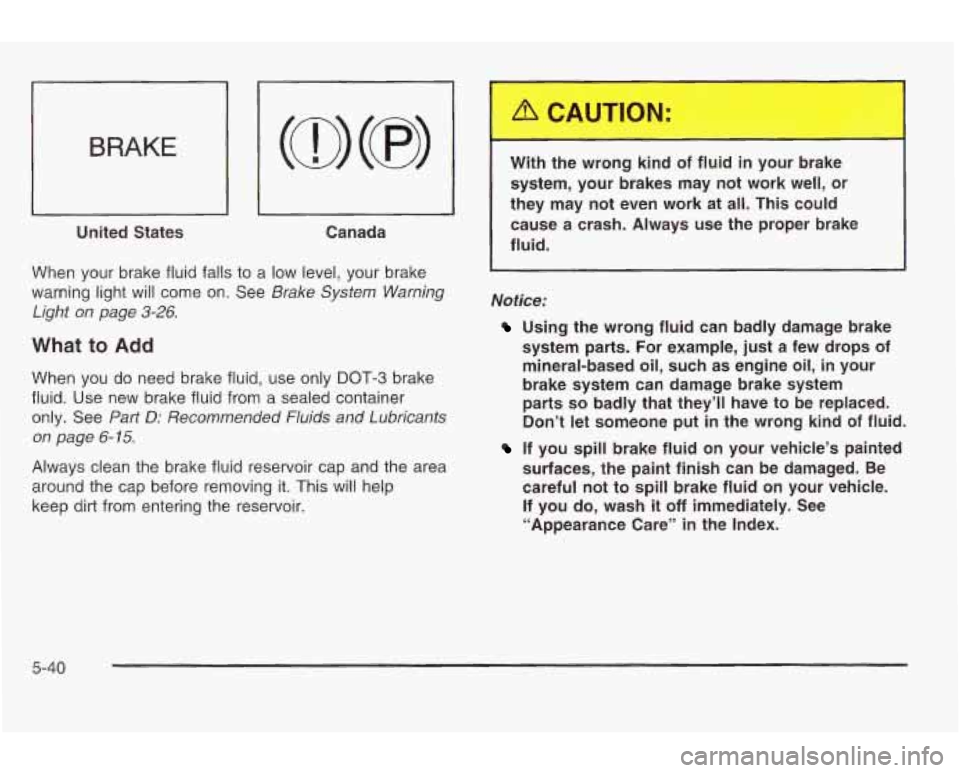
When your brake fluid falls to a low level, your brake
warning light will come on. See
Brake System Warning
Light on page
3-26.
What to Add
When you do need brake fluid, use only DOT-3 brake
fluid. Use new brake fluid from a sealed container
only. See
Part D: Recommended Fluids and Lubricants
on page
6- 15.
Always clean the brake fluid reservoir cap and the area
around the cap before removing it. This will help
keep dirt from entering the reservoir.
With the wrong kind of fluid in your brake
system, your brakes may not work well, or
they may not even work at all. This could
cause
a crash. Always use the proper brake
fluid.
Notice:
Using the wrong fluid can badly damage brake
system parts. For example, just
a few drops of
mineral-based oil, such as engine oil, in your
brake system can damage brake system parts
so badly that they’ll have to be replaced.
Don’t let someone put in the wrong kind of fluid.
If you spill brake fluid on your vehicle’s painted
surfaces, the paint finish can be damaged. Be
careful not to spill brake fluid on your vehicle.
If you do, wash it off immediately. See
“Appearance Care” in the Index.
5-40
Page 312 of 354
Section 6 Maintenance Schedule
Maintenance Schedule ...................................... 6.2
Introduction
................................................... 6.2
Your Vehicle and the Environment
.................... 6-2
Maintenance Requirements
.............................. 6-2
How This Section is Organized
......................... 6-3
Part A: Scheduled Maintenance Services
........... 6-4
Using Your Maintenance Schedule
.................... 6-4
Scheduled Maintenance
................................... 6-5
Part
6: Owner Checks and Services ................. 6-9
At Each Fuel Fill ............................................ 6-9
At Least Once a Month
................................... 6-9
At Least Twice a Year
................................... 6-10 At
Least Once a Year
................................... 6.10
Part
C: Periodic Maintenance Inspections ......... 6.13
Steering, Suspension and Front Drive Axle
Boot and Seal Inspection ............................ 6-13
Exhaust System Inspection
............................ 6.13
Fuel System Inspection
.................................. 6.13
Engine Cooling System Inspection
................... 6.14
Throttle System Inspection
............................. 6.14
Brake System Inspection
................................ 6.14
Part
D: Recommended Fluids and Lubricants .... 6-15
Part
E: Maintenance Record ........................... 6.16
6-1