check oil PONTIAC GRAND AM 2003 Owners Manual
[x] Cancel search | Manufacturer: PONTIAC, Model Year: 2003, Model line: GRAND AM, Model: PONTIAC GRAND AM 2003Pages: 354, PDF Size: 16.3 MB
Page 8 of 354
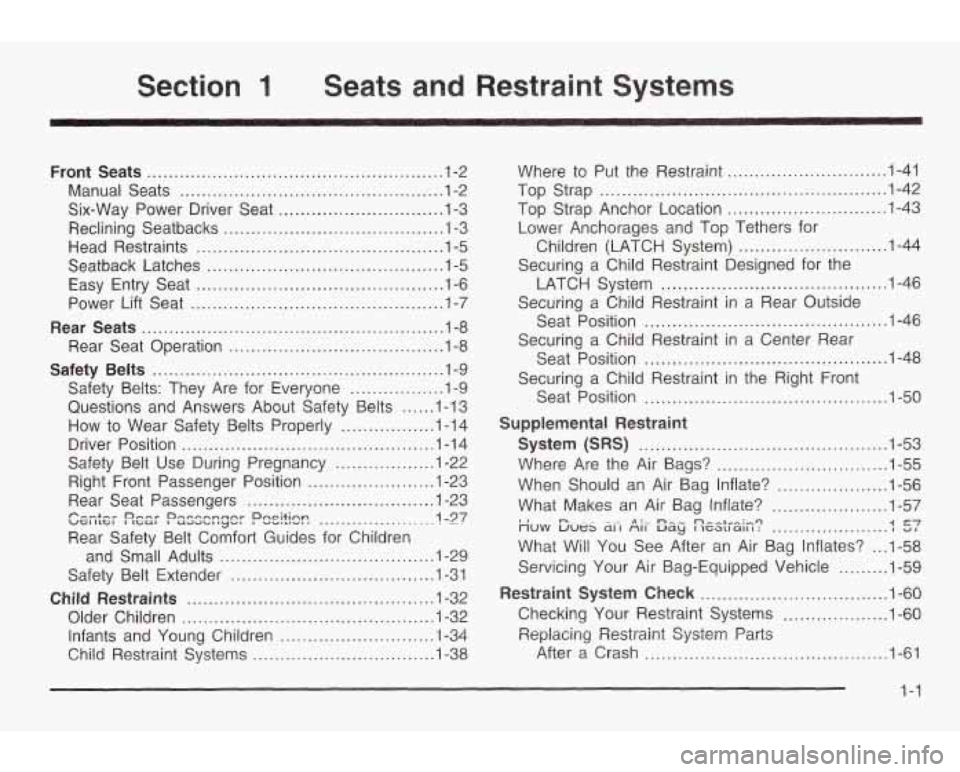
Section 1 Seats and Restraint Sy
Front Seats ...................................................... 1.2
Manual Seats
................................................ 1.2
Reclining Seatbacks 1 -;j
Head Restraints ............................................. 1.5
Seatback Latches ........................................... 1-5
Easy Entry Seat ............................................. 1-6
Power Lift Seat
.............................................. 1-7
Rear Seats ....................................................... 1-8
Rear Seat Operation
....................................... 1.8
Safety Belts
..................................................... 1.9
Safety Belts: They Are for Everyone ................. 1-9
Questions and Answers About Safety Belts ...... 1-1 3
How
to Wear Safety Belts Properly ................. 1-14
Driver Position
.............................................. 1-1 4
Safety Belt Use During Pregnancy
.................. 1-22
Right Front Passenger Position ....................... 1-23
Rear Seat Passengers
.................................. 1.23
UGI 11G1 I IbUI I U~~~OILJUI VVI.~V. ...................... 1-27
Rear Safety Belt Comfort Guides for Children
and Small Adults
....................................... 1-29
Safety Belt Extender
..................................... 1-31
Child Restraints ............................................. 1.32
Older Children
.............................................. 1-32
Infants and Young Children
............................ 1-34
Child Restraint Systems ................................. 1-38
Six-Way Power Driver Seat
.............................. 1-3 ,-. ........................................
p-- +-v 0n-v Dnemnnnnr Dneitinn
Where to Put
the Restraint ............................. 1-41
Top Strap
.................................................... 1-42
Top Strap Anchor Location
............................. 1.43
Lower Anchorages and Top Tethers for
Children (LATCH System)
........................... 1 -44
Securing a Child Restraint Designed for the
LATCH System
......................................... 1-46
Securing a Child Restraint in a Rear Outside
Seat Position
............................................ 1-46
Securing a Child Restraint in a Center Rear
Seat Position
............................................ 1-48
Securing a Child Restraint in the Right Front
Seat Position
............................................ 1-50
System (SRS) ............................................. 1-53
When Should an Air Bag Inflate?
.................... 1-56
What Makes
an Air Bag Inflate? ..................... 1-57
What Will You See After an Air Bag Inflates? ... 1-58
Servicing Your Air Bag-Equipped Vehicle
......... 1-59
Restraint System Check
.................................. 1-60
Checking Your Restraint Systems
................... 1-60
Repiacing Resirzlint System Parts
After a Crash ............................................ 1-61
Supplemental Restraint
Where Are the Air Bags?
............................... 1-55
nuw Lues 5i-l Ail- Ea9 ECS~E~G? ..................... 157’
1-1
Page 141 of 354
Oil Pressure Light
If you have a low engine
oil pressure problem, this
light will stay on after
you start your engine,
or
come on and you will hear
a chime when you are
driving.
This indicates that your engine is not receiving enough
oil. The engine could be low on oil,
or could have
some other oil problem. Have it fixed immediately.
When the ignition is on but the engine is not running,
the light will come on as a test to show you it is working,
but the light will go out when the engine is running.
If
it doesn’t come on with the ignition on, you may have a
problem with the bulb. Have it fixed right away. Don’t keep driving if the oil pressure
is low. If
you
do, your engine can become so hot that it
catches fire. You or others could be burned.
Check your oil as soon as possible and have
your vehicle serviced.
Notice: Damage to your engine from neglected oil
problems can be costly and is not covered by
your warranty.
3-34
Page 142 of 354
Low Oil Level Light
LOW
OIL
If your vehicle is equipped
with a
3400 V6 engine,
then you will have a
LOW
OIL light in your
instrument panel cluster.
This light will come on briefly when you start your
vehicle.
If the light stays on after starting your vehicle, or comes
on and chimes while you are driving, your engine oil
level should be checked.
Prior to checking the oil level, be sure your vehicle has
been shut
off for several minutes and is on a level
surface. Check the oil level on your dipstick and bring it
to the proper level. See Engine Oil on page 5-15.
A false LOW OIL light may be generated when parking
on steep grades.
The oil level monitoring system only checks oil level
during the brief period between when the key is on and
the engine is cranking.
It does not monitor engine oil level
when the engine is running. Additionally, an oil
level check is only performed
if the engine has
been turned
off for a considerable period of time
allowing the
oil normally in circulation to drain back into
the oil pan.
CHANGE
OIL
The CHANGE OIL light
should come on briefly as
a bulb check when you start the engine. If the light
doesn’t come on, have it
serviced.
If the CHANGE OIL light comes on and stays on after
you start the engine, have the oil changed.
To reset the CHANGE
OIL light, see Engine oil On
page
5- 15.
3-35
Page 203 of 354

Here are some things you can check before a trip:
Windshield Washer Fluid: Is the resewior full? Are
all windows clean inside and outside?
Wiper Blades: Are they in good shape?
Fuel, Engine Oil, Other Fluids: Have you checked
all levels?
Lamps: Are they all working? Are the lenses clean?
Tires: They are vitally important to a safe,
trouble-free trip.
Is the tread good enough for
long-distance driving? Are the tires all inflated to the
recommended pressure?
Weather Forecasts: What’s the weather outlook
along your route? Should you delay your trip a
short time
to avoid a major storm system?
Maps: Do you have up-to-date maps?
Highway Hypnosis
Is there actually such a condition as “highway
hypnosis”? Or is it just plain falling asleep at the wheel?
Call it highway hypnosis, lack of awareness, or
whatever. There
is something about an easy stretch
of road with
the same scenery, along with the hum of the tires on the
road, the drone of the engine, and the rush of the
wind against the vehicle that can make you sleepy. Don’t
let
it happen to you! If it does, your vehicle can leave
the road in
less than a second, and you could crash and
be injured.
What can you
do about highway hypnosis? First, be
aware that it can happen.
Then here are some tips:
Make sure your vehicle is well ventilated, with a
comfortably cool interior.
Keep your eyes moving. Scan the road ahead and
to the sides. Check your rearview mirrors and your
instruments frequently.
service or parking area and take a nap, get some
exercise, or both. For safety, treat drowsiness
on the highway as an emergency.
If you get sleepy, pull off the road into a rest,
4-24
Page 222 of 354
When You Are Ready to Leave After
Parking on
a Hill
1. Apply your regular brakes and hold the pedal down
while you:
0 start your engine,
0 shift into a gear, and
0 release the parking brake.
2. Let up on the brake pedal.
3. Drive slowly until the trailer is clear of the chocks.
4. Stop and have someone pick up and store the
chocks.
Maintenance When Trailer Towing
Your vehicle will need service more often when you’re
pulling a trailer. See the Maintenance Schedule for more
on this. Things that are especially important in trailer
operation are automatic transaxle fluid (don’t overfill), engine
oil, drive belt, cooling system and brake system.
Each of these
is covered in this manual, and the
Index will help you find them quickly.
If you’re trailering,
it’s a good idea
to review this information before you
start your trip.
Check periodically to see that all hitch nuts and bolts
are tight.
Engine Cooling When Trailer Towing
Your cooling system may temporarily overheat during
severe operating conditions. See
Engine Overheating on
page 5-26.
4-43
Page 224 of 354
Section 5 Service and Appearance Care
Service ............................................................ 5.3
Doing Your Own Service Work
......................... 5.3
Adding Equipment to the Outside of Your
Vehicle
...................................................... 5.4
Fuel ................................................................ 5.5
Gasoline Octane
............................................ 5.5
Gasoline Specifications
.................................... 5.5
California Fuel
............................................... 5-6
Additives
....................................................... 5-6
Fuels in Foreign Countries
............................... 5-7
Filling
a Portable Fuel Container ..................... -5-9
Filling Your Tank
............................................ 5-7
Checking Things Under the Hood
.................................................... 5-10
Hood Release
.............................................. 5-10
Engine Compartment Overview
....................... 5-12
Engine Oil
................................................... 5.15
Engine Air CleanedFilter
................................ 5-21
Manual Transaxle Fluid
.................................. 5-22
Hydraulic Clutch
........................................... 5-23
Engine Coolant
............................................. 5-23
Engine Overheating
....................................... 5-26
Cooling System
............................................ 5-29
Power Steering Fiuia
~1-36
I~~ULWIII~LIW I 1ulIaUAlG I lulu J-LL An ntnmntie Trnnr.r-.vln Cln #;PI r on ..............................
- -- ....................................
Windshield Washer Fluid ................................ 5-37
Brakes
........................................................ 5.39
Battery
........................................................ 5.42
Jump Starting
............................................... 5-43
Bulb Replacement .......................................... 5.49
Halogen Bulbs
.............................................. 5.49
Headlamps
.................................................. 5.49
Front Turn Signal and Parking Lamps
.............. 5-50
Center High-Mounted Stoplamp (CHMSL)
......... 5.50
Taillamps, Turn Signal, and Stoplamps
............ 5.51
Replacement Bulbs
....................................... 5.51
Windshield Wiper Blade Replacement
.............. 5.52
Tires
.............................................................. 5.53
Inflation
.. Tire Pressure ................................ 5-54
Tire Inspection and Rotation
........................... 5-55
When It
Is Time for New Tires ....................... 5-56
Buying New Tires
......................................... 5-56
Uniform Tire Quality Grading
......................... 5-57
Wheel Alignment and Tire Balance
.................. 5-59
Wheel Replacement
...................................... 5-59
Tire Chains
.................................................. 5-60
If a Tire Goes Flat ........................................ 5-61
Changing
a Flat Tire ..................................... 5-62
Compact Spare Tire
...................................... 5-71
5-
1
Page 230 of 354

Fuels in Foreign Countries
If you plan on driving in another country outside the
United States or Canada, the proper fuel may be hard
to find. Never use leaded gasoline or any other fuel
not recommended in the previous text on fuel. Costly
repairs caused by use
of improper fuel wouldn’t be
covered
by your warranty.
To check the fuel availability, ask an auto club, or
contact a major oil company that does business in the
country where you’ll be driving.
Filling Your Tank
1
The tethered fuel cap is behind a hinged door on the
passenger’s side of the vehicle.
Fuel vapor is highly flammable. It burns
violently, and that can cause very bad injuries.
your vehicle. Keep sparks, flames and smoking
materials away from fuel.
Don’t sm&p If yop’rp npzr fee! e!. !.ef&]ng 1
5-7
Page 233 of 354

Checking Things Under
the Hood
Hood Release
To open the hood, do the following:
1. Pull the handle located
under the instrument
panel on the drivier's side
of the vehicle.
L% CAUTION:
An electric fan under the hood can start up
and injure you even when the engine is not running. Keep hands, clothing and tools away
from any underhood electric fan.
Things that burn can get on hot engine parts
and start
a fire. These include liquids like fuel,
oil, coolant, brake fluid, windshield washer and
other fluids, and plastic or rubber. You or
others could be burned. Be careful not to drop
or spill things that will burn onto a hot engine.
I
5-1 0
Page 238 of 354
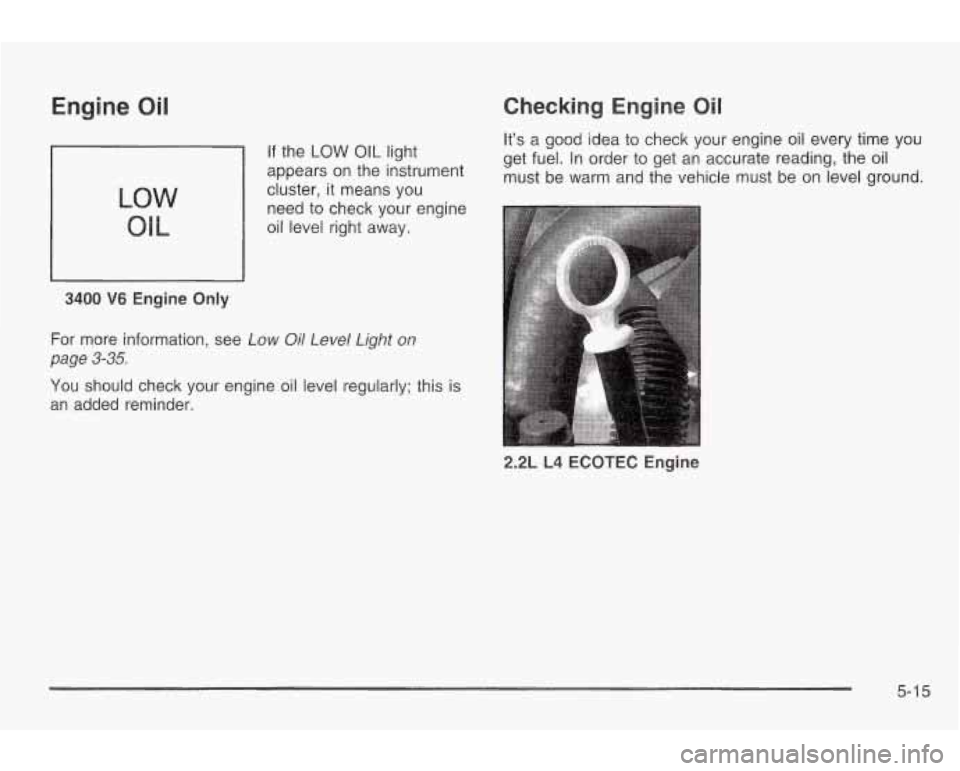
Engine Oil
LOW
Ole
3400 V6 Engine Only
If the LOW OIL light
appears on the instrument
cluster, it means you
need to check your engine
oil level right away.
Checking Engine Oil
It’s a good idea to check your engine oil every time you
get fuel. In order to get an accurate reading, the oil
must be warm and the vehicle must be on level ground.
For more information, see
Low Oil Level Light on
page 3-35.
You should check your engine oil level regularly; this is
an added reminder.
2.2L L4 ECOTEC Engine
5-1 5
Page 239 of 354

3400 V6 Engine
The engine oil dipstick handle is yellow. The dipstick on
the
2.2L L4 ECOTEC engine is located at the front of
the engine compartment. The dipstick on the 3400
V6 engine is located at the front of the engine, behind
the fan. See
Engine Compartment Overview on
page 5-12 for more information on location.
Turn
off the engine and give the oil several minutes to
drain back into the oil pan. If you don't, the oil
dipstick might not show the actual level.
Pull out the dipstick and clean it with a paper towel or
cloth, then push it back in all the way. Remove it again,
keeping the tip down, and check the level.
2.2L L4 ECQTEC Engine
3400 V6 Engine
5-1 6