clutch PONTIAC GRAND AM 2003 Owners Manual
[x] Cancel search | Manufacturer: PONTIAC, Model Year: 2003, Model line: GRAND AM, Model: PONTIAC GRAND AM 2003Pages: 354, PDF Size: 16.3 MB
Page 89 of 354
Manual Transaxle
The gear selector should be in neutral and the parking
brake engaged. Hold the clutch pedal
to the floor
and start the engine. Your vehicle won’t start
if the clutch
pedal is not all the way down
- that’s a safety feature.
Starting Your 2.2L L4 ECOTECTM
Engine
1. With your foot off the accelerator pedal, turn your
ignition key
to START. When the engine starts, let
go of the key. The idle speed will
go down as
your engine gets warm.
Notice: Holding your key in START for longer than
15 seconds at a time will cause your battery to
be drained much sooner. And the excessive heat
can damage your starter motor. Wait about
15 seconds between each try to help avoid draining
your battery or damaging your starter.
2. If it doesn’t start, wait about 15 seconds and try
again to start the engine by turning the ignition
key to START. Wait about
15 seconds between
each
try.
When your engine has run about 10 seconds to
warm up, your vehicle is ready to be driven. Don’t
“race” your engine when it’s cold.
If the weather is below freezing (32°F or OOC), let
the engine run for a few minutes
to warm up.
3. If your engine still won’t start (or starts but then
stops),
it could be flooded with too much gasoline.
Try pushing your accelerator pedal all the way
to the
floor and holding
it there as you hold the key in
START for about three seconds. If the vehicle starts
briefly but then stops again, do the same thing,
but this time keep the pedal down for five or
six seconds. This clears the extra gasoline from
the engine.
Notice: Your engine is designed to work with the
electronics in your vehicle.
If you add electrical
parts or accessories, you could change the way
the
engine operates. Before adding electrical equipment,
check with your dealer.
If you don’t, your engine
might not perform properly.
2-20
Page 96 of 354
FIRST (1): This position gives you even more power
but lower fuel economy than SECOND
(2). You can use
it on very steep hills, or in deep snow or mud.
If the
shift lever is put in FIRST
(I), the transaxle won’t shift
into first gear until the vehicle
is going slowly enough.
Notice: If your front wheels won’t turn, don’t
try to drive. This might happen
id you were stuck in
very deep sand or mud or were up against a solid
object. You could damage your transaxle.
Also,
if you stop when going uphill, don’t hold your
vehicle there with only the accelerator pedal. This
could overheat and damage the transaxle. Use your
brakes to hold your vehicle in position on a hill.
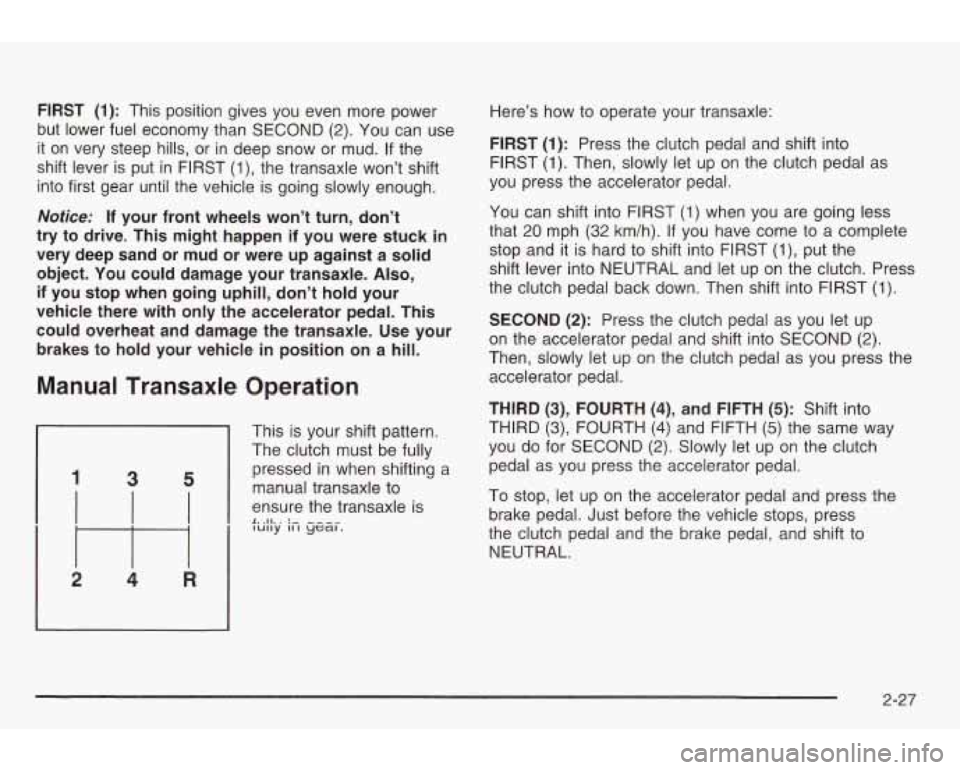
Manual Transaxle Operation
Here’s how to operate your transaxle:
FIRST
(1): Press the clutch pedal and shift into
FIRST
(1). Then, slowly let up on the clutch pedal as
you press the accelerator pedal.
You can shift into FIRST
(1) when you are going less
that
20 mph (32 km/h). If you have come to a complete
stop and it
is hard to shift into FIRST (I), put the
shift lever into NEUTRAL and let up on the clutch. Press
the clutch pedal back down. Then shift into FIRST
(1).
SECOND (2): Press the clutch pedal as you let up
on the accelerator pedal and shift into SECOND
(2).
Then, slowly let up on the clutch pedal as you press the
accelerator pedal.
1 3 5
THIRD (3), FOURTH (4), and FIFTH (5): Shift into
This
is your shift pattern. THIRD (3), FOURTH (4) and FIFTH (5) the same way
The clutch must be fully you do for SECOND
(2). Slowly let up on the clutch
manual transaxle
to
ensure the transaxle is
pressed
in when shifting a pedal as
YOU press the accelerator pedal.
To stop, let up on the accelerator pedal and press the
the clutch pedal and the brake pedal, and shift to
NEUTRAL.
L. .II. I :- -^^“ brake pedal. Just before the vehicle stops, press lully Ill ycal.
2-27
Page 97 of 354
NEUTRAL: Use this position when you start or idle
your engine.
REVERSE (R): To back up, press down the clutch
pedal and
lift up on the ring on the shift lever to shift into
REVERSE
(R). Let up on the clutch pedal slowly
while pressing the accelerator pedal.
Notice: Shift into REVERSE (R) only after your
vehicle
is stopped. Shifting into REVERSE (R) while
your vehicle is moving could damage your
transaxle. The repairs would not be covered by your
warranty.
Also, use REVERSE (R), along with the parking brake,
for parking your vehicle.
Once the shift lever is in REVERSE (R), the ignition can
be turned to OFF and the key removed.
S ft Speec'
If you skip a gear when you downshift, you
could lose control
of your vehicle. You could
injure yourself or others. Don't shift down
more than one gear
at a time when you
downshift.
Up-Shift Light
If you have a manual
transaxle, you may have a
SHIFT light located on
the instrument panel
cluster. This light will show
you when to shift to the
next higher gear for
the best fuel economy.
When this light comes
on, you can shift to the next
higher gear
if the weather, road and traffic conditions
permit. For the best fuel economy, accelerate slowly and
shift when the light comes on.
2-28
Page 101 of 354
Shifting Out of Park (P)
If your vehicle has an automatic transaxle it has an
automatic transaxle shift lock control system. You have
to apply your regular brake before you can shift from
PARK (P) when the ignition
is in ON. See Automatic
Transaxle Operation on page
2-24.
If you cannot shift out of PARK (P), ease pressure on
the shift lever and push the shift lever all the way
into PARK (P) as you maintain brake application. Then
move the shift lever into the gear you wish. Press
the shift lever button before moving the shift lever.
If you ever hold the brake pedal down but still can’t shift
out of PARK (P), try this:
1. Turn the ignition key to ACCESSORY.
2. Apply and hold the regular brake until the end of
Step
5.
3. Shift to NEUTRAL (N).
4. Turn the ignition key to START, to start the vehicle.
5. Shift to the drive gear you want.
6. Have the vehicle fixed as soon as you can.
Parking Your Vehicle/Key Removal
Before leaving your manual transaxle model vehicle,
fully press the clutch pedal in, move the shift lever into
REVERSE
(R) and firmly apply the parking brake.
Once the shift lever has been placed in REVERSE (R)
with the clutch pedal pressed in, you can turn the
ignition key
to OFF, remove the key and release the
clutch. See
Manual Transaxle Operation on page 2-27.
2-32
Page 117 of 354
The cruise control will turn off if any of the following
occur:
The brakes are applied,
the clutch pedal is applied (manual transaxle),
the automatic transaxle is shifted to NEUTRAL (N),
the parking brake is applied, or
e the brake system warning light is on. If your vehicle
is in cruise control when the enhanced
traction control system,
if your vehicle has this feature,
begins
to limit wheel spin, the cruise control will
automatically disengage. See Enhanced Traction
System
(€E) on page 4-9. When road conditions allow
you to safely use it again, you may turn the cruise
control back
on.
Setting Cruise Control
Cruise control can be dangerous where
you can’t drive safely at a steady speed.
So, don’t use your cruise control on
winding roads
or in heavy traffic.
Cruise control can be dangerous on
slippery roads. On such roads, fast
changes
in tire traction can cause
needless wheel spinning, and you could
lose control. Don’t use cruise control on
slippery roads.
If you leave your cruise control on when yc re
not using cruise, you might hit a button and go
into cruise when you don’t want to. You could
be startled and even lose control. Keep the
cruise control switch
off until you want to use
cruise control.
1, Press cruise ON OFF. An indicator light will come
2. Get up to the speed you want.
3. Press the SET COAST button and release it.
4. Take your foot off the accelerator pedal.
on when ON OFF is pressed.
3-1 0
Page 119 of 354
Passing Another Vehicle While Using
Cruise Control
Use the accelerator pedal to increase your speed.
When you take your
foot off the pedal, your vehicle will
slow down
to the cruise control speed you set earlier.
Using Cruise Control on Hills
How well your cruise control will work on hills depends
upon your speed, load and the steepness of the
hills. When going up steep hills, you may have to step
on the accelerator pedal to maintain your speed.
When going downhill, you may have
to brake or shift to
a lower gear to keep your speed down. Of course,
applying the brake takes you out of cruise control. Many
drivers find this to be too much trouble and don’t use
cruise control on steep hills.
Ending Cruise Control
There are four ways to turn off the cruise control:
Step lightly on the brake pedal.
Press the cruise control RESUME ACCEL button
and the SET
COAST buttons at the same time.
Press cruise ON OFF.
Push the clutch pedal if you have a manual
transaxle.
Erasing Speed Memory
When you turn off the cruise control or the ignition, your
cruise control set speed memory is erased.
3-1 2
Page 224 of 354
Section 5 Service and Appearance Care
Service ............................................................ 5.3
Doing Your Own Service Work
......................... 5.3
Adding Equipment to the Outside of Your
Vehicle
...................................................... 5.4
Fuel ................................................................ 5.5
Gasoline Octane
............................................ 5.5
Gasoline Specifications
.................................... 5.5
California Fuel
............................................... 5-6
Additives
....................................................... 5-6
Fuels in Foreign Countries
............................... 5-7
Filling
a Portable Fuel Container ..................... -5-9
Filling Your Tank
............................................ 5-7
Checking Things Under the Hood
.................................................... 5-10
Hood Release
.............................................. 5-10
Engine Compartment Overview
....................... 5-12
Engine Oil
................................................... 5.15
Engine Air CleanedFilter
................................ 5-21
Manual Transaxle Fluid
.................................. 5-22
Hydraulic Clutch
........................................... 5-23
Engine Coolant
............................................. 5-23
Engine Overheating
....................................... 5-26
Cooling System
............................................ 5-29
Power Steering Fiuia
~1-36
I~~ULWIII~LIW I 1ulIaUAlG I lulu J-LL An ntnmntie Trnnr.r-.vln Cln #;PI r on ..............................
- -- ....................................
Windshield Washer Fluid ................................ 5-37
Brakes
........................................................ 5.39
Battery
........................................................ 5.42
Jump Starting
............................................... 5-43
Bulb Replacement .......................................... 5.49
Halogen Bulbs
.............................................. 5.49
Headlamps
.................................................. 5.49
Front Turn Signal and Parking Lamps
.............. 5-50
Center High-Mounted Stoplamp (CHMSL)
......... 5.50
Taillamps, Turn Signal, and Stoplamps
............ 5.51
Replacement Bulbs
....................................... 5.51
Windshield Wiper Blade Replacement
.............. 5.52
Tires
.............................................................. 5.53
Inflation
.. Tire Pressure ................................ 5-54
Tire Inspection and Rotation
........................... 5-55
When It
Is Time for New Tires ....................... 5-56
Buying New Tires
......................................... 5-56
Uniform Tire Quality Grading
......................... 5-57
Wheel Alignment and Tire Balance
.................. 5-59
Wheel Replacement
...................................... 5-59
Tire Chains
.................................................. 5-60
If a Tire Goes Flat ........................................ 5-61
Changing
a Flat Tire ..................................... 5-62
Compact Spare Tire
...................................... 5-71
5-
1
Page 246 of 354
Hydraulic Clutch
The hydraulic clutch linkage in your vehicle is
self-adjusting. The clutch master cylinder reservoir is
filled with hydraulic clutch fluid.
It is not necessary
to regularly check clutch fluid unless
you suspect there is a leak in the system. Adding
fluid won’t correct a leak.
A fluid
loss in this system could indicate a problem.
Have the system inspected and repaired.
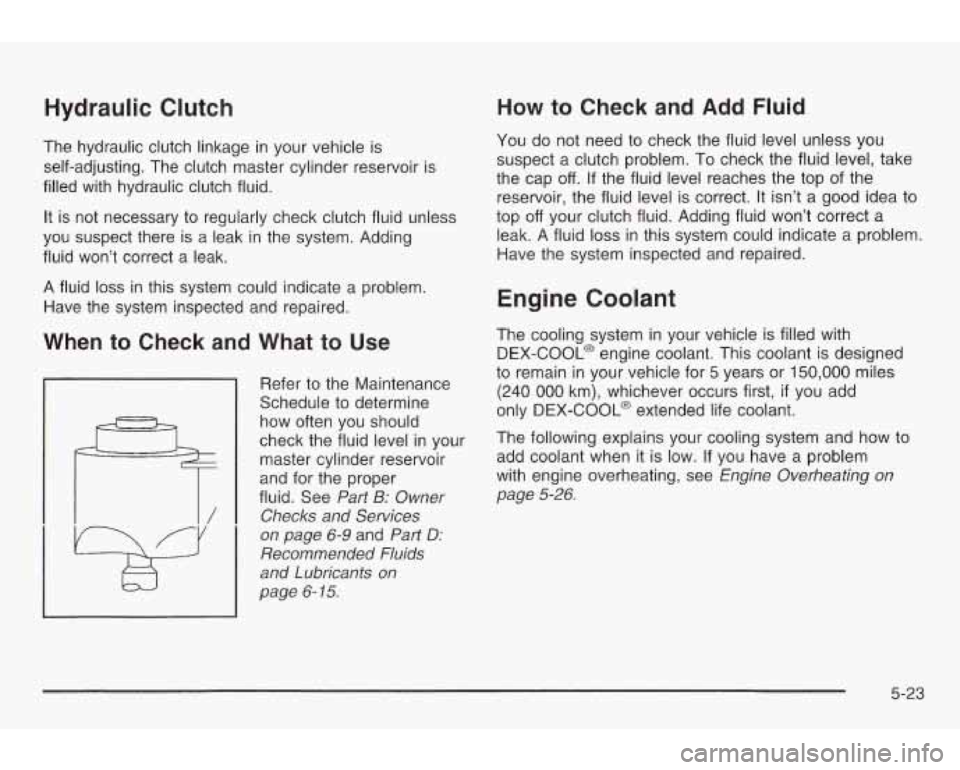
When to Check and What to Use
Refer to the Maintenance
Schedule
to determine
how often you should
check the fluid level in your
master cylinder reservoir
and for the proper
fluid. See
Part B: Owner
Checks and Services
on page
6-9 and Part 19:
Recommended Fluids
and Lubricants on
page
6- 15.
How to Check and Add Fluid
You do not need to check the fluid level unless you
suspect a clutch problem. To check the fluid level, take
the cap
off. If the fluid level reaches the top of the
reservoir, the fluid level is correct. It isn’t a good idea to
top
off your clutch fluid. Adding fluid won’t correct a
leak. A fluid loss in this system could indicate a problem
Have the system inspected and repaired.
Engine Coolant
The cooling system in your vehicle is filled with
QEX-COOL@ engine coolant. This coolant is designed
to remain in your vehicle for
5 years or 150,000 miles
(240 000 km), whichever occurs first, if you add
only QEX-COOL@ extended life coolant.
The following explains your cooling system and how to
add coolant when it is low. If you have a problem
with engine overheating, see
Engine Overheating on
page
5-26.
5-23
Page 321 of 354
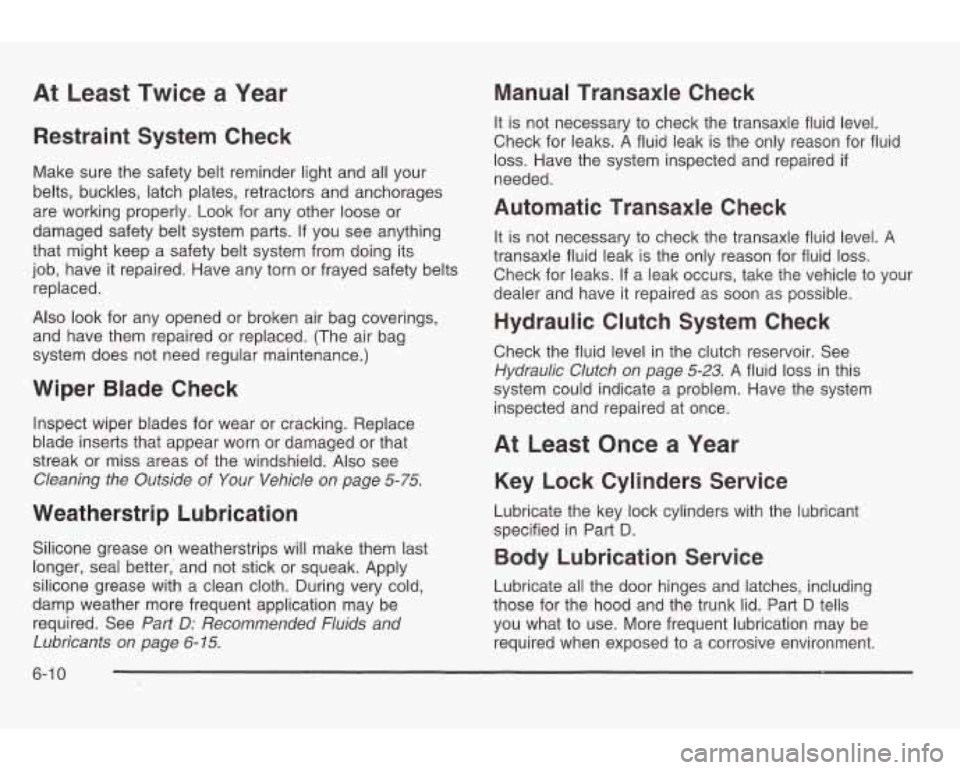
At Least Twice a Year
Restraint System Check
Make sure the safety belt reminder light and all your
belts, buckles, latch plates, retractors and anchorages
are working properly.
Look for any other loose or
damaged safety belt system parts. If you see anything
that might keep a safety belt system from doing its
job, have it repaired. Have any torn or frayed safety belts
replaced.
Also look for any opened or broken air bag coverings,
and have them repaired or replaced. (The air bag
system does not need regular maintenance.)
Wiper Blade Check
Inspect wiper blades for wear or cracking. Replace
blade inserts that appear worn or damaged or that
streak or miss areas of the windshield.
Also see
Cleaning the Outside of Your Vehicle on page 5-75.
Weatherstrip Lubrication
Silicone grease on weatherstrips will make them last
longer, seal better,' and not stick or squeak. Apply
silicone grease with a clean cloth. During very cold,
damp weather more frequent application may be required. See
Part D: Recommended Fluids and
Lubricants on page
6- 15.
Manual Transaxle Check
It is not necessary to check the transaxle fluid level.
Check for leaks. A fluid leak is the only reason for fluid
loss. Have the system inspected and repaired if
needed.
Automatic Transaxle Check
It is not necessary to check the transaxle fluid level. A
transaxle fluid leak is the only reason for fluid loss.
Check for leaks. If a leak occurs, take the vehicle to your
dealer and have
it repaired as soon as possible.
Hydraulic Clutch System Check
Check the fluid level in the clutch reservoir. See
Hydraulic Clutch on page 5-23. A fluid loss in this
system could indicate a problem. Have the system
inspected and repaired at once.
At Least Once a Year
Key Lock Cylinders Service
Lubricate the key lock cylinders with the lubricant
specified in Part
D.
Body Lubrication Service
Lubricate all the door hinges and latches, including
those for the hood and the trunk lid. Part D tells
you what to use. More frequent lubrication may be
required when exposed to a corrosive environment.
6-1 0
Page 326 of 354
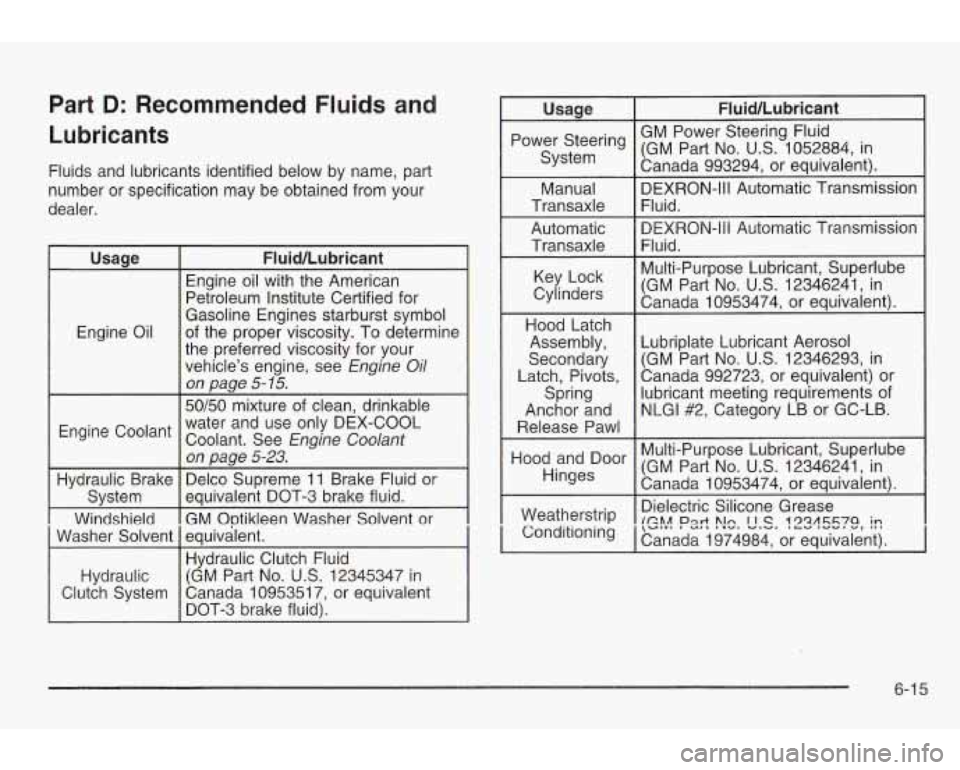
Part D: Recommended Fluids and
Lubricants
Fluids and lubricants identified below by name, part
number or specification may be obtained from your
dealer.
Usage
Engine Oil Fluid/Lubricant
Engine oil with the American
Petroleum Institute Certified for
Gasoline Engines starburst symbol
of the proper viscosity.
To determine
the preferred viscosity for your
vehicle’s engine, see
Engine Oil
on page 5-15.
Engine Coolant
Hydraulic Brake Svstem
Windshield
Washer Solvent
Hydraulic
Clutch System 50/50
mixture of clean, drinkable
water and use only DEX-COOL
Coolant. See Engine Coolant
on page
5-23.
Delco Supreme 11 Brake Fluid or
equivalent DOT-3 brake fluid.
GM Optikleen Washer Solvent or
equivalent.
Hydraulic Clutch Fluid
(GM Part No.
U.S. 12345347 in
Canada 1095351 7, or equivalent
DOT-3 brake fluid). Usage
Power Steering System
Manual
Transaxle
Automatic Transaxle
Key Lock
Cylinders
Hood Latch Assembly,
Secondary
Latch, Pivots,
Spring
Anchor and
Release Pawl
Hood and Door Hinges
Weatherstrip Conditioning Fluid/Lubricant
GM Power Steering Fluid
(GM Part No.
U.S. 1052884, in
Canada 993294, or equivalent).
DEXRON-Ill Automatic Transmission
Fluid.
DEXRON-Ill Automatic Transmission
Fluid.
Multi-Purpose Lubricant, Superlube
(GM Part No.
US. 12346241, in
Canada 10953474, or equivalent).
Lubriplate Lubricant Aerosol
(GM Part No.
US. 12346293, in
Canada 992723, or equivalent) or
lubricant meeting requirements of
NLGl
#2, Category LB or GC-LB.
Multi-Purpose Lubricant, Superlube
(GM Part No.
U.S. 12346241, in
Canada 10953474, or equivalent).
Dielectric Silicone Grease
Canada 1974984, or equivalent).
(a! Part ?!e. V.S. 123?557S, Ir!
6-1 5