seat PONTIAC GRAND AM 2003 Owners Manual
[x] Cancel search | Manufacturer: PONTIAC, Model Year: 2003, Model line: GRAND AM, Model: PONTIAC GRAND AM 2003Pages: 354, PDF Size: 16.3 MB
Page 2 of 354
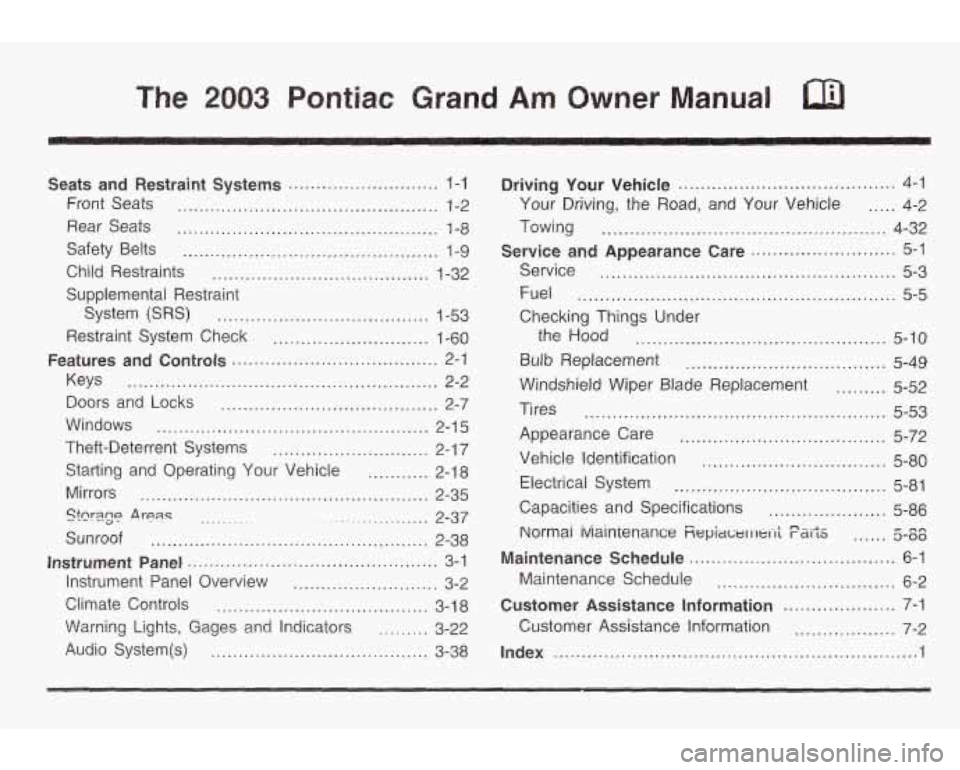
The 2003 Pontiac Grand Am Owner Manual
Seats and Restraint Systems ........................... 1-1
Front Seats ............................................... 1-2
Rear Seats ............................................... 1-8
Safety Belts .............................................. 1-9
Child Restraints ....................................... 1-32
Supplemental Restraint
System
(SRS) ...................................... 1-53
Restraint System Check ............................ 1-60
Keys ........................................................ 2-2
Doors and Locks ....................................... 2-7
Theft-Deterrent Systems ............................ 2-1 7
Starting and Operating Your Vehicle ........... 2-18
Mirrors .................................................... 2-35
Sunroof .................................................. 2-38
Instrument Panel Overview .......................... 3-2
Climate Controls ...................................... 3-1 8
\Warning Lights, Gages a.nd Indicators ......... 3-22
Audio System@) ....................................... 3-38
Features and Controls ..................................... 2-1
Windows ................................................. 2-1 5
Stcr3.g~ .A rean ~ ................... 2-37 ..........
Instrument Panel ............................................. 3-1
Driving Your Vehicle ....................................... 4-1
Your Driving, the Road, and Your Vehicle ..... 4-2
Towing ................................................... 4-32
Service ..................................................... 5-3
Fuel ......................................................... 5-5
Checking Things Under
Service
and Appearance
Care .......................... 5-1
the Hood ............................................. 5-10
Bulb Replacement .................................... 5-49
Windshield Wiper Blade Replacement ......... 5-52
Tires ...................................................... 5-53
Appearance Care ..................................... 5-72
Vehicle Identification ................................. 5-80
Electrical System ...................................... 5-81
Capacities and Specifications ..................... 5-86
Normai iviainienance Fiepiawl I 1t.1-1; F&iJiS ...... 5-00 nn
Maintenance Schedule ..................................... 6-1
bhintenance Schedule ................................ 6-2
Customer Assistance Information .................... 7-1
Customer Assistance Information .................. 7-2
Index ............................................................... ..I
Page 6 of 354
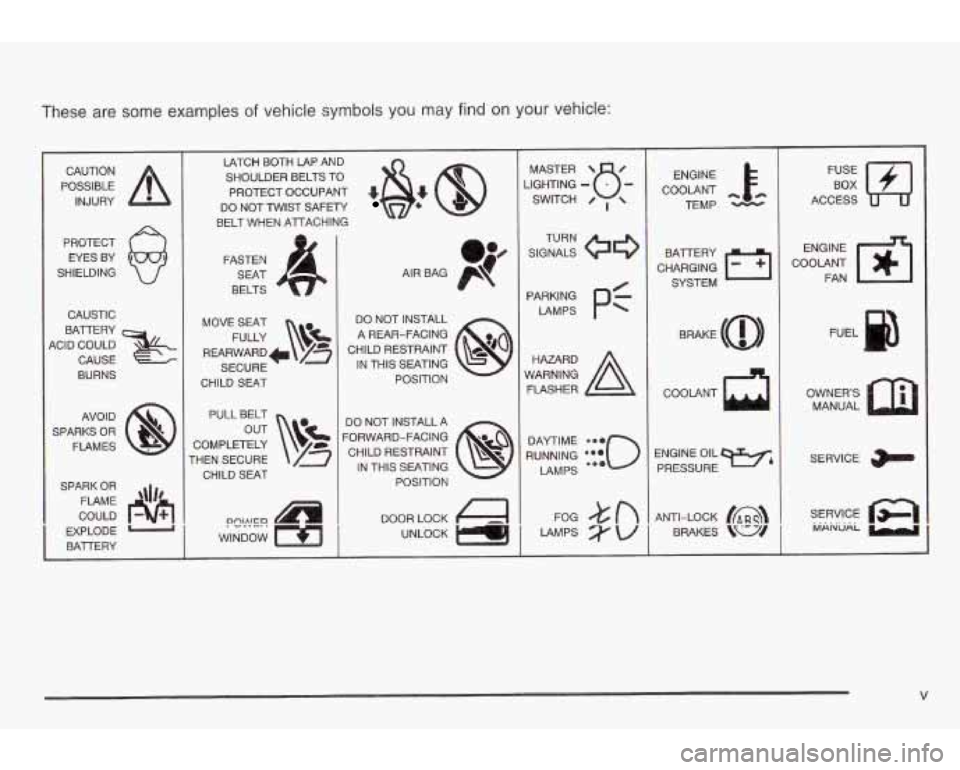
These are some examples of vehicle symbols you may find on your vehicle:
POSSIBLE A
CAUTION
INJURY
PROTECT EYES BY
SHIELDING
CAUSTIC
BATTERY
4CID COULD CAUSE
BURNS
AVOID
SPARKS
OR
FLAMES
SPARK
OR
FLAME 'lb'
COULD
EXPLODE
-
BATTERY
1
I
LATCH BOTH LAP AND
SHOULDER BELTS TO
PROTECT OCCUPANT
4
DO NOT TWIST SAFETY
BELT WHEN ATTACHING
FASTEN SEAT
BELTS
MOVE SEAT FULLY
\!&
REARWARD+ /z
SECURE
CHILD SEAT
PULL BELT
COMPLETELY
-HEN SECURE
CHILD SEAT
?"!"!E?
WINDOW DO
NOT INSTALL
A REAR-FACING
CHILD RESTRAINT IN THIS SEATING
POSITION
DO NOT INSTALL A
FORWARD-FACING CHILD RESTRAINT IN THIS SEATING POSITION
DOOR LOCK UNLOCK LIGHTING
-
PARKING PC
LAMPS
FOG n LAMPS w
ENGINE
COOLANT TEMP
CHARGING
1-1
BAlTERY SYSTEM
COOLANT
a
ENGINE OIL
PRESSURE
Wb
ANTI-LOCK fm)
BRAKES \u/
FJ
ACCESS
ENGINE
COOLANT FAN
FUEL
OWNER'S MANUAL
SERVICE
SERVICE
iviAi\iuWi
V
Page 8 of 354
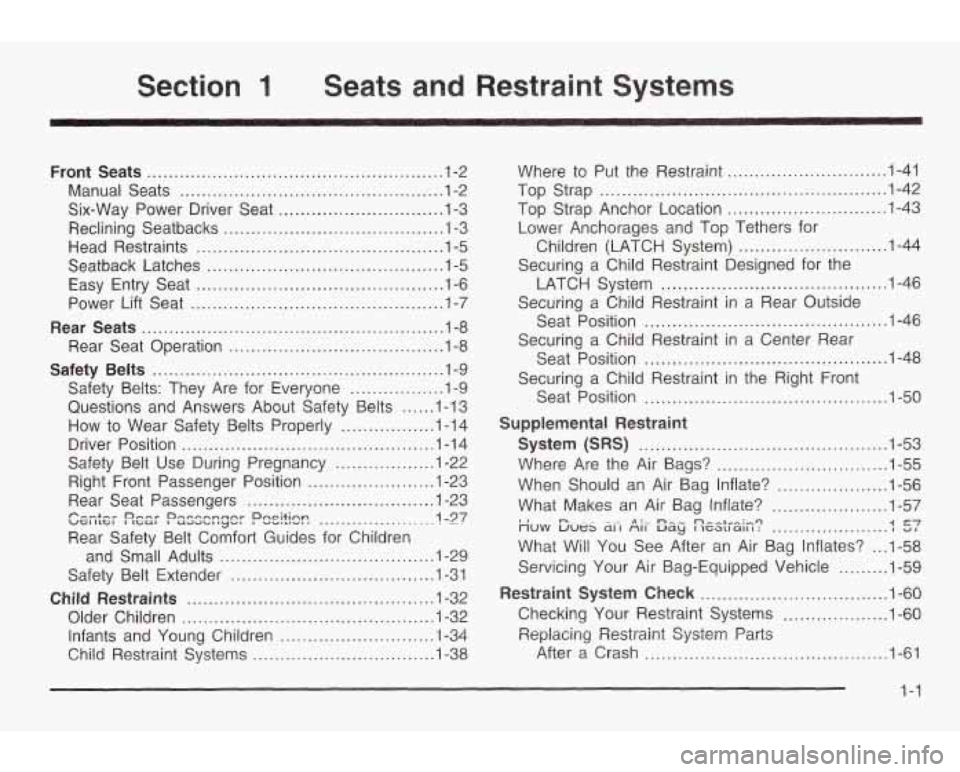
Section 1 Seats and Restraint Sy
Front Seats ...................................................... 1.2
Manual Seats
................................................ 1.2
Reclining Seatbacks 1 -;j
Head Restraints ............................................. 1.5
Seatback Latches ........................................... 1-5
Easy Entry Seat ............................................. 1-6
Power Lift Seat
.............................................. 1-7
Rear Seats ....................................................... 1-8
Rear Seat Operation
....................................... 1.8
Safety Belts
..................................................... 1.9
Safety Belts: They Are for Everyone ................. 1-9
Questions and Answers About Safety Belts ...... 1-1 3
How
to Wear Safety Belts Properly ................. 1-14
Driver Position
.............................................. 1-1 4
Safety Belt Use During Pregnancy
.................. 1-22
Right Front Passenger Position ....................... 1-23
Rear Seat Passengers
.................................. 1.23
UGI 11G1 I IbUI I U~~~OILJUI VVI.~V. ...................... 1-27
Rear Safety Belt Comfort Guides for Children
and Small Adults
....................................... 1-29
Safety Belt Extender
..................................... 1-31
Child Restraints ............................................. 1.32
Older Children
.............................................. 1-32
Infants and Young Children
............................ 1-34
Child Restraint Systems ................................. 1-38
Six-Way Power Driver Seat
.............................. 1-3 ,-. ........................................
p-- +-v 0n-v Dnemnnnnr Dneitinn
Where to Put
the Restraint ............................. 1-41
Top Strap
.................................................... 1-42
Top Strap Anchor Location
............................. 1.43
Lower Anchorages and Top Tethers for
Children (LATCH System)
........................... 1 -44
Securing a Child Restraint Designed for the
LATCH System
......................................... 1-46
Securing a Child Restraint in a Rear Outside
Seat Position
............................................ 1-46
Securing a Child Restraint in a Center Rear
Seat Position
............................................ 1-48
Securing a Child Restraint in the Right Front
Seat Position
............................................ 1-50
System (SRS) ............................................. 1-53
When Should an Air Bag Inflate?
.................... 1-56
What Makes
an Air Bag Inflate? ..................... 1-57
What Will You See After an Air Bag Inflates? ... 1-58
Servicing Your Air Bag-Equipped Vehicle
......... 1-59
Restraint System Check
.................................. 1-60
Checking Your Restraint Systems
................... 1-60
Repiacing Resirzlint System Parts
After a Crash ............................................ 1-61
Supplemental Restraint
Where Are the Air Bags?
............................... 1-55
nuw Lues 5i-l Ail- Ea9 ECS~E~G? ..................... 157’
1-1
Page 9 of 354
Front Seats
Manual Seats
You can lose control of the vehicle if you try to
adjust a manual driver’s seat while the vehicle
is moving. The sudden movement could startle
and confuse you,
or make you push a pedal
when
you don’t want to. Adjust the driver’s
seat only when the vehicle is not moving.
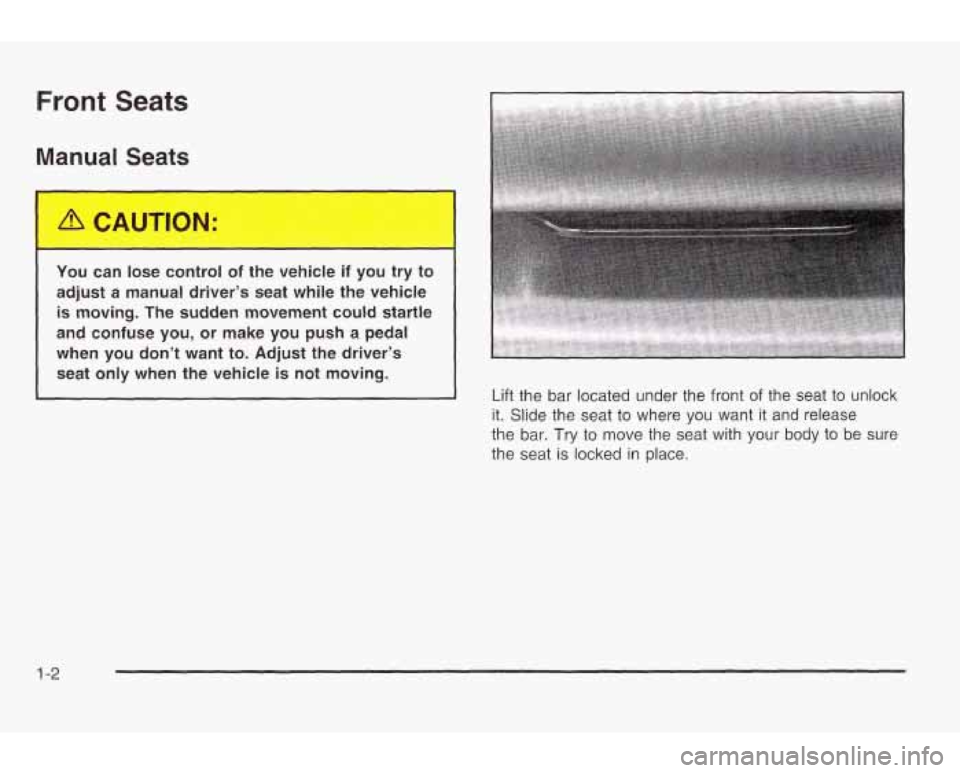
Lift the bar located under the front
of the seat to unlock
it. Slide the seat to where you want
it and release
the bar.
Try to move the seat with your body to be sure
the seat is locked in place.
1 -2
Page 10 of 354

Six-Way Power Driver Seat Reclining Seatbacks
If your vehicle has this
feature, the power seat control is located on
the outboard side of the
driver's seat.
This control allows
you to move the seat up, down,
forward, or backward.
It will also move the front or rear
of the seat cushion up or down.
Move the seat forward or rearward by pushing the
control toward the front or rear of the vehicle.
Raise or lower the entire seat cushion by holding
the control up or down.
Raise or lower the front of the seat cushion by
holding the front of the control up or down.
Raise or lower the rear of the seat cushion by
holding the rear of the control up or down. To adjust the seatback, lift the
lever located on the
outboard side of the seat and move the seatback
to where you want it. Release the lever
to lock the
seatback.
Pull up on the lever without pushing on the
seaiback
ana iile seaiuack wiii yu iu 2i-l Uprighi ~GS~~GK.
1 -3
Page 11 of 354
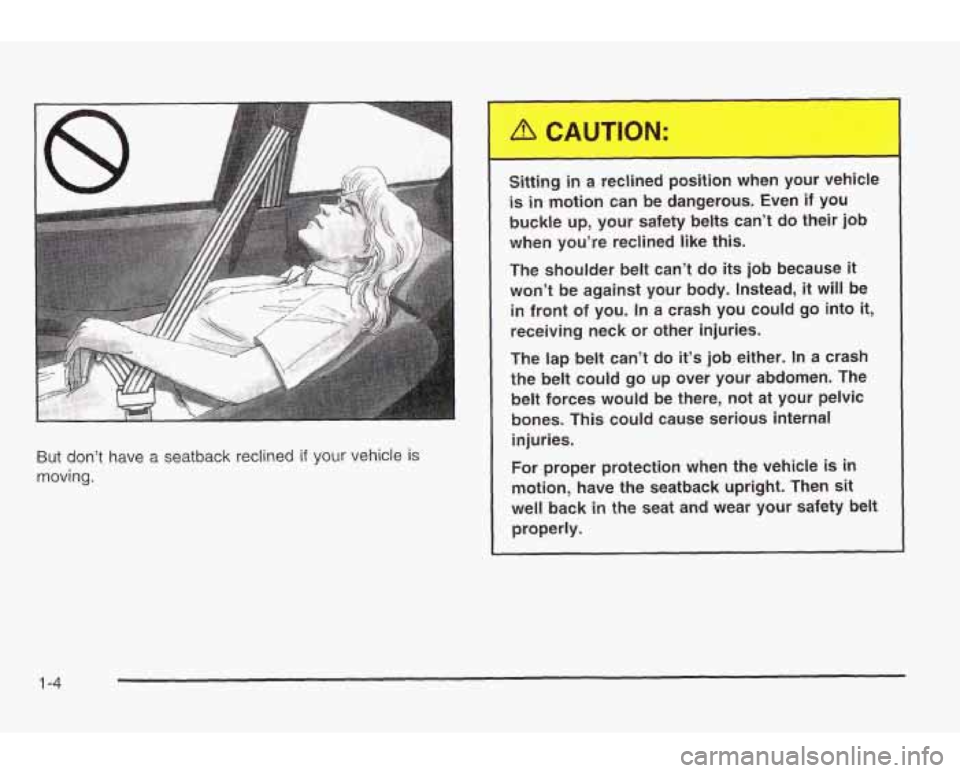
But don’t have a seatback reclined if your vehicle is
moving.
I
Sitting in a reclined position when your vehicle
is in motion can be dangerous. Even if you
buckle up, your safety belts can’t do their job
when you’re reclined like this.
The shoulder belt can’t do its job because
it
won’t be against your body. Instead, it will be
in front of you. In a crash you could go into it,
receiving neck or other injuries.
The lap belt can’t do it’s job either. In
a crash
the belt could
go up over your abdomen. The
belt forces would be there, not at your pelvic
bones. This could cause serious internal
injuries.
For proper protection when the vehicle is
in
motion, have the seatback upright. Then sit
well back in the seat and wear your safety belt
properly.
1 -4
Page 12 of 354

Head Restraints
Slide the head restraint up or down so that the top of
position reduces the chance of a neck injury in a crash.
+L- r--+r-:n+ :m mlnr.nmt tn +hn tnn nf \/n~tr hnad Thic LIIC IG3LIUtIIl la blkJaba& bu LI IW rwp VI y vu- I IVCIU. a I ~IY
Seatback Latches
For two-door model vehicles, the front seatbacks fold
forward
to let people get into the back seat. The
seatback latch
is designed for one-handed operation.
To fold a front seatback forward, lift the seatback
latch fully without pushing forward on the seatback to
unlock it. Then the seatback will fold forward.
Push the seatback to
its original position, and the
seatback will lock.
forward in a sudden stop or crash. That could
cause injury to the person sitting there. Always
press rearward
on the seatback to be sure it is
1-5
Page 13 of 354

Easy Entry Seat
For two-door model vehicles, the right front seat of your
vehicle makes it easy for people to get in and out
of
the rear seat.
1. Fold the right front seatback forward by lifting the
2. The seat will slide forward to allow someone to get
seatback
latch fully.
into the rear seat area.
3. Push the seatback upright to lock it and slide the
seat fully rearward to lock it.
4. Adjust the seat to the desired position.
4b CAUTION:
If the easy entry right front seat isn't locked, it
can move. In a sudden stop or crash, the
person sitting there could be injured. After
you've used it, be sure to push rearward on an
easy entry seat to be sure it
is locked.
5. The front passenger should try to move the seat to
make sure the seat
is locked into place.
I -6
Page 14 of 354

Bower Lift Seat
If your vehicle has this feature, to move the power lift
seat forward or rearward, pull up on the lever located
under the front of the driver’s seat to unlock it. Slide the
seat to where you want it and release the lever. Try
is locked into place.
L- .- +L. ---& ..,:&h .,e,lr h,-.A,, +- --Iln +hn c.--t LW IIIWVC LI 12 acat VVIU I yuu~ uuuy LW IIIUI\~ ~UIU II IU uwut
To raise or lower the power lift seat, hold the switch
located
on the outboard side of the driver’s seat
up or down.
1 -7
Page 15 of 354

Rear Seats
Rear Seat Operation
Folding the Seatback
If your vehicle has this feature, do the following:
2. Fold the seatback down from the inside of the
vehicle.
To raise the seatback, push the seatback up
to return it
to its original position.
Push and pull on the seatback
to make sure it is latched
securely in the fully upright position.
1. Pull the release straps
located in the trunk.
The right strap operates
the passenger’s side
rear split seat. The left
strap operates the
driver’s side rear
split seat.
1-8