service PONTIAC GRAND AM 2003 Owners Manual
[x] Cancel search | Manufacturer: PONTIAC, Model Year: 2003, Model line: GRAND AM, Model: PONTIAC GRAND AM 2003Pages: 354, PDF Size: 16.3 MB
Page 2 of 354
The 2003 Pontiac Grand Am Owner Manual
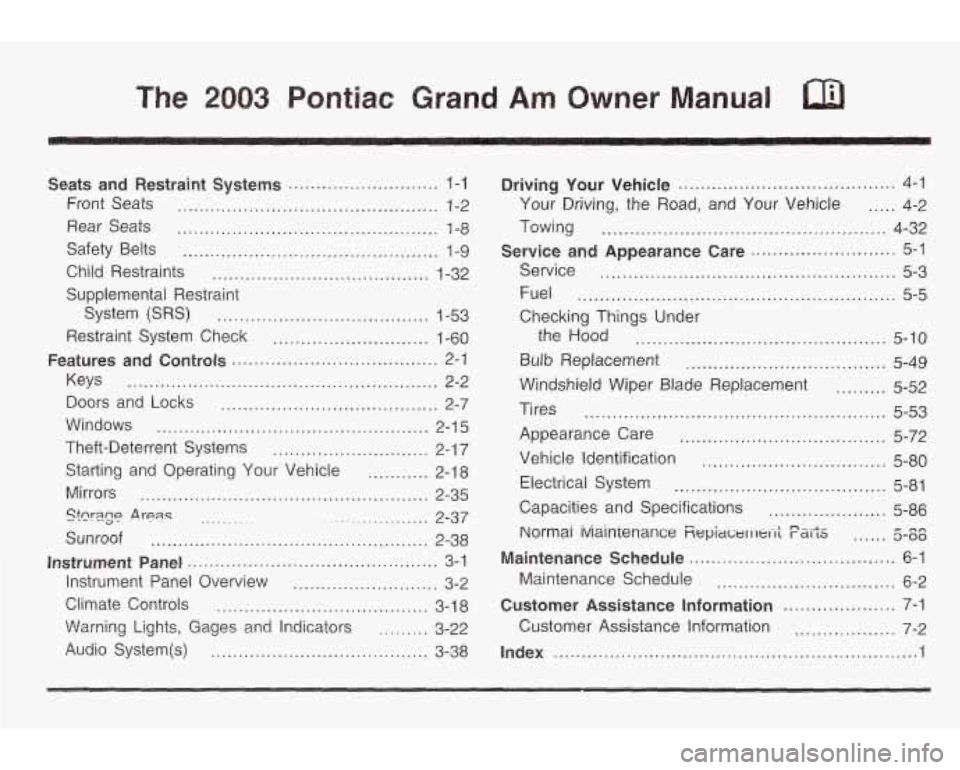
Seats and Restraint Systems ........................... 1-1
Front Seats ............................................... 1-2
Rear Seats ............................................... 1-8
Safety Belts .............................................. 1-9
Child Restraints ....................................... 1-32
Supplemental Restraint
System
(SRS) ...................................... 1-53
Restraint System Check ............................ 1-60
Keys ........................................................ 2-2
Doors and Locks ....................................... 2-7
Theft-Deterrent Systems ............................ 2-1 7
Starting and Operating Your Vehicle ........... 2-18
Mirrors .................................................... 2-35
Sunroof .................................................. 2-38
Instrument Panel Overview .......................... 3-2
Climate Controls ...................................... 3-1 8
\Warning Lights, Gages a.nd Indicators ......... 3-22
Audio System@) ....................................... 3-38
Features and Controls ..................................... 2-1
Windows ................................................. 2-1 5
Stcr3.g~ .A rean ~ ................... 2-37 ..........
Instrument Panel ............................................. 3-1
Driving Your Vehicle ....................................... 4-1
Your Driving, the Road, and Your Vehicle ..... 4-2
Towing ................................................... 4-32
Service ..................................................... 5-3
Fuel ......................................................... 5-5
Checking Things Under
Service
and Appearance
Care .......................... 5-1
the Hood ............................................. 5-10
Bulb Replacement .................................... 5-49
Windshield Wiper Blade Replacement ......... 5-52
Tires ...................................................... 5-53
Appearance Care ..................................... 5-72
Vehicle Identification ................................. 5-80
Electrical System ...................................... 5-81
Capacities and Specifications ..................... 5-86
Normai iviainienance Fiepiawl I 1t.1-1; F&iJiS ...... 5-00 nn
Maintenance Schedule ..................................... 6-1
bhintenance Schedule ................................ 6-2
Customer Assistance Information .................... 7-1
Customer Assistance Information .................. 7-2
Index ............................................................... ..I
Page 6 of 354
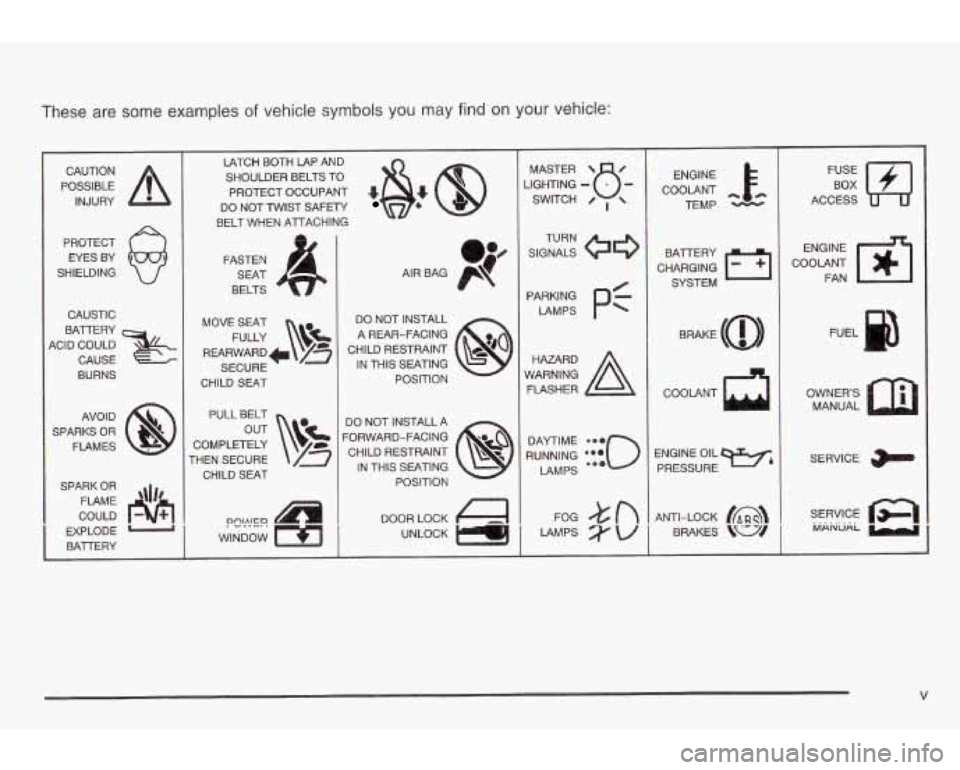
These are some examples of vehicle symbols you may find on your vehicle:
POSSIBLE A
CAUTION
INJURY
PROTECT EYES BY
SHIELDING
CAUSTIC
BATTERY
4CID COULD CAUSE
BURNS
AVOID
SPARKS
OR
FLAMES
SPARK
OR
FLAME 'lb'
COULD
EXPLODE
-
BATTERY
1
I
LATCH BOTH LAP AND
SHOULDER BELTS TO
PROTECT OCCUPANT
4
DO NOT TWIST SAFETY
BELT WHEN ATTACHING
FASTEN SEAT
BELTS
MOVE SEAT FULLY
\!&
REARWARD+ /z
SECURE
CHILD SEAT
PULL BELT
COMPLETELY
-HEN SECURE
CHILD SEAT
?"!"!E?
WINDOW DO
NOT INSTALL
A REAR-FACING
CHILD RESTRAINT IN THIS SEATING
POSITION
DO NOT INSTALL A
FORWARD-FACING CHILD RESTRAINT IN THIS SEATING POSITION
DOOR LOCK UNLOCK LIGHTING
-
PARKING PC
LAMPS
FOG n LAMPS w
ENGINE
COOLANT TEMP
CHARGING
1-1
BAlTERY SYSTEM
COOLANT
a
ENGINE OIL
PRESSURE
Wb
ANTI-LOCK fm)
BRAKES \u/
FJ
ACCESS
ENGINE
COOLANT FAN
FUEL
OWNER'S MANUAL
SERVICE
SERVICE
iviAi\iuWi
V
Page 65 of 354

What Will You See After an Air Bag
Inflates?
After an air bag inflates, it quickly deflates, so quickly
that some people may not even realize the air bag
inflated. Some components of the air bag module
- the
steering wheel hub for the driver’s air bag or the
instrument panel for the right front passenger’s
bag
- will be hot for a short time. The parts of the bag
that come into contact with you may be warm, but
not too hot to touch. There will be some smoke and dust
coming from the vents in the deflated air bags. Air
bag inflation doesn’t prevent the driver from seeing or
being able to steer the vehicle, nor does it stop
people from leaving the vehicle. When
an air bag inflates, there is dust in the
air. This dust could cause breathing problems
for people with a history of asthma or other
breathing trouble.
To avoid this, everyone in
the vehicle should get out as soon
as it is safe
to do
so. If you have breathing problems but
can’t get out
of the vehicle after an air bag
inflates, then get fresh air by opening a
window or a door.
In many crashes severe enough to inflate an air bag,
windshields are broken by vehicle deformation.
Additional windshield breakage may also occur from the
right front passenger air bag.
Air bags are designed to inflate only once. After an
air bag inflates, you’ll need some new parts for
your air bag system.
If you don’t get them, the air
bag system won’t be there to help protect you
in another crash.
A new system will include air bag
modules and possibly other parts. The service
manual for your vehicle covers the need to replace
other parts.
1-58
Page 66 of 354
Your vehicle is equipped with a crash sensing and
diagnostic module, which records information
about the air bag system. The module records
information about the readiness of the system, when
the system commands air bag inflation and
driver’s safety belt usage at deployment.
Let only qualified technicians work on your air bag
system. Improper service can mean that your air
bag system won’t work properly. See your dealer for
service.
Notice: If you damage the covering for the driver’s
or the right front passenger’s air bag, the bag
may not work properly. You may have to replace the
air bag module in
the steering wheel or both the
air bag module and the instrument panel for
the right front passenger’s air bag. Do not open or
break
the air bag coverings.
Servicing Your Air Bag-Equipped
Vehicle
Air bags affect how your vehicle should be serviced.
There are parts of the air bag system in several places
around your vehicle. You don’t want the system to
inflate white someone is working on your vehicle. Your dealer and
the service manual have information
about servicing your vehicle and the air bag system.
To purchase a service manual, see Service Publications
Ordering Information on page
7-9.
For up to 10 minutes after the ignition key is
turned
off and the battery is disconnected, an
air bag can
still inflate during improper
service. You can be injured
if you are close to
an air bag when
it inflates. Avoid wires
wrapped with yellow tape or yellow connectors. They are probably part of the air bag system. Be sure to follow proper service
procedures, and make sure the person
performing work for you is qualified to do
so.
The air bag system does not need regular maintenance.
1-59
Page 73 of 354
Changes or modifications to this system by other than
an authorized service facility could void authorization to
use this equipment.
At times you may notice a decrease in range. This is
normal for any remote keyless entry system. If the
transmitter does not work or
if you have to stand closer
to your vehicle for the transmitter to work, try this:
e
e
Check the distance. You may be too far from your
vehicle. You may need to stand closer during
rainy or snowy weather.
Check the location. Other vehicles or objects may
be blocking the signal. Take a few steps to the
left or right, hold the transmitter higher, and
try again.
Check to determine
if battery replacement is
necessary. See
“Battery Replacement” under
Remote Keyless Entry System Operation on
page
2-4.
If you are still having trouble, see your dealer or a
qualified technician for service.
Remote Keyless Entry System
Operation
If your vehicle has this feature, you can lock and unlock
your doors or unlock your trunk from about
3 feet
(1 m) up to 30 feet (9 m) away using the remote keyless
entry transmitter supplied with your vehicle.
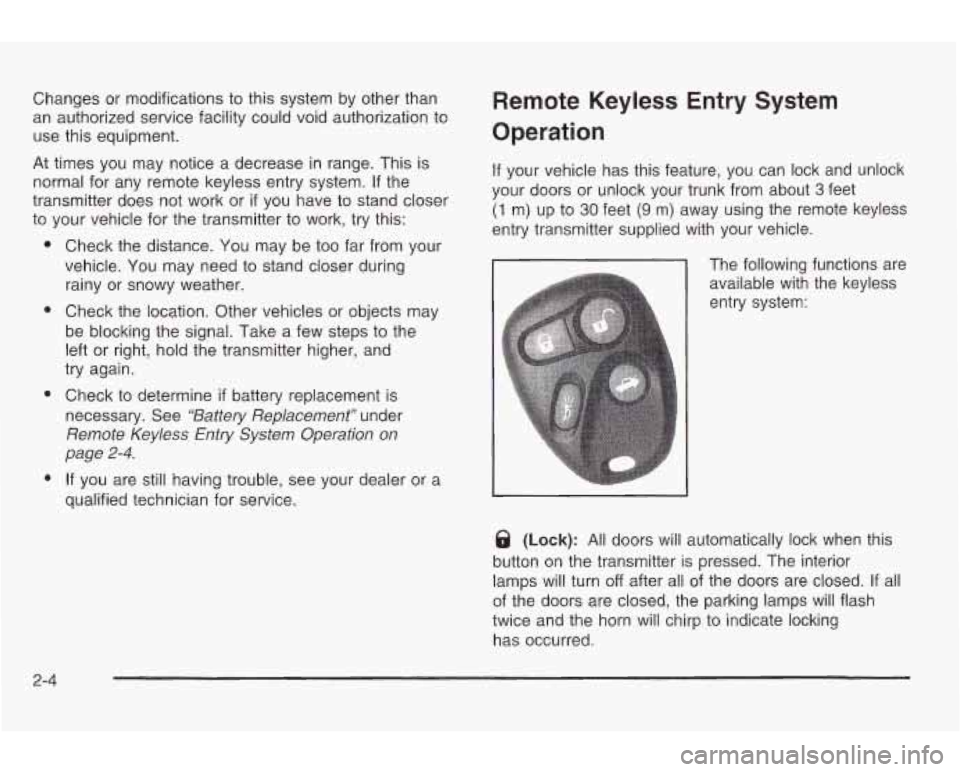
The following functions are
available with the keyless
entry system:
8 (Lock): All doors will automatically lock when this
button on the transmitter is pressed. The interior
lamps will turn
off after all of the doors are closed. If all
of the doors are closed, the parking lamps will flash
twice and the horn will chirp to indicate locking
has occurred.
2-4
Page 88 of 354

A warning chime will sound if you open the driver’s door
when the ignition is
off and the key is in the ignition.
Notice: If your key seems stuck in OFF and
you can’t turn it, be sure you are using the correct
key; if
so, is it all the way in? Turn the key only
with your hand. Using
a tool to force it could break
the key or the ignition switch.
If none of this
works, then your vehicle needs service.
B (ACCESSORY): This position unlocks the transaxle.
It also lets you use things like the radio and windshield
wipers when the engine is not running. To use
ACCESSORY, turn the key clockwise to the first
position. Use this position
if your vehicle must be pushed
or towed, but never try to push-start your vehicle.
C (ON): This position is where the key returns to after
you start your engine and release the key. The
ignition switch stays in ON when the engine is running.
But even when the engine is not running, you can
use ON to operate your electrical accessories and to
display some instrument panel warning lights.
Retained Accessory Power (RAP)
Your vehicle is equipped with a Retained Accessory
Power (RAP) feature which will allow the radio to
continue to work up to
10 minutes after the ignition is
turned to
OFF.
Your radio will work when the ignition key is in ON or
ACCESSORY. Once the key is turned from ON to
OFF,
the radio will continue to work up to 10 minutes or
until the driver’s door is opened.
Starting Your Engine
Automatic Transaxle
Move your shift lever to PARK (P) or NEUTRAL (N).
Your engine won’t start in any other position
- that’s a
safety feature. To restart when you’re already moving,
use NEUTRAL (N) only.
Notice: Don’t try to shift to PARK (P) if your
vehicle
is moving. If you do, you could damage the
transaxie.
shift to PARK (Pj oniy when your
vehicle
is stopped.
D (START): This position starts the engine. When the
engine starts, release the key. The ignition switch
will return to ON for normal driving.
2-1 9
Page 95 of 354

AUTOMATIC OVERDRIVE (D): This position is for
normal driving.
If you need more power for passing, and
you’re:
Going less than 35 mph (55 km/h), push your
Going about 35 mph (55 km/h) or more, push the
You’ll shift down to the next gear and have more power.
accelerator pedal about halfway
down.
accelerator all the way down.
Notice: If your vehicle seems to start up rather
slowly, or if
it seems not to shift gears as you go
faster, something may be wrong with a transaxle system sensor.
If you drive very far that way, your
vehicle can be damaged.
So, if this happens,
have your vehicle serviced right away. Until then,
you can use SECOND
(2) when you are driving less
than
35 mph (55 km/h) and AUTOMATIC
OVERDRIVE (D) for higher speeds. THIRD
(3): This position is also used
for normal driving.
However, it offers more power and lower fuel economy
than AUTOMATIC OVERDRIVE (D). Here are some
times you might choose THIRD
(3) instead of
AUTOMATIC OVERDRIVE (D):
When driving on hilly, winding roads.
0 When towing a trailer, so there is less shifting
between gears.
When going down a steep hill.
SECOND
(2): This position gives you more power but
lower fuel economy. You can use SECOND
(2) on
hills. It can help control your speed as you go down
steep mountain roads, but then you would also want to
use your brakes
off and on.
Notice: Don’t drive in SECOND (2) for more than
25 miles (40 km), or at speeds over 55 mph
(90 km/h), or you can damage your transaxle. Use
THIRD
(3) or AUTOMATIC OVERDRIVE (D) as
much as possible. Don’t shift into SECOND (2)
unless you are going slower than 65 mph (105 km/h)
or you can damage your engine.
2-26
Page 108 of 354
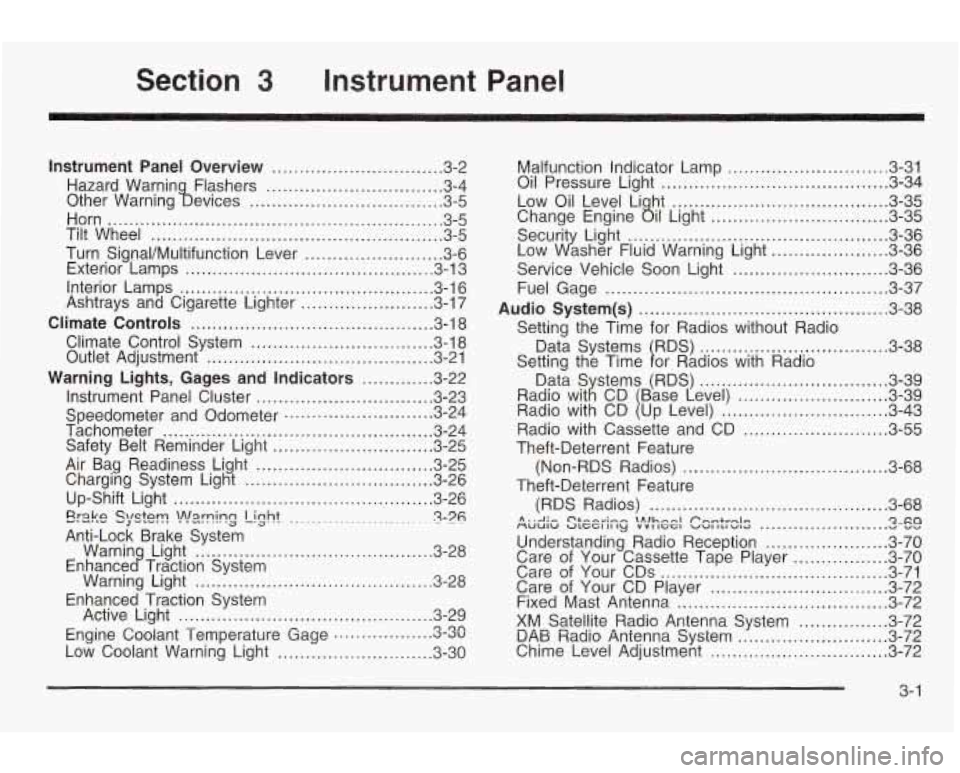
Section 3 Instrument Panel
Instrument Panel Overview ............................... 3.2
Hazard Warnin Flashers
................................ 3.4
Other Warning !bevices
................................... 3.5
Horn
............................................................. 3.5
Tilt Wheel
..................................................... 3.5
Turn Signal/Multifunction Lever
......................... 3.6
Exterior Lamps
............................................. 3.13
Interior Lamps
.............................................. 3.16
Ashtrays and Cigarette Lighter
........................ 3.17
Climate Controls
............................................ 3.18
Climate Control System
................................. 3.18
Outlet Adjustment
......................................... 3.21
Warning Lights, Gages and Indicators
............. 3-22
Instrument Panel Cluster
................................ 3.23
Speedometer and Odometer
........................... 3.24
Tachometer
................................................. 3.24
Safety Belt Reminder Light
............................. 3.25
Air Bag Readiness Light ................................ 3.25
Charging System Light
.................................. 3.26
Up-Shift Light
............................................... 3.26
Erake QlQtT! -J -.-. !n!=lrning Light ........................ ~ 3-76 .
Warnin Light ........................................... 3-28
Warning Light
........................................... 3.28
Active Light
.............................................. 3.29
Low Coolant Warning Light
............................ 3.30
Anti-Lock
Brake System
Enhance
c? Traction System
Enhanced Traction System
Engine Coolant Temperature Gage
3.3~ rl on ..................
Malfunction Indicator Lamp ............................. 3.31
Oil Pressure Light
......................................... 3.34
Low Oil Level Li ht
....................................... 3.35
Securit Light:
............................................... 3-36
Service Vehicle Soon Light
............................ 3-36
Fuel Gage
................................................... 3-37
Audio System(s)
............................................. 3-38
Data Systems RDS)
.................................. 3-38
Change Engine
ail Light ................................ 3-35
Low dsher Fluid Warning Light
..................... 3-36
Setting the Time for Radios without Radio
Setting the Time
1 or Radios with Radio 3-39
........................... 3-39
.............................. 3-43
Radio with Cassette and CD
.......................... 3-55
Theft-Deterrent Feature
Theft-Deterrent Feature (Non-RDS Radios)
..................................... 3-68
(RDS Radios)
........................................... 3-68
MUUIW ULCCI II ly VVI IGGI VU1 ILI WIG v vv A . .A .- C'&-A~;~~ \Alhnnl Pnmtrnlrr Qxa .......................
Understanding Radio Reception ...................... 3-70
Care of Your Cassette Tape Player
................. 3-70
Care of Your CDs ......................................... 3-71
Care of Your CD Player
................................ 3-72
Fixed Mast Antenna ...................................... 3-72
XM Satellite Radio Antenna System
................ 3-72
DAB Radio Antenna System 3-11 Chime Level Adjustment ................................ 3-72
n Tn ...........................
3- 1
Page 132 of 354
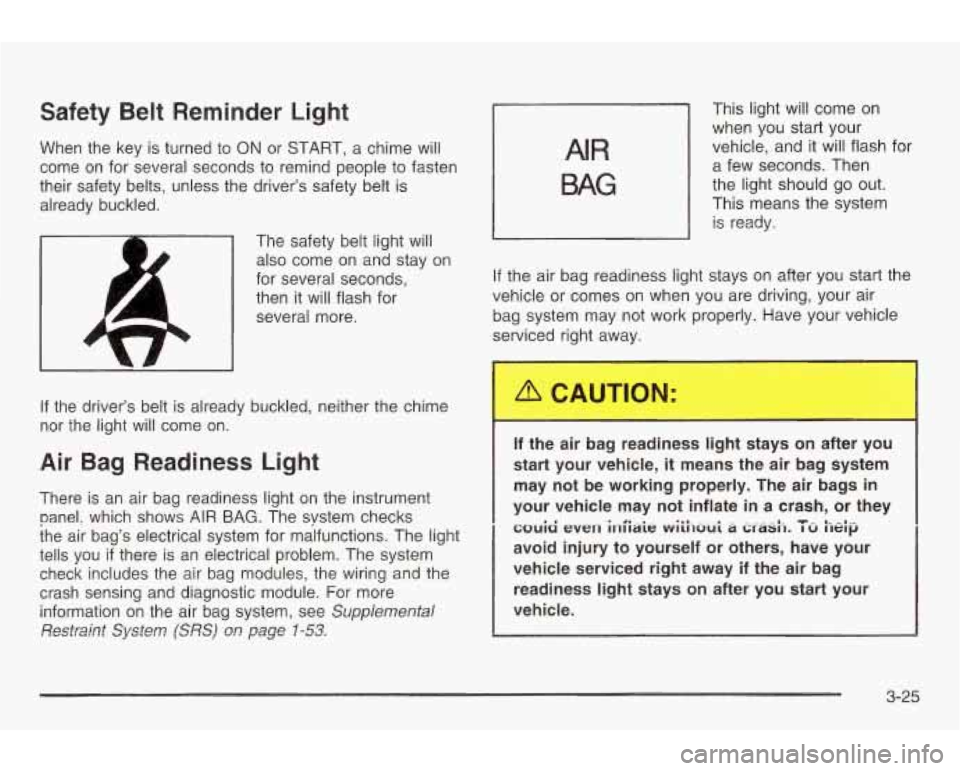
Safety Belt Reminder Light
When the key is turned to ON or START, a chime will
come on for several seconds to remind people
to fasten
their safety belts, unless the driver's safety belt is
already buckled.
The safety belt light will
also come on and stay on
for several seconds,
then it will flash for
several more.
If the driver's belt is already buckled, neither the chime
nor the light will come on.
Air Bag Readiness Light
There is an air bag readiness light on the instrument
panel, which shows AIR BAG. The system checks
the air bag's electrical system for malfunctions. The light
tells you
if there is an electrical problem. The system
check includes the air bag modules, the wiring and the
crash sensing and diagnostic module. For more
information on the air bag system, see
Supplemental
I Rnctmint '""'1UIII. VJIVL"' Cwctnm /.CR.S) \"' 'V, 0.n p~p 1-53.
AIR
BAG
This light will come on
when you start your
vehicle, and it will flash for
a few seconds. Then
the light should go out.
This means the system
is ready.
If the air bag readiness light stays on after you start the
vehicle or comes
on when you are driving, your air
bag system may not work properly. Have your vehicle
serviced right away.
If the air bag readiness light stays on after you
start your vehicle, it means the air bag system
may not be working properly. The air bags in
your vehicle may not inflate in a crash, or they
avoid injury to yourself or others, have your
vehicle serviced right away if the air bag
readiness light stays on after you start your
vehicle.
couid even inbit: wiiiiuui a CfaSi-1. Tu ii&p
3-25
Page 134 of 354
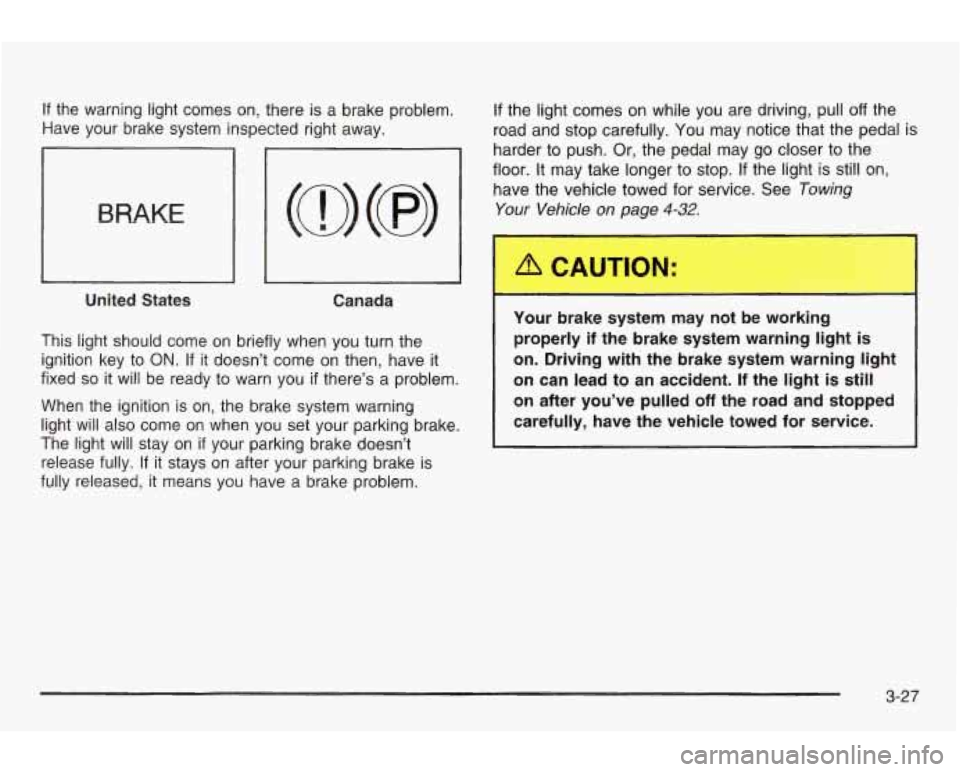
If the warning light comes on, there is a brake problem.
Have your brake system inspected right away.
BRAKE
~~~
United States
Canada
This light should come on briefly when you turn the
ignition key to
ON. If it doesn’t come on then, have it
fixed
so it will be ready to warn you if there’s a problem.
When the ignition is on, the brake system warning
light will also come on when you set your parking brake.
The light will stay on
if your parking brake doesn’t
release fully.
If it stays on after your parking brake is
fully released, it means you have a brake problem.
If the light comes on while you are driving, pull off the
road and stop carefully. You may notice that the pedal is
harder
to push. Or, the pedal may go closer to the
floor. It may take longer to stop.
If the light is still on,
have the vehicle towed for service. See
Towing
Your Vehicle on page 4-32.
Your brake system may not be working
properly
if the brake system warning light is
on. Driving with the brake system warning light
on can lead to an accident.
If the light is still
on after you’ve pulled
off the road and stopped
carefully, have the vehicle towed for service.
3-27