light PONTIAC GRAND AM 2004 User Guide
[x] Cancel search | Manufacturer: PONTIAC, Model Year: 2004, Model line: GRAND AM, Model: PONTIAC GRAND AM 2004Pages: 364, PDF Size: 2.48 MB
Page 96 of 364
Neutral:Use this position when you start or idle your
engine.
REVERSE (R):To back up, press down the clutch
pedal and lift up on the ring on the shift lever to shift into
REVERSE (R). Let up on the clutch pedal slowly
while pressing the accelerator pedal.
Notice:Shifting to REVERSE (R) while your vehicle
is moving forward could damage the transaxle.
The repairs would not be covered by your warranty.
Shift to REVERSE (R) only after your vehicle is
stopped.
Also, use REVERSE (R), along with the parking brake,
for parking your vehicle.
Once the shift lever is in REVERSE (R), the ignition can
be turned to OFF and the key removed.Shift Speeds
{CAUTION:
If you skip a gear when you downshift, you
could lose control of your vehicle. You could
injure yourself or others. Don’t shift down
more than one gear at a time when you
downshift.
Up-Shift Light
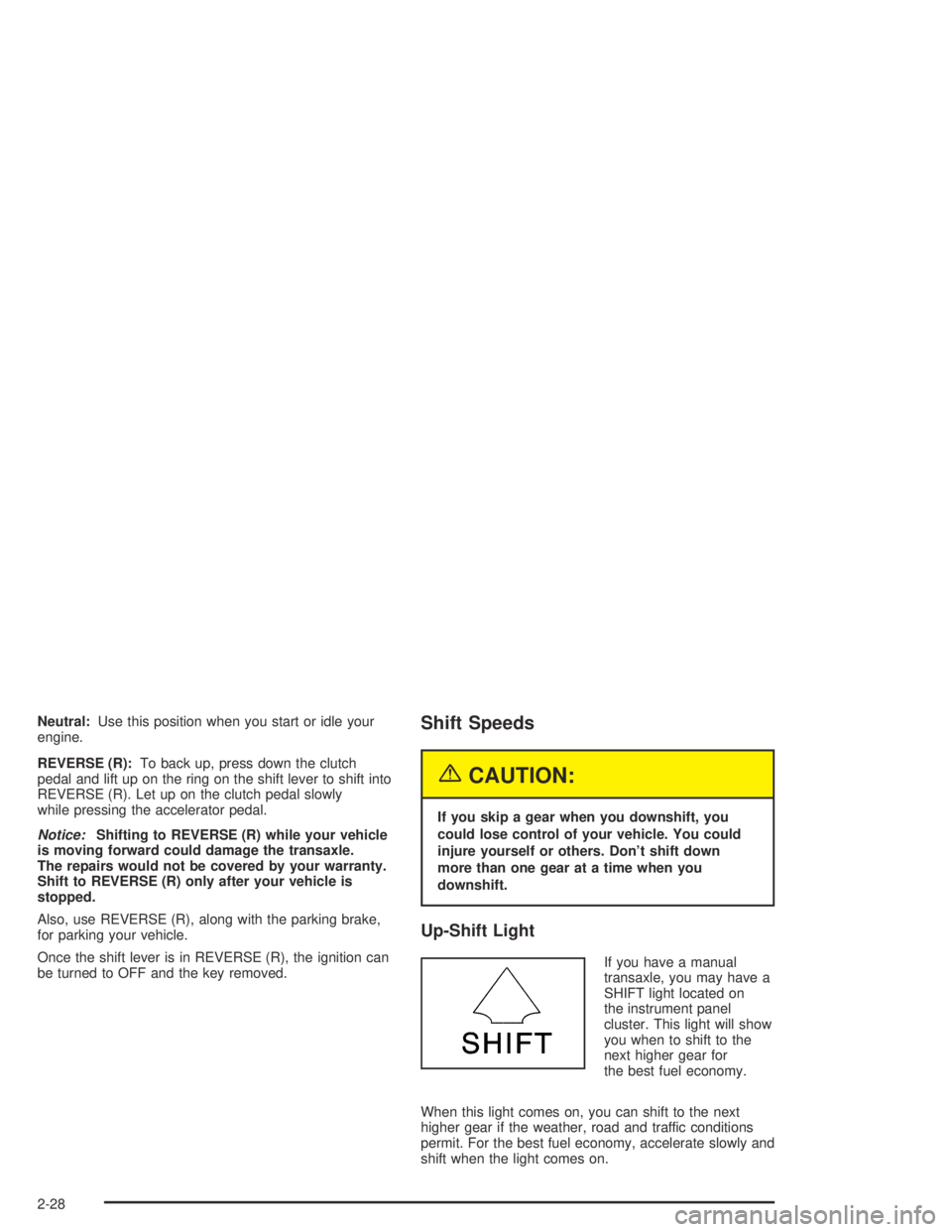
If you have a manual
transaxle, you may have a
SHIFT light located on
the instrument panel
cluster. This light will show
you when to shift to the
next higher gear for
the best fuel economy.
When this light comes on, you can shift to the next
higher gear if the weather, road and traffic conditions
permit. For the best fuel economy, accelerate slowly and
shift when the light comes on.
2-28
Page 97 of 364
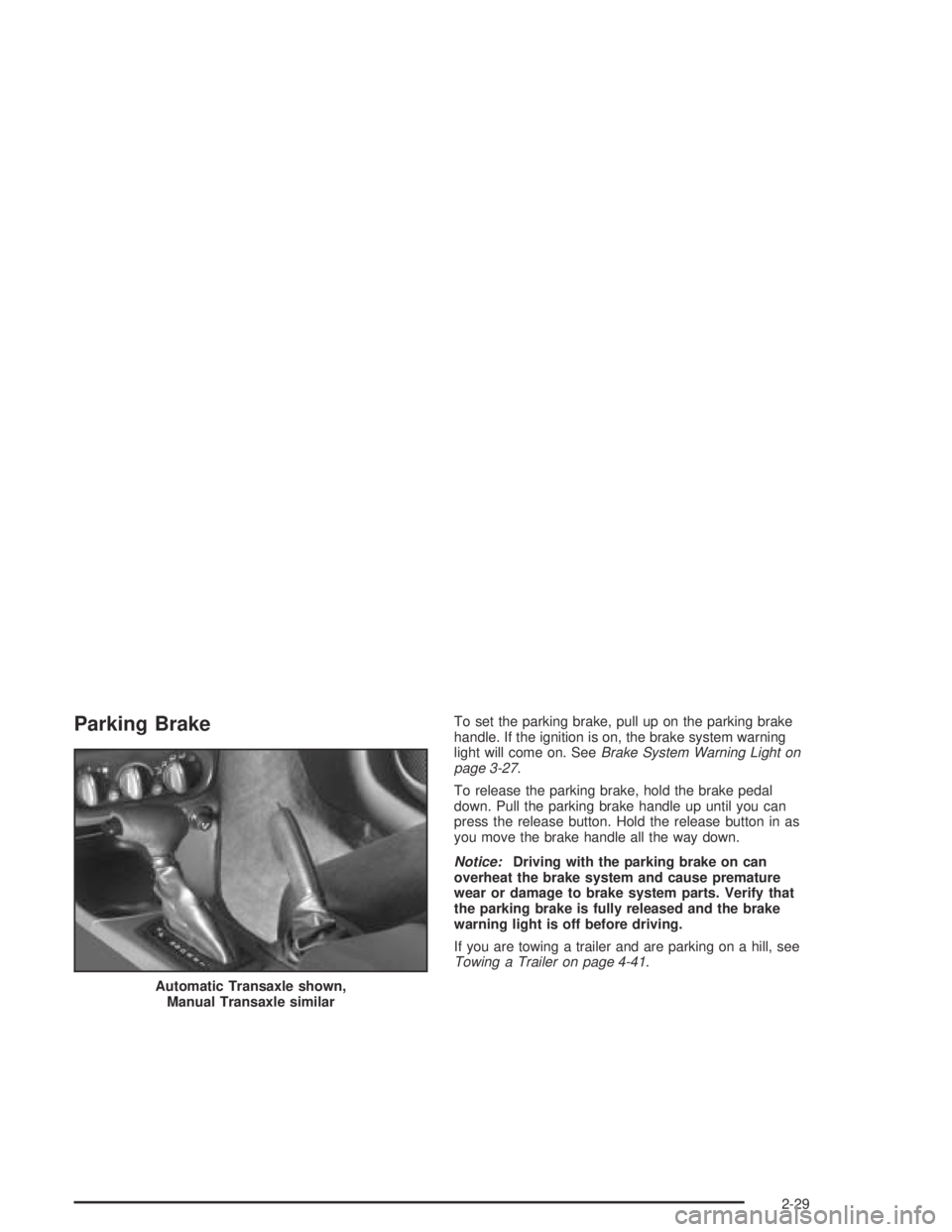
Parking BrakeTo set the parking brake, pull up on the parking brake
handle. If the ignition is on, the brake system warning
light will come on. SeeBrake System Warning Light on
page 3-27.
To release the parking brake, hold the brake pedal
down. Pull the parking brake handle up until you can
press the release button. Hold the release button in as
you move the brake handle all the way down.
Notice:Driving with the parking brake on can
overheat the brake system and cause premature
wear or damage to brake system parts. Verify that
the parking brake is fully released and the brake
warning light is off before driving.
If you are towing a trailer and are parking on a hill, see
Towing a Trailer on page 4-41.
Automatic Transaxle shown,
Manual Transaxle similar
2-29
Page 107 of 364
Instrument Panel Overview...............................3-2
Hazard Warning Flashers................................3-4
Other Warning Devices...................................3-5
Horn.............................................................3-5
Tilt Wheel.....................................................3-5
Turn Signal/Multifunction Lever.........................3-6
Windshield Wiper Lever...................................3-9
Cruise Control..............................................3-10
Exterior Lamps.............................................3-14
Interior Lamps..............................................3-17
Ashtrays and Cigarette Lighter........................3-18
Climate Controls............................................3-19
Climate Control System.................................3-19
Outlet Adjustment.........................................3-21
Warning Lights, Gages, and Indicators............3-22
Instrument Panel Cluster................................3-23
Speedometer and Odometer...........................3-24
Tachometer.................................................3-24
Safety Belt Reminder Light.............................3-25
Air Bag Readiness Light................................3-25
Charging System Light..................................3-26
Up-Shift Light...............................................3-26
Brake System Warning Light..........................3-27
Anti-Lock Brake System
Warning Light...........................................3-28
Enhanced Traction System
Warning Light...........................................3-28Enhanced Traction System
Active Light..............................................3-29
Engine Coolant Temperature Gage..................3-30
Low Coolant Warning Light............................3-30
Malfunction Indicator Lamp.............................3-31
Oil Pressure Light.........................................3-34
Change Engine Oil Light................................3-35
Security Light...............................................3-35
Low Washer Fluid Warning Light.....................3-36
Service Vehicle Soon Light............................3-36
Fuel Gage...................................................3-37
Audio System(s).............................................3-38
Setting the Time for Radios without Radio
Data Systems (RDS)..................................3-38
Setting the Time for Radios with Radio Data
Systems (RDS).........................................3-38
Radio with CD (Base Level)...........................3-39
Radio with CD (Up Level)..............................3-43
Radio with CD (MP3)....................................3-54
Theft-Deterrent Feature..................................3-68
Audio Steering Wheel Controls.......................3-69
Radio Reception...........................................3-70
Care of Your CDs.........................................3-70
Care of Your CD Player................................3-70
Fixed Mast Antenna......................................3-71
XM™ Satellite Radio Antenna System.............3-71
Chime Level Adjustment................................3-71
Section 3 Instrument Panel
3-1
Page 109 of 364
The main components of your instrument panel are the following:
A. Fog Lamp Button (If Equipped). See “Fog Lamps” in
Exterior Lamps on page 3-14.
B. Instrument Panel Brightness Thumbwheel. See
“Instrument Panel Brightness” inInterior Lamps on
page 3-17.
C. Turn Signal/Multifunction Lever. SeeTurn
Signal/Multifunction Lever on page 3-6.
D. Horn. SeeHorn on page 3-5.
E. Instrument Panel Cluster. SeeInstrument Panel
Cluster on page 3-23.
F. Windshield Wiper/Washer Lever. SeeWindshield
Wiper Lever on page 3-9.
G. Ignition Switch. SeeIgnition Positions on page 2-18.
H. Enhanced Traction System Button (If Equipped).
SeeEnhanced Traction System (ETS) on page 4-9.
I. Hazard Warning Flashers Button. SeeHazard
Warning Flashers on page 3-4.J. Instrument Panel Fuse Blocks. SeeFuses and
Circuit Breakers on page 5-87.
K. Hood Release Handle. SeeHood Release on
page 5-10.
L. Tilt Wheel Lever. SeeTilt Wheel on page 3-5.
M. Audio System Steering Wheel Controls (If Equipped).
SeeAudio Steering Wheel Controls on page 3-69.
N. Cruise Control Buttons (If Equipped). SeeCruise
Control on page 3-10.
O. Shift Lever. SeeAutomatic Transaxle Operation on
page 2-24.
P. Cigarette Lighter. SeeAshtrays and Cigarette
Lighter on page 3-18.
Q. Climate Control System. SeeClimate Control
System on page 3-19.
R. Audio System. SeeAudio System(s) on page 3-38.
3-3
Page 114 of 364
O(Exterior Lamps):Turn the outside part of the
lever with the symbol on it, to operate the lamps.
The exterior lamps control has three positions:
<(Parking Lamps):Turn the control to this position
to turn on the parking lamps, together with the
following.
•Sidemarker Lamps
•Taillamps
•License Plate Lamps
•Instrument Panel Lights
3(Headlamps):Turn the control to this position to
turn on the headlamps, together with the previously
listed lamps and lights.
AUTO:Turn the control to this position to turn the
headlamps, taillamps and parking lamps on and
off automatically while the ignition is on, by sensing how
dark it is outside. For more information see “Automatic
Headlamp System” later in this section.
Headlamp High/Low-Beam Changer
To change the headlamps from low beam to high beam,
push the turn signal/multifunction lever away from you.
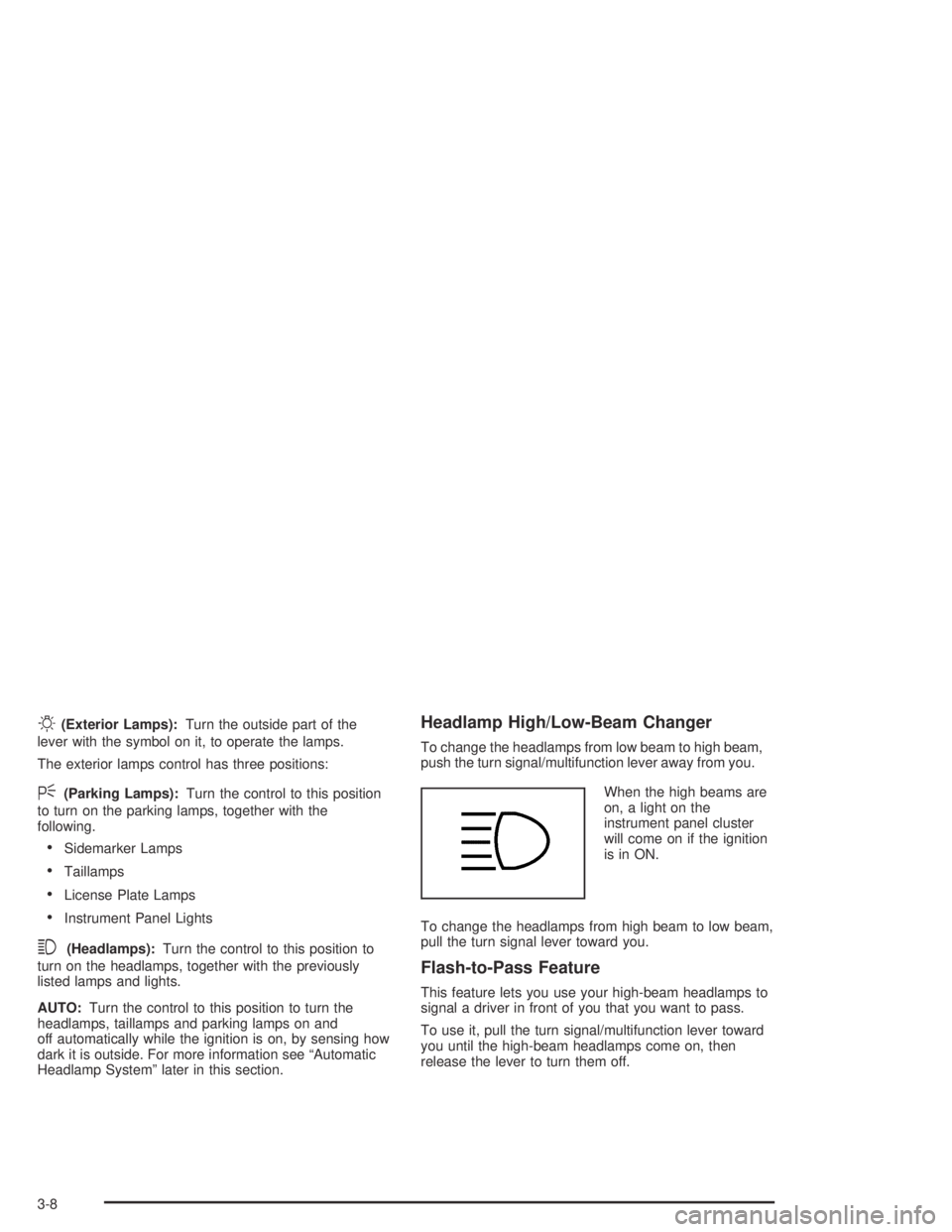
When the high beams are
on, a light on the
instrument panel cluster
will come on if the ignition
is in ON.
To change the headlamps from high beam to low beam,
pull the turn signal lever toward you.
Flash-to-Pass Feature
This feature lets you use your high-beam headlamps to
signal a driver in front of you that you want to pass.
To use it, pull the turn signal/multifunction lever toward
you until the high-beam headlamps come on, then
release the lever to turn them off.
3-8
Page 115 of 364
Windshield Wiper Lever
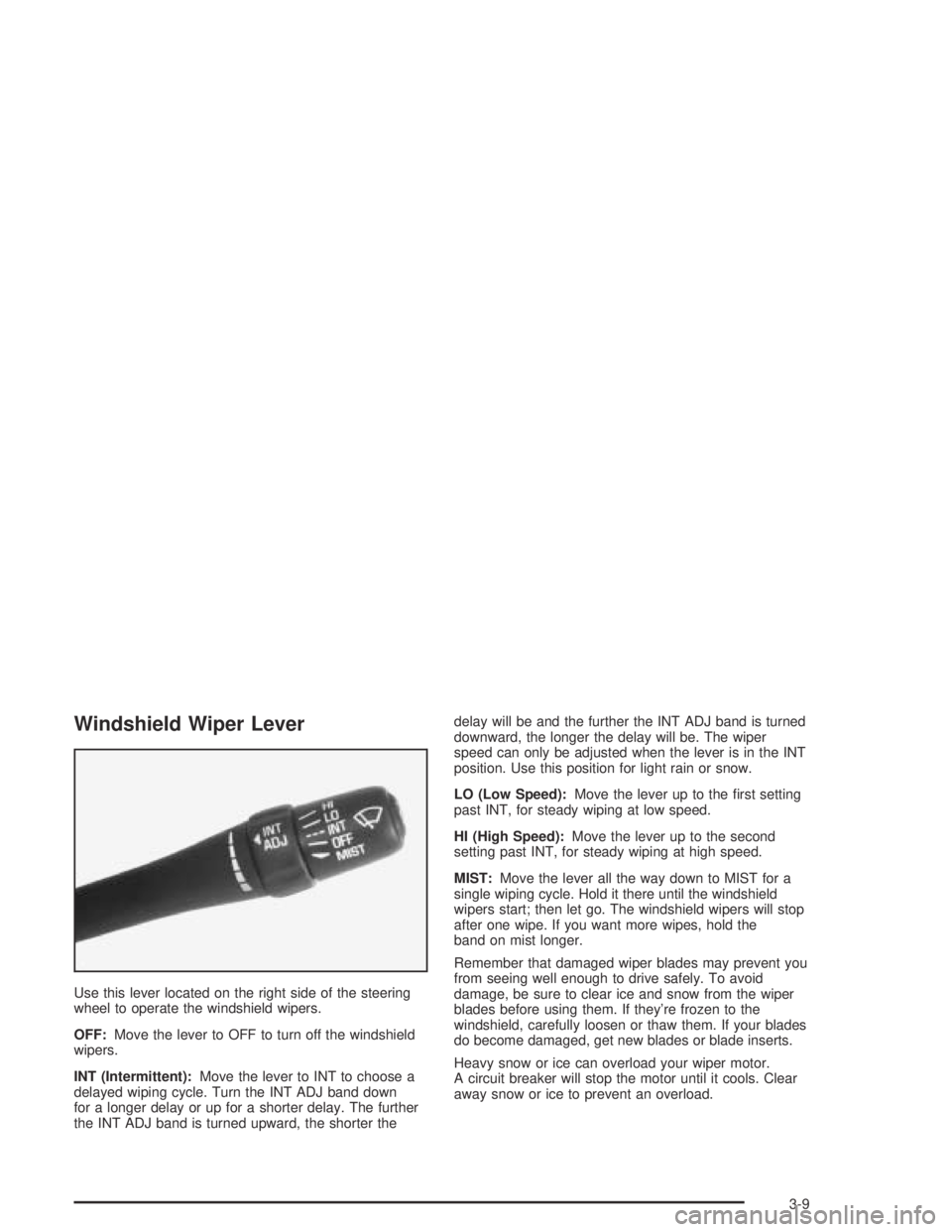
Use this lever located on the right side of the steering
wheel to operate the windshield wipers.
OFF:Move the lever to OFF to turn off the windshield
wipers.
INT (Intermittent):Move the lever to INT to choose a
delayed wiping cycle. Turn the INT ADJ band down
for a longer delay or up for a shorter delay. The further
the INT ADJ band is turned upward, the shorter thedelay will be and the further the INT ADJ band is turned
downward, the longer the delay will be. The wiper
speed can only be adjusted when the lever is in the INT
position. Use this position for light rain or snow.
LO (Low Speed):Move the lever up to the first setting
past INT, for steady wiping at low speed.
HI (High Speed):Move the lever up to the second
setting past INT, for steady wiping at high speed.
MIST:Move the lever all the way down to MIST for a
single wiping cycle. Hold it there until the windshield
wipers start; then let go. The windshield wipers will stop
after one wipe. If you want more wipes, hold the
band on mist longer.
Remember that damaged wiper blades may prevent you
from seeing well enough to drive safely. To avoid
damage, be sure to clear ice and snow from the wiper
blades before using them. If they’re frozen to the
windshield, carefully loosen or thaw them. If your blades
do become damaged, get new blades or blade inserts.
Heavy snow or ice can overload your wiper motor.
A circuit breaker will stop the motor until it cools. Clear
away snow or ice to prevent an overload.
3-9
Page 117 of 364
The cruise control will turn off if any of the following
occur:
•The brakes are applied,
•the clutch pedal is applied (manual transaxle),
•the automatic transaxle is shifted to NEUTRAL (N),
•the parking brake is applied, or
•the brake system warning light is on.
{CAUTION:
Cruise control can be dangerous where you
can not drive safely at a steady speed. So, do
not use your cruise control on winding roads
or in heavy traffic.
Cruise control can be dangerous on slippery
roads. On such roads, fast changes in tire
traction can cause needless wheel spinning,
and you could lose control. Do not use cruise
control on slippery roads.Your vehicle may have Enhanced Traction System
(ETS). SeeEnhanced Traction System (ETS) on
page 4-9. If your vehicle is in cruise control while the
ETS begins to limit wheel spin, the cruise control
will automatically disengage. When road conditions allow
you to safely use it again, you may turn the cruise
control back on.
Setting Cruise Control
{CAUTION:
If you leave your cruise control on when you
are not using cruise, you might hit a button
and go into cruise when you do not want to.
You could be startled and even lose control.
Keep the cruise control switch off until you
want to use cruise control.
1. Press cruise ON OFF.
2. Get up to the speed you want.
3. Press the SET COAST button and release it.
4. Take your foot off the accelerator pedal.
3-11
Page 119 of 364
Passing Another Vehicle While Using
Cruise Control
Use the accelerator pedal to increase your speed.
When you take your foot off the pedal, your vehicle will
slow down to the cruise control speed you set earlier.
Using Cruise Control on Hills
How well your cruise control will work on hills depends
upon your speed, load and the steepness of the
hills. When going up steep hills, you may have to step
on the accelerator pedal to maintain your speed.
When going downhill, you may have to brake or shift to
a lower gear to keep your speed down. Of course,
applying the brake takes you out of cruise control. Many
drivers find this to be too much trouble and don’t use
cruise control on steep hills.
Ending Cruise Control
There are four ways to turn off the cruise control:
•Step lightly on the brake pedal.
•Press the cruise control RESUME ACCEL button
and the SET COAST buttons at the same time.
•Press cruise ON OFF.
•Push the clutch pedal if you have a manual
transaxle.
Erasing Speed Memory
When you turn off the cruise control or the ignition, your
cruise control set speed memory is erased.
3-13
Page 120 of 364
Exterior Lamps
Headlamps
See “Headlamps” underTurn Signal/Multifunction Lever
on page 3-6.
Daytime Running Lamps (DRL)
Daytime Running Lamps (DRL) can make it easier for
others to see the front of your vehicle during the
day. DRL can be helpful in many different driving
conditions, but they can be especially helpful in the short
periods after dawn and before sunset. Fully functional
daytime running lamps are required on all vehicles
first sold in Canada.The DRL system will make your low-beam headlamps
come on at a reduced brightness when the following
conditions are met:
•The ignition is on,
•the exterior lamps control is in AUTO or the parking
lamps only position,
•the light sensor detects daytime light,
•the parking brake is released, and
•the shift lever is not in PARK (P) on vehicles with
an automatic transaxle only.
When the DRL system is on, the taillamps, sidemarker
lamps, parking lamps and instrument panel lights
will not be illuminated unless you have turned the
exterior lamps control to the parking lamp position.
As with any vehicle, you should turn on the regular
headlamp system when you need it.
3-14
Page 121 of 364
Automatic Headlamp System
When it is dark enough outside, your automatic
headlamp system will turn on your headlamps at the
normal brightness along with other lamps such as
the taillamps, sidemarker, parking lamps and the
instrument panel lights. The radio lights will also be dim.
Your vehicle is equipped with a light sensor on the
top of the instrument panel under the defroster grill, so
be sure it is not covered which will cause the
automatic headlamp system to be on whenever the
ignition is on.
The automatic headlamp system may also be on when
driving through a parking garage, heavy overcast
weather or a tunnel. This is normal.
There is a delay in the transition between the daytime
and nighttime operation of the DRL and the automatic
headlamp systems so that driving under bridges or
bright overhead street lights does not affect the system.
The DRL and automatic headlamp systems will only
be affected when the light sensor sees a change
in lighting lasting longer than this delay.If you start your vehicle in a dark garage, the automatic
headlamp system will come on immediately. Once
you leave the garage, it will take approximately
one minute for the automatic headlamp system to
change to DRL if it is light outside. During that delay,
your instrument panel cluster may not be as bright
as usual. Make sure your instrument panel brightness
control is in the full bright position. See “Instrument
Panel Brightness Control” underInterior Lamps
on page 3-17.
To idle your vehicle with the automatic headlamp
system off, set the parking brake while the ignition is off.
Then start the vehicle. The automatic headlamp
system will stay off until you release the parking brake.
As with any vehicle, you should turn on the regular
headlamps when you need them.
3-15