lights PONTIAC GRAND AM 2004 User Guide
[x] Cancel search | Manufacturer: PONTIAC, Model Year: 2004, Model line: GRAND AM, Model: PONTIAC GRAND AM 2004Pages: 364, PDF Size: 2.48 MB
Page 129 of 364
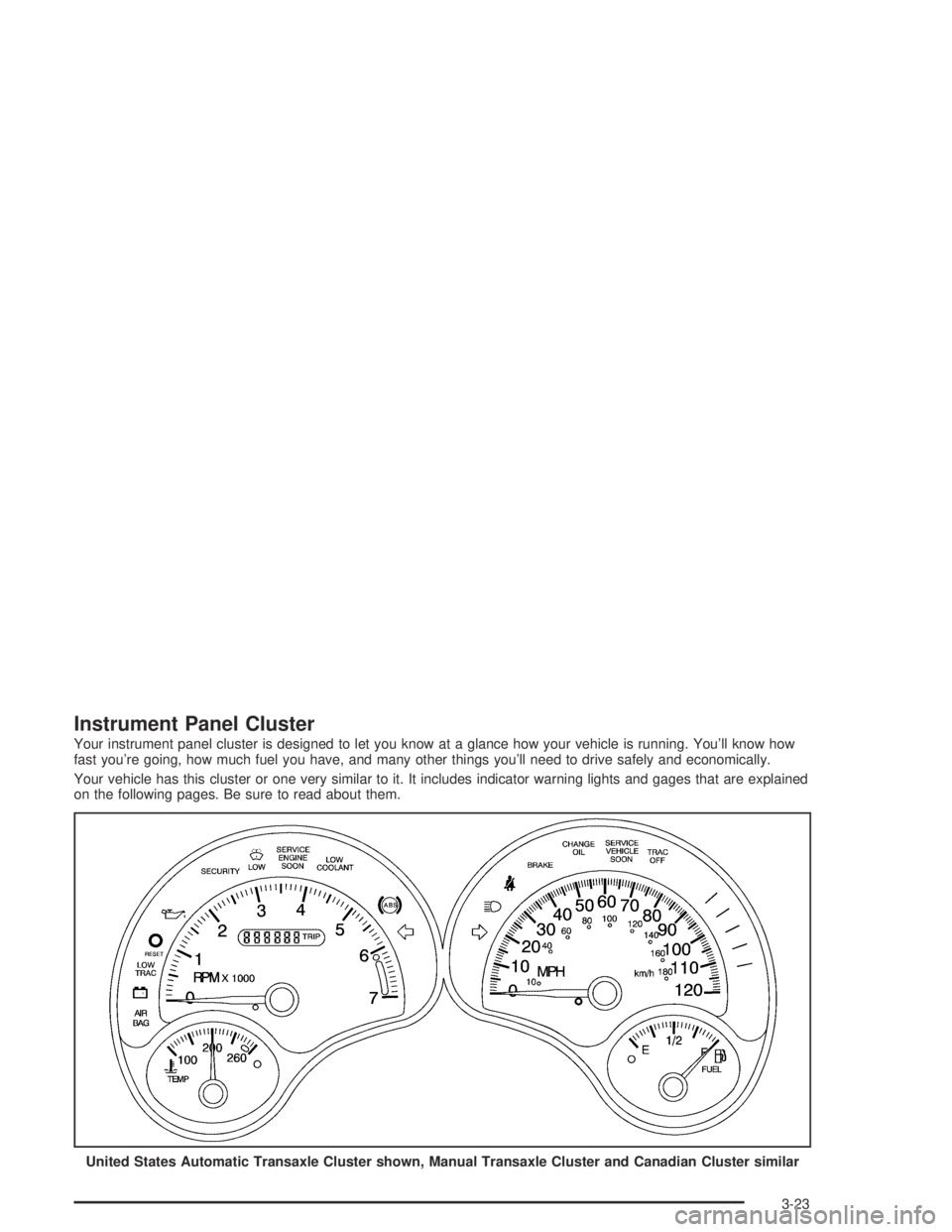
Instrument Panel Cluster
Your instrument panel cluster is designed to let you know at a glance how your vehicle is running. You’ll know how
fast you’re going, how much fuel you have, and many other things you’ll need to drive safely and economically.
Your vehicle has this cluster or one very similar to it. It includes indicator warning lights and gages that are explained
on the following pages. Be sure to read about them.
United States Automatic Transaxle Cluster shown, Manual Transaxle Cluster and Canadian Cluster similar
3-23
Page 196 of 364

No one can see as well at night as in the daytime. But
as we get older these differences increase. A
50-year-old driver may require at least twice as much
light to see the same thing at night as a 20-year-old.
What you do in the daytime can also affect your
night vision. For example, if you spend the day in bright
sunshine you are wise to wear sunglasses. Your
eyes will have less trouble adjusting to night. But if you
are driving, do not wear sunglasses at night. They
may cut down on glare from headlamps, but they also
make a lot of things invisible.
You can be temporarily blinded by approaching
headlamps. It can take a second or two, or even several
seconds, for your eyes to readjust to the dark. When
you are faced with severe glare (as from a driver
who does not lower the high beams, or a vehicle with
misaimed headlamps), slow down a little. Avoid
staring directly into the approaching headlamps.Keep your windshield and all the glass on your vehicle
clean — inside and out. Glare at night is made much
worse by dirt on the glass. Even the inside of the glass
can build up a film caused by dust. Dirty glass makes
lights dazzle and flash more than clean glass would,
making the pupils of your eyes contract repeatedly.
Remember that your headlamps light up far less of a
roadway when you are in a turn or curve. Keep
your eyes moving; that way, it is easier to pick out dimly
lighted objects. Just as your headlamps should be
checked regularly for proper aim, so should your eyes
be examined regularly. Some drivers suffer from
night blindness — the inability to see in dim light — and
are not even aware of it.
4-18
Page 249 of 364
How to Check and Add Fluid
You do not need to check the fluid level unless you
suspect a clutch problem. To check the fluid level, take
the cap off. If the fluid level reaches the top of the
reservoir, the fluid level is correct. It isn’t a good idea to
top off your clutch fluid. Adding fluid won’t correct a
leak. A fluid loss in this system could indicate a problem.
Have the system inspected and repaired.
Engine Coolant
The cooling system in your vehicle is filled with
DEX-COOL®engine coolant. This coolant is designed
to remain in your vehicle for 5 years or 150,000 miles
(240 000 km), whichever occurs first, if you add
only DEX-COOL
®extended life coolant.
The following explains your cooling system and how to
add coolant when it is low. If you have a problem
with engine overheating, seeEngine Overheating on
page 5-25.A 50/50 mixture of clean, drinkable water and
DEX-COOL
®coolant will:
•Give freezing protection down to−34°F (−37°C).
•Give boiling protection up to 265°F (129°C).
•Protect against rust and corrosion.
•Help keep the proper engine temperature.
•Let the warning lights and gages work as they
should.
Notice:Using coolant other than DEX-COOL
®may
cause premature engine, heater core or radiator
corrosion. In addition, the engine coolant may
require changing sooner, at 30,000 miles (50 000 km)
or 24 months, whichever occurs rst. Any repairs
would not be covered by your warranty. Always use
DEX-COOL
®(silicate-free) coolant in your vehicle.
5-23
Page 363 of 364
V
Vehicle
Control........................................................ 4-6
Damage Warnings........................................... iv
Loading......................................................4-35
Parking Your...............................................2-32
Service Soon Light......................................3-36
Symbols......................................................... iv
Vehicle Data Collection and Event Data
Recorders.................................................... 7-9
Vehicle Identification
Number (VIN).............................................5-86
Service Parts Identification Label...................5-86
Vehicle Storage..............................................5-41
Ventilation Adjustment......................................3-21
Visor Vanity Mirror..........................................2-16
Visors...........................................................2-16
W
Warning Lights, Gages and Indicators................3-22
Warnings
Hazard Warning Flashers............................... 3-4
Other Warning Devices.................................. 3-5
Safety and Symbols......................................... iii
Vehicle Damage.............................................. iv
Washer Fluid, Low Warning Light......................3-36
Washing Your Vehicle......................................5-81
Weight of the Trailer........................................4-42
Weight of the Trailer Tongue.............................4-42
What Kind of Engine Oil to Use........................5-16
What to Do with Used Oil................................5-19
What to Use..........................................5-24, 5-35
Wheels
Alignment and Tire Balance..........................5-64
Replacement...............................................5-65
15