light PONTIAC GRAND AM 2005 User Guide
[x] Cancel search | Manufacturer: PONTIAC, Model Year: 2005, Model line: GRAND AM, Model: PONTIAC GRAND AM 2005Pages: 334, PDF Size: 2.27 MB
Page 87 of 334
Parking Brake
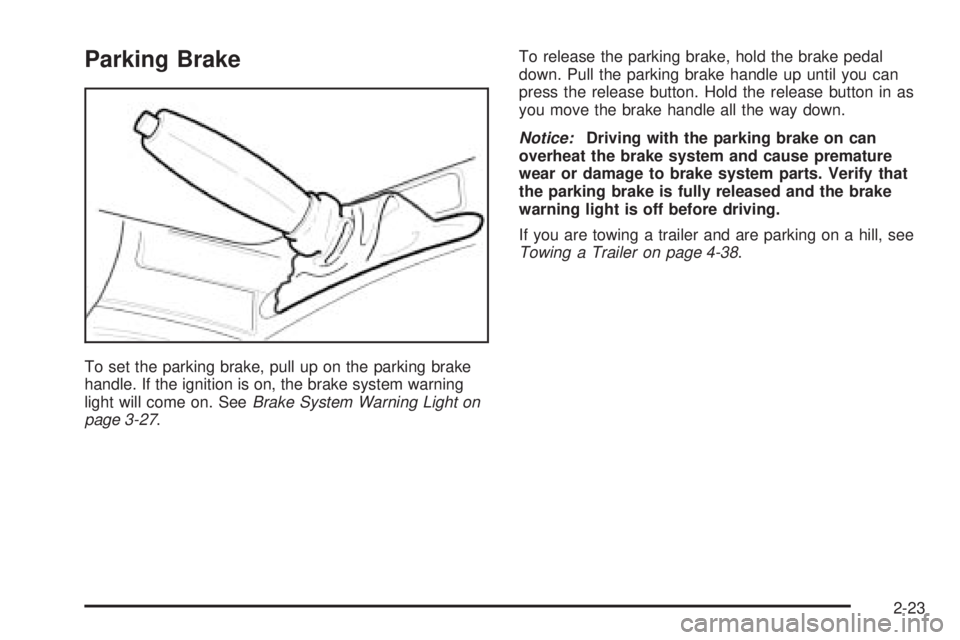
To set the parking brake, pull up on the parking brake
handle. If the ignition is on, the brake system warning
light will come on. SeeBrake System Warning Light on
page 3-27.To release the parking brake, hold the brake pedal
down. Pull the parking brake handle up until you can
press the release button. Hold the release button in as
you move the brake handle all the way down.
Notice:Driving with the parking brake on can
overheat the brake system and cause premature
wear or damage to brake system parts. Verify that
the parking brake is fully released and the brake
warning light is off before driving.
If you are towing a trailer and are parking on a hill, see
Towing a Trailer on page 4-38.
2-23
Page 93 of 334
Outside Convex Mirror
{CAUTION:
A convex mirror can make things (like other
vehicles) look farther away than they really are.
If you cut too sharply into the right lane, you
could hit a vehicle on your right. Check your
inside mirror or glance over your shoulder
before changing lanes.
The passenger’s side mirror is convex. A convex
mirror’s surface is curved so more can be seen from the
driver’s seat. It also makes things, like other vehicles,
look farther away than they really are.
Storage Areas
Glove Box
To open the glove box, lift up on the lever. The glove
box has a light inside.
Cupholder(s)
There are two cupholders in the front of the vehicle near
the center console and two in the rear of the vehicle.
Pull down the door on the rear of the center console to
use the rear seat cupholders.
2-29
Page 95 of 334
Instrument Panel Overview...............................3-4
Hazard Warning Flashers................................3-6
Other Warning Devices...................................3-7
Horn.............................................................3-7
Tilt Wheel.....................................................3-7
Turn Signal/Multifunction Lever.........................3-8
Turn and Lane-Change Signals........................3-8
Headlamp High/Low-Beam Changer..................3-9
Flash-to-Pass.................................................3-9
Windshield Washer.........................................3-9
Windshield Wiper Lever.................................3-10
Cruise Control..............................................3-11
Headlamps..................................................3-14
Headlamps Off in PARK (P)...........................3-14
Delayed Headlamps......................................3-15
Daytime Running Lamps (DRL).......................3-15
Automatic Headlamp System..........................3-15
Fog Lamps..................................................3-16
Instrument Panel Brightness...........................3-17
Dome Lamp.................................................3-17
Entry/Exit Lighting.........................................3-17
Trunk Lamp.................................................3-18
Battery Run-Down Protection..........................3-18
Ashtrays and Cigarette Lighter........................3-18Climate Controls............................................3-19
Climate Control System.................................3-19
Outlet Adjustment.........................................3-21
Warning Lights, Gages, and Indicators............3-22
Instrument Panel Cluster................................3-22
Speedometer and Odometer...........................3-24
Trip Odometer..............................................3-24
Tachometer.................................................3-24
Safety Belt Reminder Light.............................3-25
Airbag Readiness Light..................................3-25
Charging System Light..................................3-26
Brake System Warning Light..........................3-27
Anti-Lock Brake System Warning Light.............3-28
Enhanced Traction System Warning Light.........3-28
Enhanced Traction System Active Light............3-29
Engine Coolant Temperature Gage..................3-29
Low Coolant Warning Light............................3-30
Malfunction Indicator Lamp.............................3-30
Oil Pressure Light.........................................3-34
Change Engine Oil Light................................3-34
Security Light...............................................3-35
Highbeam On Light.......................................3-35
Low Washer Fluid Warning Light.....................3-35
Service Vehicle Soon Light............................3-35
Fuel Gage...................................................3-36
Section 3 Instrument Panel
3-1
Page 99 of 334

The main components of your instrument panel are the following:
A. Fog Lamp Button. SeeFog Lamps on page 3-16.
B. Instrument Panel Brightness Thumbwheel. See
Instrument Panel Brightness on page 3-17.
C. Turn Signal/Multifunction Lever. SeeTurn
Signal/Multifunction Lever on page 3-8.
D. Horn. SeeHorn on page 3-7.
E. Instrument Panel Cluster. SeeInstrument Panel
Cluster on page 3-22.
F. Windshield Wiper/Washer Lever. SeeWindshield
Wiper Lever on page 3-10.
G. Ignition Switch. SeeIgnition Positions on page 2-16.
H. Enhanced Traction System Button (If Equipped).
SeeEnhanced Traction System (ETS) on page 4-8.
I. Hazard Warning Flashers Button. SeeHazard
Warning Flashers on page 3-6.
J. Instrument Panel Fuse Blocks. SeeFuses and
Circuit Breakers on page 5-80.K. Hood Release Handle. SeeHood Release on
page 5-10.
L. Tilt Wheel Lever. SeeTilt Wheel on page 3-7.
M. Audio System Steering Wheel Controls (If Equipped).
SeeAudio Steering Wheel Controls on page 3-68.
N. Cruise Control Buttons. SeeCruise Control on
page 3-11.
O. Shift Lever. SeeAutomatic Transaxle Operation on
page 2-20.
P. Cigarette Lighter (If Equipped). SeeAshtrays and
Cigarette Lighter on page 3-18.
Q. Climate Control System. SeeClimate Control
System on page 3-19.
R. Audio System. SeeAudio System(s) on page 3-37.
3-5
Page 103 of 334

Headlamp High/Low-Beam Changer
To change the headlamps from low beam to high beam,
push the turn signal/multifunction lever away from you.
When the high beams are
on, a light on the
instrument panel cluster
also will be on if the
ignition is in ON.
To change the headlamps from high beam to low beam,
pull the turn signal lever toward you.
Flash-to-Pass
This feature lets you use your high-beam headlamps to
signal a driver in front of you that you want to pass.
To use it, pull the turn signal/multifunction lever toward
you until the high-beam headlamps come on, then
release the lever to turn them off.
Windshield Washer
To wash your windshield, press the button at the end of
the lever until the washers begin.
{CAUTION:
In freezing weather, do not use your washer
until the windshield is warmed. Otherwise the
washer uid can form ice on the windshield,
blocking your vision.
When you release the button, the washers will stop, but
the wipers will continue to wipe for about three times
or will resume the speed you were using before.
3-9
Page 104 of 334

Windshield Wiper Lever
Use this lever located on the right side of the steering
wheel to operate the windshield wipers.
OFF:Move the lever to OFF to turn off the windshield
wipers.INT (Intermittent):Move the lever to INT to choose a
delayed wiping cycle. Turn the INT ADJ band down
for a longer delay or up for a shorter delay. The further
the INT ADJ band is turned upward, the shorter the
delay will be and the further the INT ADJ band is turned
downward, the longer the delay will be. The wiper
speed can only be adjusted when the lever is in the INT
position. Use this position for light rain or snow.
LO (Low Speed):Move the lever up to the first setting
past INT, for steady wiping at low speed.
HI (High Speed):Move the lever up to the second
setting past INT, for steady wiping at high speed.
MIST:Move the lever all the way down to MIST for a
single wiping cycle. Hold it there until the windshield
wipers start; then let go. The windshield wipers will stop
after one wipe. If you want more wipes, hold the
band on mist longer.
Remember that damaged wiper blades may prevent you
from seeing well enough to drive safely. To avoid
damage, be sure to clear ice and snow from the wiper
blades before using them. If they’re frozen to the
windshield, carefully loosen or thaw them. If your blades
do become damaged, get new blades or blade inserts.
Heavy snow or ice can overload your wiper motor.
A circuit breaker will stop the motor until it cools. Clear
away snow or ice to prevent an overload.
3-10
Page 105 of 334

Cruise Control
The cruise control buttons are located on the bottom of
the steering wheel.
With cruise control, you can maintain a speed of about
25 mph (40 km/h) or more without keeping your foot
on the accelerator. This can really help on long
trips. Cruise control does not work at speeds below
25 mph (40 km/h).
The cruise control will turn off if any of the following
occur:
•The brakes are applied,
•the automatic transaxle is shifted to NEUTRAL (N),
•the parking brake is applied, or
•the brake system warning light is on.
{CAUTION:
Cruise control can be dangerous where you
cannot drive safely at a steady speed. So, do
not use your cruise control on winding roads
or in heavy traffic.
Cruise control can be dangerous on slippery
roads. On such roads, fast changes in tire
traction can cause needless wheel spinning,
and you could lose control. Do not use cruise
control on slippery roads.
Your vehicle may have Enhanced Traction
System (ETS). SeeEnhanced Traction System (ETS)
on page 4-8. If your vehicle is in cruise control while the
ETS begins to limit wheel spin, the cruise control will
automatically disengage. When road conditions
allow you to safely use it again, you may turn the cruise
control back on.
3-11
Page 107 of 334

Reducing Speed While Using Cruise
Control
There are two ways to reduce your speed while using
cruise control:
•Press the SET COAST button until you reach the
lower speed you want, then release it.
•To slow down in very small amounts, press the
SET COAST button briefly. Each time you do
this, you’ll go about 1 mph (1.6 km/h) slower.
Passing Another Vehicle While Using
Cruise Control
Use the accelerator pedal to increase your speed.
When you take your foot off the pedal, your vehicle will
slow down to the cruise control speed you set earlier.
Using Cruise Control on Hills
How well your cruise control will work on hills depends
upon your speed, load and the steepness of the hills.
When going up steep hills, you may have to step on the
accelerator pedal to maintain your speed. When going
downhill, you may have to brake or shift to a lower gear to
keep your speed down. Of course, applying the brake
takes you out of cruise control. Many drivers find this to
be too much trouble and don’t use cruise control on
steep hills.
Ending Cruise Control
There are four ways to turn off the cruise control:
•Step lightly on the brake pedal.
•Press the cruise control RESUME ACCEL button
and the SET COAST buttons at the same time.
•Press the cruise ON OFF button.
Erasing Speed Memory
When you turn off the cruise control or the ignition, your
cruise control set speed memory is erased.
3-13
Page 108 of 334

Headlamps
The lever on the left side of the steering column
operates the exterior lamps.
O(Exterior Lamps):Turn the outside part of the
lever with the symbol on it, to operate the lamps.
The exterior lamp control has three positions:
<(Parking Lamps):Turning the control to this
position turns on the parking lamps, together with the
following.
•Sidemarker Lamps
•Taillamps
•License Plate Lamps
•Instrument Panel Lights
3(Headlamps):Turning the control to this position
turns on the headlamps, together with the previously
listed lamps and lights.
AUTO:Turning the control to this position turns the
headlamps, taillamps and parking lamps on and
off automatically, while the ignition is on, by sensing
how dark it is outside. For more information see
“Automatic Headlamp System” later in this section.
Headlamps Off in PARK (P)
To turn the headlamps off when it is dark outside, turn
the exterior lamps control to the parking lamp position.
In this position, the parking lamps, sidemarker lamps,
taillamps, license plate lamps and instrument panel
lights will be on, but the headlamps will be off.
To turn on the headlamps along with the other lamps
when it is dark outside, turn the exterior lamps control to
the AUTO or headlamp position.
3-14
Page 109 of 334

Delayed Headlamps
The delayed headlamps feature will continue to
illuminate the headlamps for 20 seconds after the key is
turned to OFF, then the headlamps will automatically
turn off.
To override the 20 second delayed headlamp feature
while it is active turn the turn signal/multifunction
lever up one position and then back to AUTO.
Daytime Running Lamps (DRL)
Daytime Running Lamps (DRL) can make it easier for
others to see the front of your vehicle during the
day. DRL can be helpful in many different driving
conditions, but they can be especially helpful in the short
periods after dawn and before sunset. Fully functional
daytime running lamps are required on all vehicles
first sold in Canada.
The DRL system will make your low-beam headlamps
come on at a reduced brightness when the following
conditions are met:
•The ignition is on,
•the exterior lamps control is in AUTO or the parking
lamps only position,
•the light sensor detects daytime light,
•the parking brake is released, andWhen the DRL system is on, the taillamps, sidemarker
lamps, parking lamps and instrument panel lights
will not be illuminated unless you have turned the
exterior lamps control to the parking lamp position.
As with any vehicle, you should turn on the regular
headlamp system when you need it.
Automatic Headlamp System
When it is dark enough outside, your automatic
headlamp system will turn on your headlamps at the
normal brightness along with other lamps such as
the taillamps, sidemarker, parking lamps and the
instrument panel lights. The radio lights will also be dim.
Your vehicle is equipped with a light sensor on the
top of the instrument panel under the defroster grill, so
be sure it is not covered which will cause the
automatic headlamp system to be on whenever the
ignition is on.
The automatic headlamp system may also be on when
driving through a parking garage, heavy overcast
weather or a tunnel. This is normal.
There is a delay in the transition between the daytime
and nighttime operation of the DRL and the automatic
headlamp systems so that driving under bridges or
bright overhead street lights does not affect the system.
3-15